Showing posts with label Mental Health. Show all posts

Sunday, April 24, 2022

This Is a Post

Not actually Erin.
& is used with permission.
Dear readers, how are you these days?

I must confess that for about the past month I have struggled to stay on target. I wouldn't call it depression, exactly (although I suppose it could be and I just haven't noticed -- I call it "the creeping darkness" for a reason); I've just found myself caught by a one-two combo of not sleeping well and an increasing amount of family drama. This has resulted in me not having as much energy as I used to have and needing to spend a good chunk of that energy on my family, which means that when I finally have the opportunity to write I'm either upset or exhausted. While I am able to push through these feelings when necessary, it is increasingly difficult. Just writing these words has taken more time and more effort than I feel it should. 

There's probably a lesson relevant to prepping there, but I can't find it. Check in with your friends? Practice self care? Change your socks and hydrate? I don't know. Please tell me if you can find it, because right now it's all opaque to me. 

I have recently acquired some Work Sharp tools and it's been my intent for a while now to give you my thoughts on these products, but I just don't have the wherewithal to do that tonight. I apologize for that. 

I do seem to have worked out the kinks with my rucksack and now it's just a matter of making small adjustments until I have it dialed in just the way I want it. When that's done I'm probably going to give some more attention to my Get Home Bag; it feels like it sticks out more than it should. 

It's strange that even though writing seems difficult, I'm able to find the time to tinker with my packs. It probably uses a different part of my brain. 

I was going to write more, but my little dog Daisy came into my room and wanted attention. She's developed a nasty cough lately that the vet can't seem to fix, and it's getting worse. We don't know exactly how old she is (she's a rescue) but we're sure she's at least 10 years old. Given her age and how the cough is getting worse, mom and I are worried that she won't be with us much longer. (This is just part of the family drama I was talking about.)

So in conclusion, as I attempt to make this rambling post vaguely about prepping:
  • Check on your friends to see if they're all right. Maybe you'll be able to see what's troubling them and give them advice. 
  • If you can't be productive one way, be productive another way. At least you'll get something done. 
  • Love your pets. They won't be with you forever, and you'll never regret the time you spent with them.
Sorry, I know this isn't a very good post. I tried my best. 

Monday, August 30, 2021

Depression

As the title implies, this article is going to be more serious than what I usually post.

I’ve struggled with depression most of my life. By the time I was 18 I’d gotten through almost a decade of therapy, which helped quite a bit and taught me some good coping mechanisms. Unfortunately, depression is never something that completely goes away, and the blue devils are always waiting at the edges for me to let my guard down. I’m not alone in this; a great many people suffer from similar issues of varying severity, and we all have our own ways of dealing with the internal darkness: some are healthy, some less so, and some  are tragically permanent.

This was where I was from childhood all the way through 2019 and leading up to the year that shall not be named or its sequel. Over the past couple of years I’ve taken some severe emotional blows; a number of people reading this know about some of them. So if this is what I’m dealing with now, when the lights go on with the flick of a switch and the internet is there to distract me, what am I going to do if things get really bad? Not just bad for me, but bad in general?

What I’m not going to do is give up. That’s not in my nature. Will I have the occasional pity party? Of course, I’m a human being, but I’ll find reasons to carry on. In a survival situation we can’t afford to wallow in self-pity; we have to get up and get to work to ensure we see the next day. This can be very hard with depression, even in “normal” times. To get me through the tough times, I have resources and abilities:

  • I spent more than the first half of my life without the internet or cell phones, and so I can get used to living without them again if need be. 
  • I was involved with a couple of living history groups over the years and they taught me valuable skills and also helped me add to my reference library. If we’re sheltering in place, I’ll still have access to my books and my tools.
  • Regardless of where we are, I’ll also have my wife and our cats. They are four reasons to get up every morning no matter how much I’d rather stay in bed with my head under the blankets.

The author's three interfering little angels

Ten years ago this August we survived Hurricane Irene, even though our house was the worst hit in our town and the DEC considered ruling it uninhabitable. My wife and I lost a great number of things, and the financial hit was significant, but we carried on and we were there for each other. Which leads to my next point: one of the best resources we have to keep us going is other people, aka our tribe. Friends, biological family, or family of choice doesn’t matter; be there for each other, be kind to each other, help each other through the rougher patches and we’ll all be stronger on the other side.

If you have, or know anyone who has worked the AA program, you’ll be familiar with the phrase “One day at a time.” Dwelling on the past or overthinking about the future will interfere with living in the present. The general meaning of the phrase is that you should  focus on shorter term and smaller goals to help eventually achieve longer term and larger goals. When we can’t control most of what’s happening around us, we can focus on what we can control.

Having a routine helps. These are some of the tricks I leaned from hard won experience:

  • Make lists. Keep the items on them achievable, but don’t get too granular.
  • Try to start each day with a small success; it can help set the mood of the day. 
    • One of the things I try to do every single morning (unless a cat interferes) is make the bed. Is it a little thing? Yes, but it gives me a minor dose of endorphins from completing a task and makes the next one that much easier. 
  • Try very hard to maintain a regular sleep schedule. I struggle with this one in particular, but for those who can manage it, the benefits in attitude and general mood will be obvious.

As Harra Csurik said to Miles when he visited Silvy Vale in the Lois McMaster Bujold book Memory: “You go on. You just go on. There’s nothing more to it, and there’s no trick to make it easier. You just go on.”

Monday, July 26, 2021

Life in the Time of WTF

Not actually Erin.
As& is used with permission.
I seem to be living in a constant state of "What the F**k" as I deal with the ramifications of my father having dementia, being in rehab, and trying to get him into a VA home. Some days I am sobbing in frustration, wondering WTF I can do to fix things; other days I am full of rage as I scream "WTF is going on here?"; and others I am physically, mentally and emotionally exhausted, wondering WTF is wrong with me and why can't I pull it together? And of course there's all the family drama going on that I haven't touched on because it doesn't belong here. 

So this (unfortunately late) post is going to be a buffet of things that have kept me more-or-less sane over the past few months.

Escapism
Being able to get out of my own head and escape the stress for a few hours is a wonderful tool and I make use of it constantly. In addition to playing online games with my friends, which is both escapism and socialization, I also listen to audiobooks. I prefer them to books because I can do other things while I listen, like drive the car or clean the house, and that increases my efficiency. 

Right now I'm (re-)listening to The Martian, which is a science-fiction story of survival. If you've already seen the movie I encourage you to read (or listen to) the book anyway; it goes into more technical detail than the book does, and I find that level of crunchiness enjoyable. Also, the narrator of the audiobook does a magnificent job with all the different voices. 

Projects
I've mentioned before that my father is a hoarder, and so mom and I are going through his room and closet to get rid of things he won't ever use. For example, he's lost so much weight that most of his clothes will no longer fit him, so we're deciding what to keep, what to give to friends, and what to donate to charity. This may sound like drudgery, and I admit it's not very fun to do, but there's something to be said for the sense of control it gives me ("I may not be able to change my current situation, but I can control this") and the feelings of accomplishment I get when I accomplish something (hahahah dopamine goes ping!)

Directed Rage
Yes, you read that correctly; there are times when my only option is to vent my anger by destroying something, and so the challenge is to direct that rage towards something that either needs to be destroyed (like cutting down a tree) or won't be harmed by the destruction. For example, the other day I buzzcut my hair to 1/8 inch. Oh, I look horrible like this, but I feel so much cooler now in hot, humid Florida, and I love the non-maintenance of it. Besides, it's not like I'm trying to impress anyone with my looks these days anyway. 

As a point of interest, I have made the decision not to go shooting on days I feel like this. 

Eating
Hey, I never said these were healthy ways of coping. I know it's not good for me to eat late at night, or to inhale a pint of ice cream in one sitting, but it's psychologically fulfilling. Not only does it tell my brain "I know you're worried about survival right now, so let me reassure you that we aren't going to starve any time soon", but I also sleep better at night with something in my belly. 

There's even a German word for this: Frustfressen, which means "frustration eating". There, that's something you know now. 


I can't think of a good way to end this, so I'll just say that hopefully the next time I post, it will be more helpful than this. Maybe I'll have pictures of some of my prepping projects. 

Saturday, April 10, 2021

Dementia & Elderly Care

Not actually Erin.
& is used with permission.
This one's going to be a ramble, because my post is less a case of "Here's what you need to do" and more like "This is what I've learned through experience."

To give you a brief idea of what my home life is like, I live with my elderly parents (dad is 85, mom is 82) and in exchange for room and board I do the things they can't do, like drive them to doctor's appointments, take them to the ER late and night, fix the computer, lift things they cannot, climb ladders to reach things, etc. In short, I'm the only able-bodied person in the house, which is rather like having the lamest superpowers ever. ("Behold NORMALWOMAN! She has all the abilities of a middle-aged woman, which makes her the strongest, sturdiest, and fastest person in the house!")

My father has Parkinson's Disease, and his manifests primarily as having bad balance. He falls a lot, and frequently hits his head. He refuses to use his walker inside the house, and I don't know how much of that is due to him just being an ornery cuss (we're Texan) or how much of that is due to his dementia. Parkinson's is a neuro-degenerative disease, and one of the non-motor symptoms is dementia. We knew things were bad when he complained that the remote control wasn't working... while pointing the cordless phone at the TV. 

So, my father falls a lot, injures himself often, and frequently can't get up without help. This means that I have become an on-call nurse, or at least an orderly, 24/7/365. Here's what I've learned:
  • If you can at all afford it, get in-home care for your loved ones with dementia or who otherwise need constant monitoring. Not only will they respond to professional care, but -- and I cannot stress this enough -- you need the constant burden off your shoulders. Even professional caregivers have shifts which end and they get to go home at the end of the day, but if you are a live-in caregiver then your shift never ends and that's terrible for your morale and your physical health. 
  • The moment your loved one is diagnosed with a degenerative illness you should start the legal paperwork so that someone in the family has both Medical and Financial Power of Attorney over them. This is because, in my experience, it takes a long time for these things to go through; we started the ball rolling in mid-February of this year and we still don't have everything done. 
    • All of this has been with my father's help, by the way, and the reason we waited so long was because he was stubborn and didn't want to give up control, and it took him several nasty falls to realize that things were getting worse and not better. If we'd done this sooner we could have had him in a VA home by now; as it currently stands, when we finally get all the paperwork done he'll still have to be on a waiting list. 
    • Get the paperwork done early if possible. Even if your loved one fights you on this. It's better to have a fight now and get them help sooner than wait until they give in and then you're trying to beat the clock. 
  • Speaking of paperwork, I don't know about other homes but I know that the Veteran's Home where my father wants to go requires miles and tons of forms, including but not restricted to: a checkup at the VA hospital; a transfer of all his medical documentation to them; a form filled out by his primary care physician stating that my father needs constant care; documentation of his disability (in his case he's 100% disabled); and of course the previously mentioned Powers of Attorney. I think we'll be lucky if we get him into the VA home before July, and I honestly don't know if he will last that long; one of these days he's going to take a nasty fall and break something. 
  • Finally, remember to take care of yourself. If you get sick because you push yourself too hard, or injure yourself because you try to do too much, you've hurt two people: yourself and the person you're caring for. In my case I hurt three, because then the burden falls to my mother and she's already at her wit's end. 
    • If you can afford it, seeing a therapist is highly recommended. It's immensely frustrating having to take care of an adult-sized, adult-weight toddler, and that's what dementia patients can become. It's very, very easy to become resentful of the person for whom you're caring, and that can lead to tension at home and strained relationships. The very last thing you want is for your final years with someone to be filled with anger towards them. 
    • To circle back, this is why you need professional help in the home. Being able to take a break, to have "me time", to be able to do things for yourself without filtering it through the lens of "Can I do this or will my duties prevent it?" will help your mental and emotional health immensely. 
That's all I have for now. When I learn more I will post a follow-up. 

Thursday, January 28, 2021

Soothing Flames

Fire is one of humanity's oldest tools, and one we've spent some time writing about it here. Building a campfire isn't difficult to do well, but a poorly laid fire won't burn as efficiently and will be harder to light and keep lit. Fire is important to a prepper for its many uses: fireplaces and wood stoves produce heat for some of our houses, candles and liquid-fueled lamps can provide light, and gas or oil stoves/ovens cook our food. 

One of the lesser-known uses of fire, and specifically flames, is the calming or soothing effect it has on people. We're hard-wired to associate sitting around an open fire with security, socialization, and relaxation. Our ancestors used fires to cook their food, deter predators, chase away insects, and light their dwellings. All of these things lead to a reduction of stress and a feeling of security. In times of crisis a fire might be needed to stay alive, but the side effects are worth the effort even if you have food, water, and shelter taken care of.

Several studies have confirmed the benefits of watching a fire. Researchers as far apart as Sweden, Japan, and Alabama have done scientific studies to measure the effects of real and virtual fireplaces, campfires, and candles on the human mind and body. Lowered stress, reduced blood pressure, and more relaxed brain functions are all proven effects of the simple act of watching a flame. People become most sociable around a fire; they're willing to sit closer to each other and conversations are easier to start. One of the interesting bits I found in the studies was that the audible crackle of a wood fire had much to do with the level of relaxation associated with a fire. Deep down in our subconscious, we can tell a fake fire from a real one.

Most modern houses and apartments aren't furnished with a usable fireplace, about the closest you're going to find is the fake log gas fireplaces that provide the ambiance without the mess. Virtual fireplaces are more common around the holidays, but you can find DVDs of hours of fireplace video if you look around. Setting up a flat-screen TV with a DVD player is a lot easier and cleaner than lighting a fireplace, and we all know how convenience is the goal for a lot of folks. Flickering “flame” light bulbs are another option; the LED versions are cheap and simulate a candle pretty well.

I do have to throw in the caveat that “fire is a useful servant but a terrible master”. Fire and flames MUST be kept under control to prevent tragedy. Never leave an open flame unsupervised, keep children and pets (and people with similar mindsets) away from fires of all sizes, and always have a way to extinguish a fire close to hand. The calming effect of fire can induce drowsiness, so make sure your fireplace has a spark screen and the candles are contained in a chimney or lantern before you drift off to sleep. Up until Edison developed a usable light bulb and started running wires to every building, people used flames to light and heat their houses, so for most of our history fire and flames were a normal part of our lives. Sadly, most people are untrained in how to live with open flames in modern society.

I've always felt more at ease when sitting around a campfire and even a simple candle or kerosene lamp with its flickering light is enough to calm my nerves a bit. Cheaper than drugs or alcohol and, as long as you use some common sense, a lot safer. The next time you're felling stressed out, try watching a flame for a while to see if it helps. Anything from a candle to a bonfire, whatever you can fit into your life at the time, it's the flame that may help sooth your mind. A lot of my articles are written with a candle or lamp burning in the room. I find it relaxing and it helps coalesce the random thoughts that bounce around inside my head.

Tuesday, March 24, 2020

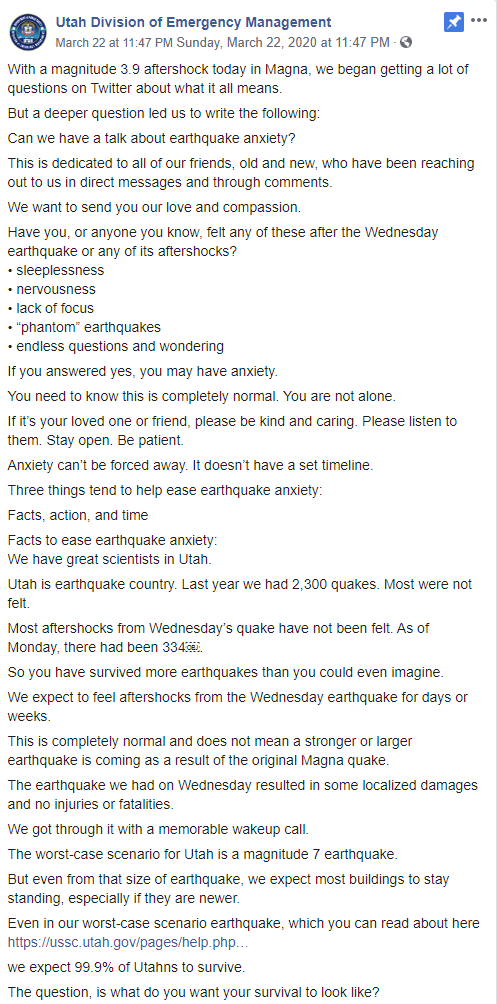
Disaster Anxiety

Last week, my area experienced a 5.7 magnitude earthquake with the epicenter was only a few miles from my house. Everyone is fine, damage was minor, and there were no injuries or fatalities, but many people were left with severe anxiety, made worse by frequent strong aftershocks.

I'd like to share a message from the Utah Division of Emergency Management, taken directly from their Facebook page.


Lokidude

Saturday, March 9, 2019

Iron and Vitamin Supplements for your BOB

Not actually Erin.
& is used with permission.
I am some degree of anemic. I base this upon my observed experiences over several years (mentioned here and here on my personal blog) where the introduction of 25-50 mg of iron via a supplement is enough to combat feelings of lethargy and brain fog.

I'm going to stop you right there. I can already hear the comments being typed in:
  1. You don't need supplements, just cook everything in a cast iron pan!
  2. Be careful, you don't want to overdose on iron!
  3. Are you sure it isn't [X]? You should get that checked / use this other supplement instead. 
Yes, I've heard all this before. Here are my answers:
  1. I'm really skeptical about the amount of iron that will leach into my food through cast iron cooking, and even if it did work, I'm not going to eat exclusively from cast iron for the rest of my life. 
  2. You're right, iron poisoning is nasty stuff. However, iron overdose only begins at 20 mg iron per kg of ingester (me), and a lethal dose is 60 mg/kg. So if I weigh 60 kg, that means I can safely ingest 1200mg of iron before it has any adverse effect on me. That's twenty-four times my daily dose, so even if I eat a big steak (6 mg iron in a 250g [8 ounce] steak), I'm nowhere near the danger zone. 
  3. Yes, I'm sure. I've been like this since 2012, but here's a more recent example: I briefly ran out of iron this week and was unable to take it for two days. The first day I was all right, but on the second I crashed like a rock into a pond. I had no energy and no desire to do anything except stay in bed. Then more iron arrived, I took it, and I immediately perked up. 
So based on all this, it is vital that I have iron supplements in my various Bug Out and Get Home Bags. I'm going to need energy in a disaster scenario, and that's not the time to find out if I can get the proper nutrition to carry me through.

https://amzn.to/2EZER4Y


I require a dose higher than most supplements provide (typically between 10 and 15 mg), so this is what I take on a daily basis. At $11 for 90 capsules, Vitamin Shoppe Comfort Iron is a very economical way for me to keep my energy on an even keel.


https://amzn.to/2XVdfW2


However, for my BOB and GHB I have this. It's slightly more expensive, but it's chewable and it also contains 100 mg of Vitamin C, which is also a good thing to have in an emergency as it boosts your body's immune system and prevents diseases like scurvy. 


Even if you don't have anemia, it's a good idea to have some form of multivitamin in your Bug Out and Get Home Bags. I recommend Centrum multivitamins; not only do they have a good spread of ingredients, but they come tailored for the specific chemistries of men, women, and adults 50+. If you have children in your family, don't forget to pack vitamins for them, too.

Sunday, December 17, 2017

GunBlog VarietyCast Radio #174 - What Caliber for Taylor Swift's Husband?


'Cause baby, now we've got bad blood
You know it used to be mad love
So take a look what you've done
’Cause baby, now we've got bad blood, hey!
 -- Taylor Swift, "Bad Blood"
  • Beth and her husband are getting ready to shoot a 3-gun "buddy match". What is it? What kind of gear do you need? How do you practice for it? Listen and find out!
  • Where do they find each other? It sounds like a random shooting, but the records make it sound like more is going on. Sean takes a look.
  • Barron runs the websites for several pro-gun blogs, including the website for this podcast. He recently dealt with a bizarre issue where the websites were basically spamming people. He walks us through the thought processes necessary to effectively troubleshoot what turned out to be a rather complex problem.
  • Miguel is on assignment.
  • In this week's Main Topic, Sean and Erin analyze the CNN article "How an 'ugly,' unwanted weapon became the most popular rifle in America".
  • Tiffany is on assignment.
  • Holidays are naturally the most wonderful time of the year... except when they aren't. Erin has some practical tips on how to manage holiday stress and depression.
  • Jordan Klepper, former Daily Show member and current host of “The Resistance” on Comedy Central made a special titled “Jordan Klepper Solves Guns” and it’s filled with anti-gun nuttery. Weer’d is here to set him straight.
  • And our Plug of the Week is the NeuYear Monday First Large Wall Calendar.
Thank you for downloading, listening, and subscribing. You are subscribed, right? We are available on iTunes, Stitcher Radio, and Google Play Music!

Listen to the podcast here.
Read the show notes here.

Thanks to LuckyGunner and Remington for their sponsorship, and a special thanks to Firearms Policy Coalition for their support.

Blue Collar Prepping Transcript: 
Dealing with Holiday Stress and Depression

Hey there, preppers. It’s widely believed that suicide is more common around the holidays, but that’s a myth; the peak is actually during  late spring and early summer. However, regardless of the myth I’ve been having a rough time lately, and so probably some of you have as well. This week I’m going to give you some tips for avoiding or dealing with holiday stress and depression. 

1. Keep your expectations balanced. Or, as I like to put it when I’m feeling cynical, “Embrace the suck.”  Acknowledge that you won't get everything that you want, that things will go wrong, and that sometimes you won't feel like singing Christmas carols. Try to internalize the belief that  everything doesn't need to be perfect, so don't worry about things that are out of your control.

2. Don't try to do too much. Fatigue, over scheduling, and taking on too many tasks can make you miserable. Women especially think they have to do everything this time of year. Instead, ask for help from your family delegate as much as possible; it can be fun making Christmas preparations a family event. Learn to say “no” if you need to; by choosing to do less,  you will have more energy to enjoy the most important part of the season - friends and family.

3. Stay warm. Research has shown that warmth improves mood. If you’re sad or lonely, treat yourself to a warm bath or cup of hot cocoa, or snuggle up under a cozy blanket with a pet or loved one. 

4. Be aware of Seasonal Affectiveness Disorder. Many people suffer depression due to a lack of sunlight because of shorter days and bad weather. Using a full spectrum lamp for twenty minutes a day can lessen this type of depression. There’s a link to one that I recommend in the show notes. 

5. Understand that it's appropriate to mourn if you're separated from or have lost loved ones. If you can't be with those you love, make plans to celebrate again when you can all be together. Spend time alone to reflect and grieve, if necessary, because keeping feelings inside can lead to depression, stress, or poor health. So allow yourself to feel, but don’t isolate yourself; get out of the house and find some way to join in the festivities or otherwise do something nice for yourself, like having a quiet dinner at a favorite restaurant. 

6. Watch your diet and remember to exercise. It's normal to eat more during the holidays, but be aware of how certain foods affect your mood. Refined carobohydrates like sugar, or refined starches like white bread and crackers, can cause your energy levels, and therefore your mood, to rollercoaster up and down. Instead, eat more protein which slows the absorption of carbohydrates in your blood and increase the release of dopamine, and take a walk before or after -- or both! -- a big holiday meal.

7. Don’t play the shame game. Embarrassment about finances can lead to taking on more debt than you can afford. Instead of struggling to buy a gift, let your loved ones know how much you care and would like to, but can’t afford it. One thing I have done is told them that since I can’t get them anything, they aren’t obligated to get me anything either. It works about as well as you’d expect, but it makes me feel better because I know they chose to get me a gift anyway. 

8. Practice forgiveness, understanding, and avoidance. If some of your relatives always upset you, they are unlikely to change, so don’t set yourself up for frustration by trying and failing. Try to accept family members and friends as they are, even if they don't live up to all of your expectations. Set aside grievances until a more appropriate time for discussion. Be understanding if others get upset or distressed when something goes awry. Chances are they're feeling the effects of holiday stress and depression, too.

And if you can’t accept them for who they are, don’t let them push your buttons. You can accomplish that by not giving them the chance; get out of the house to get away and adjust your attitude. Go for a walk or drive and admire the decorations, or go see a movie. I know for a fact most movie theaters are open on Christmas Day. 

Sunday, November 12, 2017

GunBlog VarietyCast Radio #169 - The Personification of the Firearm

“The rifle itself has no moral stature, since it has no will of its own. Naturally, it may be used by evil men for evil purposes, but there are more good men than evil, and while the latter cannot be persuaded to the path of righteousness by propaganda, they can certainly be corrected by good men with rifles.” ― Col. Jeff Cooper, Art of the Rifle
  • Beth detests the phrase “gun violence”. She’s talked about that before, so if she brings it up again, it must mean it's important! She has more examples and details.
  • A cop walks into a gas station just in time to interrupt an armed robbery. Sean tells us how this story ends.
  • Barron is on assignment.
  • In this week's Mental Flea Market, Miguel reminds us that some SOB won't try to murder you just because you're worshiping God.
  • David Yamane, sociologist and new member of the Gun Culture, has been saying it for a while now, but it bears repeating: the laser focus of gun control advocates on the criminal use of firearms ignores the REAL gun culture, which is the average gun-owning citizen.
  • Tiffany is on assignment.
  • Avoid that sedative! Erin explains how sleeping too soon after trauma can negatively affect your ability to recover from it.
  • A lone anti-gun crusader has proposed a "national gun buyback day".  Weer’d looks at the lies and delusions of grandeur as this nut promotes his little pipe dream.
  • And our Plug of the Week is MAG-20 / Classroom – Armed Citizen’s Rules of Engagement.
Thank you for downloading, listening, and subscribing. You are subscribed, right? We are available on iTunes, Stitcher Radio, and Google Play Music!

Listen to the podcast here.
Read the show notes here.

Thanks to LuckyGunner and Remington for their sponsorship, and a special thanks to Firearms Policy Coalition for their support.

Blue Collar Prepping Transcript:
Trauma and Sleep Disorder
It will come as no surprise to anyone that ever since I was attacked, I’ve had trouble sleeping. I should clarify this, though: to the best of my knowledge, I haven’t been having nightmares or reliving the experience. I just feel tired all the time, like I’m sleeping but not getting enough rest, if that makes any sense.

So as a result of this I started looking into how traumatic experiences affect sleep patterns, and I discovered some interesting information. The biggest surprise was learning that sleep after a trauma actually helps to cement the trauma within your mind!

In a 2012 study, two groups of rodents were exposed to a predator's scent, which was a traumatic event for them. One group was prevented from sleeping for six hours afterward, and one group was not. Interestingly, the sleep-deprived group displayed fewer physiological signs of stress and less PTSD-like behavior, such as freezing and a heightened startle response, than the group which was allowed to sleep. This was later confirmed with human experiments in 2015.

When you stop to think about it, this makes sense. It’s widely believed that while we sleep, our brain attempts to make sense of of the events of the day, filing them away into memories and running “what-if” scenarios. So it stands to reason that if you avoid sleep while the traumatic event is still fresh in your mind, there will be more “stuff” for your brain to process when you do sleep, and the likelihood of those events being turned into traumatic memories is reduced.

Fortunately for me, I suffered sleep deprivation after my attack: it happened at 10 pm and I didn’t get to bed until 11 am the next day, and I was only under local anesthesia instead of general when the plastic surgeon was sewing me up. This may explain why I don’t seem to be exhibiting PTSD characteristics.

I also asked for an anti-anxiety medication while I was in the ER, because I was quite understandably upset at my face being in tatters and was worried that I might have pieces missing. They gave me Ativan, which did indeed help me calm down without making me want to sleep. I don’t know if this is causation or just correlation, but keep it in mind for future use, especially if the doctors want to prescribe a sedative.

If something like this happens to you, and you decide to delay sleep, you may have difficulty getting back on your normal sleep schedule. Here are a few tips and tricks for that:
  • Realize that there’s no such thing as a “sleep bank.” If you miss 8 hours of sleep, you don’t then need to sleep for 16 hours the next night. Just try to sleep your regular amount, going to bed and getting up at your usual time. 
  • Exercise before sleep is a bad idea, because it is more likely to energize your body and keep you awake longer. However, gentle stretching is a good idea as it should release tension in your muscles. 
  • Take a hot shower before bedtime. The body cools off as it sleeps, and so after a hot shower your body will start to cool off and that will send a message to your brain that it’s time for sleep. 
  • Don’t drink alcohol before bed. While it is a depressant and will indeed help you fall asleep, it will depress everything in your body including your REM sleep. Alcoholics claim they don’t dream when they sleep, and dreaming is essential to your health. 
  • Finally, if you’ve been lying in bed for an hour and still can’t sleep, don’t force yourself to stay there, Instead, get up and do something relaxing. Avoid watching TV or getting on the computer, because the light from the screen will stimulate your brain and make it think it’s time to get up. Instead, do something low-stress and relatively boring, like dusting the furniture or doing laundry. 
So to summarize:Avoid sleep for at least 6 hours after a traumatic experience, but after that, you should get back to your regular sleep schedule.

Sunday, August 6, 2017

Gun Blog Variety Podcast #155 - RINO Hunting


"One morning I shot an elephant in my pajamas. How he got into my pajamas I'll never know." - Groucho Marx
  • Beth and her husband went to Shootrite Academy in Alabama. They discuss what it’s like to train as a married couple, and Beth learned an important lesson about defensive pistol use in 101 degree heat.
  • Sean has a doozy of a Felons Behaving Badly segment featuring five, count 'em, FIVE suspects involved in a kidnapping. You're going to need a score card to figure out who is related to whom!
  • Barron is on assignment and will return soon.
  • We're all supposed to grow up, not just grow older, but some people miss the maturity bus. Miguel tells us what to do when you run into an alleged adult who throws a childish temper tantrum in public.
  • Sean went RINO hunting with the pro-gun group Grass Roots North Carolina. There were people dressed in Rhino pajamas, a rhino mask, and more Sergeants-at-Arms than you can shake a pro-gun banner at.
  • Tiffany is on assignment and will return soon.
  • Erin finishes up her series on Surviving Survival with a double-length segment on successful coping strategies.
  • The One and Only Anti-Gun Podcast brings on a researcher to talk about research and the anti-gun agenda. Weer’d listens so that you don't have to!
  • And our Plug of the Week is for the PHLster Flatpack Tourniquet Holder
Thank you for downloading, listening, and subscribing. You are subscribed, right? We are available on iTunes, Stitcher Radio, and Google Play Music!

Listen to the podcast here.
Read the show notes here.

Thanks to LuckyGunner and Remington for their sponsorship, and a special thanks to Firearms Policy Coalition for their support.

Blue Collar Prepping Transcript -
Surviving Survival
For the past two months, I’ve been talking about what trauma is and why our brains respond it the way that they do, and giving suggestions on how to manage anger, fear, anxiety, and post-traumatic stress. This week I conclude this series by giving general strategies for getting past the traumatic event and getting on with your life. In other words, how to survive the rest of your life once you’ve survived the emergency, tragedy, disaster or trauma. 

There are six strategies that lead to successful outcomes. Of these, the most effective strategy -- contrary to all expectations -- is Suppression. In other words, Put it out of your mind. Just don’t think about it. Think about other things instead. 

In the paper titled Study Of Adult Development, psychiatrist George Vaillant found that simply suppressing a traumatic experience and getting on with life is, quote, "the defensive style most closely associated with successful adaptation". Suppression is straightforward, practical, and best of all, it works. "Of all the coping mechanisms," Vaillant writes, "suppression alters the world the least and best accepts the terms life offers." 

However, not everyone can simply stop thinking about things that trouble them. This is a problem which I have; when something bothers me, I end up chewing on it over and over, like a cow with its cud. For those of you who end up ruminating on your problems like I do, here are other successful strategies:

Sublimation - Do something to channel anger, energy and anxiety into something productive. This is engaging the seeking pathway, and I went into this in detail in episode 148. Sublimation is another form of suppression, because seeking pathway overrides the rage pathway of rumination. 

Altruism - Do something kind for someone else. This helps you twice: first by occupying your mind with the task, and the second with the chemical reward that comes with positive emotions when your gift makes its recipient happy. 

Anticipation - See the future and prepare for it. Like studying for a test so hard that you score a 100% on it, if you over-prepare then the actual event is a nonissue. This is an excellent strategy for things which have a definite end goal, such as a diagnosis of cancer. If you’re a prepper, you are constantly using this technique. 

And finally Humor - Being able to laugh at yourself is healing. It has been said that you “Can’t be laughing and worrying at the same time,” and I’ve found this to be true, which is why I always try to make a joke to lighten the mood when things seem horrible. 

The best coping mechanism of all, if you can manage it, is to combine suppression with laughter. Laugh about the good things in life and don’t think about the terrible things -- or laugh AT the terrible things, to rob them of their power. A thing you mocking is not a thing to be feared. 

There are 12 steps for successful survival, whether you are in the middle of a disaster or you are dealing with the aftermath. 
  1. Perceive & Believe - Recognize the reality of the situation. Don’t deny it is happening; accept it and deal with it. 
  2. Remain Calm - acknowledge whatever fear, rage, or sadness you have, but don’t dwell on them. Instead, use that energy to be productive by engaging the seeking pathway. 
  3. Think, Analyze, Plan - Know what you have and what you want. Once you have a realistic assessment of your resources and predicament, set achievable goals. Tell yourself “OK, this bad thing has happened. Now what?” Look to future instead of ruminating on the past or what could have been. 
  4. Act on that plan - This is sublimation, and it effectively directs negative emotions outward into productive effect. Do something other than dwelling on pain and trauma. 
  5. Celebrate success once action is taken - This creates a dopamine reward within your brain, which makes you feel better and causes you to want to keep progressing forward. This is a “virtuous circle”. 
  6. Count your blessings - This results in gratitude, which calms negative emotions. 
  7. Play - Have fun, which is part of living a healthy happy life. Without joy, you aren’t living, you’re merely existing. 
  8. See the Beauty - Focus on positive, ignore the negative. This binds you to the world so you want to keep living. 
  9. Believe you can influence events - Believing that you will succeed is the attitude of the survivor, not the victim. Do not wait for rescue; rescue yourself. 
  10. Surrender - Don’t let your fears hold you back; let go of them and move forward.
  11. Do whatever is necessary to make that move happen - By this point, you should know, deep within yourself, that you have the will and skill to accomplish what is needed for healing or rescue. Do not let obstacles keep you from your goal. 
  12. Never give up - You’re still alive. That means you can always improve your situation. 
Finally, there is happiness, which is what everyone wants in life. I’m going to conclude this series with three key thoughts on happiness and the pursuit thereof:


“It’s possible to lead a healthy happy life even in the aftermath of trauma. Perhaps more importantly, happiness is not a matter of avoiding trouble; it’s a matter of how you deal with it.”

“Happiness as a goal is a recipe for disaster. Happiness as a byproduct of living your life is a great thing.”


To make your live more complete, and therefore help you achieve happiness:
  1. Do something you love.
  2. Do something for someone who needs you.
  3. Be with people who care about you.
I can’t stress that last one enough: Be with people who care about you.

Take care of yourself, folks.

Monday, July 31, 2017

Gun Blog Variety Podcast #154 - The Legal Episode


This week we discuss the exciting legal cases Norman vs. Florida, Wrenn vs. District of Columbia, and Kat Von D vs. Dita Von Teese*.

* Sean says I couldn't talk about Dita Von Teese in the intro because we didn't talk about her in the actual podcast, but I showed him!
  • Gun violence!  Beth hates that term. She's going to tell us what's wrong with it, and what we should call it instead.
  • A woman is arrested after robbing a Charlotte bank. Who was she? Sean checks her permanent record.
  • Barron is on assignment and will return next week.
  • Miguel talks about Kat Von D, Contract Law, and why letting your politics interfere with doing the right thing is unacceptable.
  • Florida Carry is assisting with one of the next possible Supreme Court decisions on the Second Amendment, Norman vs. Florida. Here to talk about that case is the lead counsel, Special Guest Eric Friday, of the law firm Kingry & Friday.
  • Tiffany is a busy lady who’s on the move! But even though she’s in an airport about to board her flight, she still takes the time to talk to us about the momentous Wrenn vs District of Columbia decision.
  • Did you know that you can rewrite your brain's conditioned responses to stress? Erin tells us how to hack your brain.
  • When interviewed about Moms Demand Action, Shannon Watts piles it high. Weer’d takes on the lies in part two of her interview on the Hellbent Podcast.
  • And our Plug of the Week is for the GBVC Radio Group on Facebook. Join us! and subscribe to this podcast on your smartphone!
Thank you for downloading, listening, and subscribing. You are subscribed, right? We are available on iTunes, Stitcher Radio, and Google Play Music!

Listen to the podcast here.
Read the show notes here.

Thanks to LuckyGunner and Remington for their sponsorship, and a special thanks to Firearms Policy Coalition for their support.

Blue Collar Prepping Transcript -
Extinguishing Conditioned Responses
Back in June, I talked about PTSD and conditioned responses and I said that the reason so many people have flashbacks after a trauma is because nerve clusters in the brain fired during the event, permanently associating a specific sensory stimulation with the trauma. This week, I’m going to talk about how you can break that pairing.

This first thing you need to understand is that these conditioned responses are perfectly normal, and are in fact deeply rooted in prehistoric survival traits. For example, let’s say that you were attacked by a crocodile while swimming in a lake, and although you managed to survive, your brain now associates the sound of splashing water with a crocodile attack.

This is your brain trying to protect you. It believes that if you stay away from splashing water, then you won’t be attacked by a crocodile again. This makes a fair amount of sense, but unfortunately, not all conditioned responses make such sense. In one instance, a victim of child abuse associated the sound of rattling keys with impending sexual assault, because the keys announced that her father was home.

What is important to keep in mind, though, is that you are not broken or crazy for associating events or having flashbacks; this is your brain trying to warn you of danger to keep you safe. “Learn this to save your life,” your brain is saying.

The next important thing to know is that talking therapy doesn’t help for severe anxiety disorders like PTSD, and can in fact make things worse. In the early days of the Vietnam War, psychologists encouraged veterans to tell their stories, to “get it all out”, in the belief that this would unburden them. The results were catastrophic and resulted in suicides as the veterans were forced to relive the horror over and over. So don’t ever let anyone make you talk about it unless you are 100% ready.

The next step is to realize that if your brain can be programmed, then it can be un-programmed in the same way. Micki Glenn, the victim of a devastating shark attack, was quite understandably terrified of pictures of sharks. To combat this, Micki’s husband put a close-up image of that very shark -- he photographed it before it attacked her  -- on her computer as the screensaver. Every time Micki walked into the room, she had to confront the face of her attacker. This resulted in an anxiety response, but through breathing exercises she would calm herself and then force herself to look at the picture.

Over the course of several weeks, Micki was gradually de-sensitized to images of sharks. She systematically re-wrote a new memory over the traumatic one. This new memory said “Seeing a shark does NOT feel like pain and terror; it feels like walking into my office.” This process is called “extinguishing a conditioned response.”

At Brook Army Medical Center in San Antonio, there is a sophisticated virtual reality system called CAREN Dome. CAREN stands for Computer Assisted Rehabilitation ENvironment, and it helps veterans overcome PTSD from ambushes and IED by replicating a lifelike Iraqi village.

At first, the street is completely clean, with nothing on it that can set off a panic attack. Then the technician starts to add gradual details like people or trash until, eventually, the soldier can comfortably walk down a chaotic street. This process often takes years, but it does work.

Next week, I’ll bring this series to a close as I detail other ways people successfully cope with trauma and learn how to survive their survival.

Monday, July 24, 2017

Gun Blog Variety Podcast #153 - First, Do No Harm


Actions have consequences.
  • Beth has had enough of the madness! Yet another woman has been shot, by her own gun, from inside her purse. This kind of tragedy is 100% avoidable if you use your brain and follow the do's and don'ts of purse carry
  • An assault suspect is found dead in the basement of a Winston-Salem home. What killed him? Sean takes a closer look.
  • Just this week, a guy sneaked into the Conor McGregor/Floyd Mayweather press conference with badges he cloned from images on Facebook. Barron tells us how it’s done
  • Miguel is on assignment and will return next week.
  • GunBlog VarietyCast Radio is proud to introduce Special Guest Charl van Wyk to our show. Mr. van Wyk was a member of the Saint James Church in Capetown, South Africa, when it was attacked by terrorists, and he was able to save the lives of many by returning fire with his pistol. In the third of a three-part interview series, Charl explains the Christian justification for self defense.
  • What is your calling? Do you know? And are you really being honest with yourself about what your true calling might be?
  • Tiffany salutes those who answer the call of law enforcement, but she also has a warning for those who only do so half-heartedly.
  • Erin breaks a promise this week, but it's so she can explain something you'll need to know for next week. Are you primed for an emotional reaction to stress? Erin explains what that means.
  • Shannon Watts does an interview about the Origins of Moms Demand Action... or at least, how she CLAIMS it happened. Weer'd explains what’s truth and what’s fiction inside Shannon Watts’ mind!
  • And our Plug of the Week is for The Lawdog Files, on Amazon for Kindle.
Thank you for downloading, listening, and subscribing. You are subscribed, right? We are available on iTunes, Stitcher Radio, and Google Play Music!

Listen to the podcast here.
Read the show notes here.

Thanks to LuckyGunner and Remington for their sponsorship, and a special thanks to Firearms Policy Coalition for their support.

Blue Collar Prepping Transcript -
Emotional Priming
Last week I promised that I would talk about PTSD and ways to break the cycle of flashbacks. However, I’m afraid that I have to postpone that segment for a week, because I need to talk about emotional priming first. 

Put simply, witnessing trauma is itself traumatic to the viewer. This is because humans have structures in the brain called Mirror Neurons, which fire when performing an act but also when seeing an act. This is why you have the urge to yawn when you see another person yawn, why you often vomit when you see or hear or smell another person vomit, and why you wince in pain when you see another person get hurt.

 Mirror neurons are essential to our development during childhood because they are how we learn. “Monkey see, Monkey do” isn’t just a childhood taunt; it’s literally how we and other primates, learn. It follows, then, that if we witness something horrible that happens to another person, our mirror neurons simulate that sense of horror, that pain, that shock within us. And while the sensation isn’t as vivid, it’s still real, and therefore it’s entirely possible to develop post-traumatic stress disorder from watching tragedy happen to another person.

In other words, PTSD can be considered an environmental or occupational hazard as much as a psychological one, especially if you work as a first responder. This means that you are more at risk for developing PTSD if you’ve already been exposed to extreme stress one or more times, and this vulnerability can last the rest of your life. This is what is known as being “emotionally primed” for PTSD. 

Think of your mind like a plate. Each traumatic event you witness is a crack within that plate. Some cracks are minor, but get enough of them, and the plate will fall apart. Get a single big crack, and the plate will fall apart.  Unlike bones, which can heal over time and become stronger, the mind retains the memory of the horrors it sees and this can make it weaker, more prone to injury. This explains why so many first responders take up unhealthy habits in their desire to forget what they’ve seen. They’re trying to erase those memories, to heal the cracks in the plate of their psyche. 

So if you have witnessed anything truly horrific or traumatic, I urge you to seek counseling from a professional. Not because you are crazy, not because you are broken; think of it as preventative maintenance. Just as you see the doctor every 6 months for a physical to keep on top of how your body is doing and to get ahead of potential issues so too should you see a therapist if you have a history with trauma, especially chronic trauma. A professional will be able to detect patterns of unhealthy behavior and poor coping mechanisms, and hopefully will help de-prime you so that you don’t suffer PTSD. 

Sunday, June 18, 2017

Gun Blog Variety Podcast #148 - Welcome to the Suck

People are the reason we can't have nice things.
  • Beth is on assignment this week.
  • A Gastonia grandmother is tied up and robbed at gunpoint. Who would do such a thing? Sean checks him out.
  • Barron explains how setting up a dedicated firewall will protect your network from WannaCry 2.0 ransomware.
  • Florida just enacted Enhanced Self Defense Immunity. Miguel tells us why this is a very welcome development.
  • For our Main Topic we have Special Guest Lucas Apps from Triangle Tactical Podcast. Luke explains what he thinks the biggest problem is with advancing our gun rights.
  • You may have survived your ordeal, but how do you survive being a survivor? Erin talks about ways to cope with anger, guilt, and PTSD.
  • Tiffany is still on medical leave.
  • It's now the final week of Weer'd's audio fisk of the Demanding Mommies' protest at the NRAAM!
  • And our plug of the week is a call to action. Get in touch with us! Like us on Facebook, send us emails, and donate or subscribe to the podcast!

Thank you for downloading, listening, and subscribing. You are subscribed, right? We are available on iTunes, Stitcher Radio, and Google Play Music!

Listen to the podcast here.
Read the show notes here.

Thanks to LuckyGunner and Remington for their sponsorship, and a special thanks to Firearms Policy Coalition for their support.

Blue Collar Prepping Transcript -
Coping with PTSD
This week is the one-year anniversary of the Pulse Massacre. Many people were traumatized by this; not just those who were injured, but also the friends and family of the victims. A loved one being injured or killed is itself a form of victimization.

Anger, grief, survivor’s guilt, post-traumatic stress disorder: all of these are the brain’s way of trying to cope with the loss of something cherished, be it a person or a body part or your sense of self. Any or all of these can be taken away through accident or violence.

Last year, I did a series of segments on Lawrence Gonzales’s books Deep Survival and Everyday Survival. This year, I’m going to do a series on his book Surviving Survival, which deals with what happens to people after they’ve made it through their ordeal - being lost at sea, the death of a child, having a spouse try to murder them - and the difficulties they face as they try to integrate the new person they needed to become in order to survive into their old life.

Flashbacks are very common with people who have PTSD. This is due to what is known as a conditioned response, and it’s exactly the same thing as when Pavlov trained his dogs to salivate at the sound of a bell.

In neurobiology, when two nerve cells fire at the same time, even if by accident, they will fire together in the future. The phrase is “Fire together, wire together.” They become linked into what is known as a cell assembly, and so when one fires, they all fire. And if they are assembled during a moment of high emotion, then it becomes difficult to keep them from firing - to effectively un-wire them - even if the things which are linked are completely separate.

This is how and why flashbacks occur. If you hear a particular sound or smell a specific scent when something traumatic happens, the event will become paired with that sound or smell in mind. So if you were listening to a particular song on the radio right before you were injured in an automobile accident, your brain will associate that song with pain and fear and auto accidents, and listening to it will cause a fear or pain response.

It is this association which explains why we become attached to people. Their presence causes nerve cells to fire, and at the same time the cells for us being happy because of something they do or say fire, and so we associate their presence with that emotional state. The longer we are around them, the more those cells fire and the stronger the response is.

There are also nerves in our brain which are called “seeking pathways”, and they allow us acquire what we need to survive. If we are thirsty, a seeking pathway helps us find water. If we are tired, a seeking pathway encourages us to find a safe place to sleep, and so on. But if you are thirsty and cannot drink - if you are tired and cannot sleep - your seeking pathways cannot complete their task and this results in frustration, which is another form of anxiety. It’s one thing to just be hungry or thirsty, especially if you know (even subconsciously) that you can easily remedy the situation. It’s another to know that you are unable to fix it, because the human mind has trouble soothing a frustrated pathway.

If left unchecked, this anxiety activates another form of path, the rage pathway, which is an essential survival mechanism among mammals. It’s why your initial desire is to lash out when you’re hurt, because instinct tells us that whatever is hurting us is a predator and we have to kill it before it kills us. And so, if your brain is telling you that you NEED something and you cannot have it, that anxiety registers as fear, and your body believes it’s being attacked, and so attacks back. Suddenly, toddler temper-tantrums make a lot more sense, now don’t they?

When you want something that was taken from you - a loved one, a limb, that sense of innocence or feeling of not having been violated you had before you were attacked - and you cannot get at it, the rage pathway activates. Sometimes it’s violent and destructive; sometimes it’s focused inward, and manifests at grief. But in all cases, the underpinning desire is the same: Something bad is happening to me and I don’t want it to happen. Go away, bad thing!

The brain is essentially dominated by just these two systems, the seeking and rage pathways. We are either trying to draw something toward us - even if it’s something abstract, like the pleasure of a job well done - or we are trying to push things away from us.

What’s interesting about this - and relevant to people who are angry, grieving, or suffering from flashbacks - is that these two systems cannot activate at the same time. If you want to destroy, you cannot create; and if you are creating, you have no desire to destroy.Just be aware of how quickly one can shift to the other!

But it’s this rapid shift that can actually be of benefit to people suffering from loss, because it enables you to overwrite feelings of rage, grief and anxiety by engaging the seeking pathway. A simple, repetitive, constructive activity - like knitting, or weeding the garden, or physical activity, or hunting or fishing or shooting - activates the seeking pathway and deactivates the rage pathway.

Perhaps this is because humans are predators: if we are hungry we need to eat, and so our focus on getting the meal precludes our fear of being eaten by something larger. And perhaps this is how humans became tool users: the seeking pathway rewards our brain with dopamine when we accomplish something (like acquiring food) and so the act of creating tools similarly engaged our seeking pathways and rewarded our actions with dopamine.

If you take nothing else from my segment today, take this:  if you are angry, if you are grieving, if you are anxious, then engage in a simple, repetitive task that rewards you for completing it. You will find that not only will it soothe the pain you feel, but you will also have something to show for your efforts


Thursday, December 22, 2016

Hoarding or Stockpiling?

Most preppers tend to keep extra amounts of food, water, and clothes on hand, as they are important enough that we like to have a backup supply available. Keeping a full pantry and storing bottled water in a closet is called stockpiling, as is having a cache or two hidden away. Stockpiling supplies is a good idea for most people, but the hoarder needs to be watched over.

There are a few TV shows about hoarders, and they cover the worst that they can find because it's television, where everything has to be blown out of proportion. I don't recommend watching these shows unless you have a strong stomach and can tell when things are being hyped for ratings. I've seen hoarding on different scales, from the garage full of moving boxes (we might need to move again someday!) to the survivor of the Great Depression who owned piles of shoes and coats (he was the youngest of 4 boys and didn't own a new pair of shoes until he joined the Army), all the way to a distant aunt whose house was a maze of pathways through the stacks of papers and magazines. That distant aunt (great aunt, something removed -- it's a large family) passed away when I was a child, and her children spent a day gathering what they wanted from the house before burning it down. It was beyond the point of cleaning; better to start over from scratch, they felt.

The Clinical Definition
Hoarding is a psychological disorder where people are unwilling or unable to discard things, which leads to large piles of things collecting in their living spaces. The disorder was finally recognized by the psychiatric community in 2013 and is now considered as a possible symptom of Obsessive-Compulsive Disorder (OCD) as well as a disorder by itself.

Hoarding is distinct from collecting in that:
  • A collector will search for, properly store, and maintain things of value, while a hoarder will tend towards never discarding  what others consider worthless.
  • A collector will often trade items in order to get something more valuable, whereas a hoarder will find it hard to part with anything.
  • A collector knows what he has and is proud of his collection, whereas a hoarder is often ashamed of the confused mess that has gathered.
  • Collectors tend to talk about their prizes; hoarders tend to pull the curtains so nobody can see inside their house.
Hoarders eventually reach a point where their living spaces fill up with junk and can no longer be used for their intended purposes. This is also the point where the clutter starts to become a health hazard by attracting or harboring insects and vermin.
  • Beds and other furniture covered to the point that they can't be slept in or sat on.
  • Movement or passage through rooms is  limited due to clutter.
  • Visitors and family are turned away because of the mess.
  • Normal activities are difficult or impossible, because supplies for food preparation and cleaning  are buried.
  • At its most extreme, the clutter can reach a point where it is a hazard of collapsing and trapping the hoarder. There are instances of people being killed when their hoarded possessions fell on them, or trapped them until they starved.
  • Piles of paper create a fire hazard, and cluttered rooms make it hard for firefighters to move through.
There is an opposite to hoarding, though: obsessive clearing is as bad as never clearing out junk. The trend of "discarding anything not used in the last X months" picked up steam several years ago, and I saw families waste money buying the same things three or more times over a decade just because they were told that they didn't need to keep them around. Now we have the “tiny house” movement starting to grow, and I can see that the same thing will happen, as lack of storage space means buying and discarding the same things multiple times.

I have tools that I haven't used in years, but I'll laugh at anyone who tells me that I “need” to de-clutter my shop. Those tools have saved my friends from having to buy them for one-time use, and I know that the tools are around if I ever need them. Prices aren't coming down, and the quality of modern tools seems to be degrading, so I'll keep my collection of tools rather than have to replace them with an inferior copy years from now.

The concept of needing a personal trainer to tell us how to live strikes me as the ultimate admission that parents are not teaching their children how to act like adults.

The Hoarder Prepper
From a prepper viewpoint, a hoarder is someone who mindlessly buys extra stuff and doesn't maintain it.

  • Bags of rice and beans from big-box stores stacked up in the basement
  • Towers of cases of bottled water that have been there long enough to have cobwebs on them
  • Cans of food with rust on them
  • Weapons and other tools gathering rust and dust in a corner
  • etc
I remember that  Dante's Fourth Circle of Hell was reserved for hoarders and wasters, because they both went to extremes. If you can't get through the original Dante's Inferno (it was a political piece, written a long time ago, in poem form, in Italian) there is a somewhat more recent version titled “Inferno”.


Watch for hoarding tendencies in yourself and your tribe. The numbers vary by source, but roughly 5% of the population has hoarding issues, so if you have a large enough tribe, it could become a problem. Get help, or be the help, as the case warrants. The things we set aside as preps are too important to let them go to waste or be lost in a pile of trash.

(Editor's Note: I have a touch of the hoarder within me, as do both my parents. I blogged about this back in 2014, and it's something I have to fight on a regular basis.)

The Fine Print


This work is licensed under a Creative Commons Attribution- Noncommercial- No Derivative Works 3.0 License.

Creative Commons License


Erin Palette is a participant in the Amazon Services LLC Associates Program, an affiliate advertising program designed to provide a means for sites to earn advertising fees by advertising and linking to amazon.com.