Showing posts with label For educational purposes only. Show all posts

Thursday, February 28, 2019

Medications

There's more than one reason to prepare. Yes, we spend a lot of time getting ready for disasters and emergencies, but there are several things which don't quite reach that level that still need to be on your radar. Having a stockpile of your daily medications is one of those oft-neglected preps that I think should be kicked up a notch or two on your priority list. While not as important as air or water, a lot of the medications we take on a daily basis are life-saving.

A Little Background
My wife is disabled due to some serious damage to her spine. Surgery is not an option that any doctor we've seen is willing to attempt, so she lives with a lot of pain. As a way to manage that pain, she has taken legal opiate-based pain killers for over a decade.

About four years ago, the Drug Enforcement Agency (DEA) started threatening small-town doctors who were prescribing opiate-based pain medications with “Stop writing prescriptions (Rx) or face the wrath of the federal government.” They swooped in and made examples of a couple of known pill-pusher doctors, which scared the rest into submission -- which isn't really hard to do when there are three corporations that run every hospital and clinic within 75 miles. Instead of a 15 minute drive to our local clinic, we had to find a pain specialist and the nearest is an hour away.

The DEA also changed the prescription rules: No more than a 30 day supply on a single Rx, and opiates require a paper Rx (no faxing or emailing), so every month we have to drive to the city to pick up a piece of paper.

Three weeks ago, the DEA led a “raid” on the pain management clinic we've used for those four years. They gathered up all of the patient charts (records) and computers and took them away, effectively shutting down a clinic that has been running for 25 years without a problem. No arrests, no indictments, no reason given; they just shut the clinic down without having to go through the hassle of pulling licenses. This is a form of “lawfare” that is being used to fight the “war on drugs” and battle the “opiate epidemic”. The process becomes the punishment, without any need for frivolous things like actual evidence of a crime. These imaginary wars and epidemics are great for funding and time in the spotlight, so I don't expect them to ever be won or cured, but that's getting close to our self-imposed prohibition on politics so I'll leave it alone.

This is an emergency on several levels for us:
  • Without any control of her pain and the likely withdrawal symptoms from running out of a very addictive medication, her life becomes torture.
  • We're looking into other local options as there are a few other pain clinics around, but the DEA still has all of her charts. This means that any new doctor has to start from scratch, something which isn't going to be pleasant.
  • Being a bit pig-headed, my wife has not been listening to me and only had about a week's worth of pain meds left, so it's been a scramble to find another doctor.
  • The DEA now has my wife's medical records and that doesn't fill me with joy. No politics, I know.
The same thing could happen to anyone who takes a life-saving medication. Blood pressure meds, diabetes supplies, anti-rejection drugs for transplants, and the like are all things that you don't want to run out of. Certain common anti-depressants come with a warning that you should never stop taking them abruptly, as the withdrawal effects can be deadly. It might not be a federal agent cutting off your source of the medications you need to get by (or stay alive); disruptions caused by any major disaster would have the same effect. Losing your job and/or health insurance will also put a crimp in your medications (been there, done that for two years.)

How to Prepare
  • Have a stockpile if at all possible. If you take a medication on an “as needed” basis, it's possible to set aside a few doses every month until you have a safe stockpile. I like 30 days, but you need to decide for yourself.
  • Talk to your doctor, see if they will write your Rx for several months at a time. Many insurance companies require mail-order Rx service and they like to deliver several months worth in one box.
  • Renew your Rx as soon as they will let you, and you should gain a few days each time. For example, my insurance will let me renew a 30 day RX after 28 days
  • Look into alternative sources for your meds. I did an article a long time ago about mail-order meds. The information is still valid, even if the names have changed over the years. 
  • Look into alternative medications. Not every ailment is treatable by herbal or alternative medicine, but some are. Medical marijuana and derivatives are spreading, so check their many uses. Don't forget the less-than-legal options; what they may lack in quality control they can make up for in lack of records. Getting meds from someone who no longer needs them may be possible as well.This is generally illegal, but you have to be alive for them to charge you.

If you take any medication on a daily basis, you should know as much as possible about what it is, how it works on your body, how it's made, what can be used as a substitute, and where to get it. Supplies and gear aren't going to do you any good if you're not around to use them.

Thursday, March 22, 2018

Wound Closure

Having been an “accident-prone” child, and then working with my hands for most of my life, I have developed an appreciation for skilled wound closure. My job puts me near a lot of agricultural equipment, which is either designed to be sharp or ends up worn to a razor's edge from use. Once something breaks, it's rarely a smooth break and there are jagged edges of wood and metal that need to be worked around.

I don't mind having scars, but if the medic closing a cut knows what they're doing, the scars are much less visible and the wounds heal much quicker.
  • I've had an intern suture up a 2” cut on my knee and when I went back after a week to have the stitches removed, they required a doctor to dig them out with a scalpel. 
  • The surgeon who worked on my neck was kind enough to make the incision in an existing fold of skin and used Steri-strips to close it instead of sutures, so the scar is really hard to see. 
  • I've seen a friend go through two weeks of IV antibiotics because a surgeon sutured up an incision so sloppily that there was a fold of skin between two stitches, leading to a nasty infection. 
Natural disasters like tornadoes and hurricanes produce a lot of damage, creating a myriad of ways to get hurt, and simple wounds like cuts and small punctures are common when you work around sharp things. If local medical infrastructure is damaged or destroyed, you may find it handy to know how to close minor wounds on your own. If you run into something that is beyond your abilities you need to find professional help, so know where your limits are and where that help can be found.

Suturing is a skill that takes practice, skill, and some training. Luckily, there are resources available to the average person that will allow you to get the practice and training. 

DISCLAIMER
I am not a doctor, I don't even play one on TV. The following is presented for educational and informative purposes only. I am not responsible for any actions you take, whether you read this or not.

Animal First Aid
Part of raising livestock is learning when you need to call the veterinarian and when you can deal with a problem on your own. Dogs run into sharp things once in a while, and sometimes they get into fights with other animals and get chewed up. Goats are pretty smart and nimble, but I've seen them lose a battle with barbed wire fencing. And any hoofed animal can injure themselves or other animals during the breeding season; those horns and sharp hooves aren't there for decoration.

Since veterinarians aren't supposed to work on humans, they aren't as closely regulated as actual physicians. Looking around the Internet, I've found several mentions of things like antibiotics for fish tanks being identical to those requiring a prescription for human use. A lot of other medical gear is available without a medical license if you start your search with “vet supplies”.

Learning How
A quick Amazon search shows several medical school texts covering wound closure, but they run $50-100 apiece. There are some less expensive manuals to teach the basics, like the US Army training manual (Kindle edition only) for $12.00, or a used copy of one of the manuals printed by a suture maker for about $20.00. These will teach you the basic knots and how to choose the proper material and size of suture for differing types of wounds.

Once you have something or someone to teach you the knots, you're going to need to practice them. There are rubber practice pads available, but I learned a few simple techniques on a chicken from the grocery store. 
  1. Buy a whole chicken, or at least a large uncooked piece. A whole chicken will give you lots of room to practice and will help some people get over the squeamish feelings associated with sticking a needle into flesh.
  2. Use a sharp knife to cut into it. 
  3. Practice sewing the cut closed until you're happy with your handiwork.  
  4. Unless you're using sterile sutures and working on a clean table, I would advise that the test chicken be discarded rather than eaten when you're done. 
Supplies
Sutures are readily available at most farm supply stores; look in the veterinarian aisle. If you live in an area without a Tractor Supply, Bomgaar's, FleetFarm, Farm Supply, or Rural King store handy, they all have websites. You can also shop on Amazon, where $20.00 will get you a dozen “training” sutures and three tools for working with them. “Training sutures” brings up a good list to choose from and they will deliver just about anywhere. Once upon a time I got a couple hundred “expired” sutures from eBay, but that venue has been over-run with 'bots and scams in recent years. 

A lot of doctors have recently started using Steri-Strips instead of sutures if a wound is shallow or small. They are easier to apply and don't leave as large a scar, but they have a shorter shelf-life and need closer temperature control for storage. I may have to do some more research into this method, as I've had very limited personal experience with them.


Being a prepper means becoming more self-reliant, and being able to patch up minor wounds on your animals is a good way to save the expense of calling a vet. Plus, if you ever get into a situation where you need to close a wound on another person, having the skills and materials at hand could be life-saving.

Thursday, April 13, 2017

Pump It Up

Last week, I mentioned pumps that could be used to empty an underground storage tank (UST) and how I was having a hard time finding a suitable pump for emergency use. There are several issues that I ran into, but in order to explain them I need to make sure our readers have a basic understanding of pumps, pump mechanics, and the limitations of each type of pump. My knowledge of pumps comes from a few decades of working with (and on) various types of pumps and not from any formal schooling, so I may get a few details wrong, but the basic knowledge is from personal experience.

What Is a Pump?
 A pump is a mechanism for moving a fluid (gas or liquid state) from one area to another. Both a trash pump and your heart are liquid pumps, but they work by different methods and are examples of the two main types of pumps.
Centrifugal pumps
Centrifugal pumps work by using a spinning disk, usually one with vanes on its face, to throw the fluid against a casing that directs the flow in the desired direction. Normally the intake is in the center of the disk (called an impeller) and the discharge is rotated 90° from the intake. Here's a simple example :

Image #1

If you have a well, you probably have a submersible centrifugal pump at the bottom. Your water-cooled vehicle has a centrifugal water pump that moves the coolant through the engine and radiator. The fuel pump in newer (fuel injected) cars is a centrifugal pump. Centrifugal pumps are very common in industry.

Pros
  • Easy to work on: as long as you have the correct seals on the drive shaft, the pump will run for years and parts are not built with excruciatingly tight tolerances. 
  • Long life: because the impeller and volute are not actually touching each other, there is very little wear between the two. 
  • Variable rates: by changing the speed of the drive shaft, you can easily change the rate of flow (within reason). There is a minimum speed below which the pump won't move anything, and a maximum speed where the spinning parts will fail, but there is a range of flow rates from a single pump.
  • Tolerant of variable feed: properly designed, they can handle a limited amount of solids mixed in with the fluid feed. Liquid pumps will handle a limited amount of gasses in the feed.
  • Good for pushing fluids long distances and up high vertical distances (AKA "head").
  • Dead-head resilient: If the discharge is blocked, the pump will not build up much pressure. This is handy if you can't, or don't, want to deal with high pressure lines.
  • High flow rates at lower pressures: I used to work with pumps that had up to 18,000 gallons per minute flow rates, but they were only working against about 6 feet of vertical head -- about 3 PSI.
Cons
  • No dry start: the volute must be full before the pump will work. So-called "self priming" pumps simply have a method of filling the volute before starting the pump, or they have a volute that is designed to hold fluid after power is shut down.
  • Poor suction: while they are capable of generating moderate discharge pressures, they won't suck up anything below the inlet port.
  • Lower efficiency: only about 60% of the energy put into the pump is transferred to the fluid. There is a method of figuring out peak efficiency, but I don't want to get into how to read a pump curve in this post.
  • Works best with thin fluids: oils and greases are too viscous to be moved through a centrifugal pump.

Positive Displacement Pumps
Unlike centrifugal pumps, positive displacement (PD) pumps use a wide variety of methods of moving fluids. They all have two things in common: check valves, and a chamber that changes in volume. The check valves may not be separate pieces, or they may be an integral part of the mechanism, but there has to be some way to prevent back-flow for a PD pump to work.


image #2
Here's a common pitcher pump, which is a good example of a piston pump. The volume of the space between the pump base and the piston is changed by the action of the handle. The check valves are at the base and on the piston. Deep, old wells may not have a valve on the "foot" of the pump and will rely on the leather seals on the piston to do all of the work.


Image #3


This is a peristaltic pump, commonly used as a "metering" pump because the volume of fluid is set by the size of the tubing. By changing the speed of the drive, you can easily meter out exact amounts of fluid. The changing volume is in the tubing, and the check valves are formed by the rollers as they pinch the tubing against the housing. They're easy to work on since the great majority of any wear is in the tubing, which is easily replaced.


Image #4
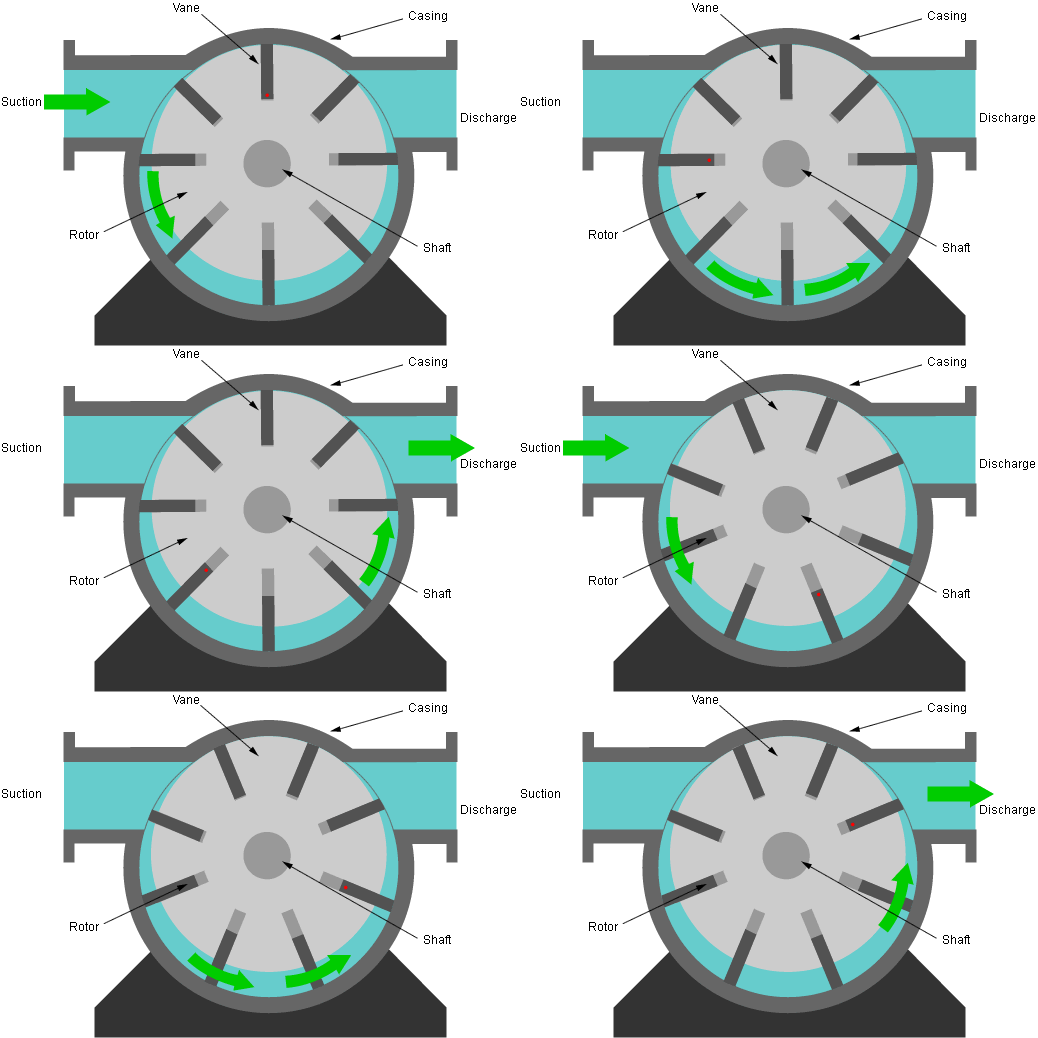
This is a vane pump. The centrifugal force of the spinning rotor throws the vanes out against the casing, creating a sealed volume that it then moves around the bottom of the casing to the discharge. We use this type of pump to move anhydrous ammonia because the materials are selected to withstand the temperature extremes. They don't last long if you run them dry, though; the fluid acts as the only lubricant available to the vanes as they slide along the inside of the casing.

There are other types of PD pumps that use diaphragms or some other way to create a changing volume, but I think you get the idea. PD pumps have many uses.

Pros
  • Often self-priming:  they are designed to move gasses as well as liquids, so they can prime themselves from a dry start. A pitcher pump may need a cup of water dumped down the casing to wet the leather piston to form a good seal, which is why you'll sometimes find a full water jar next to the hand pump. 
  • Good for thicker fluids: high viscosity liquids like oil and grease are no problem for a PD pump. I've seen specialty PD pumps that will move wet concrete through a hose to the building site. 
  • High pressure: the common pressure washer that you use to clean your sidewalk or power-wash your siding uses a piston pump. Pressures in the thousands of PSI are easy to achieve with a PD pump.
Cons
  • High pressure: if the discharge gets blocked, most PD pumps will create dangerous levels of pressure in a matter of seconds. I've seen someone close the wrong valve and have to clean up after a 6" diameter pipe blew out. 
  • Touchy to work on: much tighter tolerances in the manufacture means that PD pumps tend to be harder to work on, especially in the field. Special "clean rooms" are normally set aside for working on PD pumps to keep dust and dirt out of the internal parts.
  • Lower flow rates than centrifugal pumps.
  • Shorter life-span than a centrifugal pump: the tighter tolerances and constant motion of parts against each other lead to increased wear.


So picking a pump is not as easy as it seems. Like most of life, there are compromises and trade-offs in deciding which pump to choose if you're trying to empty a UST. I'm still doing some research and will update last week's article soon. Unfortunately I haven't been able to find a gas station that will let me field test any of my possible solutions; for some reason they're not fond of anyone spreading information that could help thieves...


Gif credits

  1. https://blogger.googleusercontent.com/img/b/R29vZ2xl/AVvXsEj4ejOGvbeD7cILWxqg7X8R_efrKQ4Jlq0Rts5BW2fQccMA1MYXwxqAGwIve6HYuopk3Vh0DKQ43fKAEaBcjpIekHJMVBZ8f37KQ5TYAgFfiw8ro8agY1QeXPdzOm7bVkZ4aNaEEcV32Hyt/s1600/animatedcentrifugalpump.gif
  2. https://upload.wikimedia.org/wikipedia/commons/thumb/6/69/Hand_Pump_-_Animation.gif/220px-Hand_Pump_-_Animation.gif
  3. http://www.ipumps.biz/i-Pumps2.gif
  4. http://www.gmpumpsa.com/wp-content/uploads/2014/01/Proc201_010100_G08.gif

Thursday, October 9, 2014

Mail Order Medicine

This is a short, hybrid post. It started as a guest post by a friend, but by the time they got all of the information together they were a bit paranoid about divulging too much personal information or possibly getting in trouble for advocating that people "get around the system" by skirting the laws. That's when I sat down with them and went over it line-by-line and we hashed out a way to put forth the information without the personal risks to them.

If you're without insurance or need to stockpile medication in your preparations but your doctor won't help, this may be of interest to you. I am in no way, shape, or form advocating anyone use this information to acquire drugs for illegal use. This information is for those who have a legitimate medical need for medications and may not have any other viable source for them.

A while back, my friend (we'll call them Pat) lost a job and the health insurance that went along with it. Pat isn't stupid, and had a small stockpile of the medications taken on a daily basis set aside but some of it ran out before replacement insurance was found. Pat has some health issues: high blood pressure, border-line diabetes (controlled by diet and exercise, no drugs), frequent infections (due to the diabetes) and some others that I can't mention. One of the side-effects of high blood pressure medications is fluid retention, so the doctor gave Pat a prescription for a "water pill", a common diuretic. That's the one that ran out before insurance was found. Now Pat could have gone back to the clinic, seen the doctors and gotten another prescription, but the cost of an office visit (~$200) and the pills (~$150) at the pharmacy without insurance would have destroyed the budget for the month and recurred every month until things got sorted out.

What's a person to do? Going without the medicine was not an option, since water retention will make you swell up in the legs to the point where walking is painful and eventually impossible, so Pat needed to find another source of the needed medication. While emptying the spam folder of an email account, Pat saw one of the ubiquitous ads for Viagra/Cialis/etc that we all see caught in the spam filters. Since the ED (Erectile Dysfunction) drugs are not a Scheduled Controlled Substance (the DEA classifies drugs according to their abuse/addiction potential), and neither is the diuretic Pat needed, it was a small logical leap to think about using a pharmacy overseas to get the prescriptions filled.

The types of medications available online include:
  • Allergies
  • Anti Fungal
  • Anti Viral
  • Antibiotics 
  • Anxiety
  • Arthritis
  • Asthma
  • Birth Control
  • Blood Pressure
  • Cholesterol Lowering
  • Depression
  • Diabetes
  • Erectile Dysfunction
  • Gastrointestinal
  • Hair Loss
  • Heart Disease
  • Herbals
  • Men's Health
  • Muscle Relaxant
  • Pain Relief
  • Skincare
  • Sleep Aid
  • Quit Smoking
  • Weight Loss
  • Women's Health

On-line pharmacies work in a couple of different ways. 
  • The more legitimate pharmacies will ask you to fax of email a copy of your prescription to them and they will send your medications out to you through the mail once you've paid for them. This system works and is a good way to save money if you're on a fixed or low income since the pharmacy has much lower overhead and if they're not in the USA they don't have to abide by minimum pricing rules/agreements/contracts. They will be able to get generic versions of most non-scheduled medications at a substantial discount. The best ones are in Canada or the UK, and their quality is the same as you'd expect to find in your corner drug store.
  • The borderline pharmacies will ask you for a brief medical history and have a licensed Physician on their staff look at it and write your prescription. This may be seen as a "rubber stamp" prescription, since the doctor never actually sees the patient in person. Again, your medications will be sent to you through the mail after payment. Sometimes they come from Canada, sometimes from the factory in India. They will be generic versions of the medications, usually made in factories in India that are regulated by the Indian version of the FDA. The quality should be on par with those made in the USA.
  • The questionable online pharmacies will ask you what you want and mail it to you. The medications are usually made in China or Mexico and the quality is a crap-shoot. There are plenty of stories of adulterated food coming out of China and Mexico, and I'm not sure I'd trust them to make my medicines.
  • The downright illegal places are those found on the "darknet". Google "Tor services" and "the Silk Road" for examples of how to access the hidden layers of the internet, where you can buy anything imaginable if you can pay in Bitcoin or direct transfer to a bank account in the Cayman Islands. Since these vendors are working outside of the legal system, you're on your own as far as quality and delivery go.
Payment is usually by credit card and I'd suggest using pre-paid disposable cards to protect your bank accounts and personal information. Delivery through the Post Office is usually via Registered Mail and will require an adult signature upon delivery. Overseas shipment of anything via FedEx, UPS, or DHL is expensive, but a lot quicker than the international postal system.

My friend Pat needed a few months worth of medication. Under Pat's old insurance, a month's worth of the diuretic cost only the $20 co-pay; without insurance it would have cost $70. Going through a Canadian "borderline" pharmacy cost Pat about $18, having bought enough to get through 90 days. The prescription was sent in blister packs of ten pills instead of loose in a bottle, and delivery took about 8 days. They have worked just as well as the US made pills (Pat's came direct from India) and saved a bunch of money. Since Pat went through a doctor and got a prescription, there were no laws broken.

As always, your mileage may vary and I take no responsibility for any actions on your part. I am passing on information which may be used for good or evil and I have no control over how you choose to use this information. You and only you are responsible for your choices.

The Fine Print


This work is licensed under a Creative Commons Attribution- Noncommercial- No Derivative Works 3.0 License.

Creative Commons License


Erin Palette is a participant in the Amazon Services LLC Associates Program, an affiliate advertising program designed to provide a means for sites to earn advertising fees by advertising and linking to amazon.com.