Showing posts with label Protective Gear. Show all posts

Wednesday, March 9, 2022

NoCry Gloves


Not actually Erin.
& is used with permission.
I have small hands. No, smaller than that. Don't think "very short girl", think "freakishly tall Hobbit" with commensurate hand size. Naturally this means I need small things to fit my hands, and I'm thrilled when something sized "Small" is actually small enough to fit me well. 

Back in 2016 I was looking for some cut-resistant gloves to put in my preps due to some unfortunate accidents I've had in the past, and practically every cut-resistant glove offered was sized "Medium" or larger. 
Every one, that is, except for NoCry. They came in Small! And what's more, they fit my tiny Hobbit hands!

My hands in NoCry gloves, size Small. 
There's only a little bit of extra room at the tips.  

This is the point where I would love to tell you how well they work. The thing is, though, I haven't had a cutting mishap while wearing them. While this is certainly a good thing, it does make it difficult for me to say "These really work!" Since I don't believe in testing to destruction, all I can do is say the following:
  • They have a 4.5 star rating on Amazon with over 31,000 ratings
  • They are affordable
  • They are comfortable
  • They are ambidextrous
  • They do not reduce my dexterity
  • They can be cleaned in the washing machine
  • Their cuffs are color-coded for size
I can attest to all of these. They are also rated cut resistance 5, which is apparently four times that of leather, but I can't attest to that. 

I liked these gloves so much that I decided to get another pair, and when I went on Amazon I discovered that NoCry also makes gloves with a reinforced thumb, index, and middle finger. After wishing I was wearing these back in 2010 when I cut my thumb quite badly (I still don't have full sensation in it), I ordered a pair.

To my horror, I discovered that Small didn't fit me any more. 
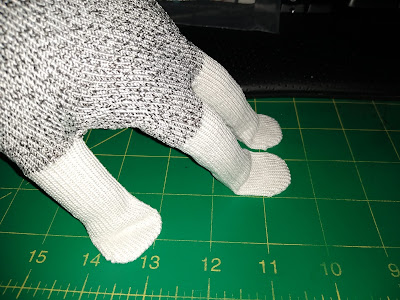

Yes, that's nearly an inch of extra material at the fingertips. I thought that perhaps there had been a mix-up in the factory where they're made and a Small label had been sewn onto a Medium pair of gloves, so I requested a replacement pair from Amazon. No sooner had I done that and left a 3-star review complaining about the fit (5 stars for the original gloves, 1 star for reinforced that don't fit, that's a 3 average), I received a message from NoCry stating that they'd already sent out a replacement pair. 

Now, before you think my hand somehow shrank, here's a comparison between my old gloves (middle), the new pair I ordered, and the replacement pair. As you can see, the reinforced gloves are quite visibly longer. 
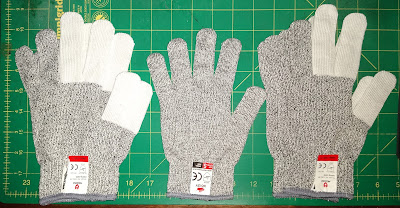

I replied to the message with the following:
Hello, and thank you for sending me a replacement pair. I am always happy to give second chances.
Unfortunately, the replacement gloves are exactly the same size as the others -- too large in the fingers by an inch, as you can see from the photos -- and I cannot use them.
Your sizes have changed since my first purchase in 2016; perhaps your children's sizes will fit me better. I will order an XXS once you have a reinforced glove in that size.
I will return both pairs to you so that you can sell them to people with larger hands. Please issue a refund.

Enter Raino Raasuke, the CEO of NoCry. He contacted me to tell me that he'd read my review and, well, read for yourself:
Hi Erin,
Thank you very much for getting back to us and for sharing the photos! 
I am really sorry about your poor experience with our reinforced gloves. I have already shared your feedback with another team of ours to investigate further from their end. I want to thank you for sharing your feedback with us as it helps us get better. Please accept my sincere apologies for any inconvenience caused. 
It appears to me that the replacement pair you received was sent out by Amazon. 
Just to point out, the difference of the reinforced fingers (why they might be slightly longer) partly comes from the difference in elasticity. The white area is not very elastic, so it has to be a bit larger to accommodate the difference. Please try pulling back each finger to see if it makes a difference.  
Here at NoCry we have a policy - if a customer receives a product that is either defective or is simply not what was expected, then we’ll always replace it for free or offer a refund, no strings attached.
With that being said, I have already issued a full refund for your order, and it should take 3-5 business days until the amount reaches you.
Also, I have taken the liberty to send you a replacement pair in size XS, free of charge, so you could see if they offer you a more comfortable fit. 
If you do not mind, I would love to hear from you once the replacement pair arrives, just to know how they fit you. 
Please rest assured, there is no need to go through the hassle and return anything to us. Feel free to give them to a friend who might make better use of them. 
Looking forward to hearing from you.
Best wishes,
Raino from NoCry

A refund and a replacement in Extra Small is fantastic customer service. But wait, it gets better! I also received in the mail an unexpected package from... Mama's Custom Cookies of Wantagh, NY?

The little red critter is NoCry's mascot.
I'm not sure if he's a dinosaur or alligator or what,
but the idea is he has tough skin like their gloves. 

It was tasty. I eated it.


So first off, "Accept Cookies (Yes/No)?" is absolute genius, and you can't go wrong by sending me a tasty cookie, so this made both my brain and my tummy happy. Plus they sent me another pair and refunded my money! Folks, this is amazing customer service and I cannot speak highly enough of them.
Raino, you magnificent person! "Accept Cookies (Y/N)?" is sheer delicious genius. I was already impressed with your customer service but this goes above and beyond.

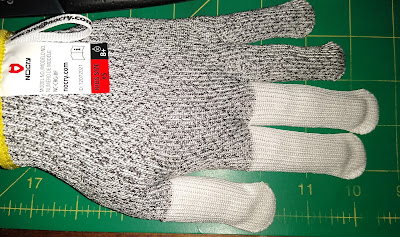
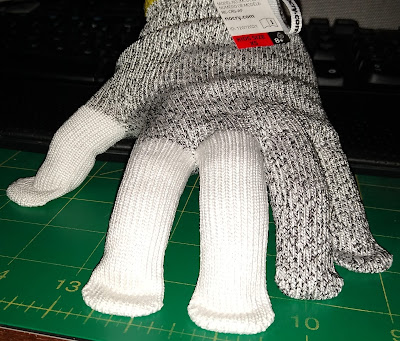
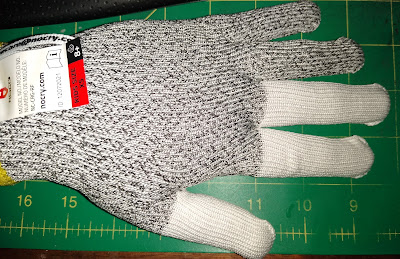
You will be relieved to know that the XS gloves fit me fairly well. There's still some space at the tips of the reinforced fingers (see first 2 photos) but I'm able to solve that by taking a finger in my other hand and moving the fabric back and forth while pushing back towards my hand. This compresses the fibers enough that I don't have loose material at the tips (see second 2 photos). The drawback is that it is a little bit tighter and a little harder to bend those fingers, but it isn't uncomfortable nor do I suffer any appreciable loss of dexterity from it (and if I need to use fine motor skills I'll take the gloves off anyway).

I will be revising my review tomorrow, praising you for making the situation right.

Further, I run a Preparedness Blog ([link removed]) and I will let everyone know about the fine customer service you gave us, and I will give away the extra pairs of gloves to my readers. How's that sound?

Thank you again for all you've done. I already recommend NoCry products to my friends, family and readers, but you've outdone yourselves in the customer service department. Cheers!

Sincerely, Erin Palette


So there you have it. I now have a pair of XS gloves which fit me, and two pairs of Small reinforced gloves which I can't. So who wants a pair? 

First two comments get them (remember, they're SMALL) -- just pay postage!

Friday, December 18, 2020

Ballistic Armor: a Recommendation

Not actually Erin.
& is used with permission.
When I was doing my Ballistic Armor series back in September, I mentioned that while I owned a set of 4401-SH-SC-L ceramic plates, I didn't know enough about them to feel good about recommending them to our readers. 

Earlier this month, Body Armor Outlet published a video of that very armor being shot by 30-06 M2 armor piercing rounds, 5.56mm M855 rounds, and  7.62x39 rounds.

As a refresher, here are the NIJ standards for this armor:

As you can see for yourself in this video, these armor plates held up in excess of NIJ standards. 


Needless to say, I am very pleased with this performance and now I feel comfortable recommending to you the Body Armor Outlet  4401SH Level IV 10x12 Plate, Standalone, Shooters Cut, Single CurveAs I write this there are 190 plates in stock and the cost is $120 per plate, so get them while you can. 

I hope you never need them. 

Friday, November 13, 2020

Protection Against Laser Blindness

Not actually Erin.
& is used with permission.
It is becoming increasingly common among certain disruptive groups to use laser pointers as blinding instruments. This is a purpose for which lasers were never designed, but are nevertheless well suited: not only will a laser flash across the eyes dazzle the victim, leaving them temporarily blind and therefore unable to defend themselves, but it can also lead to permanent eye injury and even blindness. 

According to this laser safety factsheet from Iowa University, any laser with an output of at least one milliwatt (1 mW) can cause permanent eye injury. I will not link to it, but it is possible to buy a 300 mW laser online for under $50. Given that many preppers live in the city or other urbanized areas and that unrest in this country is at an all-time high, I believe it would be prudent for some of our readers to take into account the possibility of being struck, either accidentally or deliberately, by a blinding laser. 

Some Science
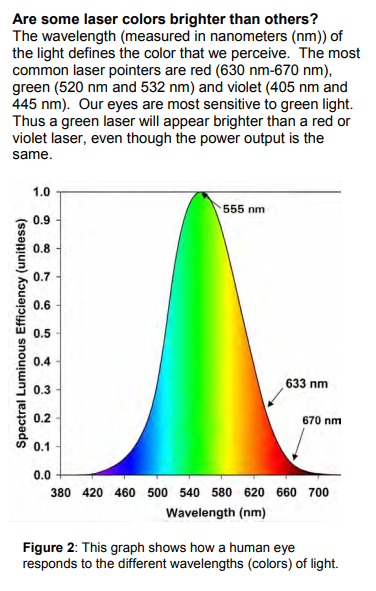
While lasers come in all colors, green lasers are most commonly used for this purpose due to the human eye's specific sensitivity to that wavelength, likely a genetic heritage from our hunter-gatherer days where being able to differentiate between shades of green helped early humans tell the difference between edible and inedible plants. (Also, the Sun's central wavelength is in the green portion of the spectrum, which likely influences the whole matter.) As such, a green laser will inflict greater damage on our eyes than a red or blue laser of the same milliwattage. 

https://usaphc.amedd.army.mil/PHC%20Resource%20Library/Laser%20Pointer%20FS_24-031-0617.pdf

https://en.wikipedia.org/wiki/Laser_pointer#Colors_and_wavelengths

Eye Protection
Fortunately, it is possible to defend against laser dazzle and eye damage through the use of protective lenses. These lenses will not provide 100% protection against lasers, because lasers are amplified and collimated visible light; any lens which protects 100% against visible light would necessarily be 100% opaque and therefore render you blind by different means. 

Furthermore, effective protection will not come cheaply; if you are not buying certified protective lenses with a known optical density and visible light transmission, you may end up buying colored sunglasses. 

Optical Density (OD) is a measure of un-attenuated laser energy that will pass through a filter. Attenuation is the absorption or scattering effect of the lenses. Therefore the higher the OD, the smaller the amount of high-energy laser light passing through the lens.

Information from https://noirlaser.com/laser-standards


Visible Light Transmission measures how much non-laser light passes through the lenses. While you obviously need light passing through a lens in order to see, this measurement is also useful if you intend to wear protective lenses at night, when you will need a higher VLT than during the day. 

Information from https://www.opticnerve.com/pages/visible-light-transmission-vlt


Armed with this knowledge, let's take a look at a certified pair of protective laser strike glasses, the Model 33 from Phillips Safety Products.

Optical Density:
  • Over 7 for wavelengths between 190nm and 400nm, which means it highly attenuates the ultraviolet spectrum. 
  • Violet pointers emit between 405nm and 445nm, for which the OD starts at 7 but rapidly drops off to 2 (reducing laser dazzle by 99%). 
  • Blue pointers emit from 450-488nm, so OD against blue is 2 to perhaps 0.5, reducing dazzle from anywhere between 90% and 50%. 
  • Green pointers emit between 515 and 532 nm, and these glasses are rated over OD 2 for that, reducing dazzle by 99%. 
  • OD zero for anything in the yellow, orange, red, or infrared spectrum. 
Visible Light Transmission: 33%, meaning that these have a tint equal to regular sunglasses. 

Conclusion: Good protection against violet and green lasers; adequate to poor against blue; no protection against red lasers. I base this conclusion on the fact that 99% attenuation against a 300mW green laser still leaves 3mW of laser energy reaching your eyes, which can still cause injury. 

An OD 3 would be preferable, as that would reduce the laser energy to 0.3 mW, well below the threshold of injury. Unfortunately, I cannot find any certified lenses of OD 3; for example, these glasses have an OD 4 and VLT of 55%, but the low price and lack of visible certification made me think they were too good to be true. A quick chat with their online customer service confirmed it. 


If you happen to come across any certified OD 3 glasses in the 520-532nm range, preferably with a VLT of 50% or more, please let me know so that I can buy them. Until then, I guess I'll have to spend $150 for OD 2. That's expensive, I know, but my vision (and potentially my life) is worth that much. 


Tuesday, October 20, 2020

Ear Protection

This week I'm taking an in-depth look at the types of ear protection available, the pros and cons of each, and what to look for when choosing your protection.

The three kinds of ear protection shown can be purchased below.


Lokidude

Friday, September 4, 2020

Ballistic Armor: Miscellaneous

Not actually Erin.
& is used with permission.
This is the final post in my series on Ballistic Armor, and it's a catch-all of topics which didn't really fit anywhere else.

Side Plates
As the name suggests, side plates are ballistic plates which cover the gap between your front and rear plates. They are typically 6x6" or 6x8" and protect your vital organs from your armpit to the bottom of your ribcage.

Do you need them? I don't feel qualified to answer that.
One veteran has told me that side plates are the kinds of things that people in foxholes need, and that as long as I shoot squared-up, the benefits of side plates are marginal at best and that a ballistic helmet is more important.

However, others have told me that engagements on the two-way range have a distressing habit of being from directions you don't expect, and that it all comes down to whether or not you're willing to take the risk and, of course, if you can afford it.

If you do decide to purchase side plates, here is what I have to say:
  1. Ensure that your plate carrier is cummerbund-compatible;
  2. Get the best plates you can afford;
  3. Do not forget to get trauma pads for them to reduce injury from impact and backface deformation;
  4. Practice moving and shooting with your armor, as full armor rigs require significant practice before you achieve proficiency with them. 

Your Abdomen
You may have noticed that ballistic plates do not cover your abdomen, leaving your vulnerable to being gut-shot. This is the unfortunate result of the "pick two" dilemma I talked about in Levels of Protection: any armor which will completely protect your front will be significantly heavier, significantly bulkier, and significantly more expensive than what we have now.

Furthermore, ballistic armor is designed to protect you from immediately fatal injuries to vital organs, and being shot in the intestines is not immediately life-ending. Yes, it is painful and yes, left untreated you will bleed out, but it is not fatal in the way that a gunshot to the heart or lungs is; unless civilization has completely collapsed, you should survive long enough to make it to a hospital to treat you for your injuries.

I know of only one company which makes a commercially available abdominal plate, and that is AR500 Armor. I am reluctant to recommend them because their abdominal plate is steel (and I covered the issues with spalling here) and because the company has a poor reputation (information on which can be found here), and so all I'm going to say about it "I rather like their plate carriers" and "If you really want a steel abdominal plate, you can get one from them."

The US Military has access to Interceptor armor, which not only covers the entire front torso but also the neck and groin, and has armored sleeves for the arms and legs. However, I do not know if it is commercially available. Furthermore, it's only rated to stop a 9×19mm 124-grain FMJ bullet at 1,400 ft/s, so it's not even level IIIa protection.

If all this makes you feel funny, then take some comfort in the fact that I don't like it either. If anything, I'm worried about my face being unarmored. Speaking of which...

Ballistic Visors
If you have $300 lying around, you can purchase a level IIIa face shield. In fact, you have two choices:


Your first choice looks like a hockey mask, and it doesn't protect your eyes nor does it look like there's any way to put a trauma pad in it. Still, it beats being shot in the face, and it works with a helmet. (for $50 more you could purchase one that doesn't work with a helmet... but why would you want to?)


Your second choice is a clear face shield which mounts to a helmet. It only protects up to 9mm so it doesn't offer full IIIa protection, but it does protect your eyes. I also don't know how much the curvature distorts your vision. Being offset from your face it won't need a trauma pad, but I imagine that even a glancing shot will reduce visibility.

Again, welcome to the world of ballistic armor, where everything is a compromise.

Beware the Fatal "V"
I cannot find the link for this now, so you'll just have to trust me on this. Back in the 90s, when cities like Los Angeles started to heat up with gang warfare and police officers were issued kevlar vests, there was a spike in fatalities where officers wearing vests were nevertheless shot in the upper chest, just below the throat, and died.

As it turned out, this spike in fatalities was due to a combination of factors:
  1. The officers in question were wearing their armor lower on their body, with the upper edge sitting below their collarbones. This is more comfortable to wear long term, and therefore understandable when pulling 8-12 hour shifts. 
  2. Department policy at that time was to wear dark uniforms with a white t-shirt underneath. This created a high-contrast "V" target for criminals. 
  3. Therefore, this provided a handy, visible target for shooting at an area which was unfortunately unprotected by the kevlar. 
Therefore, do two things to avoid the Fatal "V":
  1. Wear your armor as high on your chest as possible. 
  2. Do not create contrast between your armor and your un-armored bits. 
This video will show you how to properly position your plate carrier. There are more in-depth videos out there, but this is short and sweet.


In Conclusion...
I have taken great pains to ensure that this series is as complete and as accurate as possible, but there is always the possibility that I have missed something important or gotten something wrong. If that happens, please do not hesitate to contact me; it is more important to me to that I give correct information than it is for me to always look correct.

For those who wish to refer back to previous articles, they are here:

Friday, August 28, 2020

Ballistic Armor: Plate Carriers

Not actually Erin.
& is used with permission.
You've selected your ballistic plates based on your needs and have the protection, cut, and material you want. The next step is wearing them, and for that you need a plate carrier, which is nothing more than a tactical vest with special pockets for your plates. (Note: Despite the word "plate" in the name, there is no reason you cannot use soft armor in a plate carrier.)

There are many brands of carrier on the market, and unlike plates it really doesn't matter who makes your carrier so long as it has good reviews for durability and reliability. After all, a carrier is nothing more than a stitched nylon (usually 1000 denier cordura) vest and a choice of options. In my opinion, it is the options which make or break a plate carrier. I have listed these in my (quite opinionated) order of importance.

Straps vs. Cummerbund
A plate carrier has, at a minimum, two pieces: the front and the back. These are attached to each other by straps that fasten in a variety of ways; buckles and velcro are the most popular. Once you have it adjusted for your comfort, leave the shoulder straps in place; that will make putting it on much easier.

You put it on a plate carrier by grasping it by the shoulder straps (or near them on the front piece) lifting it up and over your head, then sticking your head between the plates so that the straps sit squarely on your shoulders. This much is universal. After this, what happens next depends on what your carrier has.

If you have a strap type carrier, there will be two straps with YKK-style buckles on either side. How you fasten them is a matter of preference; some prefer to buckle them separately, others like to keep them buckled and then tension the straps into position. My preference is to keep my weak-side strap already buckled and tensioned, so that all I have to do is fasten and then tighten my strong-side strap. The main benefit of a strap type is that they are faster to put on than cummerbund types. 

If you have a cummerbund type carrier, after you have lowered the carrier onto your shoulders you will need to lift the cummberbund retaining flap on the front of your vest (this is secured with at least 6x12" of velcro, so it might take some effort), grab the dangling end of the cummberbund on your weak side, and bring it into position on the velcro. Once you've done that, switch hands and do the other side. Finally, lower the retaining flap into place. The main benefit of a cummerbund system is that it allows you to wear side plates. 

Regardless of which system you have, the carrier should be loose enough that your movement is not restrictive -- check to see if you can smoothly raise/shoulder your weapon and acquire a sight picture -- yet tight enough that most of its weight is borne by your chest instead of your shoulders. Cummerbunds have a slight advantage in this, although a quality strap type carrier is more than able to do this.

A quality (i.e. non-budget) plate carrier will come with the ability to have a cummerbund attached to it. If your primary intended use of ballistic plates is to protect yourself while you investigate a 'bump in the night', I would forgo the use of the cummerbund and keep mine in a strap configuration. The cummerbund can be added later, if necessary.

MOLLE Webbing
You need this. Fortunately, MOLLE webbing comes standard on practically every plate carrier.

Things to put on your webbing:
  • Magazine pouches 
  • an IFAK specifically for gunshot wounds
  • a flashlight
  • a knife
  • a radio (or a cellphone in a dedicated pouch)
  • a water bladder
The water bladder is probably a surprise. I include it not just for the obvious reason, but for the fact that most level III steel plates and level IV ceramic plates weigh in the 7 to 8 pound range and that one gallon of water weighs 8.34 pounds. If you can only afford a single plate, get a 4 liter bladder (1 gallon = 3.785 liters) for your back to balance it out. 

Be advised that the more you put on your carrier (specifically ammunition), the more uncomfortable it will be to wear for a long period of time. For this reason I would specifically recommend against placing a sidearm on your carrier; wear it on your belt instead. 

Drag Handle
This is a strap on the back of your carrier, close to the nape of the neck. As the name suggests, this is a handle so that if you are wounded, one of your buddies can grab it and drag you to safety.

Do you need it? Hopefully not. Fortunately, these seem to come standard with every plate carrier I've seen. The nicer versions have a big healthy loop at the back, and the cheaper versions are essentially a strip of MOLLE webbing that hasn't been sewn into sections. 

Interior Padding
A foam lining in the inside of the plate carrier, usually with a sweat-wicking mesh as its outer layer.

This is usually one of the first options cut in budget plate carriers. You don't specifically need it, but it's very nice to have, especially if you wear your plates in the heat and/or for an extended period of time.

Shoulder Pads
These are typically aftermarket pads which wrap around the shoulder straps to give you more protection. In my opinion you shouldn't need them as the weight of the plates should be born on your chest and back, not your shoulders. However, you may disagree. I suggest trying your carrier without the shoulder pads, and then adding them later if you feel they are necessary.

Velcro Strips
These are convenient but not necessary. They are useful for the military and police to show names, units, jurisdictions etc but most people won't need them.

That said, they can be put to use. Blood type is a very popular option, and if you are working at night reflective strips can be useful.

I would recommend against patches that could arouse the ire of authorities, such as Punisher skulls.

Administrative Pocket
This is a fancy term for "There's a velcro pocket at the top of your front carrier." They aren't very large, however. I suppose you could put your Driver's Licence and Carry Permit in them?

Don't pay extra for this.


Next week: the conclusion of this series with a "Miscellaneous" post.

Friday, August 21, 2020

Custom Hearing Protection

Whether using firearms or operating noisy machinery or (especially if you ride motorcycles) dealing with wind noise, there are times you need hearing protection. Sometimes earmuffs, fancy or plain, may not be the best fit for the conditions, or you may need more than just muffs.

The usual fix for this is earplugs like these, or these, or these.  All of them work; however, the problem some people run into is that they won't stay in place (especially the foam plugs) when you have to talk or move around much, or they just don't fit your ears well.

This brings me to these: do-it-yourself custom earplugs.  They may not be quite as nice as those you can sometimes find being made a gun shows, but they cost a lot less, too.

How they work:
  1. Make sure your ears and hands are clean.
  2. The kit comes with two small tubs, each with a lump of compound in it.
  3.  Take half of each, and knead that together for 30-45 seconds, no more, until the color is even.
  4. Roll it between your palms into a smooth ball with no creases.
  5. Put it into your ear and push it in place. (A mirror helps.) Don't try to shove it all in; it needs to go a little into the ear canal but not too far, and there should be enough, after you push and fold it in and smooth it, to fill the inner bowl of the ear.
  6. Sit down for ten minutes without no chewing, drinking, or talking. 
  7. After a few minutes you'll start hearing popping sounds as the mix starts to cure and harden, which will increase for a couple of minutes, then start dying down.
  8. After ten minutes you should be able to get hold of the top edge and pull/roll it out.  
  9. Set that one aside and do the other ear.  
  10. Let them sit for a few hours to completely cure.

The Good: I really like these because, unlike any other earplug I've used, they don't start working back out after a few minutes. They'll fit under a motorcycle helmet, they're washable, and can be had in several colors (my last set was pink, which is very easy to find if I drop one).  They'll also last a long time; one of my sets is almost two years old.

The not really Bad, but keep in mind: the package shows a Noise Reduction Rating(NRR) of 26, which is the same as a lot of low-profile earmuffs, less than some of the foam-type.  Shooting outside, or around loud equipment or power tools they work well; for an indoor range I'd want them and muffs, especially around rifles and shotguns.

For what they are, I give them a five-star rating.

Saturday, August 15, 2020

Ballistic Armor: Terminology

Not actually Erin.
& is used with permission.
This article was written with information provided by Seth Schuehartt in his original submission, which was cut for content and for brevity. 

Now that you've decided upon which material and level of protection best suits your needs, it's time to go shopping. As I have limited experience with ballistic armor (other than to say that I own these Level IV ceramic plates which are off-brand Hesco) I am reluctant to make any recommendations or discommendations by name. However, I can help you narrow your search by explaining many terms used to describe armor plates. When looking at armor descriptions, the format is usually as follows:
  1. Protection Level
  2. Dimensions
  3. Protection Type
  4. Material
  5. Geometry
  6. Cut

Dimensions
Most armor plates are 10" x 12", although 11" x 14" is frequently available. Side plates (see below) are typically 6" x 6". 


Protection Types

Standalone
This means that the plate armor is sufficient by itself to protect you (although a trauma pad is highly recommended). Most plates are standalone.

ICW
This acronym means "In Conjunction With" and is seen most often in duty armor for police officers who usually don't need more than Level IIIa soft armor. Adding an ICW plate over their IIIa armor (usually in an external plate carrier) gives them Level III protection.

Side Plate
These are Level III or IV plates which attach to the cummerbund (see below) and protect your sides from your armpit to the bottom of your ribcage.

Trauma Plate
A non-ballistic hard plate worn in a dedicated pocket underneath soft armor to protect the sternum from blunt trauma.

Cheater Plate
A small ballistic plate worn as additional armor to get additional protection. Speed Plates are a type of ICW cheater plate which covers the heart and upper lungs.


Geometry
Note that this applies only to plate (hard) armor, not soft armor.

Flat Plate
This armor is a flat piece of metal, ceramic or polymer. Cheapest to buy because they are the easiest to make, but they are also awkward and uncomfortable to wear due to the fact that our bodies are curved.

Single Curve
This plate curves from left to right, making it mold more readily to your torso. Less awkward but still rather uncomfortable, especially if you have a large belly or any kind of breasts.

Multicurve
This armor has multiple curves to better fit the armor to the wearer’s body. This is the most comfortable type of armor, but also the most expensive.


Cut

Rectangular
Again, the least expensive and most uncomfortable style. The upper corners of this plate make it difficult to shoulder long guns and to move your arms inward past 90°.

Shooter’s Cut
These plates have the upper corners cut off, creating an extended hexagonal shape which makes shooting while wearing them much more comfortable. Generally recommended for most people.

Swimmer’s Cut
This is similar to a Shooter’s Cut, but has even steeper cuts at the top corners and also has the bottom corners cut off. It allows for greater flexibility but also provides less coverage. This cut is most useful for those who need more mobility, have narrower shoulders, or have a particularly slender build.


Other Terms

Backface Deformation
If a large enough or fast enough bullet strikes a plate, the force of impact is sufficient to cause a bulge (deformation) on the side of the plate closest to your body (the back face of the plate, aka backface). Depending on how dramatic the backface deformation is, it could cause additional injury to the wearer. Trauma pads are recommended to protect against backface deformation injuries.

Cummerbund
The straps that goes from the back, around the sides, and under the front of the plate carrier. This provides for a more secure and comfortable fit, albeit at the cost of being much slower to put on than a strap-and-clip system. You must have a cummerbund if you want side plates. 

SAPI
The military term for Level III plates. It stands for Small Arms Protective Inserts.

ESAPI
The E stands for Enhanced. These are Level IV military plates.

XSAPI
An experimental armor created in 2008, designed to protect against eXtreme threats. About 120,000 were made, but the threat they were designed to protect against never materialized. The FBI uses these, and probably other government agencies as well, but to my knowledge they are not commercially available.


Next Week:  Plate Carriers

Sunday, August 9, 2020

Guest Post: UHDPE Ballistic Plates

by Seth Schuehartt

Seth is an Armed Security Professional and Consultant in Phoenix, Arizona.

Editor's Note: It was pointed out to me that in my article about ballistic armor materials, I completely neglected to mention UHDPE plates. Since I have no experience with this material and there is less information about them than with steel and ceramic, I defer to Seth in this matter.

Per the author's request, it should be noted that this post has been edited down (it was originally five pages long) for content and for brevity.   -- Erin Palette
Disclaimer: Everything I say here is true to the best of my knowledge, but I am human and am currently updating my understanding of the topic. The goal here is to pass along what I’ve learned, and even as a fairly informed consumer and professional end user, my understanding of the subject is that of a layman’s when compared to the folks who do all the testing on this stuff. There’s a lot I don’t know, but I do know enough to make an informed purchase. 
When it comes to ballistic rifle armor, you typically see ceramic and steel as the  primary component of construction. What’s new is the emergence of Ultra High Density Polyethylene (UHDPE) plates on the market.

UHDPE (henceforth just called "poly") plates are extraordinarily lightweight (5 pounds per plate) and can perform well up to NIJ Level III, having been proven extremely effective at stopping lead/copper projectiles. Unfortunately, they don't hold up very well to any sort of solid projectile, such as bonded cores and mild steel (non-AP) cores.*

However, many manufacturers offer a hybrid Ceramic/Poly style plate, essentially wrapping the ceramic in rigid Polyethylene to save weight (hybrid plates are around 6 lbs) to protect the ceramic component of the armor while offering NIJ Level IV protection. If you’re looking for a standalone Level IV plate, this construction is what I would recommend.

If you can carry the extra weight, I’d also recommend a "training" or "fitness" metal plate (it doesn’t necessarily need to have a ballistic rating) to save your chest the pain of blunt trauma after being shot, and to keep you in the fight since backface deformation (how deformed the side of armor closest to your skin becomes after being struck by a bullet) allows for potentially lethal injuries. This is the only place where steel shines, as it spreads the impact across the entire body contact-area whereas other plates basically end up with all that energy directed into a solid baseball-sized area punched into the body with broken bones not uncommon. However, that same benefit of steel can be achieved by using a fitness plate. If weight is an issue, a lighter but less effective option is what's known as a trauma pad.


Footnotes
* The NIJ is currently changing their standards for armor performance. This is due to steel armors failing with high velocity rounds within their threat profile, and poly armor failing to modern bonded core and exposed penetrator type projectiles. For example, a Level IV plate should hold up to any 5.56mm bullet, but M855 (the most common 5.56mm cartridge within the US military) will punch through any poly plate, and any 55 grain bullet traveling at 3000+ fps will punch through most steel plates, whereas ceramic will maintain its protection.

The new standards will be adjusted to account for these shortcomings. A notice has been disseminated to manufacturers, but I am not privy to the details of that notice. Here’s some links to get you started:

Friday, July 31, 2020

Ballistic Armor: Materials

Not actually Erin.
& is used with permission.
Two weeks ago I talked about levels of protection. This week I will expand on that by talking about the materials involved in making ballistic armor.

Ballistic Fiber
You know this best as Kevlar, but there are other materials on the market which have similar properties. Most kevlar armor is soft, although hard armor such as ballistic helmets and speed plates do exist; these are Kevlar fibers coated with a polymer resin to produce a durable, rigid form.

Soft armor works through a process I like to call ballistic spaghetti. Normally the woven fibers are flexible (if stiff), but when struck by a fast-moving object the strands, which are stronger than steel, clump together like pasta around the bullet and prevent it from breaking through. This clumping weakens the weave of the material, however, so further strikes to the same area are more likely to punch through. Kevlar weave is also highly slash-resistant, but is only moderately stab-resistant; a stab concentrates cutting force at a point smaller than that of a bullet, whereas a slash only damages the outer layers. Many police officers have a small trauma plate over their heart to further protect from knife attacks.

Kevlar helmets are designed primarily to protect the head from shrapnel and falling damage, but they can protect against some bullets. However, they are designed to redirect the damage; a direct hit is still likely to penetrate it. See the video for more information.


Kevlar fibers are sensitive to acids, salts, and ultraviolet light, which is why most such vests come with an expiration date; it is assumed that these vests are being worn daily and that the sweat of the wearer's body is breaking it down. If kept out of the sun and in a climate-controlled area, such as your closet, these materials ought to last your lifetime.

Steel
Unlike Kevlar, steel armor will last forever so long as it doesn't rust, and most armor comes with a protective covering similar to pickup bed liner to prevent that. Steel will also protect against multiple hits from most non-armor piercing rounds through the simple fact that it is stronger and denser than lead or copper bullets, which will break upon impact. However, "breaking apart upon impact" isn't always great, as this leads to what is known as spalling which can cause injury and even death.

As an example, let us assume a 5.56 M855 bullet strikes a steel plate head-on at 3,100 feet per second. With no deflection, all that force has to go somewhere, and since the bullet cannot penetrate the plate (although it will break the lining and likely leave a dent or dig a divot in the metal) the force will break the bullet into pieces... which are still going quite fast... and since the fragments cannot go forward, they will deflect to the sides. These fragments are known as spall, and unfortunately one of the directions the spall can deflect is towards your head, specifically your unarmored neck and face. Sharp, fast-moving fragments in that area can be debilitating, if not lethal. A protective coating on steel plates helps reduce spall, but will not prevent it.


Finally, steel plates are heavy. I realize this elicits a "Well, duh" comment from many of you, but really, they are heavier than you think. As I mentioned previously:
I have worn level III steel plates, and within 5 minutes my shoulders hurt; after 15 minutes I was in such discomfort that the only thing which would make me keep them on is being shot at.

I also own level IV ceramic armor. While it weighs about the same as level III steel, because it is larger it feels lighter due to the larger dispersion of weight. I was able to wear my level IV for 15 minutes before feeling a stiffness in my neck and shoulders (that "I need to stretch it and make it go pop" feeling) but I was able to wear it for an hour before I started to cramp up.
The steel plate which I wore was two 8 pound plates carried front and rear in a plate carrier. My ceramic armor is two 7.4 pound plates, again carried front and rear. The steel feels significantly heavier than the 1.2 pounds of difference between the materials.

Ceramic
It sounds like ceramic armor is the best kind, doesn't it? I admit that it's great, but but it isn't always the best choice. On the negative side, ceramic is fragile; if you drop it or you fall on it, and it breaks, your armor is pretty much done. Ceramic armor is also only NIJ rated for one shot of .30-06 M2 armor piercing ammunition; steel is rated for six shots. Depending on the armor and the caliber and composition of the bullet, ceramic might stand up to more hits; it's up to you to figure out what your armor can do. Here's the information from my plate, which is a 4401-SH-SC-L:


As you can see, while it can stand up to a lot of hits, there are some calibers or types of ammunition where it protects by failing; i.e. the force of the bullet is distributed through the material by breaking the ceramic. In lesser cases, the ceramic breaks up the bullet and makes it larger so that the Kevlar backer can catch it and stop it. Level IV plates are more likely to fail to bullet mass than to bullet velocity for a single hit, but unlike steel they will fail just from being shot in the same location several times. Once the ceramic is shattered, it starts falling out and all that’s left is the Kevlar backer that cannot stop a rifle round on its own.

(Yes, I said Kevlar. That means ceramic plates are also susceptible to damage from sweat and UV radiation. Remember what I said earlier about "No overall winners"?)

It's up to you to decide what your needs are, and that is what will inform your choice of purchase. If you want something to leave in the trunk of a car in case of trouble, steel is a good choice. However, if you think you will be wearing it a lot, or doing a lot of walking with it (as opposed to sitting and riding), then ceramic is probably better for you.

Ultra High Density Polyethylene (UHDPE) 
After publishing this article it was pointed out to me that I neglected UHDPE. That oversight has been corrected with this article.

A Final Word on Impact
Just because a bullet is stopped from penetrating doesn't mean that it will have no effect on you! The force of impact will still be transmitted to your body; it will just be spread out across a larger area.

Think of it like this: a pin moving at a slow speed will penetrate your skin because all the force of the impact is focused on its tip. A fist moving at that same speed will not penetrate your skin, because the force is spread across a larger surface area. A fist moving at a faster speed will hurt you, but a sledgehammer swung at that speed will break bones. The speed of sound is 1,125 feet per second; most AR-15 rounds will be going nearly three times that velocity.

If you are struck by a bullet while wearing ballistic armor, you will feel every bit of the 1000+ foot-pounds of energy in that shot. Expect to be knocked off your feet because you the impact will hurt so much your legs will fail. Expect to have the wind knocked out of you. Expect to have some really impressive bruises, and maybe even some broken bones. You will not be having a good day.

But you will be alive.

Friday, July 24, 2020

Ballistic Armor: Helmets

Not actually Erin.
& is used with permission.
My apologies for this article being late and not on the subject of materials as promised last week. I've been rather busy and the subject is quite complex, so in the spirit of giving our readers something I thought I'd expand a bit on what Chaplain Tim said on Thursday about helmets.

There are various types of helmets to be found on the market today, from the M1 "pot" helmet of Vietnam to the ACH kevlar helmet of today, the FAST/ATE helmets used by Special Ops and riot helmets used by police officers.

I cannot find the NIJ rating for the M1 helmet, but all kevlar helmets on the market today give level IIIa protection which, to repeat myself from last week, is rated to withstand up to 6 shots of 240 gr .44 Magnum SJHP (semi jacketed hollow point) without penetration at a distance of 5 meters (16.4 feet). None of these helmets are rated to stop rifle rounds, and I cannot find any that do. If they exist, they are not for sale to civilians.

There does exist something known as the SLAAP Plate, which is an aftermarket accessory which claims to protect against rifle rounds up to 7.62x39mm. However, it only protects the front of your helmet and costs around $700.

This is not to say that a IIIa helmets cannot protect against rifle shots; there are numerous documented instances of IIIa rated helmets stopping rifle bullets. However, the reasons for this are a combination of factors such as the angle of the shot, the type of bullet, the range of the shooter, and so forth. While I suppose it is technically feasible to make a level III or IV helmet with today's materials, it would be exceptionally heavy and bulky and therefore an uncomfortable, and possibly dangerous, thing to have on your head. We will need to wait for further advances in materials science before level III helmets are commercially viable.

https://amzn.to/2EdPDGz
Until then, you will have to make do with a IIIa helmet. Given that the head is a small target compared to your torso, it ought to serve you well in protecting you from concussion, shrapnel, and the rare pistol bullet.

However, just because the helmet will prevent a bullet's entry does not mean it will protect against the force of the impact! If you get hit with one, expect your bell to be rung hard at the very least; a concussion is more likely. To prevent further damage, you will need -- not want, NEED -- a set of helmet pads. I was able to get a set of them from Amazon for $23.


https://amzn.to/2CGDoCd


I also bought a helmet browband for $30. It provides a much more comfortable fit.

Finally, you will also want to protect your hearing. With the exception of FAST helmets, most helmets cover the top half of your ears. This is great for protecting your ears from injury, but to protect your ears you will either need to use earplugs -- which prevent you from hearing conversation and environmental cues -- or you will need electronic earmuffs which fit underneath the helmet. I have a set of Peltor Soundtrap Tactical earmuffs and they work very well with my helmet. ($63 at Amazon).

You should now know enough to get yourself an effective ballistic helmet. I apologize for the delayed post and altered schedule, and I hope that this article was enough to tide you over until next week.


Thursday, July 23, 2020

Head Gear

Since a couple of us seem to be on a PPE theme, I thought I'd cover a oft-forgotten piece: helmets. Protecting your noggin is important in a lot of scenarios, from daily activities like riding a bike or working in construction or in a busy factory to the more extreme situations like exploring caves or searching damaged structures. Your head contains your brain, and since that is your most important tool for surviving most anything life can throw at you, it's worth protecting.

Helmets come in a wide variety of shapes and sizes; form tends to follow function, so you'll be able to look at a helmet and get a good idea of what its purpose is. I'll break the available options down into two main groups and give example of some of the subsets within the two groups.

Blunt Force Protection

Bicycle Helmets
Designed to offer protection against low-speed falls on various surfaces, most bicycle helmets are made of a thin, hard plastic shell with a crushable foam liner. Many have a air holes to ventilate the helmet and keep your head cooler while you're expending energy pedaling a bike. They don't cover the ears, so your hearing won't be impaired. Straps can be either a chin strap that cups your chin or a single strap that sits under your chin. These are a common sight on rioters since they are readily available and not obviously riot gear, while offering some protection against thrown or swung weapons.

Motorcycle Helmets
Similar to bicycle helmets, but with a thicker, harder shell usually made of fiberglass. These are designed to absorb the shock of higher-speed impacts and protect better against abrasion. There are several types;
  • Skull caps (AKA Potato Chips) are popular in states that require helmets while riding a motorcycle. They cover the top of the head but don't extend below the top of the ears. These offer very limited protection, but they don't muffle the noises around you like other styles.
  • Full helmets cover the top and sides of your head and may have a Snell or DOT rating sticker to prove that they offer a standard of protection. There is usually a clear or tinted visor that flips down to keep the bugs off of your face, but that is the extent of facial protection.
  • Full-face helmets are full helmets with a bar that wraps around your chin to give coverage in the event you end up face down on the ground. When I rode motorcycles, this was my preferred style even though they are heavier and hotter than the other styles. The visor of a full-face helmet is usually a tight fit to the helmet itself, offering good protection against wind and rain. Shop around and you can find options like built-in speakers/microphone and Bluetooth connection for use with your radio and phone.

Industrial Hard Hats
Having worn one of these at work for 16 years, I can attest that they do protect against bumps and small falling objects. Lacking a chin strap, they are held on by a somewhat rigid strap that fits under the base of your skull in the back. Wearing one for 8-12 hours at a time is not uncomfortable, but they do block your vision similar to a ball cap, and add a couple of inches to your height which makes it easier to run into low-hanging obstacles. Metal ones are rare but still available; most job sites don't allow them because they can conduct electricity, but they are better than the plastic ones at deflecting small falling objects.

The interior is a series of nylon straps connected to the rim of the helmet, so impact energy is spread out rather that absorbed. One of the trade-offs of having the webbing is the gap between your scalp and the helmet itself: this is necessary for the shock absorption, but also makes them hard to insulate in cold weather. Having a brisk breeze blowing across the top of your head in below freezing temperatures is not comfortable.

Climbing/Caving
A cross between bicycle helmets and a hard hat, these are designed to protect against falling rocks and bashing your head into overhead obstructions. There is usually a chin strap to keep it on your head, and make sure it is fitted properly to keep the helmet from slipping as you bend and twist to get around things. They aren't as well vented as a bicycle helmet, but they are designed to provide better coverage and be worn for long periods of time. This is what you'll see search and rescue crews wearing in a disaster area to protect against falling debris and overhead obstructions.

Riot Helmets
This is one I've seen but never worn. The various styles seem to fit and function like a climbing/caving helmet, but with a thick plastic visor covering the face. Designed to protect against thrown objects and melee weapons (sticks, baseball bats, etc.), most police forces have them in stock. The plastic visor can vary in thickness from thin plexiglass to thick ballistic plastic capable of stopping small caliber bullets, depending on how much the police department wants to spend.

Ballistic Helmets
The military has been using helmets to protect troops for centuries. Early ones were designed to deflect a sword blow or arrow, but the newer ones are for slowing or stopping bullets and shrapnel in a war zone.

Steel Pot
I'm old enough to have been issued a steel pot helmet and helmet liner. The helmet liner was a fiberglass shell with a nylon web inside similar to a hard hat, and the steel shell fit snugly over the top of it. Soldiers used this system in the US for several decades and found a plethora of “alternative” uses for the steel pot. You could strip the cover off and set the steel shell directly on a fire to heat water for cooking or cleaning; I know hot water makes a big difference when trying to shave in the field. The front edge was shaped like a shovel, and in a pinch you could use the helmet as one. The chin strap made a good handle, so it also made a handy “basket” for carrying small items. The uses were almost endless.

Kevlar
A few decades ago the US military switched to a more bullet-resistant helmet. The kevlar fibers that it is made of are stronger than steel and do a good job of stopping pistol caliber bullets, but a heavy rifle round will still have a good chance of penetrating. Heavier than the steel pot, they are also less useful for alternative purposes. The current design provides better coverage of the sides of the head and ears than the steel pot design, almost like a full motorcycle helmet.
A lot of police departments have adopted military equipment, so you may see these on riot control squads and SWAT teams.


Going further than a hat, helmets offer protection for the most important tool you have. Get the best you can afford that will give you the protection you need! The common advice in motorcycle shops is, “If you have a $50 brain, buy a $50 helmet”.

The Fine Print


This work is licensed under a Creative Commons Attribution- Noncommercial- No Derivative Works 3.0 License.

Creative Commons License


Erin Palette is a participant in the Amazon Services LLC Associates Program, an affiliate advertising program designed to provide a means for sites to earn advertising fees by advertising and linking to amazon.com.