Showing posts with label Tools. Show all posts

Wednesday, November 27, 2024

The Ryobi 3716 Chainsaw: a 5+ Year Review

There are big names in the Chainsaw product line, like Stihl and Husqvarna for the professional loggers, with Echo and Poulan targeting the home user market segment. And there are not-so-big names such as Craftsman (which used to be the Sears brand, and is now available at Lowe’s), Ryobi (available at Home Depot), and a whole bunch of “Me Too” Chinese brands that you can find online.

For context, I’ve used my  Ryobi 3716 chainsaw to fell trees, cut firewood, and remove debris preventing access. My Trail Life troop has a few “work days” where we assist other organizations by cutting firewood, and my Ryobi has held up alongside the Stihl, Husqvarna, Poulan, Crafstman, Homelite, and Echo saws the other dads bring. This isn’t saying the Ryobi is better, only that it isn’t any worse than other established brands. My neighbor has a BlueMax (available at Lowes) brand saw, and it too worked just fine when we were clearing his backyard.

With all this comparative experience over the years, I wouldn’t say that the Ryobi 3716 is a “must buy,” as there are plenty of reasonable alternatives in the same price bracket. For example if you have a Lowe’s near you but not a Home Depot, a Craftsman or BlueMax chainsaw might make a lot more sense in your situation. But if you do have a Home Depot as your nearest major home improvement store, perhaps it’s the right option for your situation.


The Ryobi 3716 is aptly named. The 37 is for 37 cubic centimeters of displacement, and the 16 is for the 16” bar size. It comes in at 12 pounds, which isn’t ultra-light for a chainsaw, but is much handier than the 20+ pound McCulloch chainsaw my dad let me use to cut firewood. In the 16” bar range, the 37CC engine on the Ryobi 3716 is completely adequate, and I would not recommend getting a smaller saw unless you are also stepping down to a 14” bar. A more powerful saw will cut faster (given equal blade sharpness), but not noticeably so over the course of a homeowner response to a few trees falling. If you were going to be in a job where time is money, then the chainsaw would become a time sink, and you should get  a “top tier” chainsaw.

The Good 
The initial price is cheap for a chainsaw, and is a very good value.

Consumable costs are also very good, as Ryobi is able to use the “Powercare” line of blades and bars, as well as Oregon blades and bars. My buddy with a Husqvarna pays nearly 37 dollars a blade, and I can buy a two pack for just over half that.

Other consumable parts, such as spark plugs and air filters, are cheap and available due to Home Depot carrying them, and after 5+ years of use, I should probably get a tune up kit for it. 

https://amzn.to/4g8ePLy


The Bad
After Hurricane Helene, I found myself needing to do two cuts to get through the trunk of large trees. If you have a lot of work to do, with two foot diameter trees, a more powerful saw with a longer blade is probably a better option. This was never really a problem before, as all of my chainsaw work up to that point had been pre-planned on my schedule. But in a disaster response, sometimes I wished for a 20” bar as that extra 4 inches of cutting length would have come in handy quite a bit, and a Craftsman 20 inch chainsaw with 46cc engine is only about 50 to 60 dollars more. However, the blades and bars get more expensive as well (to get more, one must pay more).

The Interesting
If you want a real German or Swedish chainsaw, you’ll pay top dollar for one. Pretty much all of the affordable chainsaws, regardless of brand, are made in China, and brands that want to build on brand recognition and brand equity keep a tight reign on their original equipment manufacturer (OEM) quality control. Ryobi is no different in this regard; the Ryobi name is Japanese, but Ryobi power tools in North America is owned by a Hong Kong conglomerate. 

If you find a brand you know nothing about, look up a YouTube review or two before purchasing. It doesn’t save you any money in the long run if the saw needs the expensive brand blades or parts.

Prepping Thoughts
To be prepared with a chainsaw you also need to stock fuel, bar oil, spare blades, and at least one spare bar. I recommend spending the money on a pre-mix fuel (I use TrueFuel 50:1 92 octane, no ethanol) as it lasts a long time, and bar oil lasts indefinitely. If find yourself without bar oil, you can substitute normal car engine oil, but as it is thinner you’ll need refill more often.

https://amzn.to/3V8zSWb

If you don’t have a chainsaw at all, and live where windstorms can knock trees down and lock you in (like what happened recently in the Pacific Northwest), or live where hurricanes are a known risk (pretty much all of the South), or even where Nor’easters can hit and drop trees, you probably should have a chainsaw in your resiliency preps, and it probably should be a two cycle gas chainsaw unless you have a robust power generation setup where you could recharge a bunch of 40 volt lithium battery packs. After Helene, no one was using electric chainsaws after day two, as there were more pressing needs for electricity, like refrigeration.

Wednesday, October 30, 2024

Prepper's Pantry: Manual Kitchen Tools

One of the things my wife and I try to prepare for is loss of power. Whether that's by having a generator, solar panels, flashlights, candles, oil lamps, or a combination of options, we have plans. If the outage is extended, some of those alternatives may become issues. For example, how much fuel do we have for our generator?

Since the triangle of immediate survival involves food, potable water, and shelter, those are the places to look for energy savings. A relatively easy one can be in our food prep tools. Our grandparents or great grandparents got along with few, or even no, powered kitchen tools. We can still learn something from their example.

The basic categories of ingredient preparation are cutting, chopping, slicing, grinding, and mixing. All of these can be done with basic tools; however, there are still labor saving options that don't require electricity.

Cutting is the easiest to address, as everyone should have a selection of kitchen knives. In a bug out situation, we should still have a few knives in our preps. Though I have quite a few cutting implements in my kitchen, the two I find myself using most often are a 3.5" paring knife and an 8" chef's knife.

The Author's two favorite kitchen knives


Though somewhat limited to firmer foods, a chopping alternative is a hand-powered vegetable chopper. These can allow for quicker dicing than most people are comfortable doing with a knife.

The Author's KitchenAid brand chopper


A Mandoline works quite well for rapid slicing of vegetables and harder cheeses. It has more cutting options than the chopper, though with greater risk of injury if used improperly.

A basic Mandoline with blades and hand protector


Along similar lines, but safer, there are graters and shredders of various types. I prefer one of the self-contained units with different cutting inserts.

The Author's food grater


When grinding and straining cooked or soft foods, like tomatoes, nothing in my experience beats a hand-cranked food mill. Some, like mine, are very basic units, but others come with replaceable disks for different output sizes.

The Author's vintage Foley Food Mill


An old-fashioned manual meat grinder, while heavy and often relatively expensive, can handle practically anything that fits down its gullet.

The Author's classic meat grinder


Finally we have the classic egg-beater type mixer, a fixture in 1960s TV sitcom kitchens. Despite its age, it's very useful for its intended purpose. Anything from dry baking mix, batter, and puddings, to sauces and even eggs, fall within its capabilities.

A modern, but traditional, Egg-Beater


There are numerous other manual kitchen tools, but this selection covers all of the basic operations for ingredients preparation. While these items can still be purchased new, keep an eye out at local thrift shops and yard sales where they can frequently be found for pennies on the dollar. That's where I bought most of my kitchen gadgets shown above.

Good luck, and good eating.

Friday, May 24, 2024

Measure Lots, Cut Once

Humans are tool users, and one of the important aspects of tool use is accurate, repeatable measurement. Prior to the 1800s, there were hundreds of systems of measurement with thousands of different units around the world, but today we're pretty much down to two: Metric and the American Customary System, often erroneously equated with England's Imperial System of Units

Whether working with wood, metal, or other materials, in order for parts to fit properly they need to be correctly sized. If duplicating an existing object, a piece of string can be used to transfer measurements from the original to the raw material of the copy. Beyond that, accurate measurements need to be taken and recorded.

Nearly all the measuring devices I'm going to mention here are available in both Metric and American Customary Unit versions. I'll also be focusing on dimensional measurements, not volume or weight.

Perhaps the most common of measuring tools is the ruler, whether it is a simple wooden school ruler, triangular scale ruler, tape measure, or yard stick. Traditionally, rulers are marked with large numbered indicators divided by smaller, differently sized marks, collectively called rules. By lining these up against the object to be measured, a reasonably accurate value can be determined. A desk ruler might be marked in quarters or eighths of an inch, while a carpenter's ruler will more likely be marked in thirty-seconds or even sixty-fourths of an inch divisions.

A selection of linear measuring tools

This type of measuring device comes in two main categories, dial (or digital) calipers and transfer calipers.

With the former, the jaws are closed against the object to be measured, and the reading is taken directly from the scale on the tool. These are commonly used by machinists for precise measurements down to one one-thousandth of an inch. My most frequent uses for these are when reloading and home gunsmithing.

Transfer calipers are similarly closed against an object, but are then compared either to another object, or a ruler of some sort. While less precise, these can be used to more easily measure awkward or irregularly shaped items. These are commonly used by wood workers, especially for lathe work.

Both types of calipers can be used to take inside, outside, and depth measurements. A single dial or digital caliper can usually perform all three tasks, while there are dedicated transfer calipers for each.

A selection of calipers and micrometers

A more limited yet more precise measuring tool than calipers, micrometers are also available in dial and digital versions. Capable of precision of up to one ten-thousandth of an inch, these are used for the most precise machining environments. Using and reading a traditional screw micrometer requires some practice. While I own several of these, I find a dial or digital caliper meets most of my needs.

Informal Measuring Tools
There are also everyday objects that can be used for rough measurements, such as an American dollar bill, which is nominally six inches wide by two and a half inches tall (more precisely, 6.14 inches wide by 2.61 inches tall), or American coins. A quarter is just under an inch in diameter, and 1/16th of an inch thick.

Many other common objects can be used to estimate dimensions, but a proper measuring device is always better. I carry a small tailor's tape measure in my jacket, and the multitool in my pants pocket has a scale on the sides.

For some history on measurements, I highly recommend the book Measuring America.

Friday, December 30, 2022

Why I Have a Motorcycle Lift Table

Not actually Erin.
& is used with permission.
Traditionally, this blog goes on vacation between Christmas and New Year's Day. For that reason I let David off the hook this week, but I wanted to write something because I've made an effort to write more often since November, and also because we just haven't had many posts this year due to Real Life problems with our other writers. 

Anyway, this Christmas I bought a Lift Table using gift cards. 

https://amzn.to/3Ccr3RH


Now, you're probably wondering why I bought a table capable of pneumatically lifting a 300 pound motorcycle, especially since you know I don't own a motorcycle in the first place. This is a fair question, and the short answer is "I need to lift heavy things and I have arthritis in my lower back." Because I'm going to be "over the hill" next year, I thought it would be prudent to have a piece of equipment that can hoist most anything I would need to lift, because I'm only going to get older and my arthritis will never get better. My mother is in her 80s now, and while she can currently move without assistance, in the future she may need help getting up like my father did a few years ago. She weighs much less than 300 lbs, but I like to say that there's no such thing as overkill, just increasingly greater chances of success. 

The longer answer, and I can practically hear the record needle scratch as I say this, is I bought it to lift my Bug Out and Get Home Bags. "But Erin," you are saying right now, "if you need a lift table for your BOB and GHB then they're too heavy!"


They're actually not too heavy for me to lift, and they're definitely not too heavy for me to carry because I'm already regularly walking a mile while wearing them. My goal is to work up to walking two miles, and the reason I need to work up to that is because I'm overweight and out of shape. I stop because I'm tired and out of breath, not because the pack is too heavy. When I get it cinched down, my hips carry most of the weight. 

No, the problem is that the arthritis in my lower back is a stone-cold bastard, and sometimes just picking up a heavier-than-usual grocery bag makes me hurt, and I don't see the point in hurting myself if it's not necessary. Furthermore, this lift table actually makes it more convenient for me to put my bag on and off, meaning that I'm more likely to put it on for exercise. 

So now I have a lift table that will easily raise my bag to waist level so I can easily put on it for walks, and then when I'm done smoothly lower it for storage or bag access/maintenance. 

https://amzn.to/3Ccr3RH


I haven't used it long enough to give a long-term evaluation of it, but here's what I've noticed so far:
  • The wheels easily move on residential carpet. 
  • ... which is good, because it weighs 70.5 lbs. I'm not picking that sucker up unless I absolutely have to. 
  • The table is wide enough for my needs without getting in the way, although the hole in the surface is a bit annoying. 
  • Weights up to 150 lbs rise with no extra effort. I just push the foot pedal down. (I haven't seen a need to put on more weight than that.)
  • The lift pedal seems to raise it about one inch per pedal pump, so I have to pump it about 30-some times. 
  • The lift pedal swings a bit from side to side. This is awkward but doesn't interfere with its function. 
  • The table lowers smoothly and swiftly. 
  • I can easily fit all of my packs onto it. 

So, I have a lift table now. It was expensive, but I'm glad to have it. I'm certain I will find other uses for it; if you read the Amazon reviews you'll see stories of people using it for other purposes, such as installing window sill air conditioners or raising generators to truck bed level. If you find your back constantly hurting from having to lift heavy things, then perhaps the Extreme Max Hydraulic Motorcycle Lift Table is right for you, too. 

https://amzn.to/3Ccr3RH


Friday, November 4, 2022

Tool Substitutions

Not actually Erin.
& is used with permission.
One of the "joys" of middle age is a loss of flexibility, strength and resilience, and a corresponding increase in aches, pains, and susceptibility to injury. One of the many ways this affects me is that I must carefully consider how much weight I can carry in a Bug Out or Get Home Bag without hurting myself.

Some heavy objects, like food, are a self-correcting problem in that my pack will get lighter as I consume them. Other items, like water and shelter, are too necessary for survival to remove from my pack. The real issue for me is when I get to the "Nice to have, but are they needed?" items, typically tools like a shovel, a saw, and an axe/hatchet.

The following is not so much This is how I solved my problem and more like These are my thoughts and I'd like to know what you think.

Cutting Wood
I don't foresee the need to cut down trees as part of my Bug Out or Get Home preps, just a need to harvest and process firewood. This means I can leave the axe at home. But what about a hatchet?

https://amzn.to/3fzsWj8

Unfortunately, at this point I can't justify the weight of a hatchet, especially since it's a tool where weight is needed to do the job properly. Instead I have decided to make do with my Cold Steel Kukri Machete, which has served me well for over a decade of hard use and which I've used to chop down saplings and limb larger trees for my mother's backyard garden. I know it will chop most anything I need it to chop, and it does a better job as a hatchet then a hatchet will as a machete when clearing brush -- which is a real need for me in this dense Florida undergrowth. 

In case there's something I can't chop, I have a Corona Tools folding 10-inch saw which is sharp, lightweight (less than a pound), and quite compact. It will easily cut branches up to six inches thick, which is far more than I need it to do. 

https://amzn.to/3UmmmeC


I think that between these two tools I have a solution for cutting anything which I will reasonably need cut during an emergency which doesn't involve me staying at home. 

Moving Earth
This dilemma is a lot harder to solve than the previous one, and it has occupied my mind for a while now. The problem with camp shovels, aka entrenching tools, is that their decreased weight comes with a concurrent decrease in size in both length and width, meaning that I will be hunched over a lot and digging harder than I would with a longer, and heavier, but proper earth-moving tool. 

In other words, my back is going to be killing me regardless; I just get to choose if I want it to hurt while traveling or while digging. 

However, after an embarrassingly long time, I eventually came to this conclusion: I don't need a shovel at all. Much like with my wood cutters above, my earth moving needs will be minimal. I can't foresee myself needing to dig a pit; at most, I'll only need to dig small holes between six inches to a foot in depth (such as a cathole). I already have a tool designed for just such a purpose: a Hori Hori, which is also known as a gardening trowel. 

https://amzn.to/3U7SYsW

This is a full-tang "knife" designed for digging, with a serrated edge good for sawing through roots. I can use it to dig fire pits and latrines, cover hot coals and ash with dirt, even forage for roots and tubers with it. I gave these out as gifts for Christmas 2017, and Lokidude reviewed it in this post


While none of these will properly replace a shovel, an axe/hatchet, and a saw, the point of this post is that they don't need to replace anything. Instead, I just needed to re-frame my tool needs for my anticipated situations, and find something which addresses those needs while also sparing my aching back. If you find yourself in a similar dilemma, I recommend you do the same thing: stop asking yourself "How can I make X thing lighter/smaller" and start asking "Do I really need an X thing at all, or can I get by with reduced capability?"

Let me know how this turns out for you. 

Tuesday, August 16, 2022

Prepper's Armory: Firearm Cleaning Equipment

The number one cause of firearms malfunctions is, by far, a poorly maintained gun. Properly cleaned and lubricated firearms generally operate more reliably and last longer than ones that aren’t.

I’m sure many of our readers, especially those with military service, are already very familiar with cleaning firearms; hopefully this series of posts will add to that knowledge, and possibly suggest some alternatives.
IMPORTANT: Do not have any live ammunition in the cleaning area!  Confirm this before starting and make it a regular habit whenever firearm maintenance is to be performed.

The basic tools for cleaning a firearm are:

  1. Aluminum or
  2. Brass cleaning rod
  3. Scraper
  4. Jag
  5. Patch holder
  6. Cleaning brush
  7. Bore brush
  8. Patches (not illustrated)


There's an impressive variety available in all these different components; there are a number of options just for patch holders, from simple multi-caliber loops to more specifically-sized jags. Patch holders are available in both metal and plastic.

Patches need to be properly sized to the barrel. The best patch material is cotton, either light flannel or T-shirt style weave. They can be purchased pre-made or cut out of old t-shirts.

Brushes are another area of great variety. They are caliber specific, so it’s important to use the correct size. These brushes are consumables and need to be replaced when they show signs of wear.
  • Nylon bristle brushes are not as aggressive as the others, but they can be used with solvents designed to remove copper fouling which would damage bronze brushes if used together. 
  • Bronze bristle brushes, an the other hand, are more aggressive and tend to last longer before needing replacement.
  • The stainless steel tornado brush is even better at removing bore fouling without presenting any sharp ends that could scratch the barrel. However they don't get into the corners of the rifling as well as the bristle style does.
Cleaning rods come in brass, aluminum, coated, and carbon fiber.  Metal cleaning rods are available in segmented and one-piece styles. 
  • Rods made of softer materials may embed particles, potentially causing scratches to the bore.  
  • With segmented rods the joints often don't line up and can present an edge to the inside of the barrel.  
  • One-piece cleaning rods, in addition to being more challenging to store, are often more expensive than segmented ones -- sometimes significantly so.
Another cleaning tool is the bore snake, which consists of a caliber-specific length of material with built-in bronze bristles. In use, it's treated with solvent, the weighted end is dropped down the barrel, then the body is pulled through.  This combines the function of both patch and brush at the same time, which is useful for a quick cleaning at the range or in the field. However, it's much less thorough than dedicated, individual tools.

In addition to the above items, there are other tools and supplies I’ve found useful:
  • First and most important is a bench mat. This is a dedicated, pliable, cleanable surface on which to perform firearms maintenance. These mats shouldn't be used for any other purpose, and should be wiped clean after each use. This not only preserves the mat, but also reduces the chance of grit or metal fragments getting stuck in the mat and scratching the finish of a firearm.
  • Any firearms that have to be cleaned from the muzzle will benefit from a bore guide, which helps protect the barrel crown from being damaged by the cleaning rod. The crown is the last thing the bullet touches when it leaves the barrel and is an important element to accuracy.
  • A set of quality, properly fitting screwdrivers is a must for disassembling many firearms past the field strip stage.  They should be hollow ground so that they lock into the screw heads instead of damaging them.
  • Punches, especially roll pin punches, are another must-have. 
  • A small double-headed brass and nylon hammer is a good companion for these.
  • Finally, there are all sorts of picks, hooks, and scrapersdental pick sets can often be found for a reasonable price. These are excellent for getting into small nooks and crannies.
One of the best old-school scrapers is home-made by taking an empty brass cartridge casing and hammering the case mouth flat. I always have several in my kit, with various edge contours, for removing carbon buildup from differently shaped surfaces.

I hope this helps you with building a gun cleaning toolkit.

Thursday, August 4, 2022

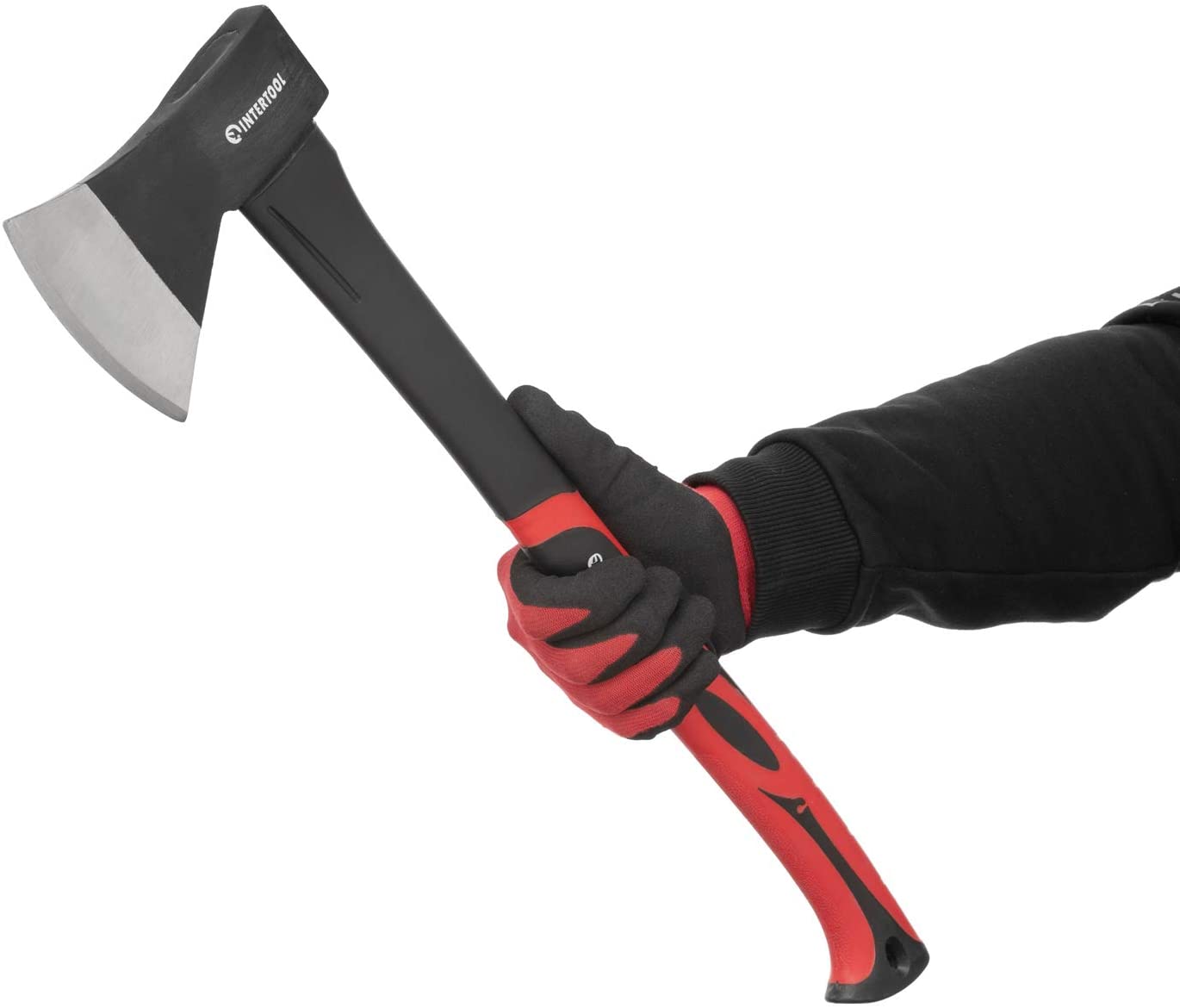
The Boy's Axe

Sometimes it's great to be a boy... or at least, it's great to use their tools.

Recently I was cruising through a hardware store, getting parts for a work project, when I stumbled across a most curious tool. It was a compact axe, and it was so striking that I had to bring it home with me.

Before I say much more about my new axe, allow me to set up the hole that it fills. In my life, I've encountered 3 common axe-type objects: the hatchet, the full-size axe, and the splitting maul. All three are great for certain tasks, but have weaknesses that are very limiting. 
  • Hatchets are light and easy to carry, but their light weight and short handle leave them lacking in actual chopping power.
  • Splitting mauls are the exact opposite, with heavy heads and long handles. They hit like sledgehammers, but packing 6-10 pounds of maul isn't anyone's idea of a good time. They're also useless for tasks like felling trees or cutting downed timber to length. That big head which splits firewood like a dream makes them very difficult to control in anything but a straight downward swing. 
  • The full-size axe is a decent middle ground between the two, but it's still a bit heavy to carry in a pack, and the full-length handle is a bit cumbersome to pack around as well.
Enter the Boy's Axe, so named because it's an axe suited for young men to use. With a 2-2.5 pound head and 24-28 inch handle, it's about half the weight of a standard axe, and about 10 inches shorter. Its compact form factor is still a foot longer than a hatchet, with roughly twice the head weight, which means it hits far harder than the hatchet while being much easier to carry than its full-size brother. The longer handle also allows for (almost demands) 2 handed use, granting even more control and power than the hatchet can muster. 

https://amzn.to/3zrUBss


As with most tools, prices vary from "the cost of a decent meal" to "I'll never financially recover from this." And as with most tools, you get what you pay for (to a point), but buying the most expensive one isn't going to garner much of an advantage. 

If you're buying online, find one that has a substantial number of reviews with a consistently high rating, like the unit linked. If you find one locally, handle it a bit; the handle should be comfortable to hold, with no burrs or snags, and move easily in your hand. The head should have a decent edge, be firmly affixed to the handle, and have some kind of finish on it to minimize rust and corrosion.

If you do pick one up, have fun hitting and splitting.

Lokidude

Tuesday, July 26, 2022

Product Review: Fix It Sticks

I'm a collector of tools. Show me an interesting, unusual, but functional gadget and you have my attention... and possibly my money. 

I'm especially fond of compact hand tools; from Swiss Army knives to pocket multitools, I've owned and carried many. I've been aware of Fix It Sticks and their various offerings for a while, but I'd never had a chance to look at them in person until a recent trip to Nashville when I stopped at a gun shop and saw they had some for sale. 

I looked at the Shooting & Hunting Edition and decided $35 plus tax was a reasonable price for what was offered.

https://amzn.to/3oy5G5Y

According to the Fix It Sticks Website:
The Fix It Sticks Replaceable Edition Shooting/Hunting offers unmatched portability, functionality and versatility. Two Fix It Sticks (which combine to form a T-Handle) and 16 bits are held in a molded bracket for portability / storage. Extra room on each end can hold two additional bits.

Replaceable Set includes two sticks, bracket, and 16 different bits:
  • 2.5mm hex3mm hex
  • 4mm hex
  • 5mm hex
  • T-10
  • T-15
  • T-20
  • T-25
  • T-30
  • 1/8" Hex
  • 5/64" Hex
  • 3/32" Hex
  • 5/32" Hex
  • 3/16" Hex
  • Slotted #5
  • Phillips #1
The ultimate gun maintenance tool. Take the shop tool experience with you on the road.
  • High quality steel construction (can withstand 40Nm of Torque)
  • Compact
  • Durable
  • Accepts any standard 1/4" bit
  • Weight: 116 grams

One of the more interesting features of Fix It Sticks is the ability to combine their parts into a T-handle to drive any bit. This gives the user considerable extra leverage when dealing with overtightened or stuck screws and bolts.

This kit has been added to my range bag for use at work. I'll likely need to swap out or add bits for specific firearm screws, but that's just the nature of the technology.

I have high hopes for this compact and versatile tool and, so far, I consider it money well spent.

(Editrix's note: Fix It Sticks: Shooting & Hunting Edition is available at Amazon for $40 with free shipping for Prime members.)

Sunday, June 26, 2022

The Work Sharp Blade Grinder Attachment

Not actually Erin.
& is used with permission.

In my last post I sang the virtues of the Ken Onion Work Sharp Knife & Tool Sharpener, while at the same time saying that it had its limitations. Those limitations can be broken with the Work Sharp Blade Grinder Attachment

Some of you may say that it's foolish to have to buy an $80 attachment to a $130 tool just to make it work, and you might be right. All I can tell you is that this attachment made me very happy because now I can sharpen pretty much anything with this tool. It works great, and I'm happy with it, so it wasn't a foolish decision for me. Whether or not it's foolish for you is a question only you can answer. 

https://amzn.to/3mHKJ7H


Why do I love it?
  1. If I can lift it, I can sharpen it. I've sharpened axe heads and machetes without breaking a sweat. 
  2. It will sharpen at any angle between 10 degrees and 35 degrees. 
  3. It will even do vertical grinding. 
  4. It comes with 5 belts (extra coarse, coarse, medium, fine, and extra fine) just like the Knife & Tool Sharpener, only these are wider. 
  5. By adjusting the two rollers on top you can select a flatter grind (good for straight blades, like knives) or a convex grind (good for high curve blades, like axe heads). 
This may not sound like much to you, but the upshot of all this is "It does everything I ask of it, and does it easily." There's only one drawback to it -- and to me it's minor, but I understand that it might be a deal-breaker for a lot of people -- is that you have to free-hand the sharpening. 

https://amzn.to/3mHKJ7H


This is why the "blade rest", also called a reference plate in the instructions, is present. Here's how you use it: 
  1. You set the blade on the rest so that you know what position the blade should be in for sharpening. 
  2. You grasp the blade in a stable, two-handed grip. I like to hold it with one hand on the handle and the other pinching the spine near the tip. 
  3. You lift the blade, keeping it steady and maintaining the reference. 
  4. You place the blade against the belts and move from base to tip, backing off the belt when you are done so that you don't round off your knife point. I find it's best to rotate at the waist while doing this so that the blade is kept as stable as possible. 
  5. You smoothly set the blade back down on the blade rest. If it touches down without wobbling, then you know you did it properly. 

https://amzn.to/3mHKJ7H


Yes, this technique requires practice. It will take confidence and a willingness to practice on some beater knives. I was nervous at first, and I did it wrong the first few times. But I got better at it, and now I have the technique solidly memorized in my hands and arms. 

This tool isn't perfect. It's loud, and expensive, and dirty, and terrifyingly vague at first. But if you just give yourself permission to screw up, and you practice steadiness and confidence, you will soon be able to sharpen anything you can lift up to the belts. 

I love this. I wish I'd bought it sooner. 

The Knifegrinder by Goya 


Sunday, June 12, 2022

The Work Sharp Knife & Tool Sharpener

Not actually Erin.
& is used with permission.

Last week I reviewed a sharpener which didn't solve my problems with hard-to-sharpen knives, and promised that this week I'd tell you what I bought which did finally solve those problems.

The answer to that is "a belt grinder"; specifically, the Work Sharp Knife & Tool Sharpener (Ken Onion Edition), which is a belt grinder designed especially for knives. 

I held off buying this for many years, partly because of its price but mainly because of the fact that it is a power tool and if I lose electricity then I cannot use it. For some reason, buying a tool that required electricity to work made me feel like a "bad prepper" and so I held off... until I finally lost my temper with not being able to sharpen things. Spite, as it turns out, is a marvelous motivator. 


https://amzn.to/3MHiy3n

For the record, I specifically recommend the Ken Onion edition ($130) over the standard Work Sharp Knife & Tool Sharpener ($80). I do this for three reasons:
  1. The Ken Onion edition will sharpen in 5 degree increments from 15 to 30 degrees, whereas the standard will only sharpen at 20 and 25 degrees. 
  2. The Ken Onion edition will accept standard belts, whereas the standard will not accept Ken Onion belts (their widths are different).
  3. The Ken Onion edition can sharpen much larger blades, either by rotating the sharpening module forward or by replacing it with another attachment, whereas the standard edition cannot. 


It's my opinion, born out through my experience, that this utility is well worth the additional $50 in price. Once you see how well it works, I'm sure you'll agree. 

And boy howdy does it work. It's fast, it's efficient, and like any belt grinder it can aggressively mess up a blade if you aren't careful. My advice is to practice with a banged-up knife first; it's not like you're going to make it any worse, and you might make it better. After that, work your way up, and soon you'll be sharpening almost any blade to a razor edge and mirror polish. 

https://amzn.to/3MHiy3n


Here's some more advice based on my experience:
  1. Changing the belts isn't difficult but it can be annoying, so if you have multiple knives to sharpen, group them by coarseness. "These are really bad and need extra coarse for re-profiling, these just need medium for sharpening, and I want to hone this one with extra fine."
    • If you do this, only sharpen at one angle setting. Trust me, it's super easy to get wrapped up in this and then midway through realize "Oh dang, that last knife was 25° instead of 20° like the others, and now I've just done them all at 25° with coarse grit."
  2. I highly recommend that you wear hearing protection. While not especially loud on its own, if you're sharpening a lot or working on a really banged-up blade you can end up subjecting your ears to some sustained loud noises, especially if you have the RPMs running high. 
  3. This is a grinder, so it will kick out a fair amount of ground metal in the form of dust. Don't use this in an enclosed area (or if you do, wear a respirator) and be prepared to sweep up a lot of blue-black metal dust. 
  4. Be very careful when sharpening a tanto tip as you can very easily grind that down into a curve if you aren't careful. I would suggest using the Precision Adjust sharpener for those. 
  5. Blades which are both long and curved (such as kukri) or which have very thick bodies (such as axes) don't do well here. For those, I recommend using the Work Sharp Blade Grinder Attachment, which is only compatible with the Ken Onion edition. I will review this attachment next week. 

https://amzn.to/3mHKJ7H


Despite its price and reliance on electricity, I really like this product. It's amazingly aggressive, which as far as I'm concerned is a feature and not a bug, as it solved in a few minutes problems which had bothered me for at least a decade. It took knives which had divots on the cutting edge and made them sharp and shiny (if somewhat slimmer) again. This tool may not be for everyone, but if you absolutely need something sharpened and you have electricity, you can sharpen it. 

The Work Sharp Knife & Tool Sharpener Ken Onion Edition is available at Amazon for $130 with Prime shipping and it comes with one set of belts (extra coarse, coarse, medium, fine, and extra fine). Extra belt kits may be bought for $18 with Prime shipping. 

Friday, April 29, 2022

Is Prepping in the Cards?

I apologize for the lack of content lately. Life has been kicking me from several directions at once, and my free time to write has been one of the casualties. Most of my online activities were the first things cut in order to make time for more important things like sleep and family. I care about my online friends and our readers, but I'd be a poor example if I didn't take care of myself and my family first.

I've been playing around with a set of "survival" cards for a few days. These are thin steel cards with various useful tools punched or cut into them. Amazon has several different sets, so I bought a few to test out. 

Here are my thoughts and observations on these cards in general:
  • They're all made of thin 304 stainless (aka 18-8 stainless), which is a medium-grade steel. This means that the steel will bend and hold its new shape rather than try to spring back. Commonly used to make dinnerware and corrosion-resistant tools, 304 stainless will rust and pit eventually.
  • These are either precision stamped or laser cut, so don't expect sharp edges on any of the knives. The hooks and arrowheads will be sharp enough to do the job, but the knife edges will be flat. 
  • The knives are small and the metal is thin. Best suited for skinning game or cutting up wild fruits, they'll get the job done but it will take longer than a good camp knife. 
  • In fact, everything is small. Viewed on a normal monitor, most of the pictures below are close to half size. These cards are sized to fit in a pocket or wallet, so they're only about 3 inches wide and 4 inches long.
  • All of the sets have the same problem; how do you store the tools once you've taken them off of the card? Two sets come with a felt "wallet" with a single snap closure, but I don't see how they'd hold the tiny tools through any rough terrain. Finding fish hooks loose in the bottom of a pack is not a good time, and it usually happens in the dark. 304 stainless is only slightly magnetic, and I did find one version that shipped with a flat magnetic card to hold the pieces.

This is a single card with 30 different tools for $14. It's not the cheapest set per piece, but it has a good selection of tools. The saw and knife are more substantial than most of the others, making them easier to work with. This kit came in a gift box with a thin flexible magnetic sheet; toss the carboard box and use the magnet to hold the pieces after you've removed them from the frame.


https://amzn.to/3OKWQxG


Buspoll 22 in 1 Card

This is a set of three identical cards, perfect for testing with one and storing the other two in a bag or pack. This cost $14 for the set of three cards, so about $4.67 per card. It has basic tools for fishing and trapping, but no knife. What they call a harpoon, we call a "gig"; gigging frogs and snakes for food is similar to fishing, and the tools will work for fish as well. 


https://amzn.to/375d6J2


4 Piece Survival Tool

This has four different cards with a good mix of pieces. The set costs $9.19, and it comes with a cheap felt carrying case. The fork is a nice addition, and the variety of saws is going to require some testing to see how well they work. 

https://amzn.to/3Kts74W


The Big Collection

This set has six different cards, 124 different tools, and a coil of fishing line with a plastic "reel" to store it on. 

With a total of 60 fish hooks, 3 knives, 8 saws, 16 sewing needles, and a bunch of other toys, this set will keep you supplied for longer than the other sets. The cost was $14, the same as some of the smaller sets.


https://amzn.to/3EYcbGM


I may try some of the fish hooks this summer to see how well they hold up; my normal hooks are made of better steel, and I'm afraid these might bend too easily. More testing is always a good thing.

I'd place all of these tools in the "Gilligan's Island" category of preps: there are better alternatives to all of the tools on these cards, but what these offer is better than trying to make your own out of rocks and twigs. 

The Fine Print


This work is licensed under a Creative Commons Attribution- Noncommercial- No Derivative Works 3.0 License.

Creative Commons License


Erin Palette is a participant in the Amazon Services LLC Associates Program, an affiliate advertising program designed to provide a means for sites to earn advertising fees by advertising and linking to amazon.com.