
Showing posts with label Hurricanes. Show all posts

Saturday, October 12, 2024

Post-Hurricane Milton Report

Not actually Erin.
Used with permission.
Much like George Groot and his family after Helene, my family and I are fine after Hurricane Milton hit Florida on Wednesday. Between Milton rapidly losing strength due to eyewall collapse after making landfill, 160 miles of land between landfall and where I live, and the storm passing well below us we were blessed with minimal damage and inconvenience. Sadly, other parts of Florida weren't so lucky, especially the Tampa Bay area which was still reeling from being flooded by Hurricane Helene a week prior. 

So far as I can tell, no damage was dealt to our house, although we have a lot of downed and damaged trees. 


This is the same tree as in the previous picture, just from a different angle. 

I don't know if this is from the same tree as the above picture or a different one,
but that's the same fence corner. 


That last picture completely justified me putting up the hurricane shutters Tuesday afternoon. I just know that if I hadn't done so, that tree would have broken one or both sets of bedroom windows. 


I live eight miles from the ocean, so storm surge isn't a concern for me. However, between a system known as a "tropical rainmaker" which dumped a lot of water on us last weekend and Milton coming through three days later, my neighborhood almost flooded. The following picture is of an artificial lake and canal for drainage. 
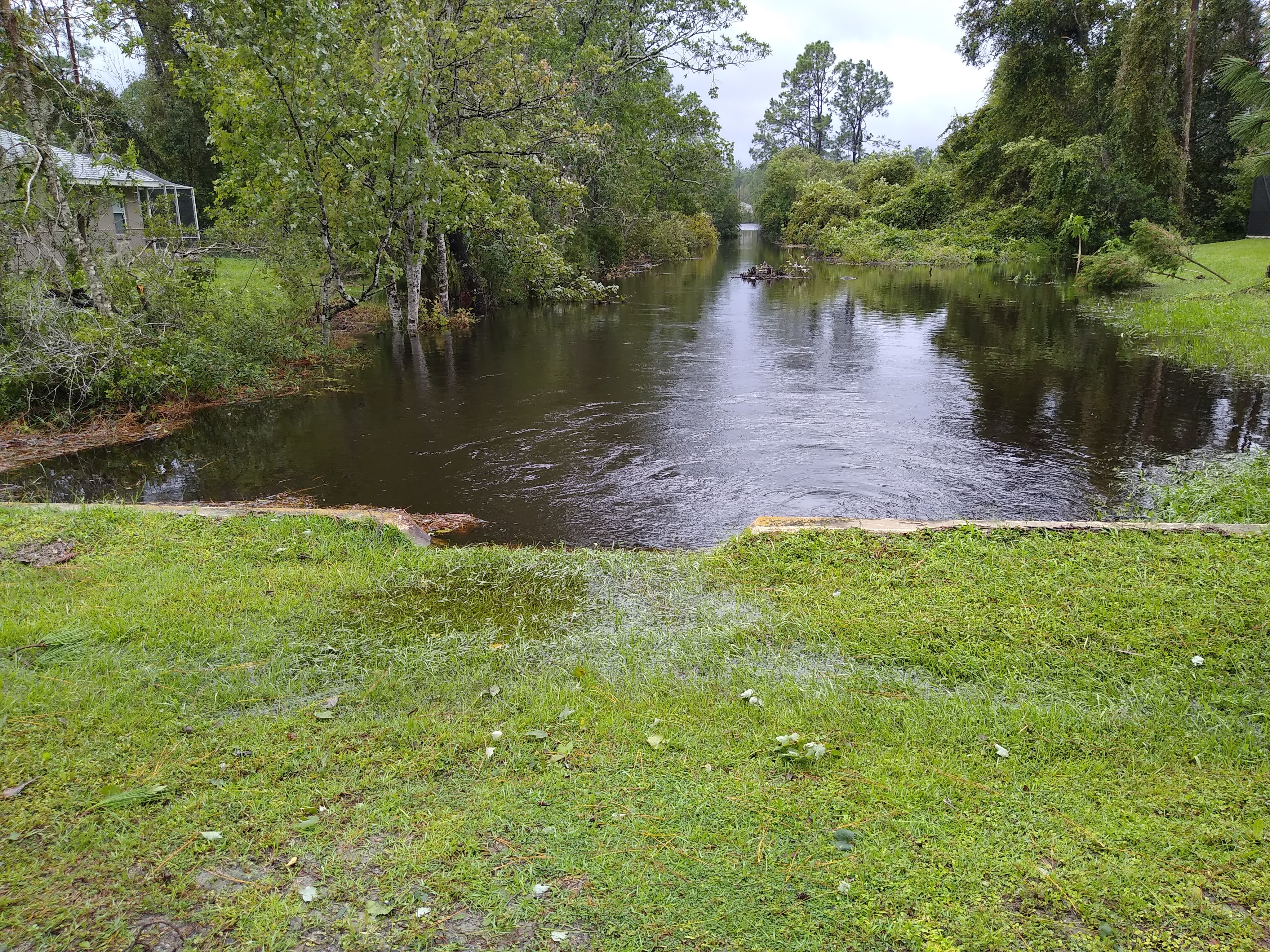

The water is supposed to be three to five feet below the concrete embankment, but it's very nearly at the top. I don't know how much water that is other than "a lot". 

Other than that, my experience was similar to what I had two years ago during Hurricane Ian, with the following changes:
  1. Because Milton happened later in the year, it wasn't quite so hot while we waited for power to be restored. 
  2. We had power back by 4:30 pm on Thursday, for an outage of about 16 hours. This was incredibly fast; post-Ian, it took about 30 hours for us to get power. I don't know what the difference was, but everyone appreciated it. 
  3. My CPAP battery backup worked extremely well. Admittedly, I had only one night without power, but for 8 hours I had my CPAP and humidifier running without an issue. 
  4. Thursday morning was too cloudy and rainy to set up solar panels, but I'm certain I could have made it another night, possibly two, before my Freeman 600 needed a recharge. 
This isn't a change from last year, but both my BioLite CampStove and my Koonie battery-powered fan did a lot of heavy lifting to make my life more comfortable. 

Once again, I am blessed that the extent of Hurricane Milton's effect on me and my family was only inconvenience and minor discomfort. Others weren't so lucky. If you'd like to make a charitable donation, I recommend the Florida Disaster Fund, which is is the State of Florida’s official private fund established to assist Florida’s communities as they respond to and recover during times of emergency or disaster. 


In partnership with the public sector, private sector and other non-governmental organizations, the Florida Disaster Fund supports response and recovery activities by distributing funds to service organizations that serve individuals within their communities with disaster response and recovery.

Donations to the Florida Disaster Fund are made to the Volunteer Florida Foundation, a 501(c)(3) charitable organization (EIN# 01-0973168), and are tax deductible. Funds given at this time will be utilized for Hurricanes Helene and/or Milton.

Visa, MasterCard, American Express and Paypal/Braintree have committed to waiving fees for those making a donation for Hurricanes Helene/Milton recovery. 100% of every donation will be used to help Floridians recover.

Monday, October 7, 2024

Hurricane Helene After Action Review

When Hurricane Helene hit the Central Savannah River Area (CSRA) on the Georgia/South Carolina border, it retained Hurricane Category 1 wind speeds. The destruction was widespread, and many disaster preparedness plans were put into effect. This is what we learned.

Water
  • You really can’t have enough water on hand for a situation like this. Being able to restock on potable water, or boil to make safe municipal water, is essential. If you run out of water all your other preps start to matter less and less. 
  • We also keep a lot of “hydration salts” products on hand, as we do a lot of outdoor activities with our children's Trail Life troop, so we were well prepped to stay hydrated. 
  • I would say a minimum is a 36 pack of 0.5 liter bottles per person per four days of use, at least in our heat conditions, but do your own math for your own situation.
Gas
  • You’ll need a lot, and in two types: unleaded gas for vehicles and generators, and 2-cycle gas for chainsaws and pole trimmers. There's a lot of wood cutting that has to be done immediately after a storm passes in order to open roads. 
  • When we needed to refill gas cans, we emptied the ones on hand into my pickup and headed east to Columbia, SC. It took 60 miles to get to a gas station without a waiting line, two miles off the I-20. 
  • The 2-cycle gas needs to be ethanol free, or it can eat the plastic/rubber fuel lines in all the “made in China” 2-cycle engines that power tools these days. I just pay the premium to pick up a 1 or 3 liter bottle from Home Depot or Lowes when shopping. 
  • Have funnels, because modern gas cans suck (never forgive the EPA for what they did to the gas can) and you may need a funnel to properly fuel a machine without spilling too much.
Tools
  • The most commonly needed tool was a chainsaw, the second a pole saw. Get the kind that uses gasoline, as there is more work to be done than electrics will be able to handle.
  • Have extra blades, bars, and bar oil to keep them running. 
  • One friend of mine used a lot of bow saw and teenage boy labor to clear branches, but the chainsaw is going to be faster. 
  • Pro tip: you need to know more than just the chain length, as different brands will have slightly different link sizes, so know what you need in case you have to have someone else do your shopping.
Cooking
  • We cooked on a single burner propane stove, a cinder block “rocket stove”, and a campfire. Of the three, the rocket stove and propane burner got used the most. The propane burner was fastest to boiling water for coffee or soup, and the rocket stove was best for big family meals (but it does take a little longer to get going). 
  • We tried to use a Coleman white gas stove, but the pump system froze up and needs to be replaced, which is probably a project for this winter. 
  • If I had to recommend any one system, it would be the single propane camp burner and a two pack of 1 lb propane bottles. It's light, cheap, and doesn’t go bad like a white gas stove can. 

    Ozark Trail Single Burner Backpacking Propane Stove 

  • If you have room on your shelter location to set up a cinder block rocket stove, absolutely do that as well. To speed up the rocket stove starting time, I used my plumber's torch to get the central chamber area hot enough really fast, which is cheating but uses way less propane than just cooking with propane.
Medicine
  • All four of us in my family got the flu. Thankfully, this was early October not mid-August, and temperatures didn’t hit into the 90s except for a few brief bits on some afternoons. But having influenza in the south with no air conditioning is a miserable experience. 
  • We didn't need to hit up a pharmacy as we had NSAIDs to bring down fevers, and expectorants to help clear lungs. A prepper’s medicine cabinet ought to be able to keep a family of four through a 7 day disruption of electricity and potable water.
  • Those hydration salts really helped me get through the worst of the “man flu” that laid me out for most of a week.
Luxuries
  • Generators and portable air conditioning units aren't a necessity to survive, but they do make “sheltering in place” more comfortable. 
  • We didn’t use either, but we plan to get a Jackery and solar charging system for camping gear anyways, and that would have made this little “free Amish lifestyle experience” a little less spartan, and it would have allowed us to run our chest freezer enough to keep frozen proteins frozen.
  • As it was, we lost maybe a few hundred dollars in groceries that could have been prevented with a small solar generator system.
Tribe
  • We know our neighbors, they know us. When we would make the 120 mile round trip supply run to anywhere open, we made sure we had their needs and wants list. 
  • When we were eating out our thawed chest freezer we came across a turkey breast, really too big for us as a family of 4, so we let our neighbor deep fry it and they made mashed potatoes and mac & cheese; we added green beans to make a little Thanksgiving meal a tad early.
  • Build your tribe before there is a problem, because the worst place to meet for the first time is disaster response. 
Cell Phones
  • The cellular network stayed up, but bandwidth was very clogged, dropping me from 5g down to LTE on multiple occasions as cable internet (the majority of home broadband in our area) was cut just as much as the electricity. 
  • Group texts became the normal way for people to organize support for people in need, and it worked out pretty well. 
  • Internet came back up in our neighborhood two days after electricity.
Final Thoughts
  • We were incredibly blessed to be in the 50% of customers in our area who got electricity back after seven days. Other than not having a portable power solution to extend the useful food storage period of our chest freezer, we were pretty happy with the skills and resources we’ve built up as a family. We didn’t even have to open up any of our freeze-dried food stores, as our home survived the winds. 
  • For those who lost their home to the storm, they may have had a different experience, and my wife and I discussed creating “prep boxes” that could be sealed long term and placed in a shed just in case we needed to direct a neighbor to resources if we weren't there to help with disaster response. 
  • Resources can be shared, or can be destroyed in the disaster, but skills are something you keep with you. If you are new to prepping and have to choose between "stocking resources" and "building resilience skills" I'd recommend the skills building option.

Wednesday, October 12, 2022

Post-Hurricane Ian Report

Not actually Erin.
& is used with permission.
So it's been a week-plus since Ian hit and things are pretty much back to normal here. This was the first hurricane I've bunkered down for and I found it an excellent learning experience. Before I share with you what I've learned, though, I first need to say something: 

I don't care what the news says, that was a Category 1 hurricane and NOT a tropical storm that hit us. I base this assertion on two factors:
  1. I have lived in Florida since the late 1980s and I've experienced plenty of tropical storms. I have never seen a tropical storm knock out power across entire counties that took days to restore, nor have I seen it knock down trees. Tree limbs, yes; entire trees, no. But I have seen the after-effects of Cat 1 hurricanes which have done exactly that. 
  2. When Ian hit Florida it missed being a Cat 5 by only two miles per hour of windspeed, and it was a Cat 3 (likely a high Cat 3, too) when it made its way to central Florida. I don't know if I have the vocabulary to tell you just how impressively strong that is; most hurricanes rapidly lose strength when they come ashore, but this beast was a Cat 3 at the halfway point. Further, when it finished crossing the peninsula and hit the Atlantic, it didn't take Ian long to be classified as a Cat 1 hurricane, which is also very rare and impressive. 
So I don't care what the media says, Ian was a Cat 1 when it came through my part of Florida. Fortunately, we only had some knocked-down trees and a power loss of about 30 hours; no one in our neighborhood suffered any damage except for losing some roof tiles (which, again, hurricanes do, but not tropical storms).

With that said, I'm going to review what I learned from this experience. 

I get bored very easily without power, especially if I'm also hot. When I don't have air conditioning I basically turn into a sloth, keeping my activity to a minimum in order to stay as cool as possible. Without power, that means either reading or using battery powered electronics to entertain me. Fortunately for me I have all sorts of battery banks for electronics and spare AA and AAA batteries, both rechargeable and alkaline, so this was never a concern for me. 

My back yard gets a lot of good light, suitable for solar panels, from at least 9 am to 5 pm. I was worried that I might have to recharge in the side yard, or worse in the driveway, but no, my secured back yard can handle that. I did have to move the panels a bit over the course of those 8 hours, but it was only a few feet rather than hauling them across the yard. On a related note, I also learned that if you have a lot of devices with panels (such as the ones mentioned in this blog post), set up a card table and put the panels on it. That way, when you need to re-position, you can just move the entire table at once rather than moving each piece individually. 


https://amzn.to/3VkPwMt

The 'candle' function of my Maglite Minis, which I first thought was laughable, proved to be surprisingly useful. We had plenty of light in the form of lanterns and headlamps, and we used those, but these flashlights were the surprise MVPs in terms of sheer convenience. Headlamps are great for reading and working, but it's annoyingly easy to flash someone else's eyes while using them. Lanterns waste a lot of light by throwing it everywhere; rather than  illuminating an entire room, they instead only lit up a five-foot radius around the lantern sufficiently to read or do tasks. Everything past that was at the level of "We can see where things are, but really need more light for tasks requiring perception and/or fine motor skills, like preparing meals." The Maglite Minis occupied a sweet spot for us: small enough to be easily portable or stowed in pockets, throwing a bright enough spot far enough for most tasks, and easily converted into a mini lantern (i.e. 'candle mode') to light up what we need to see without blinding us. As a bonus, the fact that they use two AA batteries meant that we didn't have to worry about running out any time soon. 

The BioLite CampStove proved its worth. As I mentioned in a previous post, the BioLite isn't a great survival stove but it works like a champ with wood pellets. Instead of firing up the barbecue grill to heat our meals -- which would have taken time to build the fire, making us hotter while we tended to it and leaving us smelling of smoke -- I just lit some wood pellets inside the BioLite and we were ready to eat within five minutes. As a bonus, I was able to recharge my phone as I heated our meal. This was useful as my phone was the only way to stay in touch with loved ones, keep tabs on the storm, and check to see where we were in the repair queue.


https://amzn.to/3rMIUcm

I had a secret weapon: a 10,000 mAh battery-powered fan. Just having air blowing over my face makes me more comfortable, even if the rest of me is hot, and this really helped me relax enough to fall asleep. Its Amazon page claims it has enough internal power to run for 6 hours on high, 12 hours on medium, and 24 hours on low. I didn't test those claims because I hooked it up to one those aforementioned battery banks, and it ran for 9 hours on medium without any problems. 

I need a battery solution for my CPAP. Now that I've become used to sleeping with something strapped to my face shooting pressurized air into my lungs, going to bed without it feels awkward and difficult, like I'm trying to perform a complex task without the right tools. Most CPAP batteries are only good for one night, maybe more if I don't use the humidifier which heats a plate to evaporate water inside a reservoir. I think the best solution for me is to get an electricity usage monitor plug to determine how many watts I'm drawing, then find a "solar generator" -- essentially a large power bank with the ability to deliver 12V output and a corresponding solar panel for it -- in the biggest size I can afford. That will give me at least one night of CPAP, possibly more, and the ability to recharge the bank during the day. This will be expensive ("new gun" expensive, if that means anything to you), so I will be doing a lot of research on this before buying anything. 


I am extremely fortunate that the extent of Hurricane Ian's effect on me and my family was inconvenience and minor discomfort. Others weren't so lucky, so if you'd like to make a charitable donation I recommend the Florida Disaster Fund


Friday, September 6, 2019

Hurricane Dorian AAR*

Not actually Erin.
& is used with permission.
(*After Action Report)

As you probably know by now, Hurricane Dorian skipped Florida entirely. This was good news for me, as I made the decision not to evacuate based on its projected route -- I figured that, at worst, we'd get a glancing strike from a Category 1 which all houses in Florida are built to withstand -- and I'd have felt pretty dumb if it had changed course and/or intensity and hit us harder.

Still, I learned a lot from my first ever Hurricane Bug-In, even if nothing happened, because the mere act of readying my preps pointed out two things that they lacked.

A Wingnut Driver
I talked about hurricane shutters last week, and my house has the metal kind which attach via bolt and wingnut. "Fast installation" is a bit of a relative term, as it took me two hours to cover up 6 windows. Something that would have sped that up some is a wingnut driver for a drill; I had previously been using my hands to finger-tighten them, then using pliers to torque it down. A drill would not only screw the shutters down faster, but also more securely.

https://amzn.to/2UymnyB

I have since bought one at the local hardware store for around $10 (you can order one from Amazon for $11 plus Prime shipping)  and that will definitely make taking the shutters down much faster and easier. As an added bonus, if I ever need to drive in some eyebolts this will do that, too.


An Off-Grid Way to Recharge Batteries
As I was was topping off my rechargeable AA and AA batteries, I realized that I lacked a way to recharge them if the power stayed off for any amount of time. Fortunately for me, my friend the General Purpose Egghead (listen to his segments on the Assorted Calibers Podcast for good advice on batteries, flashlights and HAM radio!) sent me a "hurricane care package" which included a Goal Zero Guide 10 Plus battery charger!

https://amzn.to/2PSxGTC


The Guide 10 can charge both AA and AAA batteries via a mini-USB port. This gives me a variety of ways to charge them:
  • With a Nomad 7 solar panel (I bought an older model years ago on closeout prices)
  • With a hand crank, such as with the Lighthouse 400 lantern (bought on clearance at the same time)
  • With a conventional power outlet

What's more, the Guide 10 acts as a power bank, meaning that I can plug a USB cable into it and use the batteries* to power anything which takes a USB charger, like a cell phone or mp3 player. This gives me a great amount of versatility when it comes to charging what I need in a grid-down situation. Thanks Egghead!

* It can even technically do that with alkaline batteries, although that's discouraged since the higher voltages of the alkaline might damage the charger. 


There's a saying in the military that "No plan survives contact with the enemy." I'd say there's a corollary with prepping, in that "No preps are 100% ready for an emergency." A near-miss by a hurricane showed me some flaws, and I'm pleased to have discovered them now instead of when it was too late to do anything about them. Review your preps regularly to discover things you've overlooked!


Monday, September 2, 2019

Hurricane Bug Out: A Short List


Hurricane season is in full swing. Sometimes you just have to evacuate, so here’s a short list of gear and advice for those who are bugging out.


Godspeed to you all. 

Friday, August 30, 2019

Hurricane Shutters

Not actually Erin.
& is used with permission.
Florida has yet another hurricane bearing down on it, so now is the time for all smart Floridians to begin implementing their hurricane preps. (No, not "go shopping". Smart Floridians stock up in June or July because we know that there'll be a rush on stores and shelves depleted when it looks like there will be landfall.)

For me, that means looking at the weather forecast and deciding when I want to put up the hurricane shutters. I don't want to put them up too soon, because honestly they're a pain in the butt to do and it's hot, sweaty, get-eaten-by-bugs and get-scratched-by-thorns work, so if I put them up when I didn't have to, I'll be annoyed. There's also enough work involved with them that once they go up they stay up until the end of the season (which is officially the end of November but is effectively the end of September).

On the other hand, if I want too long, then I end up putting them up in the wind and the rain, which is also pretty miserable and also increases the chances for injury.

Let's talk about the three major types of storm shutters.

Plywood

Image found across the internet

If you live in a coastal area frequently assaulted by hurricanes, don't use these. Yes, they're cheap, but quality and durability is suspect because plywood isn't milled, but rather manufactured from cheap wooden wafers pressed and glued together.  Plus, in order to install them you have to drill holes into your house, which looks ugly and if left untreated allow ways for termites and other vermin to get inside and damage the structure of your house. If you do this be sure to secure the sheets as tightly as you can, because they have a nasty tendency to get sheared off and go flying.

Please, for the love of all that's good and holy, don't use particle board. Just don't.

https://apps.floridadisaster.org/hrg/content/openings/diy_shutters.asp

Metal
https://youtu.be/2wkrr685enM

These are the kind of shutters that I have. They are metal (either steel or aluminum) and lock into metal fixtures with metal bolts and wignuts. So long as the fixtures are properly installed (you can find DIY instructions here, although there are companies who will install them for you quickly and professionally), you have a strong barrier that will protect your windows from storm debris.

Those are the good points. The bad points are:
  • They are expensive;
  • The edges are sharp and can result in injury if you are not wearing protective clothing; 
  • They are tiring to carry (each sheet is lightweight, but it can take between 4 and 7 sheets per window; multiplied by however many windows you have and whether or not you need to haul them up a ladder for second-story windows, they get exhausting quickly);
  • Over time, the brackets collect rust and debris and need cleaning, which delay installation;
  • Once installed they block out sunlight; 
  • Once installed, they make it impossible to escape through the window in case of emergency. 
They are very much a two-edged sword whose benefits only slightly outweigh their drawbacks. 

Motorized


This is the Cadillac of storm shutters: a miniature garage door that rolls down over doors and windows. They are the most expensive of all the options, and most of them require electricity to operate. However, some of them can be raised manually with a crank (demonstrated in the video below), and they can be wired to accept power from a backup battery as well... and honestly, if you're going to this expense, you might as well shell out for the battery too. 


Despite these significant drawbacks, the benefits are massive:
  • Your house is protected with the push of a button;
  • You can wait until the last minute to activate them;
  • You can use them against other disasters, such as tornadoes;
  • You can put them down before a vacation to protect against burglary (admittedly, at the risk of advertising you're out of town);
  • Some units can be hooked into a home wifi unit to engage them remotely if a severe storm strikes while you're at work. 
If you can afford this option, I recommend it. 

Other Options
There are other options which are less common and might not be available where you live, such as Bahama shades, Colonial shutters, and polycarbonate windows. I don't have experience with them but they may be worth investigating. 


Regardless of which option you choose, please protect your windows from hurricane damage by putting up your shutters. 

Tuesday, September 26, 2017

Guest Post: Why Live In Florida Where There Are Hurricanes?

by Miguel Gonzales


Miguel is a resident of Miami, Florida and has lived there for 20 years. He is also a contributor to the GunBlog VarietyCast and his blog, Gun Free Zone, can be found here


Erin has been asked these questions by her readers:
"Why would anyone live in Florida where there are hurricanes? Why not just live somewhere that these storms don't exist?"
Rather than answer them herself, she decided to go straight to the horse's mouth: me.

Let’s start with why I moved to Miami in the first place, and the answer (believe it or not) is prepping. When I decided to leave Venezuela, Hugo Chavez was not yet the president or even an official candidate, but I could read the writing on the wall. The missus and I made the decision to leave, and I figured that sooner or later I would have to bring my parents to the US as well. Miami was the logical choice because of its cultural diversity and affinity: 
  • Spanish spoken there
  • Similar foods
  • Nationalities we were familiar with (Venezuela used to be a great hub for refugees escaping from South American countries under dictatorships.) 
So the cultural shock to my parents would have been minimal. Dad unfortunately left us too soon, but I did finally manage to convince mom to leave Venezuela and come live with us.

"But Miami! All those Hurricanes! OMG DEATH!" Okay people, calm down and let me explain. It is not that awful, because hurricanes are polite. I repeat: Hurricanes are polite.

Why do I say that? Because in true Southern fashion, hurricanes give you plenty of warning they are fixing to mess you up. That means you get to prepare and get your stuff together before impact. Do you get that with an earthquake? Nope. Floods? Nope. Tornadoes? Nope nope. Maybe massive wildfires can give you some warning, but if the wind changes, you are screwed.

Just to be clear: with the exception of a massive wildfire, I HAVE BEEN THROUGH ALL THAT CRAP. 
  • Earthquake? Pass. It is freaky to see concrete slabs moving like jello and buildings collapsing. 
  • Floods? I almost lost my life in one when I was a toddler. I still remember the waters rushing inside the house. That was not fun. 
  • Tornadoes? Do you know how freaky is for somebody who just moved from the tropics to see the sky suddenly turn purple, feel the temperature drop 30 degrees and have hail peppering their head? Not fun! I almost left tracks in my tighty whities. 
So, if you give me a choice of natural disasters, I will pick hurricanes every single time. Hurricanes seem to come in 10 year or so cycles. Prior to last year, the last hurricane to hit is was Wilma in 2005. Can you say you had a disaster-free decade in your area? It is going to be very rare, right? I have basically spent close to half my living time in Miami only worrying about the air conditioner dying in the summer.

South Florida learned a lot after Hurricane Andrew. Building codes have been reinforced and improved,  and we have a great canal system to keep the water from flooding too much and for too long (which is a feat in an area where the highest natural peak is six feet tall). 

Many new people in the area realize things are about to get heavy when they hear their mayor or the governor say "Be advised, you will need to be on your own from three days to two weeks depending on the damage. Do not expect us to come rescue you, especially when the hurricane is blowing." It is a moment of epiphany for a lot of them, and then the panic ensues... which can be funny to us old hurricane hands. Nothing says "newbie" like buying forty packs of hot dogs that will not survive without refrigeration.

Most of the victims that you will see in the news are either idiots who refuse to take minimal precautions, newly moved carpetbaggers from the NY/NJ area (OK, just kidding there… sort of), and the professional victims who think that government is supposed to either switch the hurricane off or give them shelter, a new car and a pony because they demand it. 


After the hurricane passes, the government is not going to do squat until they figure out what happened, who is the hardest hit, and who requires immediate attention. It is called triage, and you better face that dancing song early and learn to love it.

South Floridians know that if we lose power, we aren't getting power back for a while unless we live next door to a hospital. The same goes for locations with above-ground wiring, since it is subject to the impact of pieces of the abundant greenery we are so fond of down here. I live about a mile from an electrical substation, our area has all-underground wiring, and we didn't get our power back for 36 hours after we lost it. In the meantime, we checked on our neighbors to make sure they were fine, cleaned up debris, and opened roads so traffic could flow. Some grocery stores and gas stations were running on a limited basis via portable or fixed generators, and those of us with our own generators managed to keep the fridges and freezers cold and did a lot of grilling!

What I am trying to say in a long-winded manner is that both government and citizens have a basic understanding of how to prepare for the hurricanes that are going to hit us. These preparations will not help everybody, but the load of victims will be greatly reduced. 
  • Preparation means fewer calls to 911 because there are no collapsed homes with people inside or trapped in the attic because of flood waters. 
  • Preparation means no need to wait for the county crews to come chop down tress fallen across the road, because at least three neighbors will have chainsaws for the thick stuff and everybody has machetes for the smaller stuff (this is Miami after all, we love our machetes). 
  • Preparation means no people starving to death after the second day because most bought at least some tuna and crackers to last a week. 
  • Preparation means people getting hydrated because they followed the simple rule of having one gallon a day per person for at least a week. 
  • Preparation means power companies with local and out of state linemen on staging areas ready to rebuild the grid. 
  • Preparation means all emergency service personnel ready to take care of the injured, even when it means being away from their loved ones. 
  • Preparation means carefully driving out after the storm and checking out what is open and working, so that your neighbors do not have to run around to determine what pharmacies are open or where the ice bags are being passed out. 
  • Preparation means babysitting the neighborhood kids while the parents take a well-deserved nap. 
  • Preparation means all this and much more. We have done it in the past and will do it in the future with improvements.
How effective have all these preps been? The number of deaths in Florida because of hurricanes is small, even minuscule; you get more people killed by gunshots in an average week in Chicago. The victims tend to be people that made a wrong turn and ended up drowning in a canal, or stepped on an electrified cable or puddle. I think there was one man who died when he was trying to move his car a day after a hurricane and a branch of a tree broke and hit him in the head.

I cannot end this post without mentioning guns. Other than some idiots targeting shoe stores, Miami-Dade County was almost free of looters. There might have been a couple of minor things stolen from civilians, but the total collapse like you saw during Katrina didn't happen here. The bad guys realized long ago that neighborhoods become armed encampments, and they do not take kindly to strangers or looters. Again, this means less load on county & state services that can be properly routed to those in real need.

One last thing. Turn off the Weather Channel and the News on TV. They are in the business to sell commercial time and they don’t get to raise rates by being moderate in their presentation.

In conclusion: while hurricanes are amazingly powerful and Irma scared the bejesus out of me, I have a better chance to survive them down here where there is a culture and infrastructure prepared for it.

Sunday, September 24, 2017

GunBlog VarietyCast #162 - South Florida Knows How To Hurricane

That's "be prepared for a hurricane" and not "make a rum cocktail."
  • Have you ever attended a Friends of the NRA Banquet? Are you curious about what it’s like? Beth shares her experience so you can decide if it’s something you’d like to do.
  • A man is accused of robbing three Charlotte businesses, but Sean finds out that his conviction record isn't the worst part of the story.
  • Barron is on assignment and will return soon.
  • In any situation you’ll get groups of people who have different skills and levels of preparedness. How prepared was Coral Gables, Florida for the long term loss of electricity? They apparently had their lawyers on speed dial. Miguel tells you what he thinks.
  • Our Main Topic is "Dry Fire Practice: Is It Boring?"
  • Tiffany finishes her three-part segment on the NRA Carry Guard Expo by talking about the good things she encountered within the Expo itself, especially the programs made for “the laaadieeeez.”
  • Back from her Evacu-cation, Erin has some tips and tricks for you to make your evacuation plans easier.
  • Now that the Brady Campaign’s Dan Gross  has been fired, Weer’d bids a farewell to Dan in the best way he knows how.
  • And our Plug of the Week is for the Pocket Pro II shot timer.
Thank you for downloading, listening, and subscribing. You are subscribed, right? We are available on iTunes, Stitcher Radio, and Google Play Music!

Listen to the podcast here.
Read the show notes here.

Thanks to LuckyGunner and Remington for their sponsorship, and a special thanks to Firearms Policy Coalition for their support.

Blue Collar Prepping Transcript -
 Evacuation Tips and Tricks
This was the second year in a row that I evacuated for a hurricane, and I’d like to think that I’m pretty good at it. So let me share with you some tips and tricks that I’ve learned. 

1) Know the order in which you want to load your stuff
For me, this is pretty simple:
  1. First I load my bug-out bag. Even if I can’t load anything else, that and the Get-Home bag I already have in my car will enable me to be a pretty comfortable refugee for several days. 
  2. The next thing I load are my guns and just enough ammo for them to fit inside their cases. Now, most people are wondering why I don’t load clothes next, and there’s are multiple reasons for that:
    • Clothes are cheap and easily replaced, while guns are expensive and a pain in the butt to replace. Besides, I already have changes of clothes in my bug out and get home bags. 
    • I don’t want my guns to fall into the wrong hands if looters get to my house before I can return. As a gun owner, I feel that I have an ethical duty to make sure my firearms aren’t used by criminals. 
    • In a worst-case scenario, I can trade a gun for something necessary, like food or shelter or transportation, because guns have intrinsic value. Clothes, not so much. 
  3. Then I add whatever gear isn’t in my bug-out bag but which would be useful for an extended absence (like camping supplies) or for sorting through wreckage, (like tools or protective clothing). 
  4. Next up are whatever portable electronic devices I can fit into a backpack, like my tablet computer and podcasting gear, along with recharging cables and docking stations. If I have the time, I’ll remove the hard drive from my desktop and put them into a protective waterproof box, like a Pelican Case.
  5. All of these have been items which are expensive and difficult to replace, going in order form “most useful” to “least useful”. If you’re making a list of your own, this is where you should put valuable luxuries like expensive jewelry, or irreplaceable sentimental items like heirlooms. 
  6. Then, and ONLY then, do I pack extra clothing. This is where your “nice to haves” go - things which would be nice to have with you but can be be replaced easily. 
  7. The last thing to go into my car are snacks and drinks. 
2) Have duplicates of your toiletries
I don’t know about the rest of you, but having a repeatable, reliable bathroom routine goes a long way towards making me feel normal and comfortable.

I recommend against packing up your toiletries as part of the evacuation process, because this will slow you down and you will probably forget things, like your favorite loofah sponge in the shower.

Instead, build an “overnight bag” complete with duplicates of all the things you use when showering, brushing your teeth, etc, and then grab that bag along with others in step one. That’s one less step to worry about and one more thing on your list that’s already packed.

What’s more, you can use this for things other than evacuations. If you’re going on vacation, or need to take a business trip, you can grab your overnight bag instead of having to pack, then un-pack, then re-pack your toiletries for another trip.

3) Have wonderful friends
Both times that I’ve evacuated, I have been blessed to have really great people volunteer their homes for me to stay in.

This hospitality is amazing, because not only does it save me the cost of a hotel room, but it also means I get to meet great people in real life and enjoy their company.

I’ve said this before, and I will say it again: if you’re a prepper, you can’t do it alone. You need people to help you out. Friends, extended family, other preppers in your group - all of these people constitute your Tribe, and you should cultivate those relationships. Go out of your way to help people, and they’ll be more willing to go out of their way to help you when you need it. 

Sunday, September 17, 2017

GunBlog VarietyCast #161 - We Are But Mad North-North-West


Erin's neighborhood was supposed to get its power restored this weekend. Now it's been pushed back until Tuesday next week.
  • Beth says it's always the right time to talk to children about firearms, and the new book "Safety On" by Yehuda Remer can help you with that.
  • A second suspect has been identified in a NW Charlotte homicide, and good news! He's not quite as awful as the suspect they have already charged!
  • Barron is on assignment and will return soon.
  • To be, or not to be: that is the question. Or perhaps the question is "to stay, or not to stay." And when the hurricane blows southerly, Miguel knows a hawk from a handsaw.
  • Our Main Topic is the new Wall Street Journal/NBC News poll showing that more Americans than ever have a gun in their homes.
  • Tiffany covers a few of the Every Day Carry travel considerations that aren't usually discussed in the average concealed carry permit class.
  • Erin left the hurricane behind. But she has preps in place, so why evacuate? She shares her thoughts on avoiding troubles as a valid prepping strategy.
  • The Joyce Foundation Shell Group, States United, has cooked up a “Video Game” to oppose concealed carry Reciprocity, and gets the reaction from alleged Real People™. Weer'd has the audio.
  • And our Plug of the Week is for the Eddie Eagle GunSafe Program.

Thank you for downloading, listening, and subscribing. You are subscribed, right? We are available on iTunes, Stitcher Radio, and Google Play Music!

Listen to the podcast here.
Read the show notes here.

Thanks to LuckyGunner and Remington for their sponsorship, and a special thanks to Firearms Policy Coalition for their support.


Blue Collar Prepping Transcript -

Why Evacuate When You Have Preps?
As I write this, I’m comfortably ensconced at Castello Sorrentino, enjoying the delightfully cool North Carolina weather. The reason I’m able to  enjoy it so much is because Hurricane Irma largely missed my part  of Florida, contenting herself with knocking down trees and power lines. This means I no longer have to worry about the safety of my family or the integrity of our house, and my evacuation has become a vacation. 

Despite all this, though. I’m still having trouble shaking the feeling that I am now 2 for 2 at being a gigantic pussy when it comes to hurricanes. After all, what kind of prepper am I if I chose not to reply upon those preps, but instead to run away at the first opportunity?

Friend of the show Josh made a great point last week when he posted this to the BCP Facebook group:
It occurs to me that training with a firearm and preparing for disasters are very similar.
In both cases you are gathering the tools and knowledge to handle a situation if it gets bad. In both cases your education tells you to leave the area as soon as it seems likely things actually will go bad.
And I believe this with 100% conviction. Just like concealed carriers 
believe "You win every gunfight you avoid", we preppers believe that we survive every disaster we aren’t present for. Sure, you might be able to out-draw or out-shoot a bad guy, but that doesn’t mean you’ll get through the experience unscathed. You might get hurt anyway, or be arrested and tried for murder by an overzealous prosecutor, or be harassed by the media and hated by your community. 

Similarly, if you rely on your preps to get you through a disaster you could have avoided, at the very least you’ve consumed those preps and need to replace them. Progressing up the scale of awful, take a moment to realize that “surviving a disaster” and “surviving a disaster unscathed” are two completely different things. If you’re crippled, but you lived, then technically you’ve survived…

Now I understand that there are some situations where people cannot evacuate. Perhaps you have a family member who cannot be moved, and evacuating without them would be the same as abandoning them. Perhaps you don’t have a car or the funds required to get out. Perhaps you have a job as an emergency responder, and it’s your duty to help those who didn’t leave. In all of these cases, I understand why you didn’t go, and I don’t fault you for your choice. 

But what gets me are the people who have the ability to leave but choose not to evacuate -- like my parents, who say “We evacuated once back in 2003. We were stuck in traffic, and the dogs were hot, and we couldn’t find a hotel that would take us and our pets. We’re just going to stay behind.”  To me, this is like saying “We’d rather risk death than be inconvenienced by an evacuation.” I don’t get this. I just DON’T. It’s like hearing the anti-vaccine folks talk and realize that they’re saying “Having a dead child is preferable to having one with autism.”

So I just leave at the first sign of impending doom, because the best prep is not gear, not training, but the ability to get yourself out of dangerous situations - and the best way to get out of dangerous situations is not to get into them in the first place. 

This is why I’m up here in North Carolina, enjoying lovely weather and power and internet, while my family are sweltering in summer Florida heat without air conditioning. 

Yup. They really saved themselves some inconvenience, didn’t they?

Thursday, September 14, 2017

Post-Irma Erin

Not actually Erin.
& is used with permission.
I realized that it's been a while since I posted a blog update on how I'm doing. I've been posting updates on Facebook, of course, but not everyone who reads this blog follows me there.

Short version: We're fine. We're all fine here, now, thank you. How are you?

Long version: I left Florida on Friday shortly after noon, and after twelve hours of driving -- most of which seemed to be spent in stop-and-go traffic in South Carolina, regardless of which road (interstate, US road, state road, surface streets) I took -- I ended up in North Carolina to spend the weekend with partner in podcasting Sean Sorrentino. I did some dry fire practice with Sean, met some really cool people, and then left Tuesday morning because I feel that guests,like fish, begin to stink after three days.

However, power was still out at home. It's not scheduled to be restored until this weekend, and so I'd be bored silly while sweating my bits off if I returned -- and the condition of some of the roads in Florida was still iffy -- so I decided to head west and hang out with some people in Tennessee because they'd indicated they would be happy to host me. So right now I'm in eastern TN through the weekend, hopefully heading home on Saturday or Sunday.

I've been speaking to my family every day over dad's cellphone. Mom, dad, dogs, house, they're all fine, just bored and hot. They can't even take showers to cool off because while they have water pressure, there's no power to run the electric sewer pump, so they need to be careful or else they'll cause the buried septic tank to overflow, which happened back in 2003ish. Believe me, no power + Florida heat + sewage smell = YUCK.

The house didn't take any damage from Irma so far as we can tell, but all the food in the refrigerator has gone bad, and likely all the stuff in the freezer as well. Fortunately there's enough canned food to feed everyone in the house. Yay preps!

Dad is currently in the hospital right now, and trust me, that's a good thing. He's been fighting pneumonia for about 2 weeks, and just before Irma he was diagnosed with COPD. He also has a tendency to complain and get in mom's way, so him being out of the house is good for mom's sanity, and because he's in a place with air conditioning and medical attention, it's good for him as well.

So as these things go, we were remarkably lucky. I still maintain that bugging out was the right choice of action, because (if for no other reason) I'm comfortable and they're not.


Monday, September 11, 2017

GunBlog VarietyCast #160 - Round and Round


Blood going round and round: Good.

Hurricanes going round and round: Bad.
  • Beth is on assignment and will return next week.
  • What kind of sicko breaks into rehab facilities and sexually assaults the patients? Sean takes a closer look.
  • Barron is on assignment and will return soon.
  • What do you do when a Category Five hurricane is barreling down on you? If you’re Miguel, you fret that you don’t have enough propane, because you’ve already used yours to smoke ribs and brisket.
  • Our Special Guest this week is Kelly Grayson, the Ambulance Driver, here to explain what lifesaving medical equipment lay rescuers should have in their kits… and more importantly, what they shouldn't have.
  • Tiffany’s back with her first after-action report on NRA’s Carry Guard Expo in Milwaukee, Wisconsin. You’re going to love her off-the-cuff interview with her Uber driver.
  • Unlike Miguel, Erin is evacuating Florida before Hurricane Irma arrives. On the eve of her departure, she gives us her thoughts on the bug-out process.
  • Weer'd talks about the Kellermann Study in nearly every episode. This week he finally gives that piece of anti-gun “Scientific” research the Patented Weer'd Fisk Treatment that it so richly deserves.
  • And our Plug of the Week is for Smuggler's Notch Litigation Wheat Whiskey.

Thank you for downloading, listening, and subscribing. You are subscribed, right? We are available on iTunes, Stitcher Radio, and Google Play Music!

Listen to the podcast here.
Read the show notes here.

Thanks to LuckyGunner and Remington for their sponsorship, and a special thanks to Firearms Policy Coalition for their support.

There is no Blue Collar Prepping Transcript this week because Erin recorded her segment extemporaneously and so there are no notes to transcribe. 

Friday, September 8, 2017

More Hurricane Updates

Not actually Erin.
& is used with permission.
Thursday was spent packing and putting up shutters.

Today I finished putting up the shutters, and will be loading up the car next. I hope to leave soon.

Because I've been busy and didn't have time to make a proper blog post, here's a chronology of my activities as a series of FB statuses:


Wednesday, September 6, 2017

Hurricane Irma Update

Not actually Erin.
& is used with permission.
Well, this is unpleasant.

To be clear, it isn't that the track has shifted east, aiming Irma's predicted northward turn right at me; it's that the various spaghetti models are starting to agree on the same general path.

Therefore, my posture has changed from "Wait and See" to "Plan to Evacuate". I've started packing and planning my route, with an eye to leaving on Saturday. This way, if Irma's course is different that predicted and evacuation isn't necessary, I haven't already spent the gas money and put miles on the car, but I ought to have enough lead time to get out before the rush if she's still headed my way and/or the spaghetti models form a consensus.


Tuesday, September 5, 2017

Hurricane Irma Predictions

Not actually Erin.
& is used with permission.
As the resident Floridian of Blue Collar Prepping, I've received more than a few questions about my plans and my safety from friends who are watching Hurricane Irma
get closer to me.

And these are not unfounded fears. As I write this, Irma is now a Category 5 storm with winds up to 185 miles per hour. As Miguel said, this mean Irma is essentially an F3 tornado that is the size of the entire state.

My attitude about Irma can best be summed up with this picture:


So you can bet that I'm keeping a weather eye on the situation. Now is an excellent time to look over my preps and plan my escape route. This is made slightly harder by the fact that my personal vehicle has a problem with its electrical system, making it undriveable; my options are "rent a car" or "use one of my parent's vehicles". The former is expensive, and the closer the storm gets, the fewer options I'm going to have (and prices will likely increase); the latter doesn't make me comfortable because if my parents come to their senses and decide to leave, they'll have to fit two adults, two dogs and all their gear into a single vehicle. Fortunately it's a Jeep Patriot, so it's SUV-ish in terms of space, but more cars always means more space and more carried gear.

But right now, I'm not worried, merely concerned. Here's why.


This is the prediction of Irma as of 8 pm Sunday night. People started asking me "OMG, Erin, aren't you scared about Irma?" and my reaction was "What, did something change?" because I hadn't realized it had grown to a Cat 3. And looking at the spaghetti models, it's pretty scary; lots of "It's heading right for us!" in there.

(The red line with the time and date stamps is either the average of the models or the prediction with the highest probability, I'm not sure which.)


This is what those models looked like 11 am yesterday. Notice how the predictions have shifted from the east coast of the state to the west coast. While this is worse news for Tampa and Miami, this is great news for me.


This was taken this morning (spaghetti models removed for clarity, as they all pretty much indicated a hit on either the southern tip of Florida or the west coast near Tampa).


This was taken this afternoon, and there's much less deviation on the red line than before, indicating that the forecasters may finally have a lock on Irma's path. At this point, the models all pretty much agree that Irma will turn north; the question is when it turns, and by how much.


Most of those aren't bad for me, not even the bright purple line bisecting the state. This is because, even though it's aimed right at me, there's a LOT of land between the tip of Florida and where I live, and hurricanes lose a lot of power once they make landfall. (And this isn't even counting what power it may lose over Cuba and Hispanola.)

The gray line isn't too bad, because again the landfall is going to be an energy sink for me. If that happens, Irma will probably be a Cat 2 by the time it gets here, which is strong enough to keep things interesting but not enough to induce panic.

http://wistv.typepad.com/firstalertweather/2015/06/hurricane-quadrants.html

The bright blue line along the coast is actually the most dangerous for me, because if the eye stays along the coast without actually making landfall it won't lose much power, and the front left quadrant of the storm is the one with the greatest storm surge. The good news is that I live far enough away, and on sufficiently high ground, that I'm highly unlikely to be flooded. The bad news is that the most highly populated parts of my county live close to the shore, and are likely to be affected by flooding. And then of course there's the wind damage and loss of utilities that will affect all of us.

So I'm not worried, but I am concerned. I don't wish harm on anyone, but at the same time I don't want to get hit either... and it looks like Irma is going to hit someone. Maybe, if we're fantastically lucky, it'll expend its strength on Cuba, reduce to a Cat 1 or tropical storm, and just give us a lot of rain for several days.

Right now, Miami and the Keys need to begin evacuation. I'm told it takes 2 days for the Keys to evacuate, and while I don't know how long it takes the Miami metro area to GFTO, considering that it has 6 million people (8th largest city in the US) it'll probably take a while, so starting sooner and skipping the traffic congestion is a good idea.

Don't worry about me yet. I'll let you know when it's time to worry.


The Fine Print


This work is licensed under a Creative Commons Attribution- Noncommercial- No Derivative Works 3.0 License.

Creative Commons License


Erin Palette is a participant in the Amazon Services LLC Associates Program, an affiliate advertising program designed to provide a means for sites to earn advertising fees by advertising and linking to amazon.com.