Showing posts with label Light. Show all posts

Wednesday, April 12, 2023

Headlamp-to-Headlamp Comparison

Not actually Erin.
& is used with permission.

It's been a hot minute since I've blogged here, hasn't it? I do apologize for that. March was incredibly cruel to me and I needed to practice self-care. You can read about my troubles with a mold infestation within the walls of my home on my personal blog

One of the unfortunate side-effects of the mold remediation is that many of my preps are stacked and not readily accessible in the garage, which bothers me like a piece of food stuck between my teeth. Even if I don't need to access them right now, my mind knows that if I need anything it will be a massive pain to get, and that just grates upon my patience. Lack of control regarding my immediate surroundings is a source of stress for me, and I've been dealing with that stress for over two weeks now. 

One of the ways that's been helping me manage that stress has been my nightly walks around the neighborhood. While I haven't yet reached the point where I can do two loops with a rucksack, I have been able to comfortably walk two loops without a pack, which I do when my knees or back are aching. This exercise has also helped me not gain weight from all the stress eating I've been doing. 

As a result of all this I have pretty thoroughly tested two of the headlamps that I own, and since each brings something different to the table I thought I would do a head-to-head, or perhaps a headlamp-to-headlamp, comparison between the two. 

EverBrite 350 Lumen Red/Green Headlamp 

https://amzn.to/3uRRokA

My original assessment of this light may be read here

Pros
  1. Affordable ($18) 
  2. Three color options at the touch of a button (white, red, green)
  3. Four white light options (high, medium, low, and strobe)
  4. Good battery endurance (three hours performance at the highest setting, five hours at medium)
  5. Lightweight and comfortable to wear
  6. Rear button light can be removed for added comfort when hiking with a backpack which is close to the back of your head
Cons
  1. Focal distance is fixed; no way to adjust between "spot" and 
    flood"
  2. Lack of a top strap means the light can slide down your head from sweat or strenuous activity
  3. Non-removable battery can only be charged via micro USB cord and power source (difficult to do in the field or a survival situation)
  4. Charge level is indicated with four blue lights on the bottom of the casing which shine in my eyes (correctible with black electrical tape)

Dland / Madala 1000 Lumen LED Headlamp

https://tinyurl.com/3ubzd5h2

My original assessment of this light may be read here, but please be advised that it (Dland) is no longer available at Amazon. However, an identical product (Madala, which I also own) can be bought from Walmart.com for less. I believe that both of these are knockoffs of the more expensive Explorer headlamp ($55) by Eagle Beam. 

Pros
  1. Affordable ($14)
  2. Bright setting is very bright (if not actually 1,000 lumens then at least 750 lm)
  3. Easy adjustment between spotlight and floodlight
  4. Light rotates 90°
  5. Top strap holds headlamp securely in place
  6. Surprisingly not as heavy or as uncomfortable as you might think
  7. Hinged battery pack allows dual 18650 lithium batteries to be quickly replaced if unable to charge via micro USB cord
  8. Strobe setting may dazzle/incapacitate an assailant
Cons
  1. No options for non-white light without changing lenses -- a process which is easy but not quick. These lenses are also an additional expense and more items to track. 
  2. Bright setting can easily dazzle the wearer if too close to a mirror or white-painted source, or even if your hand intersects the beam.
  3. Rear battery pack is bulky and can cause discomfort with a backpack that is close to the head.
  4. Battery life is poor -- two hours on bright diminishes output to below what the medium setting produces and reducing medium output to ineffectively dim.

Which Is Better?
While it may seem like the Dland/Madala 100 lumen light is better, that's not necessarily true; its great features are offset by some significant downsides like poor battery life and a thick battery pack. Conversely, the EverBrite's variety of colors and good battery endurance make up for its lack of focus and reduced range. 

I think that both headlamps have a place in a prepper's arsenal. The EverBrite is in my bug out and get home bags because of its versatility and its lack of a skull-bumping battery pack, and I compensate for its USB-only recharging by carrying a small power bank that can be recharged by solar or by hand crank. 

The 100 lumen headlamp trades versatility for power, and that power is best used around the home where I am unlikely to be carrying a backpack and where I will have ways to recharge it regularly, either with the aforementioned solar - hand crank - power bank solution or by changing out its lithium batteries. While I would hesitate to call it a tactical light, it is still an excellent choice for checking the outside of your house at night -- so long as you don't expect trouble from people with guns.  

I am very pleased with both of these lamps, and I am certain you will be, too, whichever one you choose. At these prices, why not get both?

Wednesday, October 12, 2022

Post-Hurricane Ian Report

Not actually Erin.
& is used with permission.
So it's been a week-plus since Ian hit and things are pretty much back to normal here. This was the first hurricane I've bunkered down for and I found it an excellent learning experience. Before I share with you what I've learned, though, I first need to say something: 

I don't care what the news says, that was a Category 1 hurricane and NOT a tropical storm that hit us. I base this assertion on two factors:
  1. I have lived in Florida since the late 1980s and I've experienced plenty of tropical storms. I have never seen a tropical storm knock out power across entire counties that took days to restore, nor have I seen it knock down trees. Tree limbs, yes; entire trees, no. But I have seen the after-effects of Cat 1 hurricanes which have done exactly that. 
  2. When Ian hit Florida it missed being a Cat 5 by only two miles per hour of windspeed, and it was a Cat 3 (likely a high Cat 3, too) when it made its way to central Florida. I don't know if I have the vocabulary to tell you just how impressively strong that is; most hurricanes rapidly lose strength when they come ashore, but this beast was a Cat 3 at the halfway point. Further, when it finished crossing the peninsula and hit the Atlantic, it didn't take Ian long to be classified as a Cat 1 hurricane, which is also very rare and impressive. 
So I don't care what the media says, Ian was a Cat 1 when it came through my part of Florida. Fortunately, we only had some knocked-down trees and a power loss of about 30 hours; no one in our neighborhood suffered any damage except for losing some roof tiles (which, again, hurricanes do, but not tropical storms).

With that said, I'm going to review what I learned from this experience. 

I get bored very easily without power, especially if I'm also hot. When I don't have air conditioning I basically turn into a sloth, keeping my activity to a minimum in order to stay as cool as possible. Without power, that means either reading or using battery powered electronics to entertain me. Fortunately for me I have all sorts of battery banks for electronics and spare AA and AAA batteries, both rechargeable and alkaline, so this was never a concern for me. 

My back yard gets a lot of good light, suitable for solar panels, from at least 9 am to 5 pm. I was worried that I might have to recharge in the side yard, or worse in the driveway, but no, my secured back yard can handle that. I did have to move the panels a bit over the course of those 8 hours, but it was only a few feet rather than hauling them across the yard. On a related note, I also learned that if you have a lot of devices with panels (such as the ones mentioned in this blog post), set up a card table and put the panels on it. That way, when you need to re-position, you can just move the entire table at once rather than moving each piece individually. 


https://amzn.to/3VkPwMt

The 'candle' function of my Maglite Minis, which I first thought was laughable, proved to be surprisingly useful. We had plenty of light in the form of lanterns and headlamps, and we used those, but these flashlights were the surprise MVPs in terms of sheer convenience. Headlamps are great for reading and working, but it's annoyingly easy to flash someone else's eyes while using them. Lanterns waste a lot of light by throwing it everywhere; rather than  illuminating an entire room, they instead only lit up a five-foot radius around the lantern sufficiently to read or do tasks. Everything past that was at the level of "We can see where things are, but really need more light for tasks requiring perception and/or fine motor skills, like preparing meals." The Maglite Minis occupied a sweet spot for us: small enough to be easily portable or stowed in pockets, throwing a bright enough spot far enough for most tasks, and easily converted into a mini lantern (i.e. 'candle mode') to light up what we need to see without blinding us. As a bonus, the fact that they use two AA batteries meant that we didn't have to worry about running out any time soon. 

The BioLite CampStove proved its worth. As I mentioned in a previous post, the BioLite isn't a great survival stove but it works like a champ with wood pellets. Instead of firing up the barbecue grill to heat our meals -- which would have taken time to build the fire, making us hotter while we tended to it and leaving us smelling of smoke -- I just lit some wood pellets inside the BioLite and we were ready to eat within five minutes. As a bonus, I was able to recharge my phone as I heated our meal. This was useful as my phone was the only way to stay in touch with loved ones, keep tabs on the storm, and check to see where we were in the repair queue.


https://amzn.to/3rMIUcm

I had a secret weapon: a 10,000 mAh battery-powered fan. Just having air blowing over my face makes me more comfortable, even if the rest of me is hot, and this really helped me relax enough to fall asleep. Its Amazon page claims it has enough internal power to run for 6 hours on high, 12 hours on medium, and 24 hours on low. I didn't test those claims because I hooked it up to one those aforementioned battery banks, and it ran for 9 hours on medium without any problems. 

I need a battery solution for my CPAP. Now that I've become used to sleeping with something strapped to my face shooting pressurized air into my lungs, going to bed without it feels awkward and difficult, like I'm trying to perform a complex task without the right tools. Most CPAP batteries are only good for one night, maybe more if I don't use the humidifier which heats a plate to evaporate water inside a reservoir. I think the best solution for me is to get an electricity usage monitor plug to determine how many watts I'm drawing, then find a "solar generator" -- essentially a large power bank with the ability to deliver 12V output and a corresponding solar panel for it -- in the biggest size I can afford. That will give me at least one night of CPAP, possibly more, and the ability to recharge the bank during the day. This will be expensive ("new gun" expensive, if that means anything to you), so I will be doing a lot of research on this before buying anything. 


I am extremely fortunate that the extent of Hurricane Ian's effect on me and my family was inconvenience and minor discomfort. Others weren't so lucky, so if you'd like to make a charitable donation I recommend the Florida Disaster Fund


Sunday, July 31, 2022

Electronic Road Flares

Not actually Erin.
& is used with permission.
Road flares can be incredibly useful if your car breaks down on the road, especially if it's dark outside or you're in inclement weather which restricts visibility. These flares will demonstrate that you need assistance while also alerting other drivers to your stopped vehicle and, hopefully, preventing those other drivers from crashing into you. 

Unfortunately, flares are also on fire and as a result can cause severe burns to people who accidentally touch them or set fire to things which shouldn't be on fire. 

Electronic road flares eliminate the burn hazard of conventional flares while also having the benefits of running longer and being reusable. Some can even be configured to flash, thereby increasing their ability to get the attention of other drivers. 

I recently picked up a set of three LED road flares and, while I have not tested these under real-world conditions, I am pleased with their performance and am satisfied with their reviews (4.7 stars and 1,244 reviews). 

https://amzn.to/3zq2aQp


The Ecoangel USB Rechargeable LED Road Flares have the following features:
  • A rubberized coating (for grip and to cushion against impacts) over a plastic body which the manufacturer says can survive being run over by a 30 ton vehicle. The casing is also said to be waterproof. 
  • A 650 mAh rechargeable battery with a claimed runtime of at least 2 hours on the highest setting (solid-on, high) and 48 hours on the lowest (single flash). The manufacturer says the battery will hold a charge for a year. It recharges via a micro-USB port. 
  • The lights can flash in 9 configurations, including SOS and a 3-LED white flashlight. 
  • The bottom of the puck has an N35 magnet and a deployable hook so that it can be used as a work light.
I don't understand why these come with 9 configurations; I think it would work just fine with single flash, SOS, solid-on, and the LED flashlight. It was probably just a matter of being super-easy to program them with multiple patterns, and so they were added because why not? I don't have a problem with this; I just think it's a bit odd. 

https://amzn.to/3zq2aQp


I don't know how bright these are in terms of lumens or candela. What I can tell you is that these are not eye-searingly bright, even at their highest setting, so they won't render you flash-blind if you look them. However, they are plenty bright even when indoors, and at night they are quite the attention-getter. 

Some people might have a concern with these losing their charge, and that's understandable. I'm not worried because I also have in my car a 20,000 mAh power bank which, in addition to being able to jump start a dead automobile battery, also has USB outputs for charging other devices like a phone, GPS or tablet. If these lights run low I can use that to recharge them. However, if that's a concern you have then you can buy a version of these lights which take three AAA batteries instead

As I said I have not tested these, so my opinion of them might change in time, but for right now I am happy their performance for their very reasonable price ($20 and Prime shipping). 

Sunday, May 1, 2022

White, Red, Green, Blue

Not actually Erin.
& is used with permission.
A few weeks ago I talked about a head lamp with red and green lights. I thought that now would be a good time to talk about the benefits of each type of light. 

White Light
This is what you get when you turn on a regular light. Your eyes are optimized for it, so even a small amount can be seen quite far away; I've read in multiple sources that a healthy, average eye can see the flicker of a candle from over a mile away, which makes it ideal for signaling for help. It also allows you to see all colors, which can be important if you're reading a map. 

White light also has its downsides. Its incredible distance means it can easily give away your position if you're trying to be stealthy or spook animals when hunting. It also causes your pupils to contract, which means anything not illuminated by the light is effectively invisible, and if you shine your light into someone's eyes you can temporarily blind them and leave them seeing spots. While this is a great prank on campouts, it can have tragic consequences in emergencies.

Red Light
The most common nonstandard light, red light has a much lower intensity than white. This means it doesn't cause your pupils to contract as much, preserving your night vision. It also doesn't travel as far, making it useful for when you need light but don't want to be obtrusive, such as when you're threading your way through tents on your way to the latrine. Many animal species aren't spooked by red light. 

On the other hand, because red light isn't as energetic as white it doesn't throw as far before it begins to diffuse, which gives it a less effective distance. I've found that red is best saved for close-up work unless the lumen output is 500 lumens or more, and even then I prefer a different color. For me, red is a "ten feet or less" light. 

Green Light
The human eye can discern more shades of green than any other color, which is why night vision devices use that color. While it doesn't preserve night vision quite as well as red, nor does it throw as far as white, it's an excellent compromise between the two. Additionally, green light doesn't seem to spook most animals (including fish), so it's ideal for night hunting.

Its limitations are also a compromise: green goes further and seems brighter than red, so it's easier to dazzle or disturb people with it, and while it provides good contrast there are times you need to see different colors and not just shades of green. 

Blue Light
I confess that I don't have much experience with blue light filters. I am told that it is ideal for tracking wounded prey, although I would have thought that since red is the opposite of green, blood would be a starker contrast under green light rather than blue. What I will tell you is that orange, specifically signal orange aka hunter orange, is practically fluorescent under blue light (or at least under the blue filter of my headlamp). I'm also told that blue light cuts through fog, but I have no experience in that regard. 

Blue is a high-energy wavelength, so it has nearly the same drawbacks as white light in terms of dazzle, disturbance and loss of night vision, while at the same time damaging night vision. 

If you have experience with a blue light, please weigh in. 

Filters
In addition to the Red/Green/White LED headlamp I reviewed here, I bought a set of red, green, and blue screw-on lenses from Amazon for $14. 

https://amzn.to/3OQ0Wos

While they are designed for the 1,000 lumen $56 Eagle Beam headlamp, they are completely compatible with the much cheaper $15 Dland headlamp reviewed here. In fact, given the near-identical nature between the two, I believe the Dland to be a knockoff of the Eagle Beam. 

In an emergency, you can also wrap colored cellophane (or packing tape colored in with markers) over your light. While inexpensive, these lack durability but will do in a pinch. 

In Conclusion
Regardless of whether they are filters or colored LEDs, every prepper needs a lamp capable of producing red, green, and white light. Blue seems like a luxury to me as I am not a hunter, but having options (especially lightweight and inexpensive options) is a good thing. 

Thursday, March 10, 2022

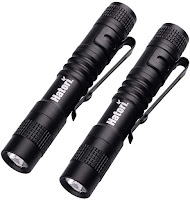
Hatori Mini LED

The dust has settled and the First 72 Hours have passed. Follow along as I build a long term plan via Prudent Prepping.

While unpacking during a little getaway I discovered some gear that, while not missing, I had misplaced and forgotten. 

In my shaving kit bag that stays in my suitcase is a small first aid kit. Besides a razor, shaving cream, and a toothbrush, clipped to a pocket was a Hatori Super Small Mini LED Flashlight. Due to the pandemic I haven't been anyplace overnight in 18 months, which made things that much worse for my poor little light. It didn't leak, so nothing else was ruined when the battery went bad, it just corroded the light.

https://amzn.to/3u6HJp1
It's my fault, since I keep an inventory of where I have lights, but this one just slipped my mind. The other Hatori is still here in my carry-along first aid kit that goes to work with me, and that one does have a fresh AAA battery, since I look at that kit once a month to restock band-aids.  
 
I really like the Hatori LED lights, as they are very small, compact, put out a good amount of light for their size and price. I believe I've ordered six of these (and gave most away), and friends have ordered several more with zero complaints. At 3.5" this light fits into a pocket or anywhere else a clip-equipped knife goes. 
 
From the Amazon ad:*
  • ♥♥3 Brightness Levels: Three beam settings (High, Low, SOS) runs only ONE AAA alkaline battery (not included). 3 Brightness Levels make it ideal for use around the house, dog walking, or camping.
  • ♥♥Pocket size outdoor flashlight: It is small and light enough to slip into a pocket and is forgotten until you need it. It is easy to fit in the palm of hand and only weights about 30g(only one).
  • ♥♥150 Lumens Powerful LED: High lumen small flashlight set in a dark or lit room will last quite two hours with moderate use(keep on) just one alkaline batterry powered, which is sufficient to light you way and light small dark spaces.
  • ♥♥Advanced Design: Skid-Proof design and Water-Proof design. Our flashlight set is made of high quality 6061T aluminum alloy with no worries in rainy day or snow days.
  • ♥♥Safe and Warranty Guarranteed: High-efficiency and great output LED chip, over-charging protection, short circuit protection. All of Hatori Flashlights has 100% SATISFACTION GUARANTEE, NO HASSLE and 90-DAY MONEY BACK GUARANTEE.
*Any typos are from the actual ad and not my usual misteaks.

Getting two nice lights for $10.19 plus free shipping is a real bargain! The order for a replacement 2-pack is going in soon.

Recap And Takeaway

  • I need to do a better job of tracking my lights. While I take my bigger lights with me every day, having a spare flashlight, even a mini like the Hatori, is a good idea.
  • two-pack of Hatori Mini LED Lights are available from Amazon for $10.19 with Prime shipping.
  • At $5 and change each, these lights aren't quite disposable, but I have never hesitated to give one up to a friend.
* * *

Just a reminder: if you plan on buying anything through Amazon, please consider using our referral link. When you do, a portion of the sale comes back here to help keep this site running!

If you have comments, suggestions or corrections, please post them so we all can learn. And remember, Some Is Always Better Than None!

NOTE: All items tested were purchased by me. No products have been loaned in exchange for a favorable review. Any items sent to me for T&E will be listed as such. Suck it Feds. 

Tuesday, January 18, 2022

Candle Making

The ability to generate light, either with a flashlight or by making fire, is a topic frequently discussed on this blog. However, the overlooked candle is another source of light and heat. From a simple birthday candle to a three wick, eight inch diameter, two foot tall column, they all have their uses. 

One of humanity's older crafts, making candles at home can be a fun and useful skill to learn. It’s also much simpler than most people realize.


Supplies and Equipment
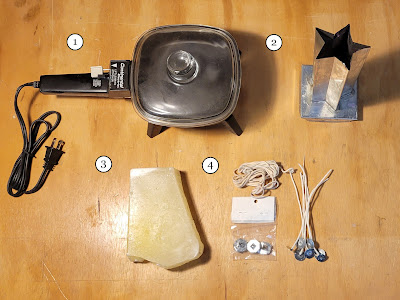
The elements necessary to make candles are not complicated or expensive, but they can be fairly specific in certain details. You will need:
  1. A method of melting wax safely
  2. A candle mold
  3. Wax
  4. Wicks and sustainer tabs

When melting wax, the two most common options are an electric melter or a double boiler. They each have their pros and cons; for example, an electric melter is considered safer as there is no open flame, but obviously requires electricity, whereas a double boiler works with nearly any heat source, but is a greater safety risk if used over an open flame as liquid wax is very flammable.

A simple aluminum double boiler

Candle molds can be simple or fancy and come in various sizes. Existing containers such as glasses, mugs, tins, and even boxes can be used as-is without needing to remove the wax after casting. You can even 3D print your own candle molds.

Paraffin, beeswax, soy, and other plant and synthetic-based waxes are all available for candle making. The range of prices varies, and so do their properties; qualities such as burn rate, drip quantity, and melt temperature should be considered. Damaged or broken candles are also a good resource.

Wicks are available in both coils that need to be cut to length and in pre-cut lengths and already threaded on keepers called sustainer tabs, which are also available separately. Another consideration when selecting wicks is matching the wick material to the type of wax and the size of the wick to the diameter of the candle.

Optionally, dyes, perfumes, and other decorative elements can be added for aesthetic purposes.

Process
The steps to follow are also fairly straightforward, and are safe as long as reasonable care is taken.

Obligatory safety warning: melted wax can be very hot! 
Avoid getting it on your skin or other important things.

  1. Place the wax in the melter and begin heating.
  2. While the wax is melting, prep the wick by attaching the sustainer tab and threading to the mold as appropriate based on manufacturer's instructions.
  3. Make certain the wick is properly centered in the candle mold.
  4. Carefully pour the melted wax into the mold.
  5. Let sit while the wax hardens.
  6. If appropriate, remove from the mold. (If the wax is being poured into something like a jar or tin that will be the permanent container for the candle this step can be skipped.)
  7. Enjoy your candle. 
With a small investment in equipment and supplies along with a few hours of time, we can make attractive and functional candles that can brighten our lives in more ways than one.

Thursday, October 7, 2021

Gear Maintenance

The dust has settled and the First 72 Hours have passed. Follow along as I build a long term plan via Prudent Prepping.

This post is late. There was an earthquake! A terrible flood! Locusts! It wasn't my fault! I SWEAR TO GOD!

Yeah, yeah. The Mystery Woman, aka our long-suffering Editrix, ain't buying it either. I had a computer glitch that, if I had any sort of software knowledge, would have been an easy fix. Fortunately, things are back to business as usual. 
 
Gear Maintenance
Just the other day the Purple Pack Lady brought me her car flashlight and said, "The flashlight is blinking at me!" I  thought that possibly the strobe function of the Nitecore P12GT was on, but it wasn't. The flashlight has a battery life indicator built into the Mode Selection button on the body, which flashes as the battery runs down to show the user that it needs a new battery. If it does die, it's your own fault for ignoring the warnings.  


I really like Nitecore lights: they're reasonably compact, feel solid in my hand, and supply all the lumens I desire at a fair price.  
 
Unfortunately, this light (the Nitecore P12GT) is now discontinued, but features have been carried over to current models.

https://amzn.to/3mvF2JH

For comparison, here are the specifications for the P12GT:
  • LED: CREE XP-L HI V3
  • Battery Run-Time (Using 18650):
    • 1000 lumens - 1 hour
    • 280 lumens - 5 hours 15 minutes
    • 55 lumens - 28 hours
    • 1 lumen - 520 hours
  • Battery Run-Time (Using CR123A):
    • 1000 lumens - 45 minutes
    • 280 lumens - 3 hours 30 minutes
    • 55 lumens- 20 hours
    • 1 lumen- 300 hours
  • Beam Distance: 350 yards / 320 meters
  • Beam Intensity: 25,700cd
  • Battery type supported: 1 x 18650 or 2 x CR123A

Here is the closest new model, the Nitecore P10i 1800 Lumen USB-C Rechargeable Tactical Flashlight. The current model uses a built-in USB charger to replace the charger in the original kit, which makes the newer set potentially much more user friendly. 

https://amzn.to/3uOZGbz

Here are the newer light's specs:
  • HIGH PERFORMANCE TACTICAL LIGHT - The Nitecore P10i emits up to 1800 lumens with a max throw of 317 yards. Designed with law enforcement and military personnel in mind, this torch is easy to operate with 3 brightness levels and strobe.
  • STROBE READY - Simply press and hold the mode switch on the tail to enable the strobe mode at any time. Non-linear strobe patterns cause enhanced dizzying effects, highly effective for diffusing a tense situation.
  • USB-C RECHARGEABLE - An upgraded 21700i battery enables higher efficiency output and minimizes loss of power, for 90 minutes on high and a max runtime of 38 hours on low. Recharge the P10i via the fast charge USB-C port.
  • READY FOR DUTY - With an IP68 waterproof rating and anti-impact protection, the P10i is ready for high intensity, tactical operations. Included is a NTH10 tactical holster that is compatible with police duty belts and standard MOLLE systems.
  • P10i POWER BUNDLE - Included in this bundle are Nitecore P10i, NL2140i battery, CR123 battery magazine, NTH10 holster, USB-C charging cable, lanyard, clip, spare O-ring, and a LumenTac battery case


I'm not in the market for a new light, but I'm always looking for a good tool at a great price, and I think this fits all the points in my shopping list.

By the way, the Purple Pack Lady now has a recharged flashlight and an explanation of why she had flashlight that was blinking on the side. 

Recap And Takeaway
  • Make sure everyone is thoroughly trained with their gear and comfortable in its use. There's no telling when missing a critical indicator like a "Low Battery" warning might cause serious problems
  • Nothing was purchased this week.
* * *

Just a reminder: if you plan on buying anything through Amazon, please consider using our referral link. When you do, a portion of the sale comes back here to help keep this site running!

If you have comments, suggestions or corrections, please post them so we all can learn. And remember, Some Is Always Better Than None!

NOTE: All items tested were purchased by me. No products have been loaned in exchange for a favorable review. Any items sent to me for T&E will be listed as such. Suck it Feds.

Wednesday, February 3, 2021

Prudent Prepping: Idle Musings

The dust has settled and the First 72 Hours have passed. Follow along as I build a long term plan via Prudent Prepping.

This post is going to be several topics that I've mentioned before, or are things that haven't really made it on my "Seriously, Make This Happen" list. At least yet. 

Range Tripping
Even with the cold, rain and wind over the last three weeks, every time I try to sneak out to the closest range and sight in the Swamp Fox Kingslayer mentioned here, here and here, either the benches have been full with a line to get in or it's been too rainy to even open up. With little rain in the forecast through the weekend, I don't expect to be reporting anything but more disappointment. However, I will make several attempts at it, just in case I get lucky. If I get in, right after finishing I'm going to buy some lottery tickets.

Purple Pack Additions
In the continuing story of The Purple Pack, the last addition was a Sawyer Mini mentioned in this post from November 2020. As was mentioned, our schedules don't match very often and getting together to discuss serious additions is hard. As the year progresses, we seem to have more and more time to talk and plan about what might happen when/if the weather calms down and the state doesn't catch on fire again. I won't push for major changes, but rather for small things that are obviously practical right now and not 'Prepping Related', like upgraded flashlights for her cars. 

Speaking of which, I ordered two Nitecore P12GT 1000 Lumen Flashlights

https://amzn.to/36B1ERF

From the Amazon page: 

  • Premium CREE XP-L HI V3 LED
  • Maximum output 1000 lumens
  • Boasts a peak beam intensity of 25,700cd and
    high efficiency circuit board provides up to 520 hours runtime on low level
  • Side switch interface provides one handed operation and easy access to all functions
  • Intelligent memory function stores preferred brightness setting
  • High-efficiency regulation circuit provides unwavering output
  • Toughened ultra-clear mineral glass with anti-reflective coating
  • Constructed from aero grade aluminum alloy with HAIII military grade hard-anodized finish
  • Waterproof in accordance with IPX-8

I have two of these right now, and I recently ordered an extra charger to have one at home and one ready to go. This way, every small flashlight uses the same batteries and charger, making it very easy to swap batteries around so everyone can have a operating light. 

The very next addition that I want to make is a stove of some kind. I've been told, "Why do I need a stove? You are with me and you have one, so why do I need one too?" I'm seriously thinking of putting an Esbit Stove and fire cubes in a ziplok, putting it in the bottom and saying nothing about it! Unfortunately, that's not how I operate and no matter how much I'd like to do that, I can't.
https://amzn.to/3aw7Ziz

Once I figure out how to clear that hurdle, I think it will be easier to upgrade to the SOLO Stove I have sitting on top of my storage totes, just waiting to go to a good home! 

Recap And Takeaway

  • Continuing to take things easy, since "Slow and Steady Wins the Race" to prepping success!
  • Purchased this week: Two NITECORE P12GT 1000 Lumen flashlights from Amazon for $73.95 each and one Nitecore D2 DigiCharger from Amazon for $20.99, both with Prime shipping. 
  • Everyone now has interchangeable lights for all vehicles and a spare charger! 
* * *

Just a reminder: if you plan on buying anything through Amazon, please consider using our referral link. When you do, a portion of the sale comes back here to help keep this site running!

If you have comments, suggestions or corrections, please post them so we all can learn. And remember, Some Is Always Better Than None!

NOTE: All items tested were purchased by me. No products have been loaned in exchange for a favorable review. Any items sent to me for T&E will be listed as such. Suck it Feds.

Wednesday, January 20, 2021

Prudent Prepping: Charging Up

The dust has settled and the First 72 Hours have passed. Follow along as I build a long term plan via Prudent Prepping. 

I was asked off-blog about my choice of flashlights, recommended battery types, and what my choices were. That topic was covered in this post from 2018 as well as several others since then; to find them, use the search box in the top left corner and put in Nitecore. 

This post, however, isn't a rehash of flashlights but rather is about charging batteries inside a flashlight! I've made jokes about fans of flashlights with ALL THE LUMENS more than once, but that doesn't mean I don't appreciate (or covet) more light. To get all the lumens -- or in my case, a reasonably large number of lumens for my budget -- you need a better set of batteries than what are found on the hardware store shelf. Making that choice affordable in the long run means using rechargeable instead of disposable batteries, which unfortunately requires a charger for those batteries. I had one Nitecore charger for the two flashlights I own, but decided that another was needed to cover my prepping bases. Who hasn't heard or said, "Two is one and one is none"? With that in mind I ordered a spare. 

https://amzn.to/3qDbYQL
This is a similar charger that was included in the first Nitecore flashlight I bought, but I wanted this particular kit for the car charger plug. If you do an Amazon search for Nitecore chargers you will find many different models, including some with USB plugs. A surprise to me was exactly how inexpensive this charger is: only $20.99! 

From the Nitecore Amazon page:

  • Compatible with and identifies Li-ion (26650, 22650, 18650, 17670, 18490, 17500, 18350, 16340(RCR123), 14500, 10440), Ni-MH and Ni-Cd (AA, AAA, AAAA, C) rechargeable batteries
  • Capable of charging 2 batteries simultaneously; Each of the two battery slots monitors and charges independently Compatible with LiFePO4 batteries too
  • Optimized charging design for IMR batteries & over-charge prevention to protect batteries
  • Integrated LCD panel clearly displays charging parameters and progress; Two conveniently located side buttons allow easy selection of specific battery types and charging parameters. This bundle includes EdisonBright battery carry case with in-car charging cable.
A nice feature about this model is the ability to select the battery type when setting up the charger; along the side are buttons that allows the user to scroll through a list until the specific type of battery is shown. 

Due to how little I actually use these flashlights, the batteries had about a 50% charge from the last time I topped them off, and the recharge time was automatically adjusted by the unit. I've yet to run down the first flashlight, and even though I'd like to see how long it would run before the batteries died, I think I'd need a way to freeze the flashlight body to keep it from either melting or setting anything close on fire from the generated heat from being on for such a long 
time! 

I will be upgrading the AA flashlight in the bag I started building last year to a Nitecore P12GT or similar very soon.

Recap and Takeaway 
  • One Nitecore D2 DigiCharger with car charger cord ordered from Amazon: $20.99 with Prime shipping.
  • A very smart addition to my gear, since I now have a charger in my GHB and one at home, ready to dump in a BOB if necessary. 
  • Nothing else was purchased, but several things need to be looked at soon. 
* * *

Just a reminder: if you plan on buying anything through Amazon, please consider using our referral link. When you do, a portion of the sale comes back here to help keep this site running!

If you have comments, suggestions or corrections, please post them so we all can learn. And remember, Some Is Always Better Than None!

NOTE: All items tested were purchased by me. No products have been loaned in exchange for a favorable review. Any items sent to me for T&E will be listed as such. Suck it Feds. 

Wednesday, October 7, 2020

Product Review: Maglite ML25LT

I've loved Maglites for decades, and recently stumbled across the Maglite L25LT. Here are my thoughts.


Lokidude

Tuesday, October 6, 2020

Prudent Prepping: A Little This, a Little That...

The dust has settled and the First 72 Hours have passed. Follow along as I build a long term plan via Prudent Prepping.

...and before long you have a whole bunch of stuff!

This a teaser to my newest Work In Progress, a Get Home Bag. Yes, I'm doing what I believe is my 4th bag since I started writing for BCP (not counting re-doing my personal bag twice a year), and I hope this will be the last new bag I make.

Hatori Super Small Mini LED Flashlight
Last week I mentioned buying two more of my favorite mini flashlight, the Hatori Mini LED. This is the new, improved 3 Mode version of the mini light I've used for years and have mentioned many different times.

From the Amazon ad:*
https://amzn.to/33hhj7s
  • 3 Brightness Levels: Three beam settings (High, Low, SOS) runs only ONE AAA alkaline battery (not included). 3 Brightness Levels make it ideal for use around the house, dog walking, or camping.
  • Pocket size outdoor flashlight: It is small and light enough to slip into a pocket and is forgotten until you need it. It is easy to fit in the palm of hand and only weights about 30g(only one).
  • 150 Lumens Powerful LED: High lumen small flashlight set in a dark or lit room will last quite two hours with moderate use(keep on) just one alkaline battery powered, which is sufficient to light you way and light small dark spaces.
  • Advanced Design: Skid-Proof design and Water-Proof design. Our flashlight set is made of high quality 6061T aluminum alloy with no worries in rainy day or snow days.
  • Safe and Warranty Guarranteed: High-efficiency and great output LED chip, over-charging protection, short circuit protection. All of Hatori Flashlights has 100% SATISFACTION GUARANTEE, NO HASSLE and 90-DAY MONEY BACK GUARANTEE.
  • 3.54 inches long
  • One AAA battery (not included) per flashlight.
*Grammar and spelling errors are from the original ad. Any similarity to my actual writing style is strictly accidental.
The three modes can be accessed by lightly depressing the button on the base or by actually clicking through. I would have to say the levels are HIGH, MEDIUM and STROBE, with the difference between High and Medium being enough you could possibly use Medium to check pupil reaction. When Strobe is on, it certainly qualifies as strobe, even if the pulses are not quite as fast as some smaller flashlights. Just to be clear, though, looking at the light reflecting off a white wall was enough to get me feeling a headache starting, so I'm not sure what someone with light sensitivities might make of all the flashes.

I will be placing one of the 3 Mode lights into the Bat Belt bag with the other going in the SFD Responder ankle rig mentioned here and other places. The original single mode light I'm not sure what to do with, except to add it to one of the individual first aid kits I have.

Recap And Takeaway
  • Two LED AAA flashlights with 3 light modes for $2 more that the single mode light? This was hard for me to pass up. 
  • Two Hatori Mini LED lights were bought for $10.19 with Prime shipping.

* * *

Just a reminder: if you plan on buying anything through Amazon, please consider using our referral link. When you do, a portion of the sale comes back here to help keep this site running!

If you have comments, suggestions or corrections, please post them so we all can learn. And remember, Some Is Always Better Than None!

NOTE: All items tested were purchased by me. No products have been loaned in exchange for a favorable review. Any items sent to me for T&E will be listed as such. Suck it Feds.

Thursday, September 3, 2020

Collapsible Camp Lantern

Summer is drawing to its end, which means that cooler weather is coming. Autumn is my favorite time to spend in the woods,; the cool mornings and bearable afternoons make hiking and hunting more enjoyable and sitting around evening campfires are actually comfortable.

I like to travel light, so I'm always looking for toys and tools that are smaller and perform more than one function. Wandering through Wal-Mart, I noticed an “expandable” solar powered LED light/charger. It was a brand I've never heard of (not unusual in Wal-Mart) and as I was looking at it I noticed an almost identical version further down the shelf with the store brand (Ozark Trail), so I grabbed one of each. Neither brand is on Amazon, but this is the same item with yet another brand on the packaging.

At about 3 inches square and 2 inches high, the lights are about the same size as two hockey pucks stacked up. Here are the specs I was able to find on the packaging, along with a few observations:
  • The solar panel on top is about 2” square, so minimal output; my estimate is maybe 10mA.
  • The folding carry handle on top is cheap and it will break off soon. Nice for hanging the lamp, though.
  • The switch on the side has three functions: low, high, and flashing.
    • Low power is about 30 Lumens and will run 5-6 hours on a full charge.
    • High power is about 125 Lumens and lasts 3 hours.
    • The flashing mode is standard these days. I find it annoying.
  • There is a rubber panel protecting the USB in and out ports. It's rated IPX4, so it's good for heavy rain but not for immersion in water. In other words, weather-proof but not water-proof.
  • There is a USB A port and a short cord supplied for use as a battery bank, as well as a micro-A USB port for charging with a phone/device charger.
  • The internal battery is non-replaceable with about an 800mAh capacity. Pretty small for use as a battery bank, but it will top off a cell phone.
  • The indicator lamp shows red when charging, green when fully charged.
  • Charge times varied wildly by source. Plugged into a 1A car charger, it took 3 hours to fully recharge; my home charger is rated for 2.1A and it took less than an hour. I haven't tested the solar panel yet, but I'm expecting it to take at least 10 hours of daylight to fully charge.

After playing with the lamps for a few days, I noticed a few things:
  • The lamps are a comfortable size in my hand. I have large hands and small lights are hard to grasp when I'm wearing gloves, so this is a good size for me. Small things also tend to get lost, so I look for the middle ground when choosing sizes.
  • The battery, LED, and other electronics are all in the “head” of the unit; the “base” has a cute little lens to focus the light when the lamp is collapsed. Collapsed, it does make a decent flashlight, with a concentrated center spot and a diffuse outer ring of light. The plastic lens is slightly recessed in the base but will be prone to scratches. I may disassemble one of the lamps to test the lens as a fire starter later.
  • Expanding the lamp is done by gently pulling the base away from the head, exposing a plastic bellows-shaped diffuser. Think about the bendy straws you played with as a kid, except 2” in diameter and about 4” long. You can bend it sideways to direct more of the light through the lens on the bottom to where you need it, but it isn't much light. Bending it did come in handy for blocking most of the light on one side, creating a darker area. This is good if you've got someone trying to sleep but you still want to read for a while.
  • The switch is a simple push-button, but you have to cycle through all three modes to turn it off.

The surprising thing about these lights is the price. The display at Wal-Mart didn't have the price for the “Alpha” brand, so I was a bit shocked at checkout. Amazon has them for $9.00, and the Ozark Trail version was $10.00, but the exact same light in almost the exact same packaging with the “Alpha” brand was $20.00! This is not a $20 light. Save your money and get the store brand if you're paying cash, or go to Amazon and use it as an add-on item to get free shipping. 

Wednesday, August 12, 2020

Prudent Prepping: Etekcity CLK30 Camping Lantern

 The dust has settled and the First 72 Hours have passed. Follow along as I build a long term plan via Prudent Prepping.

My long-awaited package finally arrived! I ordered it with Prime shipping, but since it was non-essential it took a bit longer to get here. 

Light, But Variable
In my July Take-Out post, I mentioned the small lantern I've had for years and when I looked at the Amazon ad there was a new version listed. I went ahead and ordered one to see if there was any actual improvement. I think there is! 

Just as a refresher, here are the high points from the Amazon ad for the Etekcity Camping Lantern CL30


https://amzn.to/2XUTkrD
About this item

  • ULTRA BRIGHT: This lantern includes 30 individual low consumption LED bulbs carrying 360° of luminous light while saving energy
  • LONG-LASTING: Light up at least to 30 hours of regular, continuous use with enough battery capacity (batteries pre-installed in the lantern).
  • 4 LEVELS BRIGHTNESS CONTROL: Easily adjust the brightness with dimmer button to fit the environment for camping, reading, power outage, emergency, hiking, backpacking etc.
  • MAGNETIC BASE: Effortlessly stick it to any metal frames for hand-free lighting in any working environment.
  • DURABLE MATERIALS: Constructed with military grade ABS material; FCC Certified, RoHS Compliant.
  • COMPACT & LIGHTWEIGHT: The extremely lightweight build allows you to take lanterns on the go with ease. When not in use collapse the lantern to a smaller size; taking up little space.
  • TACTICAL STORAGE: The top lid of the lantern contains a small room for storing some small things like some change, yours keys, some spare batteries, etc.
  • BUY WITH CONFIDENCE: Feel free to contact our California Support Team. We are always ready help if you have any question about our product.
Due to a change in my work schedule I haven't given these a serious test or a head-to-head battery life trial, but I'm hoping to grab fresh batteries and try them out very soon. What I have done is a bit of testing, and I really like some of the features on the new lantern! One in particular is a nice addition that I can't clearly photograph, but there is a molded-in spot that holds the handles down. The previous model didn't have that, and I used a rubber band to keep everything neat in my bag. 


New, Old, Soda


Here are both models for comparison. From left to right we have the new version, the old version, and a typical soda can.
 

They would be the same size if not for  the small storage compartment in the top of the new version.


The light output from the new model appears to be a bit brighter to my eye when fully extended, even if there is no apparent difference in the arrangement of the LED 'bulbs'.  I'm not sure if it's actually brighter, or if it's just the fact that the lantern opens up taller, allowing more light to be reflected out of the housing.


Here is the CL30 on the lowest brightness setting compared to my existing lantern with only one setting. The amount of light on Low is still sufficient to see well.


I think having a variable amount of light,  plus a magnetic base (which I haven't had a chance to try out in a real world test) is going to be a benefit!


Recap And Takeaway 
  • Finally getting a new toy and finding out it really does do what the ad says is satisfying!
  • While the new lantern certainly does more things, I am not dumping the old version. Having a reliable back-up is another cure for my 'One Is None' problem.
  • Nothing was purchased this week but you can order a pair of these Etekcity CL30 Lanterns from Amazon for the amazing price of $19.79 for two! Prime shipping is available.
* * *

Just a reminder: if you plan on buying anything through Amazon, please consider using our referral link. When you do, a portion of the sale comes back here to help keep this site running!

If you have comments, suggestions or corrections, please post them so we all can learn. And remember, Some Is Always Better Than None!

NOTE: All items tested were purchased by me. No products have been loaned in exchange for a favorable review. Any items sent to me for T&E will be listed as such. Suck it Feds.

The Fine Print


This work is licensed under a Creative Commons Attribution- Noncommercial- No Derivative Works 3.0 License.

Creative Commons License


Erin Palette is a participant in the Amazon Services LLC Associates Program, an affiliate advertising program designed to provide a means for sites to earn advertising fees by advertising and linking to amazon.com.