Showing posts with label Car Survival. Show all posts

Sunday, February 9, 2025

Shuffle Steering

Not actually Erin.
Used with permission.
When I was a member of Sheriff's Explorers in high school, I was taught shuffle steering. I picked it up pretty quickly and have been using it all my life. 

Put simply, shuffle steering (also called push-pull steering) is a method of holding the steering wheel such that your hands never cross the 12:00 and 6:00 positions on the wheel. I was taught that this allowed you to retain control of the vehicle because both hands were on the wheel at all times, but another reason to use it is to prevent you from striking yourself with your hand or arm should the airbag deploy. 

Let's say I need to make a right turn. Using shuffle steering, the technique would look like this:
  1. My hands start at 3 and 9 (or 10 and 2, or 8 and 4, depending on the steering wheel configuration). 
  2. As I begin the turn, my left hand grips the wheel, turning it until the hand reaches the 12:00 position. 
  3. My right hand remains loose, allowing the wheel to move smoothly through it but able to grasp it for control when needed. 
  4. As my left hand reaches the 12:00 position, my right hand slides up the wheel to meet it. 
  5. At 12:00, my hands "hand off" steering, and now my right grips the wheel and pulls it down, with the left hand loose and allowing the wheel to traverse through it. 
  6. If the turn is sharp and my right hand will cross the 6:00 line, my left hand slides down to receive the "hand off" and continue the turn. 
  7. When the turn is complete, loosen both hands to allow the wheels to return to a neutral position. This is known as the "caster effect", and it's the same principle that makes the front wheels of grocery carts point ahead when you're pushing them. 
  8. Your hands should now be at your  3 and 9 (or whatever your home position is). 
It may sound complicated, but it's not hard to learn and it's super easy to use. This professional driving instructor will show you how it's done:


I've found this technique very useful when driving though the high winds and wet roads of Florida's summer storms. I have no experience driving on snow and ice, although I assume it would be just as effective there. 

The best way to prepare for an accident is to prevent one from happening in the first place, and maintaining control while preventing injury is a great way to do that. 

Drive safely, and don't forget to shuffle. 

Monday, March 18, 2024

Product Review: Portable Car Jump Starter

Not actually Erin.
& is used with permission.
Back in 2022 I blogged about a portable car jump starter which I had bought but had not tested. Well, that situation has been rectified, because as it turns out I needed to jump start my car today, and it worked exactly as advertised. 

First, I checked the charge on the power bank. Despite not having been charged since I bought it back in August of 2022 and having been kept in a hot car for all that time, the power display still read 100% charge. 

I then plugged the sensor module into the power bank and attached the clamps to the battery terminals. As I said in my previous post, "I especially like how the clamps are manufactured with extra plastic that bulks them up such that it's impossible to short anything out by having the teeth touch each other; I would have to deliberately circumvent the safety features to short-circuit these. I also appreciate how the sensor module has lights which tell me if I have the positive clamp attached to the positive terminal or not."  The sensor showed steady green, so I got in the driver's seat said a quick prayer, and turned the key. 


The engine started effortlessly, and when I put the jump starter away the battery said 98% charge remaining. I am incredibly pleased with how well this product worked, and the only thing keeping me from giving it a full product recommendation is the fact that I can't find my specific model on Amazon, and Chinese clones of products can be a gamble in terms of quality. 

Still, even if it doesn't jump your care, you still have a rechargeable 18,000mAh power bank with built-in flashlight and emergency strobe, which is very useful in a lot of situations. And if it does work, then you've potentially saved yourself from needing to call a very expensive roadside mechanic or having your vehicle towed. 

At $60, I'll take that gamble. 

Monday, September 18, 2023

Vehicle Check: Winter Is Coming

The dust has settled and the First 72 Hours have passed. Follow along as I build a long term plan via Prudent Prepping.

Checking our vehicles is something we should be doing regularly, and it's important to do that now since winter with its cold weather, rain, and snow will be here soon.

Easy Checks
If you know when you bought your last set of tires, you're probably okay, but if you can't remember the year, grab a penny and put Honest Abe's head in the groove of the tire. If you can't see the top of his head, then you're set for a few more miles. But if your penny is showing all of Lincoln's head, then those tires should be replaced as soon as possible. 

While you're there, check your tire pressure. Don't know what your tire pressure should be? The number is molded onto the tire, and is also shown on a plate mounted to the driver's door frame showing pressure for front and rear tires as delivered from the factory.

https://nasaspeed.news/tech/wheels-tires/setting-air-pressures-for-hpde/


Tire Information
Many people change tire sizes, so the actual pressure shown on your tire should be your guide. Your tires may not have the numbers molded quite this large, but the information is there. Tire pressure should be checked on a schedule that is best for you; I check mine every third fill-up or once a month, depending how much I drive those weeks. 

Spare tires needs to be included in this as well; now might be a good time to clean out the junk in your trunk so that you can get to your spare in an emergency.

https://us.v-cdn.net/5021717/uploads/editor/1o/qhb6z50zixo9.jpg
 

Other Easy Checks
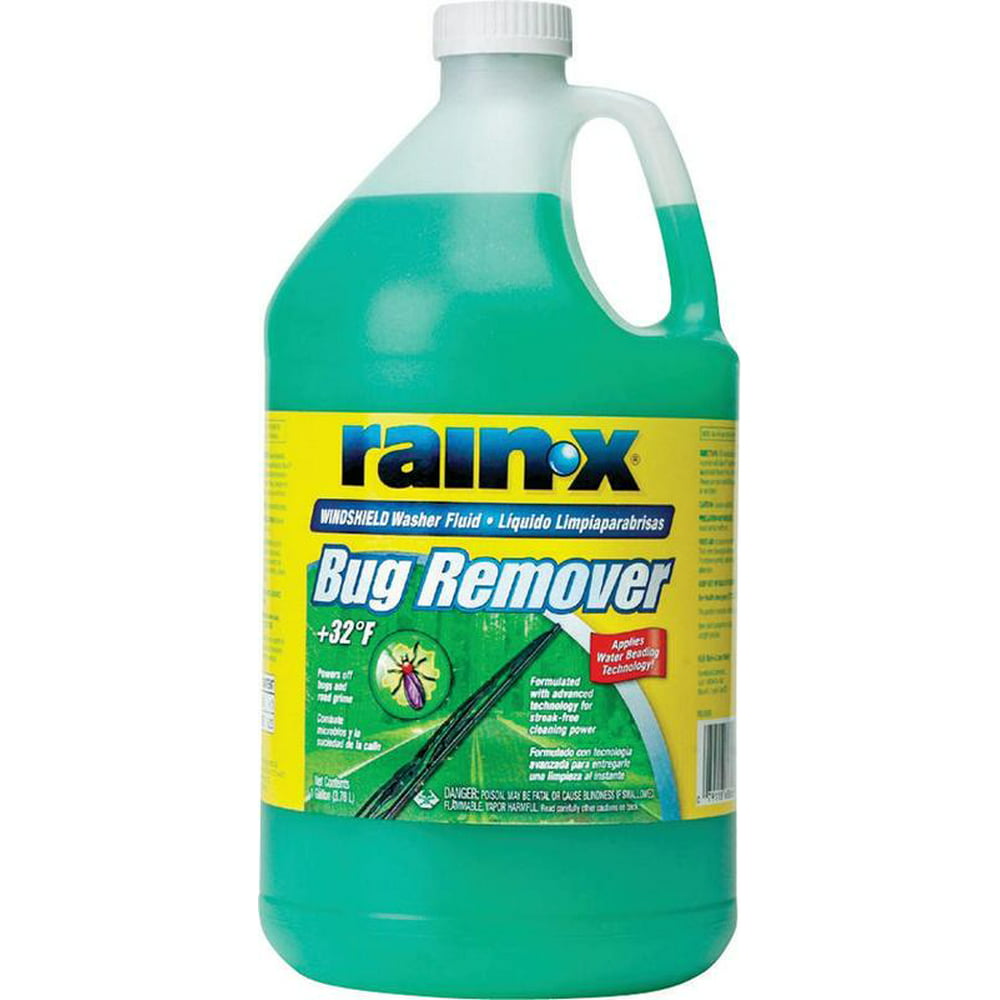
I checked the washer reservoir and topped up that with fresh fluid. I only use regular bug remover on my car, since it doesn't freeze here and I don't drive my car in the snow if I can avoid it; when there is a freeze warning, I add a small amount of lower-temperature washer fluid to get me through. 

Change your wiper blades now, if you haven't done it this year.

https://i5.walmartimages.com/asr/6d25174f-342a-432f-84fc-1fc8265d5e71_1.20469c6cc0c4e9a889858e6825c434a7.jpeg?odnWidth=1000&odnHeight=1000&odnBg=ffffff
My favorite

Not-So-Easy Checks

Brakes
If you have the room, the equipment and the skill, checking your own brakes is fairly simple. If you don't feel comfortable doing that type of work, the store where you purchased the tires will usually check them for free when you rotate your tires. Oh, you don't do that? Start now; you'll get more miles from your tires before Abe's hair starts to show.

Coolant
This is another thing that I don't have to worry about much, since it never gets below freezing for extended periods here and I don't drive in the snow if I can avoid it. In most cases, keeping the overflow tank filled to the minimum line with your recommended fluid is fine. If you don't know what that is, or can't find your Owners Manual, I would suggest driving to a trusted repair shop to look at your car.

The Really Simple But Expensive Way to Check All This
Most oil change stations can do all of these inspections and replacements for you while you are over the pit; just be aware that the prices you pay will be higher than doing the work yourself. But, it will be done all at once and correctly, with the ability of blaming someone else if something goes wrong!


Recap and Takeaway
  • Check your tires (including spares). 
  • Check your brakes. 
  • Check your fluids. 
  • Check your wipers. 
  • You are a prepper, so make sure you are doing things before the emergency!

* * *

Just a reminder: if you plan on buying anything through Amazon, please consider using our referral link. When you do, a portion of the sale comes back here to help keep this site running!

If you have comments, suggestions or corrections, please post them so we all can learn. And remember, Some Is Always Better Than None!

NOTE: All items tested were purchased by me. No products have been loaned in exchange for a favorable review. Any items sent to me for T&E will be listed as such. Suck it Feds.

Tuesday, September 20, 2022

Long Distance Travel Planning

My wife and I just returned from a long, out-of-town trip to a place I dislike and for reasons that were unpleasant. Nevertheless, it was a journey that had to be made.

This made me consider how my wife and I prepare for long trips in the car. We have a checklist with variations depending on destination and purpose. We also tend to over pack when we go away.
  • Navigation. Even though GPS is prevalent and generally accessible, we always map out the route before we get on the road. This helps with any possible detours that may occur, or points of interest we'd like to see.
  • Breaks. Over a decade ago I injured my back, and since then I can only take a limited amount of time in a car before I need to get up and walk around. These breaks help both in reducing leg cramps and in keeping us alert on the road.
  • Fuel. On a long trip, we try not to let the car get below half a tank of gas before we stop to refill. This ensures we always have enough fuel to get to the next station, even if we have to skip a string of them due to extreme prices, too many customers, or lack of gasoline at the pumps. 
  • Cash. While not accepted everywhere anymore, it's always a good idea to have a supply of cash on hand when traveling. If phone/data/wifi goes down credit cards may be useless, but cash still works.
  • Hydration. Most people live their lives insufficiently hydrated. On a long drive it's too easy to either forget to drink enough or, even worse, drink too many caffeinated and/or sugary beverages which act as diuretics. One 16.9 oz bottle of water per person per 100 miles is probably a good baseline; I tend to drink more than that.
  • Nutrition. While fast food restaurants cluster around highway exits, they can't always be counted upon to be open and even the better options aren't all that healthy. A bag of shelf-stable snacks, such as dried fruit, nuts, and pretzels as well as a cooler of cheese sticks, chocolates, etc. can help considerably.
  • Biology. If we're eating and drinking, those fluids and solids eventually have to come out, so don't wait until the demand is urgent before finding a bathroom. Last year, when the government-mandated craziness was at a higher level, we went from Nashville to Knoxville. This was about two and a half hours of driving, and very few bathrooms were open to the public on that trip. Even with the calls to wash our hands for so many seconds repeated constantly, fast food restaurants weren't allowing patrons in to use their restrooms. As a man, I had the usual alternatives of "nearly any tree", but such was not the case for my wife. Fortunately, we were able to find options farther from the highway exits.
  • Electronics. With cell phones, Kindles, tablets, and more part of our daily lives, it's important to be able to keep them charged. We have a selection of cables and adaptors in our cars to take care of all our devices.
  • Defense: Depending on the destination we may just have sidearms, but if we're going to be away overnight I prefer to have at least one long gun with sufficient ammunition, as well as a cleaning kit and basic tools. Unfortunately, it's not always legal to bring firearms to certain destinations. While I'd prefer to stay away from those places, it's not always possible, and alternatives for defense that are legal in many jurisdictions are available.

All the things listed above are in addition to the normal supplies we keep in our cars at all times such as blankets, flashlights, rope/cord, etc.

Proper planning prevents poor performance. Travel safely.

Friday, August 12, 2022

Portable Car Jump Starter

Not actually Erin.
& is used with permission.
Last week I mentioned that I wasn't worried about my LED road flares losing a charge because I have a 20,000 mAh power bank in my car designed to jump start a dead automobile battery that also has USB outputs for charging other devices like a phone... or LED road flares.

There are many products similar to this on Amazon with company names that suggest only a passing familiarity with English -- this one is POWRUN, mine is TACKlife -- which leads me to believe that products like these are all being made in China and perform more or less the same. I picked a unit with a low price ($60) and decent rating (4.5 stars and 3455 reviews); by the time you read this you may find one with a lower price or better reviews or a higher amperage. Consider this post a generalized "Here's what these do" article and not a recommendation of a specific product. 

https://amzn.to/3VkEObd


These units are basically the following:
  • a large capacity battery bank
  • a set of jumper cables connected to a sensor module
  • a carrying/storage case
  • at least one USB cable
Because these are just large batteries, the manufacturers have added utility by giving them an LED flashlight and output ports to charge electronics. This is why I said I'm not worried about having rechargeable road flares in my car: if I can recharge a tablet twice or a phone six times with one of these, then I can recharge three LED flares without any problems. 

This unit has a 12 volt input with both a USB input and a wall-mounted transformer for AC charging. For output, it was two USB ports (one 5V/9V quick charge, one 5V/2.1A) and one 12V/10A DC output socket to power things like lanterns, spotlights, and so forth. I really like the flexibility this gives me.

https://amzn.to/3VkEObd


The manufacturer claims that this model can start a vehicle 25 times before needing to recharge. While I cannot prove that, the honest answer is that I don't need to; it just needs to work once as far as I'm concerned. 


Just like with the LED flares, I have not tested my unit under real conditions; at this moment I don't need a battery jumped and I understand that it's dangerous to jump a full car battery. That said, the process itself is very easy:
  1. Connect the sensor module (with cables) to the battery.
  2. Attach the clamps to the battery. Like always, red is positive and black is negative. Unlike with car-to-car jumpstarts, do not ground the black cable to your car frame. 
  3. Start your car. 
  4. The sensor module acts like it's another car and feeds power to your battery, which hopefully makes the engine turn over. 
  5. Remove the cables and put everything away. 
Speaking as someone who has had to jump her car about a dozen or more times, I appreciate how much safer this feels than having to attach leads to a very live, and potentially dangerous, car battery. I especially like how the clamps are manufactured with extra plastic that bulks them up such that it's impossible to short anything out by having the teeth touch each other; I would have to deliberately circumvent the safety features to short-circuit these. I also appreciate how the sensor module has lights which tell me if I have the positive clamp attached to the positive terminal or not. 

Don't do what they're doing with the clamps. That's dangerous.

In conclusion, whichever model you buy, if you use your car regularly and/or are planning a car trip, buy something like this. Not only is it cheaper and faster than AAA sending someone to help you, and safer than depending upon the kindness of strangers to jump your car instead of jumping you, but it's also a source of backup power for your cell phone, GPS unit, road flares, and other necessary devices. 

Sunday, July 31, 2022

Electronic Road Flares

Not actually Erin.
& is used with permission.
Road flares can be incredibly useful if your car breaks down on the road, especially if it's dark outside or you're in inclement weather which restricts visibility. These flares will demonstrate that you need assistance while also alerting other drivers to your stopped vehicle and, hopefully, preventing those other drivers from crashing into you. 

Unfortunately, flares are also on fire and as a result can cause severe burns to people who accidentally touch them or set fire to things which shouldn't be on fire. 

Electronic road flares eliminate the burn hazard of conventional flares while also having the benefits of running longer and being reusable. Some can even be configured to flash, thereby increasing their ability to get the attention of other drivers. 

I recently picked up a set of three LED road flares and, while I have not tested these under real-world conditions, I am pleased with their performance and am satisfied with their reviews (4.7 stars and 1,244 reviews). 

https://amzn.to/3zq2aQp


The Ecoangel USB Rechargeable LED Road Flares have the following features:
  • A rubberized coating (for grip and to cushion against impacts) over a plastic body which the manufacturer says can survive being run over by a 30 ton vehicle. The casing is also said to be waterproof. 
  • A 650 mAh rechargeable battery with a claimed runtime of at least 2 hours on the highest setting (solid-on, high) and 48 hours on the lowest (single flash). The manufacturer says the battery will hold a charge for a year. It recharges via a micro-USB port. 
  • The lights can flash in 9 configurations, including SOS and a 3-LED white flashlight. 
  • The bottom of the puck has an N35 magnet and a deployable hook so that it can be used as a work light.
I don't understand why these come with 9 configurations; I think it would work just fine with single flash, SOS, solid-on, and the LED flashlight. It was probably just a matter of being super-easy to program them with multiple patterns, and so they were added because why not? I don't have a problem with this; I just think it's a bit odd. 

https://amzn.to/3zq2aQp


I don't know how bright these are in terms of lumens or candela. What I can tell you is that these are not eye-searingly bright, even at their highest setting, so they won't render you flash-blind if you look them. However, they are plenty bright even when indoors, and at night they are quite the attention-getter. 

Some people might have a concern with these losing their charge, and that's understandable. I'm not worried because I also have in my car a 20,000 mAh power bank which, in addition to being able to jump start a dead automobile battery, also has USB outputs for charging other devices like a phone, GPS or tablet. If these lights run low I can use that to recharge them. However, if that's a concern you have then you can buy a version of these lights which take three AAA batteries instead

As I said I have not tested these, so my opinion of them might change in time, but for right now I am happy their performance for their very reasonable price ($20 and Prime shipping). 

Saturday, July 9, 2022

Cleaning Up the Car Trunk

I tend to ignore the more cosmetic aspects of cleaning my car, which include not only the seats but the trunk as well. I have a trunk organizer that I talked about in this post, which makes it really easy to access what I want when I need it, and going through everything that ended up in those sections I found things that were put there with the Good Idea to come back and remove everything "Later"'. 

Taking Out
Well, Later is Now and it's way past due. Besides the washer fluid, coolant, window cleaner, first aid kit, fire extinguisher and Get Home supplies that were first put in when I had a very large territory, there was mostly junk in my trunk (quiet in the peanut gallery!). I don't mean garbage, but rather things that really needed to be put where they belonged, and where they belonged wasn't in the trunk organizer:
  • Seldom-used tools.
  • More freeze dried food than I need to Get Home.
  • Too many changes of clothes.
  • Several partial quart bottles of motor oil. 
  • Several small specialty tools that I thought were lost but simply fell out of tool kits when they were moved.
I found my missing needle file set in the bottom of one pocket, the set that I've used to touch up copies of house keys that just don't quite match the original. These came from Harbor Freight and do exactly what I need for the times a set of small files are required, which for me isn't very often.
 
My File Set

I removed a wrench and socket set, since there isn't much that I would be able to fix on the side of the road without a parts store close by. Also coming out are any cold weather items, and I think there will not be any weather specific equipment added in the future. 

Going/Staying In
My car is used for commuting to my work and also for trips, but when it is driven with two or more people, specific gear is added depending on the destination. Besides switching Purple Pack Lady's bag out of her car to my trunk, there is a small suitcase pre-loaded with trip basics for two: toothbrushes, toothpaste, soap, shampoo and underwear. Clothes for the destination go in and we are packed!

I also keep a case of water, Sawyer water filter, MSR pot and Solo stove permanently in the car.

Basics 


Food goes in and comes out depending on what we are doing, where we are going, and how long we are staying. I have reviewed freeze-dried food  a long time ago, but not these specific items. The above review is a little humorous, but testing equipment and gear before an emergency hits is just good planning.  I have duplicates that I will soon have PPL taste test in a camping setting. 

Freeze-dried food

Okay, it's car camping, but I've got to start some place. Baby steps, you know? Finally, here is a shot of more "essential" food items that must always be readily available. Different people have differing ideas on daily requirements. 

Necessities. Really! (or so I'm told)


I'm learning to deal with it.

Recap And Takeaway

  • Keeping your vehicle clean and organized helps make finding your emergency equipment easier.
  • With gas prices doubling, having less weight to carry helps improve the Miles Per Gallon.
  • Find food that is acceptable to your entire group. I'm only stocking for two now. so my choices are wide open.

* * *

Just a reminder: if you plan on buying anything through Amazon, please consider using our referral link. When you do, a portion of the sale comes back here to help keep this site running!

If you have comments, suggestions or corrections, please post them so we all can learn. And remember, Some Is Always Better Than None!

NOTE: All items tested were purchased by me. No products have been loaned in exchange for a favorable review. Any items sent to me for T&E will be listed as such. Suck it Feds.

Thursday, January 6, 2022

Winter Weather Car Survival

The dust has settled and the First 72 Hours have passed. Follow along as I build a long term plan via Prudent Prepping.

Winter is definitely here, even in California. While my part of the state is not cold, the Sierra mountains have quite a bit of snow for this time of year, but even at just a bit over 17ft, this is still short of what is needed to get drought worries put to rest. We haven't had travel problems like those in Virginia, but there certainly have been road closures. Over the holidays, a friend was leery of being stranded and so drove south from the Bay Area, east towards Las Vegas and then north to Reno! I don't know if I would have gone to that extreme to avoid being stuck, but planning ahead is sometimes better than scrambling to find a solution.

Winter Prepping
I said I don't get snow, but this year we are getting rain, and being wet at 50° will get you in trouble almost as fast as being dry inside a 10° car. Being adequately prepared for the areas you will travel through is as important as your normal, day-to-day preps. If you are living in areas that freeze regularly, many of the suggestions from the AAA will be things that are second nature to you, but not so much for us. Some excerpts from the linked page:

Cold Weather Driving Tips
  • Keep a bundle of cold-weather gear in your car, such as extra food and water, warm clothing, a flashlight, a glass scraper, blankets, medications, and more.
  • Make certain your tires are properly inflated and have plenty of tread.
  • Keep at least half a tank of fuel in your vehicle at all times.
  • Never warm up a vehicle in an enclosed area, such as a garage.
  • Do not use cruise control when driving on any slippery surface, such as on ice and snow.
  • Stay home. Only go out if necessary. Even if you can drive well in bad weather, it’s better to avoid taking unnecessary risks by venturing out.
One of the things I learned the hard way was not to leave my extra water in the trunk when traveling to Reno. While I didn't need any on that trip, it would have been... inconvenient... to need to defrost  it before drinking. Another was to get antifreeze windshield washer fluid, since the standard Rain-x Bug Remover I use will freeze solid, which is enough to damage the little pump.

If You Get Stranded
Since you planned ahead (right?), being stuck will only be an inconvenience and hopefully not life-threatening. More tips from AAA for what to do if you get stuck in the snow:
  • Stay with your vehicle: Your vehicle provides temporary shelter and makes it easier for rescuers to locate you. Do not try to walk in a severe storm. It is easy to lose sight of your vehicle in blowing snow and become lost.
  • Don’t over exert yourself: When digging out your vehicle, listen to your body and stop if you become tired.
  • Be Visible: Tie a brightly colored cloth to the antenna of your vehicle or place a cloth at the top of a rolled up window to signal distress. At night, keep the dome light on if possible. It only uses a small amount of electricity and will make it easier for rescuers to find you.
  • Clear the Exhaust Pipe: Make sure the exhaust pipe is not clogged with snow, ice or mud. A blocked exhaust pipe can cause deadly carbon monoxide gas to leak into the passenger compartment of the vehicle while the engine is running.
  • Stay Warm: Use whatever is available to insulate your body from the cold. This could include floor mats, newspapers or paper maps. Pre-pack blankets and heavy clothing to use in case of an emergency.
  • Conserve Fuel: If possible, only run the engine and heater long enough to remove the chill. This will help to conserve fuel.
Nature Calls
Yes, there's the potential for needing to use the toilet when there's no place to go. Believe it or not, there are several different guides on how to deal with this not unexpected situation, and the one I have passed on to several friends is this one from wikiHow. It addresses both men and women's needs, with more details given from a woman's point of view. After several road trips with women of varying degrees of squeamishness, I can tell you that wikiHow covered all the important parts. 

For the budget-minded, mayonnaise jars will also work for a disposable container and from a very small sample group of one, the female 'directing device' works better than expected. The important points recapped:
  • If you’re a male (and aren’t driving), you can try peeing out of an open car window. Take note that you’re risking getting caught by authorities, possibly paying a hefty fine.
  • If you don’t want to stop the car and pull over, an adult diaper is an alternative option.
  • Females squatting by the car should pay attention not to pee onto their pants or shoes.
  • For males urinating behind the passenger door: Pointing the stream directly at the ground rather than having it arch out, will avoid the stream sparkling in oncoming headlights, thus drawing less attention.
  • If you are female, make sure to open both passenger doors so no passersby see you.
  • Make sure you alert the driver before the urge is unbearable, because stopping may not be possible and you could end up peeing your pants.
  • You may want to cover up with a blanket when in a car urinating; just make sure you can see what you are doing.
  • If you are really desperate, you can use something else with a wide mouth, like a shopping bag.
 Recap And Takeaway
  • Add to your normal preps with weather-specific gear when traveling. I put in extra socks, pants and rain coat or poncho.
  • Don't forget high calorie, low-bulk and easy to eat snacks. If you're in a cold winter/snow area, a small stove with pots and easily cooked food would be a good addition. Keep your water from freezing, if possible.
  • STAY HOME. If you have to travel, be ready for the worst.
  • Prep your vehicle as thoroughly as you plan for you and your passengers.

* * *

Just a reminder: if you plan on buying anything through Amazon, please consider using our referral link. When you do, a portion of the sale comes back here to help keep this site running!

If you have comments, suggestions or corrections, please post them so we all can learn. And remember, Some Is Always Better Than None!

NOTE: All items tested were purchased by me. No products have been loaned in exchange for a favorable review. Any items sent to me for T&E will be listed as such. Suck it Feds.

Tuesday, November 30, 2021

The Cheap Dome Tent

Not actually Erin.
& is used with permission.

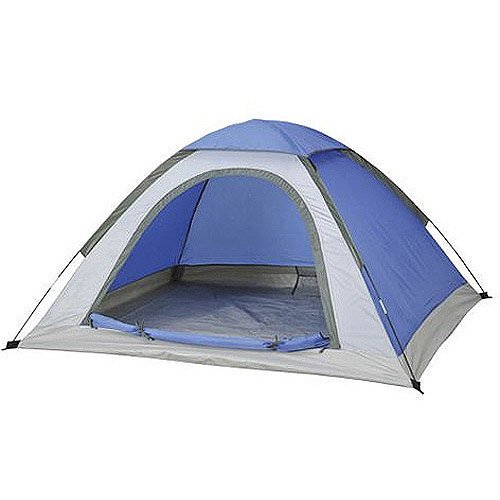
You know what I'm talking about: Small dome tents, usually marketed as "for kids", found in the sporting goods section of Walmart and Target and retailing for around $20. Yeah, those.

You should get one. 

I promise you I'm being completely serious here. I know they're not rugged, I know they're small. But you know what else they are? They're lightweight and will fit most adults, even if you have to sleep diagonally. 

Buy one and put it in your car. 


If your car ever gets stranded, you'll have a place where you can stretch out. You'll have a shelter that will keep the sun and bugs off you, and has better airflow than a car. You'll have somewhere dry to put your gear if you need to stay in the car for warmth, and if the car becomes an oven you won't worry about your preps going bad in the heat. 

If you need to walk home, it weighs something like 3.5 pounds. Compared to the food and water in my GHB, that's nothing. The shock-corded poles means it sets up quickly, which gives me more time to do other things. 

https://www.walmart.com/ip/Ozark-Trail-2-Person-Jr-Dome-Tent-6-x-5-Blue-NEW/197340435

Sure, the stakes are awful. Carry better ones

Sure, the fabric might tear or the poles might break. You have duct tape, don't you?

Sure, it won't withstand a tropical storm or keep you warm in a blizzard. It's a lightweight tent that you paid $20 for, and if it holds together long enough to get you home, then it's done its job and you've gotten your money's worth. You can always buy a new one if need be. 

https://www.target.com/p/wakeman-happy-camper-two-person-tent-green/-/A-54521249

Think of it like an umbrella you can lie down in. You've lost umbrellas before, or they've broken in rain storms, and you end up buying another to keep you dry "just in case you need it". 

Buy one, put it in your car, and don't worry about it until you need it. 

Sunday, January 26, 2020

Check Your Spare Tires

Not actually Erin.
& is used with permission.
Sorry, no Bottle Carrier BOB this week. I had something come up this weekend which put me very late in getting home from a speech I gave while 100 miles out of town.

Here's the short version:
  • I had no problems driving to my hotel, where I checked in, refreshed myself, and prepared my presentation. 
  • When I drove to the meeting three hours later, the car's rear end felt a little soft in the turns, like one of the wheels was low. I resolved to put some air into it after my speech. 
  • Driving to dinner after my speech, the tire got worse and worse until I knew I had a flat. I pulled into a parking lot to look at it and, yes, the left rear tire was flat. 
  • While I know how to change a tire, I was in my nice clothes and I didn't want to get them messy and greasy, and besides that I have roadside assistance with my car insurance anyway, so I'd just let them handle it. 
  • After a suitable wait, the assistance man showed up. I opened my trunk and he pulled out the spare tire... and then said "I can't fix this."
Here are pictures of what he saw, although these were taken 12 hours later:


I didn't know this, but apparently spare tires can go bad and should be replaced ever 4-6 years. This was my mother's car, a 2006 model, and I think that spare has been checked approximately never

For those of you wondering what happened next:
  • Roadside man tried to inflate my flat with a compressor, but I had a hole in the sidewall of the tire. 
  • It was 1 am and nothing was open, so I took a Lyft back to my hotel. 
  • The next morning I called another Lyft and put my luggage inside it (all my preps were inside the car, so I didn't have much).
  • I got back, took the above pictures, and put the luggage in the car. 
  • I intended to call roadside assistance again and get it towed to a tire place, but I had passed one coming back and knew I could get there by travelling half a mile through parking lots. 
  • The tire people asked me what I'd hit. I said "Nothing, why?" Apparently the other rear tire was also flat (no idea how) and so I replaced both. 
  • After about 3.5 hours, I was finally on the road and had an uneventful drive home. 
So if you haven't done so, check your spare tire to make sure it's still good. 

Tuesday, October 22, 2019

Stay With the Car

Every year in my part of the country, we hear tragic tales of tourists getting stranded and dying (or coming close) before they're found. If you're in the backcountry and your vehicle becomes disabled, what do you do?

The instinctive reaction from most folks is to leave the vehicle and try and hike out. This is one of the worst things you can do, and I'm going to tell you why:

Your car is easier to find than you.
A single human can very easily get lost, and is much harder to locate. Viewed from above, I occupy probably 3 square feet and have a matte finish; my truck occupies well over 100 square feet and is reflective. Additionally, I can only yell so loud and so often, whereas the horn on a vehicle carries further and can be used over a much longer time.

Your vehicle is a pretty good shelter. 
It will keep you dry in a storm, and if the engine runs you have some measure of climate control. Since most of these incidents seem to happen either in winter storms or desert environments, being able to keep warm or cool is a huge thing. You will also be more comfortable in your vehicle, sleeping better and keeping your wits more firmly about you.

Your vehicle also has all of your gear. 
If you leave your car, you have to leave substantial quantities of supplies that you may need. You can only carry about 25% of your body weight over any kind of distance, and that is with a proper pack. Loaded correctly and planning ahead, I can carry about 50 pounds; that sounds like a lot of weight, but keep in mind that a gallon of water weighs 8 pounds, and a gallon is about a day's supply under serious exertion! In the event that you're abandoning a vehicle, the odds of proper load-bearing gear being available are quite low, so that 50 pound capacity might fall to as low as 20 pounds.

If you stay with your vehicle, though, you have all of your gear at hand. You don't have to leave something potentially important behind because you have no way to carry it, or carry items you don't need on the off-chance that you might need them.

None of this applies if staying with your vehicle is a hazardous situation. 
Remaining in the path of a flood, or in an avalanche area, or with a dangerously damaged vehicle is a very bad plan. No matter how useful or easy to find your vehicle is, it's worthless if you're killed by a dangerous situation.


You may need to try to get yourself out of being stuck, but it should be your last resort, not your first.

Lokidude

Thursday, August 29, 2019

Two More for the Car Kit

While at work the other day, I realized how much duct tape we go through in a year. Granted, I work with a lot of outdated and poorly maintained machinery, but looking through the inventory logs I found that we use four times more than we sell.

Duct Tape
Duct tape is one of those "must have" items in a car kit. The uses are endless and it's easy enough to use that a child can figure it out. Be aware that the cheap dollar-store brands are a waste of money; the adhesive used is weak and not always waterproof, and the cloth backing is rarely attached to the tape well enough to withstand much weather. I prefer what is known as gaffer's tape, a type of duct tape made for the entertainment industry. (Gaffers are the "behind the scenes" people in music and movie production who spend a lot of time making sure everything goes right and that means a lot of quick repairs.) It's almost as good as the military-grade duct tape that I can't get any more (my supplier retired) and it will stick to almost anything except grease. Gaffer's tape should also be residue-free, meaning that the adhesive won't leave sticky residue behind, and most of it is a matte black color to avoid reflections.

A tip that I want to pass on about duct tape is that most brands come on a standardized cardboard tube. That tube just happens to be 3" in diameter, and is a perfect fit for dust caps or test caps for 3" PVC piping. Prices for test caps online is all over the place, and watch out for high shipping costs, but I have found them in a local DIY store for less than a buck apiece. Two of them will turn your roll of duct tape into a small storage box a bit bigger than an Altoids tin, which is a good use for wasted space and it might help you keep a few tools close to hand when you grab the tape. If you can't find test caps locally, keep an eye open in the mail room because the caps for 3" shipping tubes will work just as well.

Tie Wire
The second addition to a car kit should be some sort of tie wire. Being a farm-boy, I learned about baling wire a long time ago. Generally around 14 gauge (0.080 inch diameter), uncoated steel wire that a hay baler would use to secure small square bales of hay, the stuff was everywhere and used for every imaginable binding purpose -- I know of a lot of field gates that are still held closed by a length of baling wire. Farmers have moved to the large round bales in today's market, but you can still find small operations that use the little square bales for horses (they'll eat themselves to death if you give them a big bale) and straw for bedding.

Baling wire comes in 100 pound spools of over a mile of wire, so it's not practical for a car kit. If wire is too hard for you to cut or too stiff for the job, baling twine comes in similar spools and is jute, sisal, or polypropylene fiber. At ~8,000 feet per spool, two spools per package (the baling machines use them two at a time), this is best kept in a five-gallon bucket with a hole in the lid to feed the twine out of. It's handy to have sitting under a shelf in a garage or shop, but too big for an emergency kit.

This is what rebar tie wire was made for. It comes in smaller spools -- about 3.5 pounds, 330 feet long -- and slightly smaller wire (16 gauge/0.0625 inch diameter), but it's just as handy to have around. I've used partial rolls that I picked up out of construction site trash cans (they're already lighter) to patch up a lot of things long enough to get me home. For example, a friend hit a speed bump a little too fast and tore off his muffler, but a tie wire and a beverage can patched it up long enough to get back home. A rocking chair had to have the wooden joints re-glued and I don't have any clamps big enough, so washcloths for padding and tie wire did the trick. I don't think I can remember all of the times I've used some form of tie wire.

Both forms of tie wire feed from the center of the spool, which means the spool doesn't have to rotate as you pull the wire. A trick I learned from the construction workers is to wrap the outside of the rebar tie wire spool in a few layers of duct tape before use. This keeps the spool from getting caught on other things in a tool pouch, and prevents it from unspooling after you've cut the shipping ties.

If you live near the coast and plain steel wire will rust too fast for you, there is a more expensive option: stainless steel tie wire. I've seen this used for temporary binding of sheet metal and other things is damp or corrosive environments, and it's the same size and weight as the plain steel wire.


Holding things together until permanent repairs can be made is a key to field-expedient repairs. Make sure you have something a little stronger and more heat-resistant than zip-ties in your car kit.


Monday, May 6, 2019

Monthly Prepper Budget Part 2


Last week I spent $15 of the monthly $45 that used to go to Crate Club. This week I show you what I spent $5 and why it's a great deal for a prepper.


Tuesday, February 26, 2019

How to Change an Automobile Air Filter

Automotive maintenance is a necessary evil for folks who own cars, but it can also be incredibly expensive. While certain maintenance tasks require special tools or skills which justify the cost, some tasks extract their price based solely on convenience or ignorance. Today, we'll look at one of those tasks.

While I was doing seasonal maintenance on my truck, I noticed that my engine air filter needed replacement. A clean and unclogged air filter helps extend the life of your engine and maintain fuel mileage and power. Replacing it is a quick and easy task that requires no special tools, so I headed to my local parts house to get a replacement. As I did this, it struck me during this that people actually pay for this service, and I was curious what the charge would be. From the estimates, I could expect to pay in excess of $100 for a $13 part and 5-10 minutes of my time. Since this is a task that has to be performed at least yearly, those dollars add up quickly.

Also note that when purchasing an air filter for your vehicle, prices can range wildly. For my 2005 F150, a basic paper element filter costs the aforementioned $13. Since my truck is being prepped to regularly haul 6000 pound loads, and since I come from the land of the sand and snow, I chose to upgrade to a washable, cotton-element K&N air filter. (If you drive in extremely dirty conditions, or work your engine harder than the average Joe, this is an easy and worthwhile upgrade.) However, for your average A-B commuter vehicle (such as my wife's car) the basic paper filter matches what comes from the factory and will work just fine -- don't spend 3-5x the money if you don't need to.

To replace your air filter, follow these simple steps:
  1. Locate your air filter box. Locations vary by model, but expect it to be on top of the engine and readily accessible. If you aren't certain or can't find it, the location should be listed in your owner's manual.  Mine happens to be above the engine in the rear-center of the engine bay.

  2. Open the box and remove the old air filter. On most cars, the top lifts off and the filter lifts out, but on my truck, the filter is contained in a sliding tray. Some vehicles use clips to hold the air filter box together, while others use screws and will require a basic screwdriver to open.

  3. This filter is obviously dirty and in need of replacement.

  4. Insert the new filter into the air box and close it back up. Your filter box should go back together easily with almost no force needed. If you feel like you're having to force things, check that your filter is fitting into the box correctly and that nothing is obstructing the lid.

There is no reason to pay exorbitant prices for basic work and inexpensive parts. Do simple work like this yourself to save substantial money.

Lokidude

Monday, December 3, 2018

Driving in the Snow


Friday night there was a slight cold snap. Just a little chill, really.

On Saturday I had to go south by about a hundred miles, and ended up leaving for home right before midnight... at which point I traveled through a snow storm in the middle of the night on mountain passes with limited visibility and sheer cliffs.

For those of you on the east coast  reading this: when I talk about mountains, I'm not talking about the mountains on the Appalachian trail. The highest mountain peak in Maryland (where I spent a fair amount of time growing up) is over 3000 feet. As I look out my window I can see Mt. Timpanogos, which is close to 4 times that height, and doesn't even break the top 5 tallest peaks in my state.

These are not small mountains, and the trails in them tend to be twisty and windy due the height of the terrain. I've had to learn to drive in the snow, and have had to do so as a matter of being able to get around. I have to do it fairly well, because going off the side of the road doesn't mean getting towed; it means wondering if I left my toaster oven on in the several seconds that I have left while I plummet to my death.

The next time you are stuck somewhere where it is unexpectedly snowing -- or if you need to bug out to a snowy location -- remember these three rules.

Drive Slow
If there's snow on the road, keep an eye on your speed. Any snow at all means that it's cold enough to form ice on the road, and patches of “black ice” (ice that does not show up visually against the road, but is still very slippery) can form.

If the road is covered in snow such that you can't tell where the lane markers are, or where the edges of the road are, driving slowly is the only way to give yourself enough time to safely brake or make turns.

Sudden braking is actually a very bad idea as it's very likely to cause skidding. You may not be able to avoid it, but if you have to brake suddenly, you want to be doing so at a low speed. Sharp turns can cause the same problem.

Getting into a car accident will put a much bigger dent in your schedule than saving the five minutes by going faster. Remember that.

Drive Low
Most modern cars are front-wheel drive. A lot of them have a tendency to understeer in bad weather, due to swinging around. Having a little junk in the trunk (I recommend a thorough emergency kit) gives you extra traction, which can save your life when you are dealing with adverse conditions.

If you have nothing else, and need cheap weight, buy kitty litter or play sand. They also provide grit (for traction) if you need it to get out of a slippery spot.

Once again, a car accident (even just denting your bumper) is much more expensive than the extra mile or two per gallon you will save by having no extra weight in your car, so put the bowling ball back in the trunk.

Drive Light 
Keep your running lights on. If it's after dark, people will turn on headlights, but there's nothing wrong with keeping your running lights on at all times and erring on the side of caution. Being visible to other drivers makes much easier for them to avoid hitting you.


You can save yourself a lot of grief with some basic preparedness. Having lived in the south (Alabama) and the northeast, I understand what having an unexpected flurry of snow can do to traffic, and to the ability to get around. Hopefully, if you ever have to bug out, it won’t bite you in the back.

Good luck, and don’t forget to practice.

The Fine Print


This work is licensed under a Creative Commons Attribution- Noncommercial- No Derivative Works 3.0 License.

Creative Commons License


Erin Palette is a participant in the Amazon Services LLC Associates Program, an affiliate advertising program designed to provide a means for sites to earn advertising fees by advertising and linking to amazon.com.