Showing posts with label Plants. Show all posts

Thursday, November 9, 2017

Damaged Trees

Back in September, I wrote about the damage storms can do to trees and how to deal with downed ones. I finally got a chance to to talk to an arborist friend about damaged trees that are still standing, and he passed along some helpful tips in the form of questions to ask. He also mentioned that he gets more work from cleaning up after drunken/distracted drivers than he does storms, so there are multiple uses for this information.

Is the tree generally healthy? 
If it was struggling before the damage, it will have a poorer chance of recovery.

Is the trunk of the tree broken? 
Since the trunk is the main structural support of a tree, any serious damage to it will make the tree weak and unsafe. I have seen trees with splits in their trunks live a long time, but they rotted from the inside. Vertical breaks are not as bad as horizontal breaks or twisted trunks.

Are the major branches intact? 
If more than half of the main limbs or branches coming off of the trunk are broken, the tree will probably not survive and should be removed. Lost limbs take a lot of food and energy to replace.

Does the tree have enough leaves left on it? 
If more than half of the leaves and minor branches are gone, the tree won't be able to produce enough food to survive many more seasons.

How much of the bark is missing? 
Small tears in the bark on large trees is not a problem, but any time the bark is damaged or removed the tree will lose the ability to move water and nutrients up past the damage. Losing a patch of bark and the underlying cambium below a limb will starve that limb and kill it within a few years at most. A tree with a strip of missing bark that goes around the trunk has been “girdled” and will be dead in a year.

Keep or Replace
In the end, you're going to have to decide whether to keep the tree or not.

  • If the tree is placed to provide shade, are the remaining branches going to do the job? 
  • Is the tree a decoration in the yard (easy to replace) or does it serve a purpose (fruit production, wind break, etc,)?
  • Does the tree have any sentimental value, like being planted to mark a birth or death? 
These questions may lead to giving a tree the benefit of the doubt and trying harder to save it. If it is in the wrong place, or is a variety that is ill-suited to your area, then removing it is an easier decision to make.

After you have removed any broken limbs and made sure nothing about the tree is unsafe, take a step back and wait a while. That tree isn't going to walk away, so you can always decide to take it out later. It may surprise you and start to grow new limbs to replace the missing ones in a year or two.


Don't rush your decision and watch out for the inevitable scam artists who descend on every disaster scene. Just because someone has a business card and a magnetic sign on his pick-up full of chainsaws doesn't mean he knows what he's doing. Arborists are like any other professional service provider and are licensed by most states, so check with your state licensing boards to make sure you're not dealing with a scammer. Local people will also have a better understanding of your climate and native species of trees, so give them the first chance at looking at your trees.

Monday, October 9, 2017

Useful Potted Plants

(Sorry, but this post isn't about that kind of pot plant.)

In the event of a longer term disaster, food storage is essential. One of the most effective ways for people to have that stored food is to grow the stuff themselves. Unfortunately for apartment dwellers, growing a large garden plot is usually impossible.

However, I have grown all of the following plants in an apartment setting. I've selected plants that are easy to grow, are tolerant of poor conditions, and are dense in vitamin C (something likely to be lacking in an emergency). All of these can be transplanted if the conditions are correct, and you can grow a much larger crop of these the next year if things go badly.

Salad Greens 
These are fairly easy to grow in a coffee can, and when kept in a sunny window can produce an insane amount of food. I am partial to chard and spinach since they do well in cold climates, but for people who live in warmer areas (and have warm houses in the winter) I recommend lettuce.

If you grow these in a windowsill planter box, don’t plant them too close together; you will actually get a larger harvest if you give them a little more room to grow.

Salad greens also tend to work well for a “continual harvest” model, allowing you to have fresh greens year round as long as they have light.

Tomatoes
These work really well with a hanging planter or on a balcony, and are a little hungrier for light than a lot of other plants. Fortunately, they respond well to artificial lighting and to moderate-to-poor soil with a good fertilizer, such as the water from a freshwater fish tank.

If you are careful in your selection of plants and provide artificial light, you can get a year-round harvest of some fairly tasty fruit regardless of outdoor climate.

Bunching Onions
A small clay pot with bunching onions or chives makes an excellent source for seasonings. They will spread quickly if planted in ready ground so long as they are watered regularly (no more than once a week, no less than once a month - it's a big window).

If kept indoors, you can have onion greens year-round that you can harvest with scissors; if kept outdoors, just don't put them in heavy shade.

Small Citrus Trees
Yes, really. I like kumquats since they are small, single servings of fruit that mature quickly, but I have had dwarf limes and similar. I recommend getting  citrus fertilizer and a good clay pot with a tray.

Aloe
I consider this a non-food plant because even though it is non-toxic and edible, it tastes disgusting. There are cultures that use it as the basis for some fairly tasty foods, but only after processing it. There are however advantages to cultivating aloe:
  1. It has legitimate medical uses. There are mixed results on a couple of the studies on it, but there are some very clear uses for it, including pain relief for burns. There is even some evidence that aloe is useful for treating digestive conditions and mouth ulcers.
  2. Aloe is a succulent, which means that it stores water in its leaves. If you forget to water it for a month, it will still be around! This makes it an excellent “learner” plant -- if you want to learn how to take care of plants, and want something easy to learn on, this is it.
  3. If you keep it alive for long enough, you may be able to train your roommate's cat out of eating your houseplants -- the cat will be unhappy, but unharmed. The same thing goes for small children; barring an allergic reaction or choking on it, the child will be unhappy about the bitter taste, and otherwise unharmed. 
  4. It grows relatively slowly, so you don’t have to transplant it every three months, and is fairly popular as a house plant, so if you have to get rid of it, it is easy to find a home for.
  5. Aloe also makes pretty decent lube. Don't be dirty! You never know when you might need to grease some machinery or use a catheter. 
Honorable Mention: Spider Plants
Spider plants are awesome little air scrubbers that provide non-toxic greenery. They actually scrub industrial pollutants from the air and are generally not offensive to roommates. I recommend these as another potential “learning” plant, but your cat/small child will not find the taste offensive.

For both of these and aloe, I recommend a clay pot and a hanging planter.


Growing at least a little bit of food is totally possible, even for an apartment dweller. There are oodles of “How to” guides on how to grow all of these, and I leave it to the reader to find those. As always, don’t lick the wires, and don’t forget to practice.

Thursday, September 28, 2017

Trees After a Storm

While looking at pictures of the aftermath of this year's hurricanes (and the season's not over yet), I was struck by the number of trees toppled and torn by the 100+ mph winds. I was reminded of the trees we lost around here after the 2011 floods (although ours took a year or two to die from drowning - a tree's roots need air) and the damage I've seen tornadoes do to homesteads and wood-lots.

Most of us like having trees around. They provide shade in the summer, firewood for the winter, and we hate to see them destroyed by hurricanes, floods, and tornadoes. Trees are often symbols of permanence and strength, and it is disquieting to see them chewed up like a dog toy. Fruit and nut trees can provide food in small lots and income when planted in larger numbers. There are a lot of reasons to like trees.

So, what do you do after the storm has passed and you begin to survey the damage so you can make a plan for the future?

Safety First!
  • Be on the lookout for trees and branches in contact with power lines. There is no easy way to tell if a power line is “live” or not, and wet wood makes a fair conductor of electricity. If you see trees in the power lines, call the experts.
  • Unless you have experience felling trees, leave the standing or leaning trees to the experts. Broken branches stuck in a standing tree are often called “widow-makers” for good reason - they are unpredictable and dangerous to clear. Leaning trees will have unnatural stresses on the trunks and they may not react to cutting as you expect them to. Work from the top down if at all possible to avoid having a trunk release the pressure from a twisting or tilting stress in a way that is unexpected.
  • Use your personal protective equipment (PPE). Safety glasses, gloves, hearing protection with power tools, and Kevlar chaps if you're running a chainsaw. Keep non-workers a safe distance away; you don't want to get hurt or injure a bystander and add to the load on emergency services. (We've covered this before in various posts about firewood.)

Clear the Paths
  • Roads and walkways should have priority over yards; you're going to need the roads to get help in and out, and at the very least having a cleared path will make it easier to get rid of the debris. The only exception I can think of is if you have or expect looters and would prefer to make their travel more difficult. Some would consider clearing the roads for looters “hunting over bait” and therefore unsporting, but that's a personal decision.
  • Clear the area around where you're going to be working. Less clutter means fewer things to trip over, which is always a good idea when you're dealing with cutting tools. Having helpers keep the area cleared as you cut a tree into manageable pieces will speed things up and is a good use of unskilled labor.

Know How to Dispose of the Debris
  • In the aftermath of a major storm there is always a huge pile of debris to get rid of. Locally, we see this after every ice storm and tornado. Tree limbs and branches are often piled and burned at centralized locations in order to prevent hundreds of smaller, less well-watched fires from causing further damage. This also gives some control over the smoke produced by burning green wood, since it will be coming from a single source which is usually well away from where people are living.
  • If there are no centralized services available (yard waste collection), you may have to set up a “burn pile” on your own property. Think of it as a huge campfire and build it with the smaller pieces on the bottom and the larger ones on top. This will allow the heat from the smaller pieces burning to rise past the large ones, giving them a chance to dry out enough to burn with less smoke.
  • If you have a wood chipper, composting the debris is a good option. Even just putting a layer of wood chips down around the base of healthy trees is better than burning wood for the sole purpose of disposing of it. Wood chips will help hold in moisture and keep down weed growth, and they tend to make it easier to mow around trees as well.

I'm going to talk to an arborist friend soon and will try to get some professional advice on how to decide if a tree is too damaged to survive, so I'll cover that process in a separate post. They might grow into weird shapes, but trees are pretty resilient to damage from what I've seen.

Friday, October 23, 2015

The Universal Edibility Test

Not actually Erin.
& is used with permission.
This originally appeared in my BCP segment on last week's Gun Blog Variety Podcast. I thought the information useful enough that who who listened would enjoy a hardcopy version, and this would also make it available for those who do not listen to podcasts.

The Universal Edibility Test is a procedure whereby you can determine whether or not you are allergic to food. While the UET is designed to work on plants and fruits, I don’t see why it wouldn’t work on other foods as well.

There are more than 700 species of poisonous plants within North America. It is nearly impossible to know them all, and for those of us with severe chronic allergies (like myself), several plants which are listed as "safe to eat" may induce an allergic reaction up to anaphylactic shock. Therefore, in any long-term survival situation where food must be foraged, knowing the Universal Edibility Test and being able to perform it is critical knowledge. 

The UET
I recommend that all preppers print out this chart, laminate it, and keep it with their bags. 
http://www.wilderness-survival.net/figures/fig9-5.gif
The biggest drawback to this test is that it takes time: there are three steps with a waiting period of 8 hours between them. Fortunately, you aren’t going to starve to death while you’re doing this; it takes a healthy adult about 3 weeks to die of starvation, and if you’re in a hurry you can finish this test within 24 hours. 

However, with proper planning you won't need to do it all in one day. This test can be spread out over three days by performing each step first thing in the morning after waking up. Then, after 8 hours have passed (or less, if you have a negative reaction to the food and realize it's no good for you), you can then eat your known good food for lunch and dinner. 

Of course, this requires you to have a source of known safe food already. Don't start this process when you have nothing safe to eat, or you're going to have a miserable time. 

Pre-Screening
Before you start the test there are some things to immediately rule out. These are:
  • Anything with thorns, spines, or irritating hairs. 
  • Plants with shiny leaves. 
  • Plants with umbrella-shaped flowers. 
  • Any plant you know to be an irritant, like poison ivy, oak or sumac. 
  • Any plants with white or yellow berries. Don’t just "not eat the berries"; don’t eat anything on the entire plant. 
  • Any plant with a milky or discolored sap. 
  • Anything that smells like almonds that isn’t an almond tree. That’s usually a sign of cyanide within the plant. 
  • Anything which is moldy, rotten, or infested with parasites. The last thing you need in a survival situation is food poisoning or a parasite infection. 
  • Mushrooms. There’s just too much risk for the small calorie reward of eating a mushroom, so unless you are 100% CERTAIN that it’s not poisonous, just leave it alone. 
It's worth noting that these guidelines are just rules of thumb; there may very well be some plants with these characteristics that are safe to eat. However, there are many more with these characteristics which aren’t safe. These fall under the auspices of "In a survival situation, better safe than sorry.”
 rules.

Implementation

1) Separate
Some parts of a plant may be edible and other parts not, so you need to separate them into the five main components of leaves, roots, stems, buds and flowers. Inspect each piece and looks for some of the characteristics I mentioned earlier, like parasites or an almond smell. 

2) Contact 
(requires 8 hours of not eating prior to testing)
Take one specific plant part, crush it, and rub it against the skin on the inside of your wrist or elbow, or behind your knee. If it has sap, make sure that gets on your skin too. The idea is that you want to test it on tender skin, not something calloused like your fingers. 

Hold it there for 15 minutes, and then wait for 8 hours, drinking only purified water.

You’re looking for an allergic reaction like itching, burning, redness, bumps, hives, etc. If it’s not good for your skin you’ll have a reaction, and it’s better to have a skin reaction in a survival situation than intestinal distress. 

If there’s no reaction after 8 hours, you can go on to the next step. If you’re hungry and have a source of known good food, go ahead and eat what’s safe and perform the next step the following morning.

3) Prepare the Sample
(requires 8 hours of not eating prior to testing)
If you plan on eating the food cooked, then cook it; if you’re going to eat it raw, then do whatever you’d do to it, like peeling the skin. Just make sure that any food which passes this test is only eaten in this manner; there are plenty of plants which can become toxic after being cooked.

Some suggestions:
  • Ripe fruits are best peeled and eaten raw, but unripe fruits are best cooked. 
  • Anything taken from underground (like roots or tubers) ought to be cooked to kill any bacteria or hidden fungus. 
After the food is prepared to your satisfaction, place it to your lips and hold it for 3 minutes. You’re looking for the same kind of reaction as with the contact test.

If there is no reaction, move immediately to the Taste test. 

4) Taste
Put the food sample on your tongue and hold it there for 15 minutes. If it tastes soapy or bitter, spit it out; you're safer not eating it. 

If you experience any unpleasant sensations like itching, stinging or burning, spit it out and rinse your mouth with fresh water until the sensation ceases. 

5) Chew
Chew it well and hold it in your mouth for another 15 minutes. Don’t swallow anything, not even saliva, during this test! Spit instead.

If nothing happens after 15 minutes (you’re looking for the same unpleasant reactions as earlier), move on to the next step

6) Swallow
Swallow that soggy piece of plant you’ve been keeping in your mouth. Yum yum!

After this comes another 8 hours of waiting, where you don’t eat anything else and only drink purified water. If at any time you have feelings of nausea or stomach pains, induce vomiting. and drink as much water as you possibly can to dilute whatever is reacting inside you.

However, if you feel fine after 8 hours, you can move to the final step.

7) Chow Down
(requires 8 hours of not eating prior to testing)
Prepare a small serving, about a quarter of a cup (60 milliliters) in exactly the same way you did before and eat it. Wait 8 more hours, eating nothing else and drinking only purified water. 

If, after these three 8 hour periods, you have no adverse reactions, then that one specific piece of the plant that you tested is safe to eat. You may now move on to testing other parts of the plant.

Helpful Suggestions
  • Only test plants which are in plentiful supply. You’re basically spending a day testing, so don’t waste that time. 
  • Don’t assume that anything which is edible raw is edible cooked, and vice versa. If you plan to eat them both ways, test them both ways. 
  • Don’t assume that just because an animal can eat it that it’s safe for humans! Just like we can eat chocolate but it’s toxic to dogs, there are many plants which wild animals can eat that are poisonous to us. 
  • Of course, if you can recognize the plant -- like a banana tree or a strawberry bush -- then you can skip most of those steps. I recommend the Field Guide to Edible Wild Plants as a good addition to you bug-out bag, and the Wild Edibles app for your smartphone or survival e-reder. 
  • Finally, know that the Universal Edibility Test isn't 100% proof. There are many plants which can pass this test but present health hazards after long-term consumption

Stay safe out there!

Tuesday, July 28, 2015

Edible plants

Last week, Erin talked about plants you should definitely stay away from, and last year Evie talked about a couple plants with interesting uses. Today, we're going to take a look at other plants you should be seeking out, specifically because they're nutritious (and potentially delicious). There are also plants growing wild with various medicinal uses, but I'll leave those to folks who are far better versed in their use.


Asparagus
Wild asparagus grows over a huge portion of the United States, thriving in pretty much any place with sunlight and water. It is prepared exactly like store-bought asparagus; steamed, boiled, roasted, or any other method you like.
http://wholefedhomestead.com/how-to-hunt-and-forage-for-wild-asparagus/
I'll admit to being a gross novice at actually harvesting wild asparagus beyond a bit of blind luck. However, there is a very in-depth article here that covers the topic in wonderful detail.

Prickly Pear Cactus
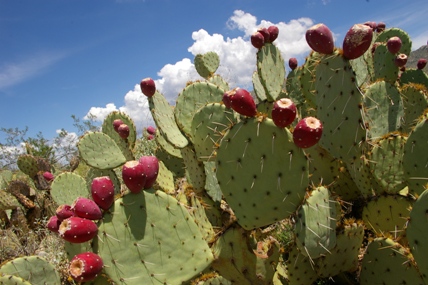
Many species of cacti are edible in some way or another. One of the best, and better-known varieties in the western and southwestern deserts I call home, is the prickly pear. While the stem of the cactus is quite edible when boiled, the real jewel is the red or purple fruit.
http://www.nps.gov/sagu/getinvolved/supportyourpark/images/prickly_pear.JPG
Be sure to skin the fruit before you try to eat it, because being a cactus, it has all of the traditional defensive measures.  Once skinned, the pulpy flesh inside is delightful.  Eat around the seeds, as they are tough and inedible.

Cattails
If the area you're foraging in includes wetlands, cattails are a very real potential food source. Nearly all of the plant is edible, with boiling required on many parts to make it edible. Dig up the roots and boil them. Boil the leaves and stalks. The head of the plant can even be cooked and eaten like corn on the cob.
http://www.fcps.edu/islandcreekes/ecology/Plants/common%20cattail/132s29.jpg

These three common, widespread edibles are high in nutritional content, simple to prepare, and can taste quite good.  While restricted in range, prickly pear fruit are a wonderful source of nutrition, water, and wonderful flavor.  The other two plant species are so widespread as to border on being universal, and can help save your life no matter where you're trying to survive.

Lokidude

Sunday, July 26, 2015

Gun Blog Variety Podcast #49


Here's Episode 49 of your weekly GunBlog VarietyCast!

Included in this week's episode:
  • Adam and Sean tell you what podcasts we listen to. We listen to a lot of podcasts. You should too. But listen to us first!
  • Erin Palette talks poison plants with a quick primer on disease prevention in Gotham City.
  • Even Nicki Kenyon will eventually bow to peer pressure. You've been asking her to talk about Iran, so she finally does.
  • Our Special Guest, Reverend Kenn Blanchard tells us about this one time he found himself in deep, deep water and needed a miracle.
  • Barron B considers the Ashley Madison hack and what could have motivated it.
  • And Weer'd points out how the anti-gunners have gone beyond their usual lies and have started slandering the rest of us.

Thanks for downloading, listening and subscribing. Like and share us on Facebook, and don't forget to tell a friend.
Listen to the podcast here.
Show notes may be found here.
A special thanks to our sponsor, the Law of Self Defense. Use discount code "Variety" at checkout for 10% off the best legal self defense training you can get.

Friday, July 24, 2015

Poisonwoods and Death-Apples

& is used with permission.
Pop quiz: How many "poison" plants are there? And by that I don't mean plants which are poisonous; I mean the ones which cause contact dermatitis after touching them?

Answer: More than you think.

Last week I talked about good survival television and mentioned Naked and Afraid. One of the reasons I specifically added that show to my article is because it brought to my attention the existence of several poisonwood species of which I was previously ignorant. Everyone knows about poison ivy, and most of us who've been to summer camp or been in the Boy/Girl Scouts know about poison oak and poison sumac. But there are other, lesser-known species that are no less dangerous  and some are much more so.

First, the Classics
Special thanks to Poison-Ivy.org for these amazing maps and references. Be sure to follow the links below for more information, including lots of detailed color photographs of the plant in various seasons and environments. 

Poison Ivy
Eastern poison ivy and its Western sister species grows everywhere within the continental United States with the exception of California. It covers nearly all of North America, going as far north as the Canadian territories and as far south as the mountains of Mexico. Note that there are many states where both kinds exist!

Poison ivy likes to grow near water, such as rivers and lakes. Eastern ivy can appear as a vine or a ground plant; western ivy is ground-only. Both are equally nasty. 
http://www.poison-ivy.org/eastern-poison-ivy
Poison Oak
Just in case you thought California was getting off lightly with not having poison ivy, let me introduce you to Pacific poison oak, which looks like it was specifically designed to bedevil Californians -- it's found all over the state, in all plant configurations, and when it burns in the state's frequent fires, the irritant inside it (urushiol, found in all of the species on this page) is aerosolized, meaning that breathing the smoke can result in harmful, sometimes even fatal, cases of rash on the inside of the lungs. 
http://www.poison-ivy.org/pacific-poison-oak

http://www.poison-ivy.org/pacific-poison-oak

Oh, but don't be too smug, East Coasters: there's also Atlantic poison oak.
http://www.poison-ivy.org/atlantic-poison-oak

Poison Sumac
The good news about poison sumac is that it doesn't exist across the entire country like the others do. The bad news is that it's much harder to detect, as it doesn't follow the "Leaves of Three" rule. It simply has an odd number of leaves, between 7 and 13, on its branches.

It also looks like a shrub or small tree -- not a vine -- and so it's harder to detect and easier to bump into. The best way to avoid it to stay away from bogs, marshes, swamps and other wetlands where it prefers to live.
http://www.poison-ivy.org/poison-sumac

http://www.poison-ivy.org/poison-sumac

And Now, the Exotics
From the above illustrations, you can see that Florida, where I live, gets all three.

Well... five, actually. 

Poisonwood
Also known as the Florida poisontree or hog gum, the Poisonwood is a flowering tree in the same family as poison ivy, oak and sumac. It can be found in south Florida (it grows abundantly in the Keys), the Bahamas, and all the way through the Caribbean. Its sister species, the chechem or black poisonwood, is found further south in Cuba, Jamaica, the Dominican Republic, and from southern Mexico (Yucatan to Veracruz) to northern Central America.
http://www.sfrc.ufl.edu/extension/4h/ecosystems/_plants/Poisonwood/index.html
Poisonwoods are nasty customers. They are infused with urishiol in greater concentrations than ivy, oak, or sumac; it's practically acidic in the way it burns. In at least one instance, poisonwood sap resulted in a second-degree burn. Watch this video to see how quickly it starts affecting someone who's touched it.


Its bark looks like it is oozing sap, or has a skin disease.
For more information on how to identify the tree, visit the University of Florida School of Forest Resources & Conservation, because if you go on vacation in South Florida or the Caribbean, you WILL want to know how to identify it.

As bad as the poisonwood is, though, there's actually another tree in Florida that's much, much worse. How much worse?  The Spanish name for it has the word "death" in it.

Manchineel
The Manchineel, also known as la manzanilla de la muerte -- "little apple of death" -- will not only burn and blister your skin if you touch it, or you stand beneath it when it rains, its sap (or smoke from burning it) can also cause blindness and eating its apple-like fruits can kill you. 

http://edis.ifas.ufl.edu/fr370
The caption for the above picture literally states  All portions of the manchineel tree are poisonous. It actually holds the Guinness World Record for "Most Dangerous Tree"! (I didn't even know there was a contest!)


Here's a first-account account of someone who ate a manchineel fruit -- a "beach apple" -- and lived to tell the tale.

https://www.flickr.com/photos/globalreset/2651266643/


Manchineel trees can be found throughout South Florida, the Bahamas, the Caribbean, Central American, and northern South America.

If you plan on going on vacation to one of those places, then learn to identify it. Not every tree will be as obligingly labeled as the one to the right.


Side Note
There's actually a sixth poison tree, the Chinese lacquer tree, which is the same genus as poison ivy, oak, and sumac. But it only grows in China, Korea, Japan, and parts of the Indian subcontinent. But as this article is already excessively long and not many of my readers will encounter one, I leave its investigation as an exercise for the curious student.

Resources

Monday, July 14, 2014

Dandelions, Stinging Nettles and Clover, Oh My!

Three weeds of annoying persistence, with secrets hidden within their simple (and in one case painful!) leaves.

Clover

Clover is an incredibly tasty wild green that people in almost every part of the North American continent walk past without much notice. With over 300 species in an incredibly broad range across the world, this simple little plant is most commonly recognized here in the United States as White Clover and Red Clover (named for the color of their blooms). When most people think of clover, they think of hay and food for animals.  The two species of clover I just mentioned above are the most common and are edible!

"Livada" by Snezana Trifunovic - User:Tsnena.
Licensed under Public domain via Wikimedia Commons.
"Trifolium repens" by Forest & Kim Starr. Licensed under Creative Commons Attribution 3.0
via Wikimedia Commons.
Yes, I said the humble clover is downright tasty. Once upon a time, when I still had a cabin in an area that I enjoyed, I used pick fresh clover and young dandelion leaves to help supplement my salad preps. Clover has a slightly sweet taste and the blossoms are edible as well.

Something to note about red clover: it's a source of many valuable nutrients including calcium, chromium, magnesium, niacin, phosphorus, potassium, thiamine, and vitamin C. There is also a slowly growing body of evidence that suggests that red clover can help lower blood pressure (something to note for those of you who may take medicine for such a thing).

Preparation

  • Seeds and dried flowers from clover can be mixed into flour supplies for breads and other grain stocks to add a boost of nutrients as well as extend the amount of food available for use. 
  • Young clover and flowers are eaten raw. 
  • Steamed clover makes a great substitute for spinach, too. Steam until just welted, season to taste, and dig in!

"Brennnessel 1". Licensed under
Creative Commons Attribution-Share Alike
3.0 via Wikimedia Commons.

Stinging Nettle

My apologies for the itch that may have erupted from your memory. If you were anything like me growing up, stinging nettle was your nemesis when adventuring. However, until a few months ago I was not aware that this bastard plant... was edible. Yes, edible.


Preparation

  • Bring the water to a boil and drop them in.  They are tender almost immediately and ready to take your favorite seasonings.  It's a top wild source for Vitamin A and C. HOWEVER, only use plants a foot tall or less.
  • Older Nettle plant stems can be used for fiber making. 
  • Nettles can also be a source of vegetable rennet. Yes, rennet as in cheese-making rennet.  You boil the plant until there starts to be a oily extraction on top of the water.  I've heard numbers from 2/3 a cup to a cup and a half of chopped nettles for roughly a tablespoon and a half.  The amount of cheese that much will render, the numbers are scattered from 1 lb to 8 lbs of cheese.


Dandelions

"DandelionFlower" by Greg Hume.
Licensed under Creative Commons
Attribution-Share Alike 3.0
via Wikimedia Commons.
Now, dandelions are once again being recognized as food and have been cropping up in articles everywhere. So I'm not going to delve into them here; instead, I'll just give you several links to the articles as those folks have broken down the plant better than I could.


All three of these plants will often be found in the same meadows and fields.  Once you brush up on what they look like, they will be a welcome treat in the spring and early summer after a long winter of dried and canned goods.

The Fine Print


This work is licensed under a Creative Commons Attribution- Noncommercial- No Derivative Works 3.0 License.

Creative Commons License


Erin Palette is a participant in the Amazon Services LLC Associates Program, an affiliate advertising program designed to provide a means for sites to earn advertising fees by advertising and linking to amazon.com.