Showing posts with label Dry Fire. Show all posts

Monday, January 6, 2025

Snap Caps & Dummy Rounds for Dry Fire & Malfunction Practice

Modern firearms are “dry fire safe” in that they don’t need a round or snap cap in the chamber to safely work the trigger mechanism through the full range of operation. However, snap caps are a useful tool for deliberately inducing a “failure to fire” event during live training to help perfect the “clear a malfunction” sequence into muscle memory. 

Snap caps are commercially available from a number of manufacturers, often in sets of five for handguns and sets of two for rifles and shotguns. However, it’s often cheaper to make your own dummy rounds using commercial ammunition components.

https://amzn.to/40f7fth

In my military service, a dummy round was an inert training aid that can be easily distinguished from live ammunition by having indentations on the sides of the brass, being a different color entirely, or a combination of both feel and appearance. These dummy rounds were used in training personnel to use weapons in a safe manner, often in classroom locations. Lessons on how to load, arm, and troubleshoot a failure to fire could all be done as slowly as needed before going to a range and doing it live. If you’re helping to introduce new people to the shooting sports, then dummy rounds are a great tool for teaching basic firearm manipulation, how to load, unload, and so forth.

Making Your Own
I like to make my dummy rounds with a drill press by drilling holes through the sides of the cartridge case for an easy visual indicator that they aren’t live ammunition. Since I’m a handloader, I can omit the steps of priming and charging a round before crimping in the bullet. This leaves me with a dummy round that has holes in the side for visual identification, but weighs very close to what a live round would weigh. I find this to be useful for properly weighting a handgun magazine, as 15 rounds of 115gr 9mm ammunition is about 3.5 ounces of additional mass if you’re practicing “draw from concealment” drills at home.

The author's handmade dummy rounds

Some of you may be wondering “Why not just take a live round and drill through it?” I’ve done this when no other option was available to me, and it works because brass doesn’t spark. I don’t recommend it, though, because there’s still a lot of steel-cased ammunition on the market and I don’t think the risk justifies the potential reward. 

Additionally, if you drill a live round and then pour the powder out the holes, you still have to deal with the primer. You can’t use your firearm to do that, either, because the chamber would be directly exposed to the hot primer gas and you might dislodge the bullet into the barrel.

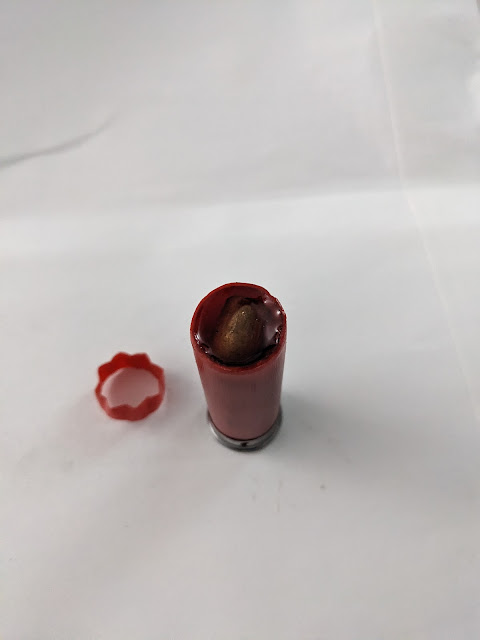
For dummy shotgun rounds:
  1. Take a spent hull and fill it with BBs and epoxy just below the crimp line. Because the vast amount of mass in a shotgun shell is in the lead shot, you really have to add a filler material back in to get the right weight/feel.


  2. Wait for the epoxy to harden, then cut the crimp away at the crimp line.


  3. Drill the visual indicators in the metal part of the hull and drill out the spent primer. 


This is a tad more expensive than pistol or rifle dummies, but still quite a bit cheaper than commercial snap caps or dummy rounds. 

Concerns
“Is there a risk of having a bullet from a homemade dummy round come loose into your firearm?” Yes, but I've not yet encountered that in reality. I’ve experienced an AK-style rifle (Saiga .308) slam uncrimped match ammo so hard into the chamber that it unseated the bullet spilling powder everywhere, so it’s entirely possible that this “inertial bullet puller effect” could happen with a dummy round. If you’re worried about that, then don’t use homemade dummy rounds mixed with live ammo for live training.  However, I haven’t experienced this with dummy pistol ammo, and the dummy shotgun ammo is epoxied in place.

Conclusion
Dummy rounds are useful for teaching new shooters the manual of arms with a firearm and for working misfire drills and dryfire practice for more skilled shooters. I cannot recommend strongly enough that every prepper incorporate dummy round-enhanced training drills at home, as they are incredibly valuable to skill building and skill retention and don't require range fees or expending live ammunition.

Dummy rounds are also cheap to purchase and easy to make if you have reloading tools, and I encourage you to buy or make them at your next opportunity. You don't need a whole lot of them, but you should have a few on hand for practice and education. 

Saturday, December 28, 2024

Product Review: Laser Ammo's Recoil Enabled Glock G19 Training Pistol

Not actually Erin.
Used with permission.
David has talked about the importance of dry fire for marksmanship, and I agree with that position. If you carry a firearm as a self-defense prep, then you must  ensure that all of your shots go where you need them to go if you ever shoot in defense of yourself or another. Unless you're law enforcement, you aren't protected under qualified immunity if you miss your target and hit an innocent person; regular folks like you and I are legally responsible for every bullet that leaves our gun. 

David also reviewed the Mantis X3 dry fire system, which has the benefit of enabling the user to practice with their own firearm. However, as he observed, any gun which uses a striker rather than an external hammer will require either working the slide between shots or the purchase of specialty dry fire magazines, which are both expensive and only fit a limited selection of firearm models (Glock seems to be universal, followed by Sig Sauer and S&W M&P). 

Another solution to this dilemma is to purchase a recoil-enabled training pistol from Laser Ammo. I have the Gen 5 Glock 19 version with infrared laser, so my review will focus on that, although I assume that the other Laser Ammo guns (Glock 171911 and Sig Sauer M17, M18, P320) function similarly. 


Comparisons With Reality
Built on the chassis of an Umarex airsoft Glock 19, these training pistols function exactly like a Glock 19 with the sole exception of being unable to fire bullets: the trigger safety functions the same way, the slide reciprocates and can be locked back, magazines are loaded and ejected identically, and it can even be field-stripped in exactly the same manner as its real counterpart. 

https://amzn.to/4gEtEpF


It's also worth noting that a proper Glock magazine will not seat inside this trainer. I have several, and they all encounter friction resistance about halfway in. It's possible to force the magazine in further, but it stops well before the slide can engage the ammunition. Only airsoft magazines will fully seat inside this trainer.

As a point of curiosity, an unfilled Umarex magazine for the airsoft Glock 19 weighs about as much as a real and loaded Glock 17 magazine, and more than a real and loaded Glock 19 magazine. I'm not sure why this is, but it does mean that magazines on this laser trainer drop free cleanly.

https://amzn.to/4gEtEpF


Speaking of weight, the Laser Ammo G19 weighs less than an unloaded Glock 26. This will become somewhat relevant later. 

Operation
Because this laser trainer is so similar to the Glock 19, the manual of arms is almost exactly the same. The two exceptions are that the slide doesn't need to be racked for it to function (although I find myself doing that anyway), and the magazine is filled with green gas from a pressurized can. 

I specifically chose a green gas (essentially propane without the smell and with silicone oil added for lubrication) trainer over CO2 because of price. According to this source, green gas is more cost-efficient and is easier on the gun because it has reduced recoil. This allows the user to practice more often without worrying about hand fatigue from recoil, although there's enough recoil that it's easy to lose your sight picture without sufficient control and practice.

As an indication of its recoil and the amount of noise it makes -- best described as a sharp snapping sound, akin to a stapler gun -- I asked my 85-year-old mother to give it a try. Despite the arthritis in her hands, the recoil wasn't too much for her, nor was the noise harmful to her ears. 

To my mind that makes this product ideal for teaching firearm safety to children and hesitant adults:
  • The light weight makes it easier to lift and use.
  • The similar manual of arms makes it possible to teach safe firearm handling without using a real gun, and with more function than a dummy gun. 
  • The mild noise means it can be used indoors. (I would suggest a well-ventilated area, as after a magazine's worth of shots are fired the smell of the green gas is noticeable. I don't find it objectionable, although some might.)
  • The gentle recoil means that children, the elderly, and anyone with an injury can use this product without discomfort. 
In fact, using this as an instruction tool is the main reason I bought it. The fact that it helps me with my shooting is a welcome secondary benefit. 

Red vs. Infrared
Laser Ammo offers two types of lasers on its trainers: visible red lasers and invisible infrared. They both have benefits and drawbacks. The red laser is less expensive, and you get immediate feedback about where you hit. On the other hand, many shooters end up "chasing the dot" rather than focusing on their technique. The infrared is the reverse, being more expensive (but only by about $20) and lacking the immediate feedback, but allowing the user to concentrate on sight picture rather than "I saw the dot go down and left, so I need to aim up and right to fix that."

Pick whichever one best suits your needs. I went with infrared because I already have a visible red laser trainer from LaserLyte (reviewed here, available from Amazon for $141). 

Targets
Regardless of which you choose, you'll need some kind of target to register your shots. I use the LaserLyte Score Tyme ($214 from Amazon, reviewed here) which I acquired 10 years ago; it still works great, and I'm happy to report that it registers hits from infrared lasers just as well as from red.  

https://amzn.to/3BQ1EQO


Another option is the LaserPET (Personal Electronic Target), also from Laser Ammo. At $70 it's much less expensive than the Score Tyme, and it's also a lot more portable (2.25" x 5.25" x 0.75", takes 2 AAA batteries). 

In terms of functionality, the LaserPET is a mixed bag. On the one hand, it doesn't show you where you hit like the Score Tyme does, only if you hit or not. If you're like me and you get validation from seeing tight groups, that's a drawback. On the other hand, the LaserPET has more modes (hit counter, shot timer, timed burst shooting, and double tap) and also comes with inserts which restrict the shot window. For example, you can shoot a 1" or 1/2" aperture if you like punishing yourself want a challenge. 

The 1/2" aperture insert


I contacted Laser Ammo to ask about the size ratio of this target and was told that 1 foot away from the PET equals 3 feet away from a full size target. This is likely only of use when shooting at the B-27 silhouette target, but I thought it was an interesting fact. 

My feeling is that the Score Tyme is better for new shooters and the LaserPET is better for experienced shooters, especially those who want to dry fire while away from home. 

The Price: $$$
Unfortunately, there's just no getting around the biggest drawback, which is its price. At over $400, these laser trainers cost as much as a good used gun and are approaching new gun prices, and that's before you add the cost of a laser-sensing target. Some people may balk at these prices, and I can't blame them. I bought mine specifically for my work with Operation Blazing Sword, and as a combination instruction tool and dry fire trainer it's fantastic. This is a good tool for anyone who teaches people how to handle firearms; for everyone else, it's likely too expensive and you should get a Mantis X3 instead. (Although, fun fact: the Laser Ammo G19 has an accessory rail on it just like a proper Glock 19, so you could also mount a Mantis on it for maximum training efficiency.)

There's also the drawback that, much like the dry fire magazines, Laser Ammo only has a small amount of brands available. If you don't shoot a 1911, a Glock 17 or 19, or a Sig P320, you aren't practicing with your carry pistol. I chose a Glock because it's still the most popular and prevalent pistol in the world, and because I have familiarity with the platform because I own a G26. 

My Rating: Well, It Depends
Are you someone who dry fires a lot, either because you need to shoot professionally or because you want to shoot really well? If you shoot one of the guns that Laser Ammo makes trainers for, then this product is definitely for you because of the feedback and the identical manual of arms. 10/10

Do you want more realism in your dry fire practice? This will give you that, but perhaps it's not the best use of your funds, especially if you don't have a lot of money to throw around. On the other hand, it's cheaper than ammunition, range fees, and gas to the shooting range and back. I'll say 8/10, because it's not for everyone, mainly due to the initial cost. That said, once you get it set up you're liable to really like it, so I don't think there will be much buyer's remorse. 

Are you just really annoyed by having to rack the side while dry firing and want a better way to do it? Don't get this. Instead, get a LaserLyte emitter and the LaserPET target. This will give you all the benefits of dry fire practice for half the price (about $211 total). 

Do you teach people how to safely operate firearms? 10/10 due to its functionality and its ability to teach at someone's home rather than going to a range. 

Dear FTC: I bought these products. Go away.

Wednesday, December 18, 2024

Product Review: Mantis X3

On this bog we've talked about the importance of shooting practice, particularly dry fire practice for improving skills, accuracy, and confidence. Erin has reviewed several dry fire systems on her blog. Such as the LaserLyte targets and emitters.

(As an aside, the product I'm reviewing here is another fruit from the Gun Owners of America GOALS event I attended earlier this year. I highly recommend it to any of our readers who can attend next year.)

Overview
The Mantis X3 is a small rechargeable unit that can be attached to any handgun or rifle that has a Picatinny accessory rail. For firearms without a Picatinny rail, Mantis also makes adaptors that attach to the bottom of a pistol magazine. 

The X3 works by detecting the amount and direction of movement during trigger pull. In conjunction with a downloadable app, it enables dry and live fire practice whenever and wherever the owner desires. The Mantis X app is available from the Apple, Samsung, and Google play stores and will work on any mobile device that has Bluetooth capability.

What You Get
The Mantis X3 comes well-packaged in a foam lined zippered hard pouch, and includes the unit, a charging cable (USB A to Micro-B), and a printed quick start guide. More detailed instructions and information are available through the app or downloadable from the website.

Mantis X3 Package Contents
 
Weighing in at just under half an ounce (or 13 grams), and measuring 1.3 inches long, one inch wide, and 0.75 inches high, the Mantis X3 is unlikely to affect the handling characteristics of any firearm (with a possible exception being if the user wants to use it in conjunction with holster draw drills).

The Mantis X3 unit

Setup of the Mantis X3 is extremely simple.
  1. Download the App
  2. Attach the unit to the firearm
  3. Connect the device to the app via Bluetooth
  4. Start practicing
The unit I received is occasionally a little finicky synching to my phone. I don't know which side of the connection string is causing this, but I haven't run into that issue with other Bluetooth items or when connecting the Mantis to my tablet.

Mantis X App Settings Screen


Once the app is installed and connected, a variety of options for firearm type, shooting hand, mount location, unit orientation, and even live or dry fire modes can be selected.

Mantis X App User Options

There are a number of Training Drills built into the app, including a rotating series of Daily Challenges. Some of these options are timed, while others are not.

Mantis X App Drills

The Mantis X app also has a weekly shot goal. When reached, it will play a fanfare and display confetti drifting down the screen to mark the shooter's achievement. I found this to be a nice, fun feature.

Dry Fire
To use the Mantis X for dry fire practice:
  1. Go through the setup steps I mentioned earlier
  2. Select a convenient target, or prop the tablet or smartphone up at an appropriate distance.* 
  3. Double check to make sure the firearm is unloaded
  4. Start the selected drill.
* Since the Mantis doesn't rely on a laser or something similar, any aiming point will do, but I like using the provided on-screen target for dry fire drills. 

Mantis X App Drill Screen


I installed the app on both my smartphone and a tablet. I use the former when practicing at shorter ranges, and the latter when I have more space to work with. There are plenty of stands available through retail sources to hold either the phone or tablet in good positions for practice, and all sorts of phone stand 3D print files can be found on sites such as Thingiverse. In a pinch, a plate stand works as well.

Once the practice session is done, the Mantis X app provides the user with a variety of feedback details to review. Accuracy is obviously measured, but also elapsed time between trigger pulls, overall time, muzzle movement, and even firearm cant. In addition, it has the ability to compare multiple sessions over time, giving a clear metric of improvement and noting any areas which need attention.

Mantis X App Results Screen

Live Fire
I've utilized the live fire drills less frequently, mostly the Shot Timer. When activated, there will be a two to five second delay then a buzzer will sound. At this point, I can fire any number of shots at any pace. Settings can be changed to fit the shooter's preference for delay and number of shots per string.

Mantis X App Live Fire Drill Results
 
I've run this drill with both slow, considered fire, as well as rapid fire. It's certainly more fun than dry fire drills, but it's limited to when I have time and access for live fire. It also consumes ammunition, which can get expensive quickly.

Mantis X3 During Live Fire Drill
 
My Experience
As already mentioned, there are a bunch of practice options included with the app. I've mainly focused on the basic marksmanship Open Training drill. This is untimed accuracy practice, with any number of shots at any pace. Unfortunately, the only pistols in my collection with rails are both striker fired, which currently makes the timed dry fire drills less useful for me.

I've also found if I rack the slide too sharply to reset the pistol, the Mantis unit occasionally registers the slide returning to battery as another shot. This obviously doesn't do my accuracy scores any favors.

Yet even with all that, I've found after only a few training sessions, my sight picture was steadier and my trigger pull was smoother. I just need to make sure I put aside regular blocks of time for additional practice.

Pros and Cons
As far as dry fire training systems go, the Mantis X3 has a number of major benefits. It's small, lightweight, and rechargeable. Installation and use are very simple, and the app is quite versatile and user friendly. Even better, it allows us to practice with our own firearms, so there's no need to adapt to new weight, balance, or trigger pull.

The primary negative element is one common to nearly all dry fire training solutions, and it is not the fault of the unit: since the Mantis X3 reacts to a hammer or striker releasing, it requires re-cocking the action after each shot. Unless you are shooting a double action firearm, this will slow down practice and add some amount of frustration. Even a single action pistol with an exposed hammer will add extra steps to the training process. Again, this isn't the fault of the Mantis unit, but simply a technological reality. Fortunately, there are products on the market to help address this issue, such as those offered by DryFireMag, and I hope to get one of these for testing and evaluation in the future.

Another aspect of the product some people may object to is the necessity for a smartphone or tablet. Considering the vast majority of people are likely to already own one or both, this is probably not a deal breaker for most potential users.

My Rating: 9/10
The Mantis X3 is an excellent unit for improving sight alignment, trigger control, and confidence. It could be especially useful for anyone who travels frequently, as they would be able to practice in their hotel room.

I give the Mantis X3 an easy rating of nine out of ten.

Practice safely, and practice often.


FTC disclaimer: I received this product from Mantis for Test and Evaluation (T&E) purposes. I was not paid for this review. All opinions are my own.

Thursday, December 12, 2024

Dry Fire Practice

With winter settling in for much of the United States, outdoor range time can be limited, and not everyone has access to a nice, cozy, climate-controlled indoor range. For those people, I'd like to talk about dry fire practice. 

Dry fire uses all the elements of shooting except for live ammunition. Stance, grip, sights, trigger control, and (to a degree) follow through can all be practiced in comfort. If done properly, dry fire practice can improve trigger control, accuracy, and confidence. 

Safety
The most important things to keep in mind when engaging in dry fire practice are:
  1. No ammunition in the area while practice is occurring! Check everything several times to make sure both the gun and the room are clear of all ammunition.  
  2. The Four Rules of Gun Safety must still be followed. Even though it isn't loaded, it's still a real gun (or gun-shaped object, in the case of simulators).
 

By maintaining vigilance at all times, we can reduce negligent firearm incidents. The life we save may be our own -- or that of an innocent director of photography

Dry Firing Your Firearm
As with any skill, practice is necessary to maintain proficiency, and shooting is no different. The purpose of dry fire practice is to achieve the perfect trigger pull while keeping your sight picture. Since live ammunition isn't being used, there's no loud noise and recoil to startle you, meaning you're less likely to anticipate the recoil or flinch from the noise. 

Try to engage in dry fire practice on a regular basis. A good start is 15 minutes a day every other day, and if possible, move this up to every single day. The benefits on the range will make themselves known in short order. 
  1. Practice the same way you shoot. Keep everything as identical as possible: stance, grip, sight picture, and trigger control.
  2. Aim your safe and unloaded firearm at a target. For my target, I like to use something I don't use on the live fire range. This helps segregate the two environments. Dry firing on a hot range isn't an issue, but the opposite certainly would be.
  3. Pull the trigger. If you've done everything correctly, you'll hear a click, not a boom.
  4. Reset and go again. 
When dry firing, try to incorporate as many operational elements as possible, such as drawing from the holster, magazine changes, one handed ( both primary and off hand) and different positions.


Semi-Auto Solutions
Dry fire practice with a revolver is in many ways much easier than with a semi-auto, since the trigger can simply be pulled over and over without any additional steps throughout the process. However, with a semi-auto, the firing mechanism needs to be reset manually after each trigger pull. There are really only three options to deal with this issue, and there are pros and cons to each:
  1. Manual: Rack the slide or re-cock the hammer after each shot. 
    • Pros: Least expensive method, and great for a beginner or  for maintaining muscle memory.
    • Cons: Only able to fire single shots, which quickly becomes frustrating.
  2. Magazine Accessory: Get a dry fire magazine solution, such as the appropriately named Dry Fire Mag
    • Pros: Resets the pistol after each shot, and keeps the feel and trigger experience of the host handgun. 
    • Cons: Expensive (around $100 per magazine), limited to certain models of handgun, and many won't work with a firing pin activated laser cartridge.
  3. Simulator: Buy a dedicated dry fire simulator such as the SIRT (Shot Indicating Resetting Trigger) pistol
    • Pros: Fully simulates operating the pistol, including (depending on brand and model) magazine release, slide manipulation, and recoil. 
    • Cons: Most expensive of all solutions, starting at "used pistol" prices at the low end and reaching "new pistol" prices at the high end. 
While dry firing won't damage a modern centerfire firearm, it's not recommended with rimfires. This is because the firing pin protrusion in a rim fire may impact the edge of the chamber, possibly damaging the firing pin, displacing the metal from the breech into the cartridge feed path, or both. Certain older centerfire handguns, such as the CZ 52, are also known for having weak firing pins. One way to reduce this issue is to place a fired cartridge in the chamber or chambers, in the case of a revolver. However, with a striker fired semi-auto, it'll likely get ejected each time the mechanism is reset. 

Accessories
A shot timer is a good thing to have, both for dry and live fire practice. The initiating beep can be set for a random amount of time, and some of the newer ones can detect dry fire operation.

Snap Caps are plastic or aluminum cartridges with a rubber cushion in the primer position. With most handgun calibers, they come 5 or 6 to a pack. This allows multiple rounds to be cycled through the gun during practice. 

If you reload, you can also make your own snap caps by following the same process Movie Armorers used to make what are called hero rounds
  1. Take an empty cartridge case.
  2. Drill and chamfer a couple of holes through it so that it's visibly different from a live round.
  3. Toss in a few BB's for weight and to add an audible difference.
  4.  Seat a bullet and crimp as normal. 
  5. Put a drop of silicone caulk in the primer pocket to act as a cushion for the firing pin. 
There are also systems like the MantisX, which incorporates a movement detecting sensor that connects to a smartphone app via Bluetooth. This allows us to practice and record our results for later review. I'll discuss this system next week.

Of course, there are always books on the subject. I recommend the following:

Have fun, and safe shooting.

The Fine Print


This work is licensed under a Creative Commons Attribution- Noncommercial- No Derivative Works 3.0 License.

Creative Commons License


Erin Palette is a participant in the Amazon Services LLC Associates Program, an affiliate advertising program designed to provide a means for sites to earn advertising fees by advertising and linking to amazon.com.