Showing posts with label Erin Palette. Show all posts

Monday, February 24, 2025

The Superior Hat

Not actually Erin.
Used with permission.
That title isn't my opinion; it's literally called the "Men's Superior Hat" over at Duluth Trading Co., but I do have to say that it is pretty nice. 

Ladies, don't let the name put you off from this hat. Despite the name, you'll look good in it too, and since the reviews state "It runs small, so order a size up" I'm certain that a medium or large size will fit you. 

I bought mine so long ago that I can't recall when it was; it was after I moved back to Florida in 2005, but before I started this blog in 2014. It was available in other colors back then, including forest green (the color I have), camouflage, khaki, and I think red. These days it only comes it black, which is a shame, but it likely keeps the cost down and black does go with everything. 

https://www.duluthtrading.com/s/DTC/mens-superior-hat-11106.html

I haven't used it often, as this is a cold-weather hat and Florida doesn't get very cold very often, but I'm always happy to have this hat when it does. 

Here's what the Superior Hat has:
  • The exterior is hard-working and hard-wearing firehose cotton. Considering I've had mine for 15-20 years and it still looks new, that's a testament to its toughness. 
  • The fabric is treated to be water-repellant, and I've never had it leak on me. 
  • There's a fold-down flap that can cover my ears. 
  • The 150-gram Thinsulate insulation keeps my head and ears toasty warm in even the coldest of Florida weather (which is, let's face it, only about 30° F).
  • In case I get too toasty and start to sweat, there's a moisture-wicking sweatband built into the buttery-soft polyester fleece liner. 
  • All this for only $30 (today's prices; I think I paid $20-$25 for mine.)
Since I don't live anywhere it snows, I don't know how well it would keep you warm in truly wintery conditions. However, the first page of reviews shows four star ratings from Michigan and Oregon, and the only reason they didn't give it a full five stars is because they ordered their regular size, found it to be too tight, and had to exchange it for the next size up. I figure if it's good enough for them, then it ought to be good enough for anyone not living in Alaska. 

https://www.duluthtrading.com/s/DTC/mens-superior-hat-11106.html


My Rating: A+
It does everything it says it will do, and has done so for over a decade without showing signs of slowing down. I recommend this for all preppers.

Even if you have a winter hat you already love, or need something more robust where you live, at $30 this is something you can keep in your car for emergencies or let friends and family borrow if they're caught in the cold. 

You'll get your money's worth out of it, and more, for a good long time. 

Sunday, February 9, 2025

Shuffle Steering

Not actually Erin.
Used with permission.
When I was a member of Sheriff's Explorers in high school, I was taught shuffle steering. I picked it up pretty quickly and have been using it all my life. 

Put simply, shuffle steering (also called push-pull steering) is a method of holding the steering wheel such that your hands never cross the 12:00 and 6:00 positions on the wheel. I was taught that this allowed you to retain control of the vehicle because both hands were on the wheel at all times, but another reason to use it is to prevent you from striking yourself with your hand or arm should the airbag deploy. 

Let's say I need to make a right turn. Using shuffle steering, the technique would look like this:
  1. My hands start at 3 and 9 (or 10 and 2, or 8 and 4, depending on the steering wheel configuration). 
  2. As I begin the turn, my left hand grips the wheel, turning it until the hand reaches the 12:00 position. 
  3. My right hand remains loose, allowing the wheel to move smoothly through it but able to grasp it for control when needed. 
  4. As my left hand reaches the 12:00 position, my right hand slides up the wheel to meet it. 
  5. At 12:00, my hands "hand off" steering, and now my right grips the wheel and pulls it down, with the left hand loose and allowing the wheel to traverse through it. 
  6. If the turn is sharp and my right hand will cross the 6:00 line, my left hand slides down to receive the "hand off" and continue the turn. 
  7. When the turn is complete, loosen both hands to allow the wheels to return to a neutral position. This is known as the "caster effect", and it's the same principle that makes the front wheels of grocery carts point ahead when you're pushing them. 
  8. Your hands should now be at your  3 and 9 (or whatever your home position is). 
It may sound complicated, but it's not hard to learn and it's super easy to use. This professional driving instructor will show you how it's done:


I've found this technique very useful when driving though the high winds and wet roads of Florida's summer storms. I have no experience driving on snow and ice, although I assume it would be just as effective there. 

The best way to prepare for an accident is to prevent one from happening in the first place, and maintaining control while preventing injury is a great way to do that. 

Drive safely, and don't forget to shuffle. 

Saturday, December 28, 2024

Product Review: Laser Ammo's Recoil Enabled Glock G19 Training Pistol

Not actually Erin.
Used with permission.
David has talked about the importance of dry fire for marksmanship, and I agree with that position. If you carry a firearm as a self-defense prep, then you must  ensure that all of your shots go where you need them to go if you ever shoot in defense of yourself or another. Unless you're law enforcement, you aren't protected under qualified immunity if you miss your target and hit an innocent person; regular folks like you and I are legally responsible for every bullet that leaves our gun. 

David also reviewed the Mantis X3 dry fire system, which has the benefit of enabling the user to practice with their own firearm. However, as he observed, any gun which uses a striker rather than an external hammer will require either working the slide between shots or the purchase of specialty dry fire magazines, which are both expensive and only fit a limited selection of firearm models (Glock seems to be universal, followed by Sig Sauer and S&W M&P). 

Another solution to this dilemma is to purchase a recoil-enabled training pistol from Laser Ammo. I have the Gen 5 Glock 19 version with infrared laser, so my review will focus on that, although I assume that the other Laser Ammo guns (Glock 171911 and Sig Sauer M17, M18, P320) function similarly. 


Comparisons With Reality
Built on the chassis of an Umarex airsoft Glock 19, these training pistols function exactly like a Glock 19 with the sole exception of being unable to fire bullets: the trigger safety functions the same way, the slide reciprocates and can be locked back, magazines are loaded and ejected identically, and it can even be field-stripped in exactly the same manner as its real counterpart. 

https://amzn.to/4gEtEpF


It's also worth noting that a proper Glock magazine will not seat inside this trainer. I have several, and they all encounter friction resistance about halfway in. It's possible to force the magazine in further, but it stops well before the slide can engage the ammunition. Only airsoft magazines will fully seat inside this trainer.

As a point of curiosity, an unfilled Umarex magazine for the airsoft Glock 19 weighs about as much as a real and loaded Glock 17 magazine, and more than a real and loaded Glock 19 magazine. I'm not sure why this is, but it does mean that magazines on this laser trainer drop free cleanly.

https://amzn.to/4gEtEpF


Speaking of weight, the Laser Ammo G19 weighs less than an unloaded Glock 26. This will become somewhat relevant later. 

Operation
Because this laser trainer is so similar to the Glock 19, the manual of arms is almost exactly the same. The two exceptions are that the slide doesn't need to be racked for it to function (although I find myself doing that anyway), and the magazine is filled with green gas from a pressurized can. 

I specifically chose a green gas (essentially propane without the smell and with silicone oil added for lubrication) trainer over CO2 because of price. According to this source, green gas is more cost-efficient and is easier on the gun because it has reduced recoil. This allows the user to practice more often without worrying about hand fatigue from recoil, although there's enough recoil that it's easy to lose your sight picture without sufficient control and practice.

As an indication of its recoil and the amount of noise it makes -- best described as a sharp snapping sound, akin to a stapler gun -- I asked my 85-year-old mother to give it a try. Despite the arthritis in her hands, the recoil wasn't too much for her, nor was the noise harmful to her ears. 

To my mind that makes this product ideal for teaching firearm safety to children and hesitant adults:
  • The light weight makes it easier to lift and use.
  • The similar manual of arms makes it possible to teach safe firearm handling without using a real gun, and with more function than a dummy gun. 
  • The mild noise means it can be used indoors. (I would suggest a well-ventilated area, as after a magazine's worth of shots are fired the smell of the green gas is noticeable. I don't find it objectionable, although some might.)
  • The gentle recoil means that children, the elderly, and anyone with an injury can use this product without discomfort. 
In fact, using this as an instruction tool is the main reason I bought it. The fact that it helps me with my shooting is a welcome secondary benefit. 

Red vs. Infrared
Laser Ammo offers two types of lasers on its trainers: visible red lasers and invisible infrared. They both have benefits and drawbacks. The red laser is less expensive, and you get immediate feedback about where you hit. On the other hand, many shooters end up "chasing the dot" rather than focusing on their technique. The infrared is the reverse, being more expensive (but only by about $20) and lacking the immediate feedback, but allowing the user to concentrate on sight picture rather than "I saw the dot go down and left, so I need to aim up and right to fix that."

Pick whichever one best suits your needs. I went with infrared because I already have a visible red laser trainer from LaserLyte (reviewed here, available from Amazon for $141). 

Targets
Regardless of which you choose, you'll need some kind of target to register your shots. I use the LaserLyte Score Tyme ($214 from Amazon, reviewed here) which I acquired 10 years ago; it still works great, and I'm happy to report that it registers hits from infrared lasers just as well as from red.  

https://amzn.to/3BQ1EQO


Another option is the LaserPET (Personal Electronic Target), also from Laser Ammo. At $70 it's much less expensive than the Score Tyme, and it's also a lot more portable (2.25" x 5.25" x 0.75", takes 2 AAA batteries). 

In terms of functionality, the LaserPET is a mixed bag. On the one hand, it doesn't show you where you hit like the Score Tyme does, only if you hit or not. If you're like me and you get validation from seeing tight groups, that's a drawback. On the other hand, the LaserPET has more modes (hit counter, shot timer, timed burst shooting, and double tap) and also comes with inserts which restrict the shot window. For example, you can shoot a 1" or 1/2" aperture if you like punishing yourself want a challenge. 

The 1/2" aperture insert


I contacted Laser Ammo to ask about the size ratio of this target and was told that 1 foot away from the PET equals 3 feet away from a full size target. This is likely only of use when shooting at the B-27 silhouette target, but I thought it was an interesting fact. 

My feeling is that the Score Tyme is better for new shooters and the LaserPET is better for experienced shooters, especially those who want to dry fire while away from home. 

The Price: $$$
Unfortunately, there's just no getting around the biggest drawback, which is its price. At over $400, these laser trainers cost as much as a good used gun and are approaching new gun prices, and that's before you add the cost of a laser-sensing target. Some people may balk at these prices, and I can't blame them. I bought mine specifically for my work with Operation Blazing Sword, and as a combination instruction tool and dry fire trainer it's fantastic. This is a good tool for anyone who teaches people how to handle firearms; for everyone else, it's likely too expensive and you should get a Mantis X3 instead. (Although, fun fact: the Laser Ammo G19 has an accessory rail on it just like a proper Glock 19, so you could also mount a Mantis on it for maximum training efficiency.)

There's also the drawback that, much like the dry fire magazines, Laser Ammo only has a small amount of brands available. If you don't shoot a 1911, a Glock 17 or 19, or a Sig P320, you aren't practicing with your carry pistol. I chose a Glock because it's still the most popular and prevalent pistol in the world, and because I have familiarity with the platform because I own a G26. 

My Rating: Well, It Depends
Are you someone who dry fires a lot, either because you need to shoot professionally or because you want to shoot really well? If you shoot one of the guns that Laser Ammo makes trainers for, then this product is definitely for you because of the feedback and the identical manual of arms. 10/10

Do you want more realism in your dry fire practice? This will give you that, but perhaps it's not the best use of your funds, especially if you don't have a lot of money to throw around. On the other hand, it's cheaper than ammunition, range fees, and gas to the shooting range and back. I'll say 8/10, because it's not for everyone, mainly due to the initial cost. That said, once you get it set up you're liable to really like it, so I don't think there will be much buyer's remorse. 

Are you just really annoyed by having to rack the side while dry firing and want a better way to do it? Don't get this. Instead, get a LaserLyte emitter and the LaserPET target. This will give you all the benefits of dry fire practice for half the price (about $211 total). 

Do you teach people how to safely operate firearms? 10/10 due to its functionality and its ability to teach at someone's home rather than going to a range. 

Dear FTC: I bought these products. Go away.

Monday, December 16, 2024

Book Review: Max Brooks' "Devolution"

Not actually Erin.
Used with permission.
As a general rule, "prepper fiction" tends to be either 
  1. Competence Porn (stories featuring competent characters carrying out difficult tasks with great aptitude).
  2. Survival (stories featuring characters struggling to survive in dangerous conditions).
  3. All of the above.
The survival horror subgenre seems to be hit or miss for us; some preppers dismiss it as unrealistic, while others (such as myself) will watch practically any show featuring zombies. 

But what about a story where a bunch of soft urban yuppies create a high-tech utopian "green enclave" deep in the woods of Washington state, an hour away from civilization and dependent on weekly food drops, who then get cut off from society when Mount Rainier erupts? That's definitely a survival story. 

(Of course they don't have guns. They're too enlightened for that. They barely have equipment for a day hike). 

Now what if these soft, urban yuppies then had to survive attacks from a tribe of hungry sasquatch, who had been displaced from their usual hunting grounds because of the volcanic eruption? 

That's the basis of Max Brooks' novel Devolution: A Firsthand Account of the Rainier Sasquatch Massacre.  

https://amzn.to/4g7sqTD

If you've read Brooks' previous novel World War Z: An Oral History of the Zombie War, you know exactly what you're getting: first there's significant worldbuilding via backstory, then the inevitable Bad Thing happens, and then things get a lot worse because people are unprepared or react poorly, and people only survive by wising up and adapting to the situation. 

Fair warning: this is anti-competence porn, by which I mean that the characters are deliberately depicted at first as being annoying and blind to the situation around them. I was rooting for all but one of them (Mostar) to die for most of the book. They adapted or they died, and I was fine with either outcome. (I watch zombie movies for much the same reason.) You'll likely be rooting for the Sasquatches for most of the book like I was, and that's okay. 

As a friend of mine observed, "the central conflict hinges on you believing that there's an entire enclave of wealthy eco-separatists  and none of them have a toolbox or a gun."

Some would say that the story suffers because of that, but to be blunt there'd be no story if someone had a gun. Slasher movies have the same flaw, and you either accept that going in or you just don't watch them. And yes, I can easily imagine a group of eco-yuppies living out in the middle of nowhere, utterly dependent upon drone drops for supplies, yet somehow thinking they're being "green" and "off grid" and maybe even "living off the land." They're engaged in the same kind of totemic magical thinking as people who believe that owning a gun is a talisman against harm, and so they don't need training.

In conclusion:
  • Is it a book about prepping? No. It's more like a cautionary (and fantastic) cautionary tale about what might happen if you don't prep for emergencies. 
  • Is it entertaining? I thoroughly enjoyed it, but some people might not be able to get past the whiny people. I tell those people "They'll either get smarter or you'll enjoy their deaths." For me it was a win-win. 
  • Is it nonsense? Setting aside the sasquatch issue for a moment, I found it highly plausible. There may have been things which I missed due to my own gaps in knowledge, but considering I was reading it as entertainment and not an instruction manual, I wasn't worried.

    However, about that sasquatch business: I want to point out that the Mount Rainier area has the highest density of Bigfoot sightings in the US, and that many soldiers and airmen who have been stationed at Joint Base Lewis–McChord (JBLM) say that there's just something "off" about those woods. A friend of mine says "There's some sh*t down in Rainier Training Area. Avoided Lewis since '94."


I say this not to convince you of the existence of Bigfoot (I'm skeptical of that myself) but to give readers, who would otherwise dismiss the entire idea as preposterous, a reason for entertaining the possibility that it might not be. 

Regardless of your feelings about cryptids, I thoroughly enjoyed this book and I think most preppers will too. It's available in hardcover, paperback, Kindle e-book and audiobook from Amazon

Friday, November 29, 2024

Black Friday Prepping Deals

Not actually Erin.
Used with permission.
As is tradition, in this post I'm going to point our readers at some great Black Friday deals on prepping items. In previous years the offerings haven't been very noteworthy, but this year I've found some good ones and I hope this pattern continues. 

Unlike a lot of prepping sites, I don't link to any old deal that's nothing but a reduced price on an item. I only link to products which I either know are good, are recommended to me by people that I trust, or have a stellar reputation for quality. If you know of any similar deals on quality prepping items, let me know in the comments


https://amzn.to/3tr21uf

I reviewed these fire starters back in 2022 and these are still my go-to method of starting fires. I have a week's supply of these starters in my bug-out bag and my get-home bag, and more are kept with my hurricane supplies. This is bar none the easiest way I've found to light fires, and you can heat a cup of water with just the starter itself. At $28.79 for 60 you're paying 48 cents for each starter, and while this is still a little on the pricy side for skinflints like me, it's nevertheless a great deal as it usually sells for $35 (58 cents per starter). 

 
https://amzn.to/49fQnpl

Another product that I have good experience with (reviewed here), I have two of these in my preps and they've served me well. With three colors of light (white, red, and green) and four white light options (high, medium, low, and strobe) there's a lot of utility in an inexpensive package. Originally it only came in black with a gray band, but now it also comes in pink, light blue, and olive green with matching bands. The green, blue, and pink ones are a dollar less than the black ($12.99), and I would recommend against getting the green because it will be harder to see if you accidentally drop it into foliage. 

 
https://amzn.to/4g8tcPS

I have owned a Hazard 4 Poncho Villa since 2016 and it's been one of the best things I've ever owned. It's kept me dry through multiple hurricane seasons, breathable enough to keep me from sweating underneath it, and giving my arms enough freedom of movement that I'm confident I could draw my concealed carry pistol from underneath it without issue. It also has grommets at the corners, giving you the ability to turn it into a shelter. Normally $140, the Royal Blue version is now $50 off! The Mk 2 version also comes with interior snaps allowing you to secure a fleece liner ($72.86) to it for cold-weather comfort. 

I don't own this (yet), but at 4.4 stars with over 22,000 reviews, I think it's pretty solid. You never know when you might need a solid belt to keep your pants up or strap some gear to your waist, and the V-ring claims to have a bearing weight of 1,100 lbs. While I wouldn't be willing to trust any belt with that much weight, I can see the use for tying it around an object like a tree trunk and using it as a rope anchor. If you don't want the V-ring but still want a decent tactical belt, Fairwin has one without the ring for $11.75.


https://amzn.to/4fVbH64


Mechanix is another company with a reputation for quality products. I can't wear their gloves because my hands are too small, but I expect they'll fit most male hands. There are a variety of models all on discount for Black Friday, and this is just the least expensive. You can also get their Tactical Work Gloves for $19 or their M-Pact Tactical Gloves for $24. 


https://amzn.to/3BhLL5c


Another product that's $50 off from another company with a reputation for making quality products, the Anker 548 is a 60,000 mAh battery that can recharge a laptop 3 times or a smartphone 7 times. It also comes with an inbuilt LED light (42 hours of runtime if not used for anything else) and a carrying handle for portability (weighs 5 lbs)


If you know of any other great Black Friday or upcoming Cyber Monday deals, let me know!

Saturday, November 16, 2024

Immersion Heaters

Not actually Erin.
Used with permission.
There are times when you lose hot water but still have some kind of electricity: when your water heater breaks; after a disaster like a hurricane where utilities are down but battery backups powered by solar panels provide you with power; or you're car camping and want a hot cup of coffee, but don't have the time or energy to make a fire to boil water. 

Regardless of the specifics, it's not an improbable, edge-case situation to need hot water and still have power, and in those cases the immersion heater shines. Invented in 1924, an immersion heater is little more than a shielded metal coil that quickly heats up from the electricity running through it from a conventional wall socket, and just as quickly cools to the touch when unplugged. It is fast, efficient, and far more portable and convenient than heating water in a kettle or over a fire. 

I bought this 300W immersion heater for $16.50 on Amazon, and I use it to heat a cup of water for rinsing my teeth after brushing (my teeth are sensitive to cold water) rather than wasting water by letting the faucet run until hot water arrives from the other side of the house. 

https://amzn.to/3CzsFIf

I don't need the water to be very hot, so a minute is all it takes for it to go from 70° at the tap to 100° in my 12 oz. (1.5 cups) mug.* This is less time than it takes me to brush my teeth, so when the water is hot enough (through practice I can determine this based on the amount of bubbles on the heating element and confirmed with touching the water with a finger) I unplug the heater to allow it to cool. When I'm finished brushing and ready to rinse, the heater is cool to the touch and can  safely be removed and placed on a towel to dry. 

* I haven't needed to boil water with it yet, but I can tell you that after 2.5 minutes the water is 125° and that's hotter than anything I'd like to drink. 

It's essential that you always immerse the heater in water before plugging it in, and submerge as much of the heating element as possible. If you hear the sound of something boiling over, too much of the element is uncovered, so add more water or push the heater deeper if possible. 

It's also essential to always unplug the immersion heater and let it cool off in the water, even if that water is boiling, for 30 seconds before it is safe to remove. Doing otherwise could result in burns to yourself or heat damage to objects. 

I would only use an immersion heater in glass, Pyrex, or similar materials. A metal container could result in burns from touching it if the water reaches boiling, and I would be concerned about the heating element melting a plastic cup. 

https://amzn.to/3CzsFIf


If you are a car camper, long haul trucker, or just want to warm your coffee during a long commute, there is also a 12V DC version (currently $11 on Amazon) which uses a standard automobile power port. Again, be mindful to prevent burns or scalds. 

https://amzn.to/3ANu4uf


Larger immersion heaters also exist, suitable for heating up buckets or even bathtubs full of water. After being very happy with my cup-size heater, I bought this larger heater for $25 on Amazon.

https://amzn.to/48QEVQL


I haven't tested this one yet because I haven't needed to use it; my planned use case is if I need a lot of hot water post-hurricane, and I will use a battery bank to power it. Given its efficiency, and that I very much doubt I'll need to boil gallons of water at a time, using this heater shouldn't drain my battery too much and I ought to be able to recharge whatever is lost via solar panels. 

https://amzn.to/48QEVQL


As with the smaller unit above, observe the safety protocol of fully immersing the heater before plugging it in, only use it in a safe container, and always unplug it and allow it to cool before removing it. 

Despite being 100 year old technology and a niche product, an immersion heater deserves a place in any prepper's supplies to provide fast, efficient, convenient, and smokeless hot water practically on demand. 

Wednesday, October 16, 2024

The OODA Loop

Not actually Erin.
Used with permission.
This is an in-cockpit video of a pilot flying a World War 2 era TBM Avenger for 2015's Arsenal of Democracy flyover. At first, everything is fine, but suddenly there's smoke in the cockpit. The pilot scans back and forth, trying to find the source of the smoke, and you can you can almost hear him thinking, "What the heck is going on?" This goes on for about ten seconds until the rear seat passenger asks, "Are we on fire?" It's only then that the pilot starts executing pre-planned emergency procedures; he was stuck in his OODA loop until the question "Are we on fire?" shocked him out of it. 

OODA is an acronym for Observe, Orient, Decide, Act. It's also called the Boyd Loop for the man who codified it, Colonel John Boyd, an Air Force strategist in the 1960s. Col. Boyd used the OODA loop as a way of describing how people think and make decisions, specifically under stress. While this process was originally designed to help pilots react to enemy planes during dogfights, the concept of the OODA loop is so universal that it has been applied to any sort of armed conflict. 


What is an OODA Loop?
In simplest terms, an OODA loop goes like this:
  1. Observe as many details about the situation as you can, as quickly as you can. 
  2. Orient yourself within that observation, essentially asking yourself, "Where do I fit into all of this?" 
  3. Decide on which course of action to take based upon your observations and your orientation.
  4. Act decisively and then observe what happens next, repeating the loop until the situation is resolved.
Anyone who has taken any sort of self-defense class is familiar with these steps. In fact, many tactical pistol classes teach OODA as part of their training, and state that the best way to win in a combat situation is to complete your OODA first, and then interrupt your opponent's OODA loop, forcing him to mentally reset from surprise. While he's observing your new behavior and trying to orient himself to it -- essentially going "Um, what?" -- you've already decided and acted to defeat him. Imagine someone coming into a crowded area with a gun, and instead of running or hiding, you charge him or you shoot at him. 

Prepping Applications
But what does this have to do with prepping? OODA isn't specifically about conflict, but rather about making correct decisions quickly so that you don't hesitate in a situation where hesitation could get you or another hurt or killed. In the video above, the pilot could clearly observe the smoke, but couldn't orient himself in regards to where it was coming from. If his passenger hadn't snapped him out of it, he might have crashed before he figured out what to do. 

Here are the components of the OODA loop as I see them applying to preppers:
  1. Observe: Always be taking stock of the situation. Know where the fire alarms and emergency exits are when you're in a building; know what the weather is going to be like; know where your gear is and what's in it. Generally, be in a state of relaxed awareness, or Condition Yellow, to borrow from another colonel's lexicon. Throughout the day, this also means being proactive and asking yourself, "What would I do if X situation happens?" For example, if I noticed dark clouds, driving rain, and strong winds, this tells me that severe weather is here and that it could get worse. 
  2. Orient: Know how the situation relates to you and what will happen if you do nothing, and what you assume will happen if you take a specific action. This is the heart of prepping: you know that bad things will happen at some point, and you can't control when that occurs, but you can control how you will respond to it. Since I live in an area where hurricanes are common, and I have observed that bad weather is here now, I orient myself by realizing that a hurricane may be approaching and that if I do nothing, I could be injured or even die. Therefore, I must ask myself, what do I do to prevent injury and death from this severe weather? 
  3. Decide: Formulate a plan of action and execute it. I decide that I need to turn on the TV or the radio, or check a weather app to determine if I am in danger, and if so where the danger is coming from. 
  4. Act: I act on my decision by investigating the weather. 
  5. The cycle then repeats: I observe the weather; I orient myself to the situation regarding how strong it is and what direction it's headed; I decide if I should seek shelter, evacuate, or just get my poncho and rain hat because it's only a really strong thunderstorm that only looks scary; and I act on my decision, continuing to observe if the situation changes at all.

Don't Get Stuck
Getting stuck in an OODA loop can be inconvenient at the best of times and devastating during an emergency. This typically manifests in the following manner:
  1. I observe something out of my experience, or I am taken by surprise. 
  2. Whether due to an instinctive "freeze" response, or an inability to orient myself in relation to this completely new threat, I am unable to decide what to do. 
  3. If I can't decide, then I can't act. 
  4. Indecision leads to my brain resetting the OODA loop back to "observe". 
  5. Sometimes this reset allows me the opportunity to observe helpful information which allows me to orient myself, and sometimes it does not. 
  6. If not, the loop resets again, trapping me in OO-OO-OO, which sounds like gibbering and is just as useful. 
When someone gets inside your OODA loop, they have forced it to reset. As legendary boxer Mike Tyson once said, "Everybody has a plan until they get punched in the face. Then, like a rat, they stop in fear and freeze." Pain, being a priority stimulus to the brain, is a fantastic way of resetting OODA. There are other ways to reset, however; as we saw in the above video, once the pilot was made to realize that his plane was on fire, he was able to act decisively based on his training. 

As has been said by others elsewhere: "Under pressure, you don’t rise to the occasion. You default to your level of training." With proper training, you can correctly orient yourself to the situation, determine what you need to do, and act with confidence. Without training, you may very well be stuck with a brain going "OO-OO-OO."


Saturday, October 12, 2024

Post-Hurricane Milton Report

Not actually Erin.
Used with permission.
Much like George Groot and his family after Helene, my family and I are fine after Hurricane Milton hit Florida on Wednesday. Between Milton rapidly losing strength due to eyewall collapse after making landfill, 160 miles of land between landfall and where I live, and the storm passing well below us we were blessed with minimal damage and inconvenience. Sadly, other parts of Florida weren't so lucky, especially the Tampa Bay area which was still reeling from being flooded by Hurricane Helene a week prior. 

So far as I can tell, no damage was dealt to our house, although we have a lot of downed and damaged trees. 


This is the same tree as in the previous picture, just from a different angle. 

I don't know if this is from the same tree as the above picture or a different one,
but that's the same fence corner. 


That last picture completely justified me putting up the hurricane shutters Tuesday afternoon. I just know that if I hadn't done so, that tree would have broken one or both sets of bedroom windows. 


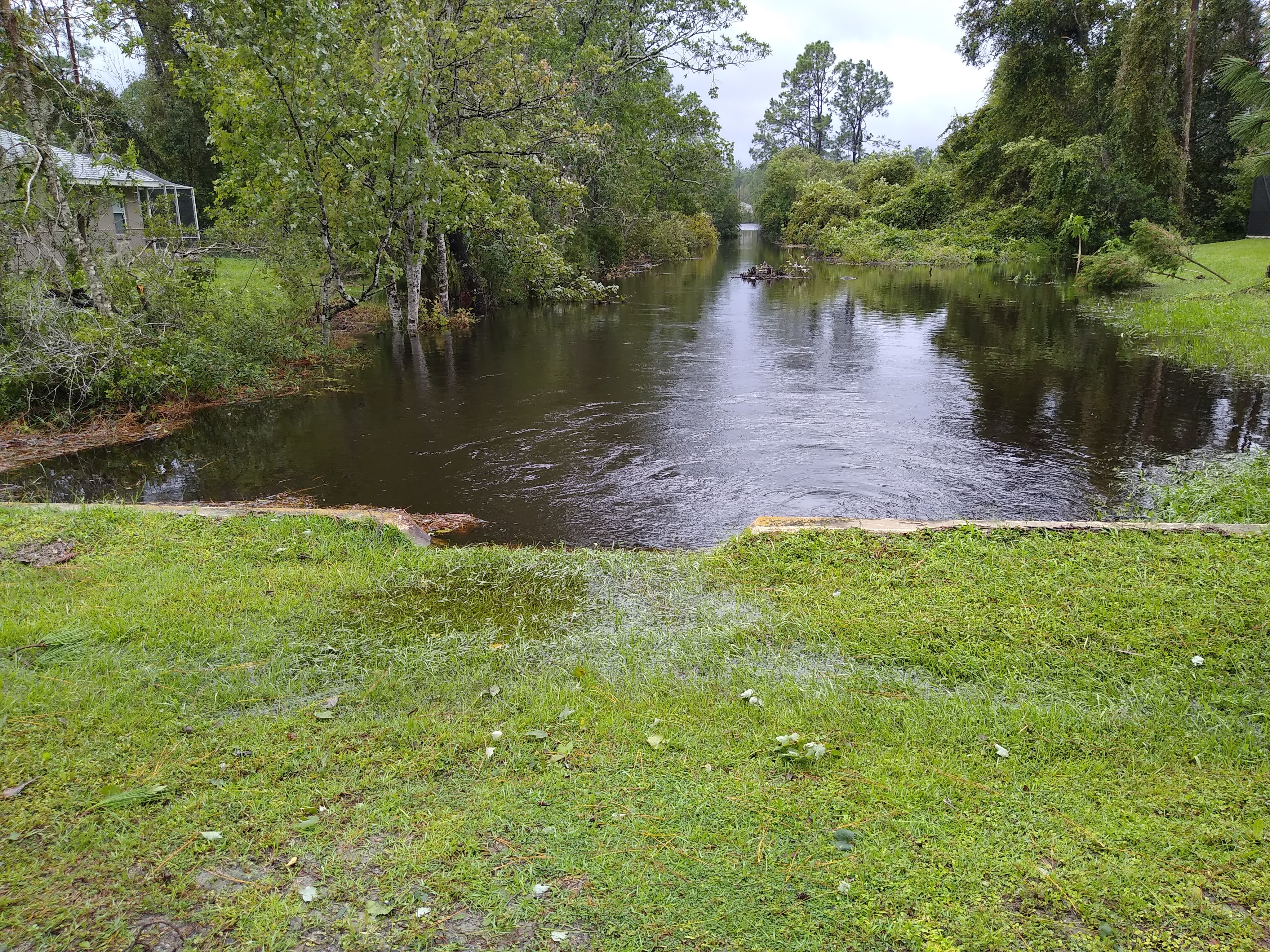
I live eight miles from the ocean, so storm surge isn't a concern for me. However, between a system known as a "tropical rainmaker" which dumped a lot of water on us last weekend and Milton coming through three days later, my neighborhood almost flooded. The following picture is of an artificial lake and canal for drainage. 


The water is supposed to be three to five feet below the concrete embankment, but it's very nearly at the top. I don't know how much water that is other than "a lot". 

Other than that, my experience was similar to what I had two years ago during Hurricane Ian, with the following changes:
  1. Because Milton happened later in the year, it wasn't quite so hot while we waited for power to be restored. 
  2. We had power back by 4:30 pm on Thursday, for an outage of about 16 hours. This was incredibly fast; post-Ian, it took about 30 hours for us to get power. I don't know what the difference was, but everyone appreciated it. 
  3. My CPAP battery backup worked extremely well. Admittedly, I had only one night without power, but for 8 hours I had my CPAP and humidifier running without an issue. 
  4. Thursday morning was too cloudy and rainy to set up solar panels, but I'm certain I could have made it another night, possibly two, before my Freeman 600 needed a recharge. 
This isn't a change from last year, but both my BioLite CampStove and my Koonie battery-powered fan did a lot of heavy lifting to make my life more comfortable. 

Once again, I am blessed that the extent of Hurricane Milton's effect on me and my family was only inconvenience and minor discomfort. Others weren't so lucky. If you'd like to make a charitable donation, I recommend the Florida Disaster Fund, which is is the State of Florida’s official private fund established to assist Florida’s communities as they respond to and recover during times of emergency or disaster. 


In partnership with the public sector, private sector and other non-governmental organizations, the Florida Disaster Fund supports response and recovery activities by distributing funds to service organizations that serve individuals within their communities with disaster response and recovery.

Donations to the Florida Disaster Fund are made to the Volunteer Florida Foundation, a 501(c)(3) charitable organization (EIN# 01-0973168), and are tax deductible. Funds given at this time will be utilized for Hurricanes Helene and/or Milton.

Visa, MasterCard, American Express and Paypal/Braintree have committed to waiving fees for those making a donation for Hurricanes Helene/Milton recovery. 100% of every donation will be used to help Floridians recover.

Friday, October 4, 2024

Luxe Bidet 120 Follow-Up

Not actually Erin.
Used with permission.
With all the rumors about toilet paper shortages in the wake of Hurricane Helene and the dockworkers' strike, it's time to revisit the product review post I made back in 2020. Go read that first, then come back for this follow-up. 

Disclaimer: In order to write a useful post about this subject, I need to talk about things which a lot of people find distasteful and/or embarrassing. Everybody poops and everybody needs to wipe, so let's just be adults about this.

The Luxe 120 that I bought back in December 2020 still works fine, although there are a few issues I have with cleaning it. First, cleaning the part of the toilet behind the bidet nozzle is inconvenient at best (I use a Clorox Toilet Wand and it can reach most areas with a bit of work) and difficult at worst, especially when it comes to removing dried-on particles. Fortunately, Luxe has addressed that issue with their latest model which flips up for easy cleaning ($44 on Amazon as of this writing). 

The Luxe Bidet 120 Plus


The second issue that I have is related to the first: despite the self-clean feature, the nozzle itself must be periodically cleaned to prevent bacterial biofilm, aka "pink mold", from growing on it and impeding the nozzle's protraction and retraction. In my case this is easily handled by opening the protective door, pulling the nozzle down and giving the entire area a good scrub with the toilet wand at the same time I'm cleaning the bowl. I expect that the new flip-up feature would make this cleaning much easier and perhaps needed less often. 

If I should ever need to purchase another bidet, I'm definitely getting the new flip-up model, but mine is still working great and shows no signs of stopping. My toilet paper usage has been drastically diminished, and overall I just feel cleaner. The only drawback to this bidet is that I miss it terribly whenever I go out of town. I make do with flushable baby wipes, but it's not the same, especially when my lower back arthritis is acting up and making it difficult to reach behind me. 


This new version also doesn't require a full removal of the toilet seat to install,
which is a welcome change and a big help.


My Recommendation: Still A+
As I mentioned in my previous product review: 

If you're a human being who poops, buy this. It's more comfortable than dry wiping, it's probably better for the long-term function of your septic system to flush less toilet paper, and the paper you do use will last longer. It's easy to install, it's great if you have health problems (including reduced flexibility that makes wiping difficult), and if you register it comes with a 2 year warranty. 

Buy one now, before the next (real or imagined) toilet paper shortage. 


Dear FTC: I bought this product with my own money. Go away. 

The Fine Print


This work is licensed under a Creative Commons Attribution- Noncommercial- No Derivative Works 3.0 License.

Creative Commons License


Erin Palette is a participant in the Amazon Services LLC Associates Program, an affiliate advertising program designed to provide a means for sites to earn advertising fees by advertising and linking to amazon.com.