Showing posts with label Disaster Response. Show all posts

Saturday, October 12, 2024

Post-Hurricane Milton Report

Not actually Erin.
Used with permission.
Much like George Groot and his family after Helene, my family and I are fine after Hurricane Milton hit Florida on Wednesday. Between Milton rapidly losing strength due to eyewall collapse after making landfill, 160 miles of land between landfall and where I live, and the storm passing well below us we were blessed with minimal damage and inconvenience. Sadly, other parts of Florida weren't so lucky, especially the Tampa Bay area which was still reeling from being flooded by Hurricane Helene a week prior. 

So far as I can tell, no damage was dealt to our house, although we have a lot of downed and damaged trees. 


This is the same tree as in the previous picture, just from a different angle. 

I don't know if this is from the same tree as the above picture or a different one,
but that's the same fence corner. 


That last picture completely justified me putting up the hurricane shutters Tuesday afternoon. I just know that if I hadn't done so, that tree would have broken one or both sets of bedroom windows. 


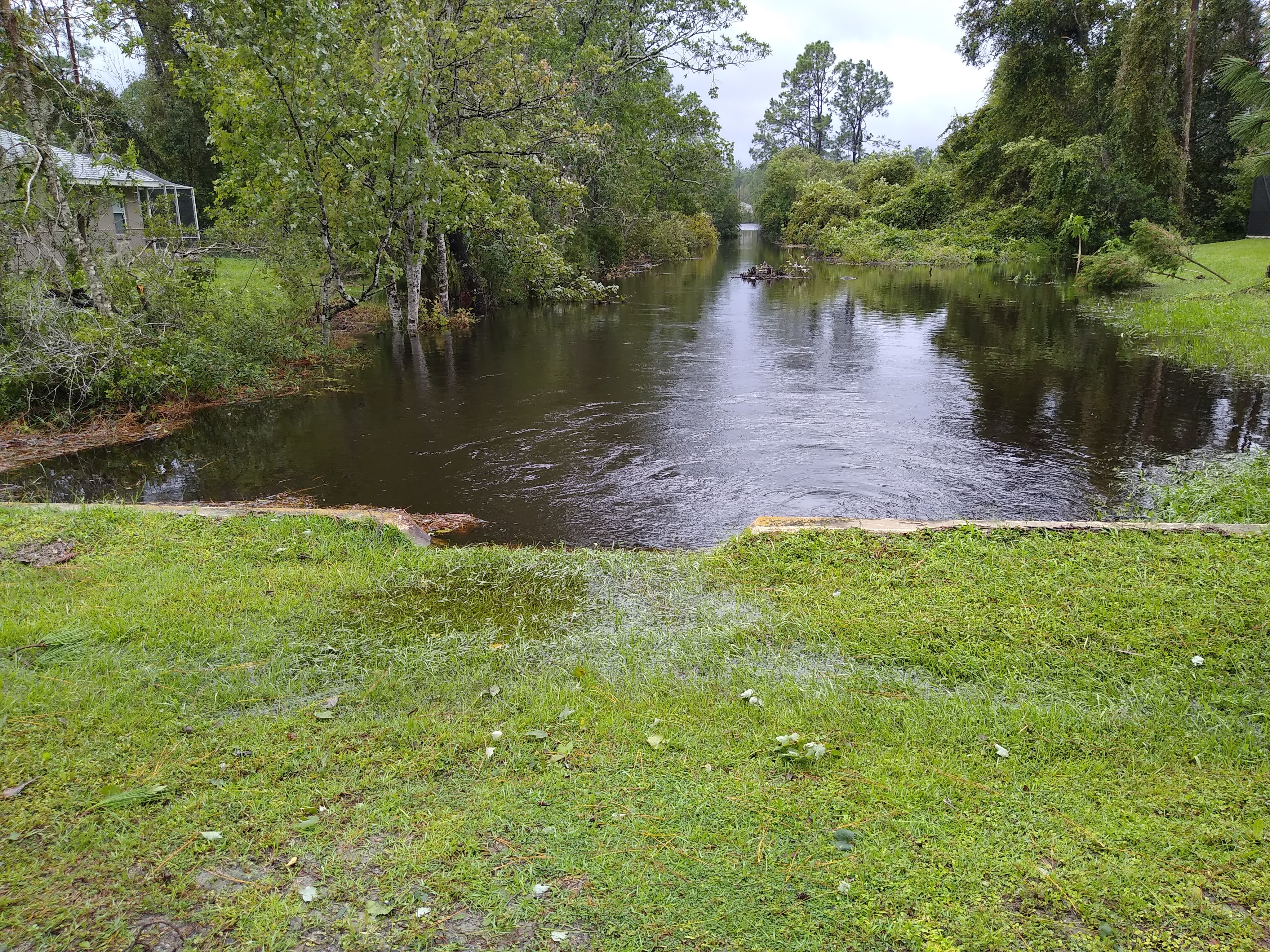
I live eight miles from the ocean, so storm surge isn't a concern for me. However, between a system known as a "tropical rainmaker" which dumped a lot of water on us last weekend and Milton coming through three days later, my neighborhood almost flooded. The following picture is of an artificial lake and canal for drainage. 


The water is supposed to be three to five feet below the concrete embankment, but it's very nearly at the top. I don't know how much water that is other than "a lot". 

Other than that, my experience was similar to what I had two years ago during Hurricane Ian, with the following changes:
  1. Because Milton happened later in the year, it wasn't quite so hot while we waited for power to be restored. 
  2. We had power back by 4:30 pm on Thursday, for an outage of about 16 hours. This was incredibly fast; post-Ian, it took about 30 hours for us to get power. I don't know what the difference was, but everyone appreciated it. 
  3. My CPAP battery backup worked extremely well. Admittedly, I had only one night without power, but for 8 hours I had my CPAP and humidifier running without an issue. 
  4. Thursday morning was too cloudy and rainy to set up solar panels, but I'm certain I could have made it another night, possibly two, before my Freeman 600 needed a recharge. 
This isn't a change from last year, but both my BioLite CampStove and my Koonie battery-powered fan did a lot of heavy lifting to make my life more comfortable. 

Once again, I am blessed that the extent of Hurricane Milton's effect on me and my family was only inconvenience and minor discomfort. Others weren't so lucky. If you'd like to make a charitable donation, I recommend the Florida Disaster Fund, which is is the State of Florida’s official private fund established to assist Florida’s communities as they respond to and recover during times of emergency or disaster. 


In partnership with the public sector, private sector and other non-governmental organizations, the Florida Disaster Fund supports response and recovery activities by distributing funds to service organizations that serve individuals within their communities with disaster response and recovery.

Donations to the Florida Disaster Fund are made to the Volunteer Florida Foundation, a 501(c)(3) charitable organization (EIN# 01-0973168), and are tax deductible. Funds given at this time will be utilized for Hurricanes Helene and/or Milton.

Visa, MasterCard, American Express and Paypal/Braintree have committed to waiving fees for those making a donation for Hurricanes Helene/Milton recovery. 100% of every donation will be used to help Floridians recover.

Monday, October 7, 2024

Hurricane Helene After Action Review

When Hurricane Helene hit the Central Savannah River Area (CSRA) on the Georgia/South Carolina border, it retained Hurricane Category 1 wind speeds. The destruction was widespread, and many disaster preparedness plans were put into effect. This is what we learned.

Water
  • You really can’t have enough water on hand for a situation like this. Being able to restock on potable water, or boil to make safe municipal water, is essential. If you run out of water all your other preps start to matter less and less. 
  • We also keep a lot of “hydration salts” products on hand, as we do a lot of outdoor activities with our children's Trail Life troop, so we were well prepped to stay hydrated. 
  • I would say a minimum is a 36 pack of 0.5 liter bottles per person per four days of use, at least in our heat conditions, but do your own math for your own situation.
Gas
  • You’ll need a lot, and in two types: unleaded gas for vehicles and generators, and 2-cycle gas for chainsaws and pole trimmers. There's a lot of wood cutting that has to be done immediately after a storm passes in order to open roads. 
  • When we needed to refill gas cans, we emptied the ones on hand into my pickup and headed east to Columbia, SC. It took 60 miles to get to a gas station without a waiting line, two miles off the I-20. 
  • The 2-cycle gas needs to be ethanol free, or it can eat the plastic/rubber fuel lines in all the “made in China” 2-cycle engines that power tools these days. I just pay the premium to pick up a 1 or 3 liter bottle from Home Depot or Lowes when shopping. 
  • Have funnels, because modern gas cans suck (never forgive the EPA for what they did to the gas can) and you may need a funnel to properly fuel a machine without spilling too much.
Tools
  • The most commonly needed tool was a chainsaw, the second a pole saw. Get the kind that uses gasoline, as there is more work to be done than electrics will be able to handle.
  • Have extra blades, bars, and bar oil to keep them running. 
  • One friend of mine used a lot of bow saw and teenage boy labor to clear branches, but the chainsaw is going to be faster. 
  • Pro tip: you need to know more than just the chain length, as different brands will have slightly different link sizes, so know what you need in case you have to have someone else do your shopping.
Cooking
  • We cooked on a single burner propane stove, a cinder block “rocket stove”, and a campfire. Of the three, the rocket stove and propane burner got used the most. The propane burner was fastest to boiling water for coffee or soup, and the rocket stove was best for big family meals (but it does take a little longer to get going). 
  • We tried to use a Coleman white gas stove, but the pump system froze up and needs to be replaced, which is probably a project for this winter. 
  • If I had to recommend any one system, it would be the single propane camp burner and a two pack of 1 lb propane bottles. It's light, cheap, and doesn’t go bad like a white gas stove can. 

    Ozark Trail Single Burner Backpacking Propane Stove 

  • If you have room on your shelter location to set up a cinder block rocket stove, absolutely do that as well. To speed up the rocket stove starting time, I used my plumber's torch to get the central chamber area hot enough really fast, which is cheating but uses way less propane than just cooking with propane.
Medicine
  • All four of us in my family got the flu. Thankfully, this was early October not mid-August, and temperatures didn’t hit into the 90s except for a few brief bits on some afternoons. But having influenza in the south with no air conditioning is a miserable experience. 
  • We didn't need to hit up a pharmacy as we had NSAIDs to bring down fevers, and expectorants to help clear lungs. A prepper’s medicine cabinet ought to be able to keep a family of four through a 7 day disruption of electricity and potable water.
  • Those hydration salts really helped me get through the worst of the “man flu” that laid me out for most of a week.
Luxuries
  • Generators and portable air conditioning units aren't a necessity to survive, but they do make “sheltering in place” more comfortable. 
  • We didn’t use either, but we plan to get a Jackery and solar charging system for camping gear anyways, and that would have made this little “free Amish lifestyle experience” a little less spartan, and it would have allowed us to run our chest freezer enough to keep frozen proteins frozen.
  • As it was, we lost maybe a few hundred dollars in groceries that could have been prevented with a small solar generator system.
Tribe
  • We know our neighbors, they know us. When we would make the 120 mile round trip supply run to anywhere open, we made sure we had their needs and wants list. 
  • When we were eating out our thawed chest freezer we came across a turkey breast, really too big for us as a family of 4, so we let our neighbor deep fry it and they made mashed potatoes and mac & cheese; we added green beans to make a little Thanksgiving meal a tad early.
  • Build your tribe before there is a problem, because the worst place to meet for the first time is disaster response. 
Cell Phones
  • The cellular network stayed up, but bandwidth was very clogged, dropping me from 5g down to LTE on multiple occasions as cable internet (the majority of home broadband in our area) was cut just as much as the electricity. 
  • Group texts became the normal way for people to organize support for people in need, and it worked out pretty well. 
  • Internet came back up in our neighborhood two days after electricity.
Final Thoughts
  • We were incredibly blessed to be in the 50% of customers in our area who got electricity back after seven days. Other than not having a portable power solution to extend the useful food storage period of our chest freezer, we were pretty happy with the skills and resources we’ve built up as a family. We didn’t even have to open up any of our freeze-dried food stores, as our home survived the winds. 
  • For those who lost their home to the storm, they may have had a different experience, and my wife and I discussed creating “prep boxes” that could be sealed long term and placed in a shed just in case we needed to direct a neighbor to resources if we weren't there to help with disaster response. 
  • Resources can be shared, or can be destroyed in the disaster, but skills are something you keep with you. If you are new to prepping and have to choose between "stocking resources" and "building resilience skills" I'd recommend the skills building option.

Wednesday, October 11, 2023

Kidde Fire Escape Ladder

The dust has settled and the First 72 Hours have passed. Follow along as I build a long term plan via Prudent Prepping.

Along with the other pointers mentioned last week, I left out one very important thing: how to escape a burning building when you aren't on the first floor. To solve that problem, I have a Kidde Fire Escape LadderI bought this right after moving into my condo, since the idea of jumping from a second story window isn't appealing. Even if the height isn't that much and the possibility of injury is low, I still don't want to do that, so this sits in the upstairs hall closet and everyone here knows what it is and where to find it.

https://amzn.to/3FdZnNu

From the Amazon ad:
  • Easy to use fire ladder - attaches quickly to most common windows (up to 11 inches deep & 16 inches wide) before rungs are released - works on casement windows
  • No assembly required
  • Flame resistant, durable & sturdy, foldable ladder - tested to 1,000 pounds
  • Tangle-free design for fast & easy deployment in an emergency
  • High quality, zinc-plated, 1-foot wide, anti-slip rungs for secure footing & a confident descent
  • Rails are constructed of red nylon straps for a secure grip
  • Single use only - discard when unfolded or used
  • 5-year limited manufacturer warranty

I have the two-story version, but you can also buy a three-story ladder as well. 

A Serious Fire Safety Story
This is a story not as in "once upon a time", but rather as something shared to others from a third party. This actually happened in the order written, so please take a minute to read the whole story about escaping from a burning apartment building. 

Recap and Takeaway
  • Think about what you you are going to do, with whom and when. Plan for leaving every building as safely as possible with everyone with you.
  • Purchased several years ago: one Kidde Fire Escape Ladder from Amazon, $43.97with Prime shipping.
* * *

Just a reminder: if you plan on buying anything through Amazon, please consider using our referral link. When you do, a portion of the sale comes back here to help keep this site running!
 
If you have comments, suggestions or corrections, please post them so we all can learn. And remember, Some Is Always Better Than None!

NOTE: All items tested were purchased by me. No products have been loaned in exchange for a favorable review. Any items sent to me for T&E will be listed as such. Suck it Feds.

Thursday, August 20, 2020

The Recent Storm

We recently had a major storm roll across Iowa, and by storm I mean it was basically an inland hurricane with sustained winds of up to 130 mph. The folks on the east coast know what a hurricane does, but Iowa is about as land-locked as you can get. We deal with tornadoes every year; they blow through and leave a swath of destruction a few hundred yards wide and a few miles long. This storm, though -- the weather people are calling it a “derecho” -- was 60 miles wide and rampaged across almost 200 miles of the state. Tornadoes have rotating winds between 100-300 mph and pass in a few minutes, but this storm had straight-line winds of 70-130 mph sustained for at least 30 minutes. If you look online you can see the damage in satellite photos, it's that wide-spread.

10 million acres of crops were leveled; that's about 40% of the farm land in the state. Storage facilities were damaged or destroyed over a quarter of the state. Numbers are still being compiled, but I've seen estimates of between 20 and 30% of the storage capacity is just gone. My local Co-op has 62 locations around the state, and 24 of them are damaged or destroyed. Demolition crews are trying to clear debris and overhead hazards so the workers can try to salvage over a million bushels of grain that's sitting on the ground, and that's for just the one Co-op that I have contact with; there are dozens more in Iowa.

We're less than 45 days from the start of a normal harvest season, and it looks like it's going to be a tie between the destroyed crops and lack of places to store grain in a lot of places. It's been about 10 days, and there are still people without electricity trying to clean up their neighborhoods. Buildings and trees took a beating and there is debris still scattered in a lot of places. City services are minimal in some areas, water and waste treatment takes electricity, and generators aren't common for small town municipal plants.

I live outside the area that got blasted, so I get the opportunity to watch as others deal with this disaster. I hope to learn from the mistakes of others and get myself and my stuff ready for the time when I'm not so lucky. We had a nasty thunderstorm (over an inch of rain in 30 minutes and strong winds gusting over 70 mph) but sustained little damage. Some tree limbs went down, and a few windows popped out of their frames in one building at work, but nothing serious happened. Metal grain bins are built to handle gusts of up to 90 mph when empty (once they're full they're even stronger), so we didn't lose any around me.

Concrete silos are weather-proof, but are more prone to dust explosions and much more expensive to build. Look at the pictures of the aftermath of the massive explosion in Beruit, Lebanon for proof of the strength of concrete grain silos: half of the large elevator that was right next to the blast survived and shielded the buildings behind it.

What I've seen and learned so far:
  • “Iowa nice” is a thing. No one is looting after a disaster, and people are helping each other all over the state.
  • Opportunists are everywhere. People are buying $300 portable generators and selling them for twice that. They're also being called out for their price-gouging, and pubic shaming still works in small towns.
  • Small engines, like portable generators, don't like gasoline with ethanol in it. Since Iowa is a major producer of ethanol for the petroleum industry, it can be a challenge to find “pure” gas for your generators. In less than 24 hours someone set up a website to track the availability of “pure” gas in some of the cities that got hit the hardest.
  • Having an “all electric” house is a mistake. You might get a slight discount from the power company, but you end up without any way to heat water or cook your food if you don't have some redundancy. Personally, I hate cooking on electric stoves and will always use gas (LP or natural gas). The “Iowa nice” has kicked in here as neighbors are letting others into their houses to cook, or are cooking for those with all electric appliances.
  • People with no experience in farming sound like total idiots when they try to report the news. Okay, they sound like more of an idiot than they normally do.
  • Yes, most farmers have crop insurance, but in order to file a claim they have to harvest as much as they can and the insurance company will pay for the “lost” portion of yield. Harvesting corn that has fallen over takes special equipment that is neither common nor cheap, and it tends to plug up more often than a standard head, requiring a lot more time and effort and exposing workers to a lot more risk. We're going to have more injuries and deaths this harvest than normal.
  • The crops that are still standing are hiding debris that will only be found once the combines hit the fields. More delays and equipment damage is likely when those million-dollar machines try to ingest a chunk of roofing or siding.
  • Roads were cleared within a few hours of the storm. Residents did not wait for the government to take care of it, and instead they brought out their own chainsaws and tractors and got to work once the electric company got the downed power lines out of the way. I saw pictures of everything from snowplows on ATVs to full-size construction equipment being put to use before the government at any level had even finished their coffee.
  • Iowa produces about 15% of the corn grown in the US, and half of that was destroyed. Expect higher food prices this winter as the shortage trickles through the economy. Losing 7% of the production of anything will have ripple effects.

The main thing that I've seen so far is the most basic: Life goes on. Even after a damaging storm, people keep going. Let's try to be ready to keep going as best we can, no matter what life throws at us.

Friday, May 1, 2020

COVID-19: Lessons (Hopefully) Learned

Not actually Erin.
& is used with permission.
Now that people are returning to work in some states, I think it's safe to say that the COVID-19 crisis has passed. We may never return to how the world was before, and I think that is potentially a good thing; while I regret the loss of life, and my sympathies go out to those people who lost loved ones during this pandemic, I think we as a nation, and perhaps as a planet, got off easy. This could have been so very much worse, with deaths in the hundreds of thousands (as in the case of the 9181 flu epidemic) or even higher.

In that light, I look at this as both a wake-up call and a practice run. We were up to this point rather complacent about a great many things, and the events of the past few months have opened our country's eyes not only to dangers we hadn't considered but also to flaws and weaknesses in our culture and infrastructure. There are a great many lessons to be learned from all this, and I hope that our country learns the right ones, because the danger of learning the wrong ones, or learning nothing at all, is great and terrible.

Normalization of Prepping
Prior to 2020, prepping was viewed by the general public as the actions of a paranoid few. However, after such events as The Great Run on Toilet Paper, bare shelves in supermarket departments, long lines into stores like Costco and Sam's Club, and even now threatened food shortages, prepping now seems like a sensible course of action in the face of unexpected developments. Hopefully more people will see the wisdom of laying in supplies against an emergency and this will mitigate future runs on supplies. There will always be grasshoppers among the ants, but hopefully they will no longer be in the majority.

Normalization of Gun Ownership
We are well upon our way in this regard; March 2020 had more gun sales and more background checks than any other month in history. The American people, almost as a single entity, realized that if this virus was as bad as they feared then the police might not show up to protect them, and many of them decided it was in their best interests to buy a firearm for home protection. While things never did get that bad, there were many instances of police departments being gutted due to illness and/or issuing statements that they would not be responding to property crimes. Understanding that you are your own first responder and that the authorities might not arrive in time (or at all) is a healthy attitude to have, and so I applaud this development. Now it is incumbent upon the rest of us to retain these newcomers by making them feel welcome in the firearms community and helping them to get the training they need in order to be safe, effective, responsible gun owners.

Normalization of Home Schooling
Prior to this, home-school programs were looked upon by many as a form of child abuse. Now that all forms of education are being done from the home, those assumptions are being overturned. Not only does home-schooling reduce the chance of infection, it is also immune to schedule disruptions like this. Perhaps in a few years remote learning will become the norm, which would free up much-needed school funds to go towards teachers instead of classrooms.

More Working From Home
While there will always be jobs which require a physical presence, most office-level jobs can be done remotely. Not only will this be healthier for families, but it also will reduce the need for commuting to work and back, which will reduce pollution, traffic, wear on roads and vehicles, and the need for expensive office space, all of which will result in funds being used elsewhere (such as on better medical facilities instead of road work, or on employee salary instead of office expenses). This would also reduce the chance of infection from future diseases, both in the office and in mass transit during rush hour.

An Exodus from Big Cities
I confess, I am biased against cities. I do not like crowds, and ever since 9/11 I have seen cities as nothing but deathtraps where people are packed in so tightly that a single disaster will imperil hundreds of thousands of people who will be unable to escape in time. Given that COVID-19's toll was felt more heavily in large cities than smaller communities, it is possible that more people will move to less-dense parts of the country, especially if combined with an increase of working from home. I say this is a good thing, as people in cities tend to be dependent upon city services, whereas those who live closer to the country are more self-sufficient.

Better Supply Chains, a Return to US Manufacturing, and Ending Kanban
That's a mouthful, but it's all interconnected. Kanban is the Japanese term for the system whereby inventory is kept to the minimum necessary to supply a store for the day, and as product goes out it is replaced with new shipments coming in. This is a fine systems to reduce waste and spoilage... so long as everything works smoothly. However, if one part of the supply chain breaks, the entire system breaks as stores lack the inventory to hold out between shipments. A country which doesn't rely on international imports to feed, clothe and heal its people is better prepared to weather international disruptions, and shorter supply chains with redundancies for shortages and a more robust inventory will safeguard against local disruption.

A Better Disease Response
I am not talking about response from local, state and federal agencies (although those do need improvement), but rather response from people. We've all had a glimpse into the life of what it means to be a hazmat worker, and we've realized  how much it takes in terms of time, effort, materials, and mental energy. "Just one slip-up and I could infect myself and family" is a terrible thought that preys upon the mind and leads to mental and emotional exhaustion. While there is no way to ease that burden, now that we have done this once it is my hope that we will learn from our experience. We will keep better supplies on hand, we will learn how to properly put on PPE and take it off without contaminating ourselves, and we will be more mindful of infection.


We were lucky this time. The next time might be worse. Even if the nation doesn't learn these lessons, I hope you all do so that the next time it happens, you are not caught unprepared.

Tuesday, March 24, 2020

Disaster Anxiety

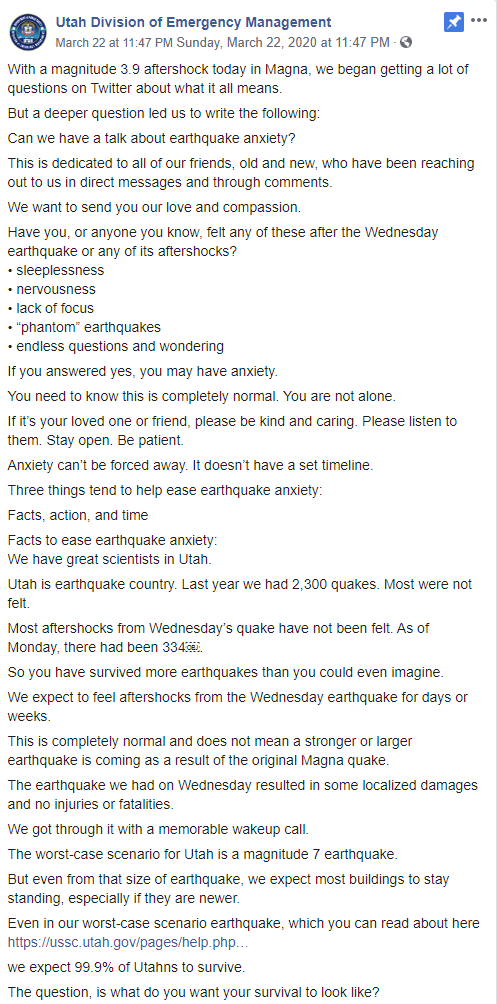
Last week, my area experienced a 5.7 magnitude earthquake with the epicenter was only a few miles from my house. Everyone is fine, damage was minor, and there were no injuries or fatalities, but many people were left with severe anxiety, made worse by frequent strong aftershocks.

I'd like to share a message from the Utah Division of Emergency Management, taken directly from their Facebook page.


Lokidude

Thursday, July 25, 2019

People in the Aftermath

After a natural disaster hits, you can expect four types of people to show up almost immediately. The timing, numbers, and duration will vary with the size of the disaster and the local population, but they're almost inevitable.

First Responders and Government
Police and fire departments do a good job of getting to the site of a disaster and checking for casualties. They don't normally stick around for long, because most disasters will have them covering more area than they have the manpower to manage.

After Hurricane Katrina hit Louisiana in 2005 , the government disarmed anyone who chose to remain in their homes during the clean-up. Most states have since passed laws forbidding such foolishness. FEMA stories are countless and rarely have a happy ending.

Gawkers
In our wonderful age of social media and live news coverage, everyone within 100 miles of a disaster will know within 100' of where the damage has occurred. I tend to lump local media outlets into this category as well, as they're not there to help or hinder but will instead clog the roads and generally get in the way in order to get the right picture for their FaceBook/Instagram/news story.

I've seen this after a tornado hit a rural area, when the ambulances couldn't get up the gravel road because of all of the cars full of gawkers wanting to see and be seen with the damage. News crews vary, and most will obey police orders if told to stay back, but the desire to be the first to report a story can make them a nuisance. Live, on-the-scene reporting also provides targeting information for the group below.

Looters
Scum that will steal anything they can get, they seem to pop up after every disaster. We've seen several reports of looters following the flooding this spring here in Iowa, which is a fairly low-crime state. After every hurricane, massive fire, or earthquake you'll find reports of looters going through damaged areas looking for things to steal. “Looters will be shot” signs are a legal gray area depending on your local politicians; in some areas the signs could be used as proof of premeditation if a looter were to be shot, changing it from self-defense to murder. Timing will vary, with the local idiots being the first to try for an easy score and the opportunistic ones traveling from miles away showing up hours and days later.

A subset of looters are the scam artists. We get them every time we have a major storm that does damage to roofs and siding, let alone a tornado. They'll come in from out of town, give an estimate for the work to repair something, get a deposit or down payment, and never be seen again.

Helpers
Friends, family, neighbors, insurance adjusters, and local groups in the more rural areas will show up and do what they can to help recover from a disaster. Food, shelter, clothing, equipment, and manpower are usually offered to victims of a disaster rapidly. Urban areas have shown that they can band together and help each other out if the disaster is large enough. The response after 9/11 is a good example, as firefighters and other first responders were given food, water, a place to rest, etc. for weeks after the attack. Aid came from all over the country.


Knowing what to expect is the first step in planning for how to deal with a disaster. Don't forget to take the people around you into consideration.

Sunday, August 27, 2017

Hurricane Harvey Disaster Relief

Not actually Erin.
& is used with permission.
We at Blue Collar Prepping are thinking of theTexans affected by Hurricane Harvey. Whatever having "our thoughts and prayers are with you" accomplishes, know that you have them.

However, we also realize that in times of disaster, thoughts and prayers aren't enough. When it comes to making a difference, the three biggest helpers are Time, Talent, and Treasure.

Time
The difference between "time" and "talent" is that talent is a specialized skill whereas time is "just being there to help" -- only surgeons can do surgery, but a lot of people can give first aid, and just about everyone can dig a ditch or fill sandbags or pass out food.

However, this does not mean you should get in your car or your boat and go to Houston to help out! Not only will you likely just put yourself in danger (the last thing we need is more victims), but you may end up diverting emergency aid from the residents there and/or contribute to the confusion.

Instead, help out from where you are:
  • Go to a hospital and donate blood
  • Volunteer at a local church, charity or food pantry to pack disaster supplies
  • Check in on friends (texts are more likely to go through than telephone calls) and let them know that if they need anything, you are there to help. Sometimes just know that people care is enough of a morale boost to get through the day. 
Talent
If you have a specific skill that can be of use without putting yourself in harm's way, do it. For example, HAM Operators are a communications lifeline during disasters. However, most forms of talent involve people being in site, which leads to the aforementioned problems of getting in the way of emergency crews. 

The "good news" about all this is that even if you can't volunteer NOW, your help will still be necessary in the weeks and perhaps months to come. Disaster recovery takes time, so wait until the authorities give the all clear before you head down to help. 

Treasure
This is also known as "donating money" and it's the best way to ensure that those in need get what they require. Many well-meaning people think that donating clothes, food, blankets and such will help those affected by the disaster, but more often than not this just slows down the distribution of needed supplies. Instead, give money so that the "boots on the ground" agencies can get what is needed. 

I do however urge you all to be discerning with your donations. Some charities spend more on advertising and payroll than they do on helping those they claim to serve. These are the charities which I endorse, due mainly to fact that they spend most of their money in achieving their mission:

Local Charities
(copied verbatim from this Fader article; given that this is disaster response, I don't think they'll mind the plagiarism)
National & International Charities

Please give generously -- but please also give intelligently. 

Tuesday, February 2, 2016

Floods

While we're still in the depths of winter, we're not far out on the time when the snows melt and the water flows. And as this gif recently shared with the BCP Facebook group shows, some floods can come fast and furious, and with zero warning.

View post on imgur.com


But some floods do come slow and steady as well. What they all have in common is that awareness and a bit of preparation can easily prevent or mitigate damage and injury.

Preparation
First, know your risk level. In a previous article, Erin linked to a handy site that gives your flood risk zone based on your street address. If your risk level comes back as minimal, congratulations! You have one less thing in your life to worry about.

If it comes back elevated, you'll need to make some plans. Step one is to make sure that you have appropriate flood insurance. There is obviously an associated cost, but if extremes descend upon you, you'll have help recovering.

When storms are pending, listen to the news on the radio, or TV, or on some manner of weather band radio. If a "watch" is announced, it means that flooding is possible in your area. If they announce a "warning" instead, it means flooding is currently occuring or will occur in the very near future. These may be accompanied by official instructions.

If you're advised to find high ground or evacuate, do so if at all possible. Crises have a real hard time hurting you if you aren't there.

When traveling in flood conditions, know how little water it takes to sweep you away. On foot, water over your ankles is enough to trip you and pull you away. In a vehicle, it takes less than two feet of water to move even large vehicles. In addition, flood flows carry all sorts of debris that can injure or kill you. Attempting to cross floodwaters is a recipe ripe for disaster.

If you can't relocate, do what you can to keep water at bay. Sandbags are backbreaking, but are excellent for this purpose. In Erin's linked article, she talks about an easy bagging tool that takes the pain out of sandbagging, and could easily be worth its weight in gold. In addition, move any valuables to the highest point possible. Unplug any electrical devices that could be exposed to flood waters.

In short, don't be there if you don't have to. If you have to be there, build the berm high and tight.

Flash Floods
Flash floods are, with very few exceptions, far less likely to hit you where you live. They are phenomenally dangerous though, striking with little to no warning, and pack a tremendous amount of force. In fact, they are the #1 weather-related killer in the USA.

Even the driest deserts are susceptible to flash flooding. Pay attention to weather reports and severe weather warnings. A storm miles away can cause flooding, especially in dry riverbeds, culverts, or other waterways.

Aftermath
After a flood, utilities are almost guaranteed to be compromised. Don't trust any water you haven't purified until you get word from local authorities. If necessary, or if advised by authorities, turn off your utilities. As waters recede, be careful of any wildlife that may have taken shelter in your home, outbuildings, or vehicles. In addition, be conscious of any food or other supplies that may be contaminated by water, waste, or debris.


You can't prevent flooding, but you can do some big things to minimize the damage.

Lokidude

Saturday, November 14, 2015

Paris 11/13/2015

This is being written as events are still unfolding, so there may be some bad information due to the “fog of war.”

Having been caught on the edge of a street riot in a major European city many years ago, I've seen what happens when a crowd loses control and is desperate. It is not a pretty sight when they're all around you -- we were lucky enough to duck into a store just before the owner locked the doors and we waited for the police to clear the streets. Paris is likely ten times as bad tonight.

Terrorists have carried out multiple attacks in Paris, France. At least 200 wounded and 100 dead from gunfire, fragmentation grenades, and suicide vests. Martial law is in effect, chaos and lack of information are the rule, the borders of France have been sealed, airports are shut down, public transportation is not running, people are being told to get inside and stay inside. There are reports of the attackers shouting “Allahu Akbar” and other reports of fire-bombs being thrown into “refugee” camps outside Paris that are full of Muslims.

The shit has truly hit the fan.


The more I hear about this attack, the more it resembles the 2008 terrorist attacks in Mumbai (Bombay), India:
  • A small number of (radical Muslim) attackers who don't plan on getting out alive,
  • targeting large gatherings of people, mostly in the wealthy areas of town,
  • using grenades and fully-automatic rifles,
  • creating chaos through multiple, closely-timed attacks.
  • Civilians, for the most part, have no clue about what to do,
  • even though there is a history of terrorist attacks in the city.

With a few differences:
  • Police in France responded much quicker than the police in Mumbai.
  • The French police were much better trained and equipped.
  • Since France is considered a “developed” nation and India isn't, the news coverage is more intense.

How do you prepare for something like this?

1) Pay heed to Uncle Remus' advice to “stay away from crowds.”
Uncle Remus wrote a weekly blog for 10 years before retiring last year, but some of us recall his constant advice to “stay away from crowds”. Crowds make large targets for idiots who don't care to aim their firearms. Crowds limit your mobility. Crowds have a type of group mentality that resembles a herd of herbivores in its reaction to anything.

2) Weigh the risks and rewards of any trip out of your normal Area of Operations (AO).
Is it really worth traveling to a strange city where you don't know anyone, can't speak the language, and don't know the streets just to watch a sports event? Especially when there is a history of violence in the city and things are getting worse rather than getting better?

3) Always have a way out.
On of the eyewitnesses to the attack on the concert hall mentioned trying to get on the stage after hearing gunfire, knowing that there was an emergency exit backstage. Always look for the exit signs in any building you enter.

When driving, always leave room to maneuver your car around the one in front of you. The shoulder or the ditch may be better than sitting still in a traffic jam.

The French government has sealed the border and shut down public transportation. How are you going to get home, or at least to your hotel room? Have a plan, or at least a map to a place of safety.

Know where the embassy is in any foreign country you visit.

Some suggest carrying a gold coin or two to be able to pay for an emergency trip home. Gold takes up very little space for its value and is generally accepted anywhere in the world

4) Be prepared to fight back if at all possible.
If you live in a place that allows citizens to carry firearms, carry the blasted things. I, personally, will not shop in stores with the “No guns allowed” signs on the doors. I refuse to be left to the tender mercies of even the common lunatics running around on the streets, let alone someone intent on racking up a high body count. If you can't carry a gun find some other way to defend yourself -- martial arts, stun guns, mace, improvised weapons, or a bodyguard are all options.

Be mentally prepared to fight back. I have met several people who have been so thoroughly conditioned in “modern” living that they are unable to fight, even to defend their lives. Pacifists will become victims when TSHTF, unless protected by those who aren't.

5) Remember the “Rules of Stupid.”
Don't go to stupid places, with stupid people, at stupid times, and do stupid things. Know how to figure out what stupid is.

6) Have first aid training.
After the shooting is over, there will be people who need medical aid. Pray that you aren't one of them and be ready to render aid to those who need it. Most of us don't travel alone, and being able to help family/friends comes right after being able to defend them.
    http://news.yahoo.com/nous-sommes-tous-fran%C3%A7ais--u-s--stands-in-solidarity-with-france-160956067.html
    My prayers and condolences go out to those hurt or killed in the attack on Paris today. It sounds like the attackers are all dead, mostly by suicide, but the investigations will take a long time to root out all of the supporters and collaborators. I pray that no American city ever witnesses such an attack, but I know that it is possible.

    Thursday, October 8, 2015

    Warning Signs

    No, not the "When the sun rises with three red circles around it" type of signs, but the "Warning: the contents of this box can melt your face" type.

    Since lawyers and bureaucrats like to stay in business, we have warning signs on just about everything (except lawyers and bureaucrats). Anyone old enough to read the warning label should know that you don't stick your hands under the deck of a running lawnmower or use a hair drier while in a bathtub full of water. Common sense and a little life experience will save you from being a candidate for next year's Darwin Awards.

    Any sign that uses the term "Authorized Personnel" is just someone telling you that they don't want you to see what they have behind that door. It's usually just a cleaner bathroom than they present to the public.

    There are some things that do need warning labels, though. A train derailing in your neighborhood or a fire at a nearby warehouse can be cause for immediate evacuation, and the clean-up could take weeks. Knowing what to look for is usually the first step in being aware of your surroundings.

    Radiation

    All radioactive sources must (by law) be labeled, since radiation is colorless, odorless, and can do damage from a distance. Because it is illegal to ship radioactive materials by airplane, they all travel on the same roads you use. Without good monitoring equipment, this is the premier "Keep Out!" sign.


    Signs similar to this, but designating X-ray or radio frequency radiation, are there to keep you from wandering into an area that could have harmful radiations that are not produced by radioactive decay. Once the power is shut off these forms of radiation are no longer present, unlike the Alpha, Beta, and Gamma radiations produced by radioactive decay. If I ever get around to writing the "Physics & Chemistry for Preppers" series of posts, I'll describe radiation and radioactive decay is more detail.

    In recent years, there have been a few thefts of old medical equipment that still contained lethal amounts of radioactive materials (old cancer treatment machines). Once the thieves figured out that they had messed up, they abandoned the machines in remote/rural areas. How'd you like to find that on your weekend hike?

    Poisons and Dangerous Chemicals
    There are commercial grade poisons out there, and I don't really care to be near them unless I'm in charge of them. Driving down the road next to a semi full of material that could kill everyone that comes in contact with it is more common than most people think. Rail cars full of chemicals roll through towns large and small every day; trucks break down and rail cars come off the rails sometimes; and warehouses catch fire and the smoke and fume can travel a long way.

    Luckily for us, the National Fire Protection Association (NFPA), the same folks who give us safer electricity through the National Electrical Code (NFPA 70), has set standards for labeling dangerous chemicals in containers. If you see the familiar diamond with four differently colored segments, that's an NFPA 704 sign. The numbers represent the level of danger (0=minimal hazard, 4=extreme hazard) and the four colors are to identify the hazard in different classes
    • Red = Flammability. How likely is it to catch fire?
    • Blue = Health risk. How likely is it to cause injury?
    • Yellow = Stability. How likely is it to have violent chemical changes or explode?
    • White = Special hazard. Does it need to be kept away from water? Is it an Oxidizer? Is it corrosive?
    http://www.compliancesigns.com/NFPA-Chart_1.shtml

    Other Physical or Chemical Hazards
    There are a lot of things out there that can cause damage by exploding, burning, freezing, asphyxiating, etc. The Department of Transportation (DOT) has rules in place for placing "placards" on vehicles carrying these kind of hazards. Like the NFPA 704, DOT placards are diamond-shaped, but the color of placard designates the hazard and other information will be on the placard. Basically, red is for flammables (diesel fuel, gasoline), green is for non-flammable compressed gasses (anhydrous ammonia or nitrogen), orange is for explosives (with the numbers indicating class of explosive), and so on. Learning the proper use of placards is about a four-hour class, since they cover such a large variety of hazards. If you're really interested, ask at your local community college or truck driver training company. 
    https://classes.hazmatschool.com/images/5-Traincrd10back.jpg
    A handy guide to hazardous material shipping is the Emergency Response Guide. It has lists of the most common hazardous materials and the placard information for each of them. There are also Android, Apple, and Windows apps available with the same information. It's a quick way to tell what's on that truck that just went by you at 90mph so you can decide how far away from him you need to stay.


    Paying attention to what is around you (AKA situational awareness) is only of use if you can identify the hazards. Not knowing the difference between a container of water and a container of poison will cause either a lot of needless panic or a lot of needless injury.

    Tuesday, August 11, 2015

    Holes in the Plan

    We had a little excitement at the House of Dude last night, and while everything came out clean in the end, it made for a good acid test of our plans and also pointed out some glaring holes in the way we'd been doing things:

    When a truck from the local gas utility arrives at your house at midnight, it's never a good sign

    My wife was in bed asleep, and I was just putting the house to bed. I was headed outside to check the garage door just as he showed up, which put me roughly 15' away from him and in a perfect conversational position.
    Me: "Evening. Can I help you?"

    Him: "Your neighbors called and said they smelled gas. Have you smelled anything?"

    Internal Monologue: Dad did 30 years with the gas company. I know what gas smells like, and I know what smelling gas means. Luckily, I haven't smelled anything, but my 'This is serious' flag has now been thrown.

    Me: "Haven't smelled anything over here. Hope it's minor. Be safe."

    Internal Monologue:  Not good, not good.  This could be nothing, this could be 'evacuate the house', this could be even worse than that.
    My plans aren't built for this. Our standard mode is to bug in; the house is fairly secure and well-supplied, and we don't leave without good reason. And our bug-out plans are either a 50 mile drive north, or a 200 mile drive south.. neither of which gives me warm fuzzies at dead-up midnight.

    I woke up my wife and gave her the brief summary, or as best you can to the half-conscious. We each got a set of clothes together, in case the night got more interesting than it already had. As I was trying to settle back down so I could get some sleep, my brain went into AAR mode, and I start seeing the acid-test outcome of some of our planning.

    The Good
    It took less than a minute for my wife and I to assemble all the necessities to walk out the door. Another 2 minutes and we could have been dressed and moving. The truck had a full tank of gas and its complement of emergency gear, so our better vehicle was ready to roll. Yay, preparedness!

    The Bad
    All sorts of holes showed up in our plans. These are being rectified with all speed.

    1) We had no specified place to go, if we needed to evacuate. We'd have been looking for a bed on the fly. Luckily, we have family within walking distance, but we'd never considered staying there, because we've always viewed "bugging out" as "leave the county." Alternate plans have been put in place with local family so that everyone has somewhere close that they can go.

    2) We need another cat carrier, immediately. We have three cats, and two carriers. In the nearly 3 years we've had that number of cats, we've never actually transported more than two at a time, so it never even crossed our minds. All the rest of their gear is grab-and-go ready, but not that. Again, it's something we could have overcome, but it is a situation that should never have arisen.

    3) I need to review our homeowner's policy. If our house had blown up last night, there are several items that I'm fairly sure aren't sufficiently covered. I also need to make sure we have coverage that extends to temporary lodgings, if needed. Renters' or homeowners' policies really should be reviewed regularly, and I'm reminded that I'm due.

    Acid tests are pretty scary. They're the single best way to find the holes in your preps, though.

    Learn from your mistakes. And from mine, while you're at it.

    Lokidude

    Sunday, May 24, 2015

    Gun Blog Variety Podcast #40

    Another week, another exciting episode of The GunBlog VarietyCast!

    Adam and Sean talk about some really interesting stuff, including that "viral" photo where the man is walking on the "wrong" side. We also talk about people driving gasoline powered cars filling up at the only pump that has diesel, and that Waco biker shootout.
    • Erin Palette discusses the OODA Loop.
    • Nicki Kenyon thinks that eventually the war in Ukraine will become a "Frozen Conflict."
    • Special Guest Bob Owens discusses his recent LA Times article "Why cops shouldn't carry Glocks."
    • Barron B. talks surge protection.
    • And Weer'd does another of his patented Audio Fisks, this time of the two Moms Demand Illegal Mayors for Everytown (a wholly owned subsidiary of Michael Bloomberg, Inc) anti-gun ads from North Carolina and Texas.
    Thanks for downloading, listening, and subscribing. And don't forget to tell a friend! (Have you "liked" The GunBlog VarietyCast on Facebook?)
    Listen to the podcast here.
    Show notes may be found here.

    Thursday, May 21, 2015

    Emergency Services in a Disaster

    Most of us have been taught to look to the police, firefighters, and hospital staff in our area for help during and after an emergency. While this may work for small, localized emergencies, the system has been known to fail when the damage and destruction gets beyond a certain point. History shows that the larger the disaster and the higher up the food chain the government response comes from, the more likely it is that the response will become less helpful and possibly even become a continuation of the problems.

    In a true WROL situation, abandoned emergency vehicles would likely contain supplies of useful items for surviving. Salvage is not the same as looting, but that's a topic for another day.

    The following is not an indictment of any Law Enforcement (LE) agency or other emergency responders. I'm not a cop-hater, I recognize that they are human and just as prone to making errors as anyone else. Angels and assholes exist in every job, and no job is filled with just one or the other. They're not all heroes, nor are they all monsters.


    Law Enforcement
    LE has resources like communications and information that maybe helpful in times of trouble. Since they are usually the first to respond to any emergency, they may (or may not) know more about what's going on than you do, but they generally have the ability to get more information than you can. Knowing things like which evacuation routes are still open, which direction the forest fire is moving, or how widespread a disaster actually is can have bearing on your plans. Research police scanners for your area to see if one will work as a source of information (many departments use channel-hopping radios that a scanner can't follow). A scanner and a large map can help you find the boundaries of a situation without having to travel.

    City
    The most likely to have someone you may know and have contact with. Most small to medium towns and cities employ residents as police, so they're more likely to be approachable. Networks of friends and relatives make it easier to find a point of commonality with a city policeman, which can help ease communications.

    County
    This still has a good chance that you may know people in common, but it covers a lot more area. County Sheriffs and Deputies will know more about the local roads and bridges than any other level of LE, because they travel them more often. 

    State
    The last level of LE that I consider trustworthy. Directed by the governor or his appointee, they should at least consider the people of their home state as people. State police will have better communications gear and access to information covering a broader area. 

    Federal
    FBI/ATF/DEA and all other alphabet agencies. Trust them at your own discretion. Coming from outside your area (generally after the fires have stopped burning) they will likely not care about the same things you do. Their job is to restore the political processes and find someone to blame. People tend to be treated as statistics at this level of government, not individuals.

    Other 
    LE shipped in from areas outside the disaster do not have a history of being helpful to individuals. The abuses during the response to hurricane Katrina actually spurred the passage of laws in many states to ensure that residents of a disaster-struck area maintained their rights. If martial law is declared, all bets are off and the normal rules of law don't apply.


    Firefighter/Rescue Crews
    These are the folks who will be there to pull your fat out of the fire immediately following a disaster. If you don't need their services (because you were prepared), leave them alone so they can do their best to thwart the Darwin Award nominees. If you have the training and resources, many of them will appreciate you helping them in their work.

    Volunteer
    Volunteer and small town firefighters are local people who choose to help other local people. Their access to information may be limited, but they are usually tied into some form of emergency communications network. Training varies widely from one department to another, but they should all know basic first aid and how to use the tools on their trucks.

    Specialists
    Ski Patrols, Fire Jumpers, and other specialists are trained for very specific rescue missions. If you see these rescue units working, leave them to their jobs. If you need one of these specialists you wouldn't want them delayed, and their information is going to be specific to the mission of the moment. They will have a fairly broad knowledge of survival techniques if you can catch them off duty and talk to them. 

    Paid/Unionized
    Once a city gets to the point of needing more than one fire station, they tend to start paying their firefighters. Politicians and unions tend to infect the fire departments in direct relation to the size of the force, reducing the efficiency and morale as they feed at the public-money trough. Training and equipment is usually a notch above volunteer units because of the larger tax base. 

    National Guard
    When the SHTF in a big way, the Governors of the states have the ability to call out the National Guard to aid in the rescue/recovery operations. Being somewhat local, they fall into the same category of trust as State Police above. Having access to helicopters, heavy equipment, and lots of workers comes in handy for a variety of emergencies. Individuals may not have much information, but they probably came from another area and will know how things are outside your location.


    Medical
    Medical personnel have extensive training and may have access to supplies that you don't. Communications in a disaster tend to break down due to the high number of patients, but most of them will do their best to treat everything they can. Look up the word “Triage” for an educational glimpse into how they are trained to deal with too many patients.

    EMT/Paramedics The first responders whose job it is to pick up broken people and get them to a place where they have a chance of being fixed. There are national standards for the different levels of first responders, so they all have to meet a minimum level of competence. Training is good for their job; supplies available vary by jurisdiction and level of training. 

    Clinic
    Usually an outpost of a larger hospital or specialized for a specific field, staff and supplies will be limited. Normally having only a few actual doctors, most of the staff will be nurses of one variation or another (CNA, LPN, RN, NP, PA). Easily overwhelmed in an emergency due to their limited staff, but still a good place to get to know people because they tend to live close to the clinics. Supplies will run out fast. 

    Hospital
    Many hospitals have found it more profitable to specialize (Spine Center, Sports Medicine, Cancer Research, etc.), but they will all have the same basic facilities; emergency room, treatment rooms, surgical rooms, recovery rooms,etc. Most hospitals have their own pharmacy, but they are stocked (like everything else in the US) using a Just-In-Time inventory system. Without resupply, they'll start to experience shortages within 24 hours

    DHHS/CDC
    Once the federal government gets involved, the level of care and communications degrades. The CDC may have some of the best labs in the world, but they are controlled by politicians, which means people are treated as statistics at the national level. The only advantage I can find in getting a federal response to a medical crisis is their ability to bring in supplies and people from unaffected areas, quickly.


    Knowing some of your local emergency services people should be part of any preparations that don't include leaving the area. If you're bugging in, or your bug out location is fairly close to home, it's only sensible to make contacts with the people who can help during an emergency. Remember that OPSEC rules apply, so don't be a source of information for them.


    The Fine Print


    This work is licensed under a Creative Commons Attribution- Noncommercial- No Derivative Works 3.0 License.

    Creative Commons License


    Erin Palette is a participant in the Amazon Services LLC Associates Program, an affiliate advertising program designed to provide a means for sites to earn advertising fees by advertising and linking to amazon.com.