Showing posts with label Zones of Assesment. Show all posts

Sunday, December 6, 2015

Gun Blog Variety Podcast #68

Adam and Sean bring you Episode 68 of The GunBlog VarietyCast!
  • Erin Pallette tells us about Zones of Assessment.
  • Nicki Kenyon answers that burning question about Iraq, about Russia, and about Foreign Policy in general: "Was Romney Right?"
  • Weer'd takes his shot at that WRAL attack on NFA Trusts in one of his patented Weer'd Audio Fisks. 
  • And make sure to listen for a peek behind the curtain and we'll tell you how the podcast gets made.
Thanks for downloading, listening, and subscribing. Please like and share The GunBlog VarietyCast on Facebook, and if you use iTunes, give us a review!

Listen to the podcast here.
Read the show notes here.

A special thanks both to Firearms Policy Coalition for their support and to our sponsor,Law of Self Defense. Use discount code "Variety" at checkout and get 10% off.

Tuesday, March 4, 2014

Car Survival Kit, Part 2

We've already looked at the grab-and-go parts of my Car Survival Kit.  Today, we'll break into the less-portable parts of the gear.  This is by no means an exhaustive list of the useful things found in my truck (that list would go on forever), but this is a pretty good measure of the hardware that is always on board.

The Tools

A double-bitted axe, a short handled shovel, and a 4-ton bottle jack.

The shovel is pretty self-explanatory.  It digs me out of places when I get a little dumb, mostly.  The jack is a small-footprint, relatively high-lift model, necessary since it's lifting a full-size truck.  While a standard axe would be more useful for splitting tasks, the price was right on this axe, and I have the previously shown big knife for splitting things.

The Fluids

One gallon of 50/50 premix coolant, and a quart of 10W40 motor oil, and the associated funnels for filling.  Not pictured, 2 gallon can of gasoline.

Most of the vital fluids to keep the old truck running, and the funnels used to fill those fluids.  You can do it without the funnels, but it's far cleaner and easier this way.  I also keep a 2 gallon gas can in my truck, which buys me about 20 miles to get back in if I get myself in a bad way.  I wouldn't be out of line to add a quart of the appropriate automatic transmission fluid, but I've never had it be a need in the past, so I've never bothered to carry any, I just keep it in the garage.

Recovery and Towing
Twenty foot tow strap, twenty foot tow rope with hooks.  Not pictured, 12 feet of 3/8 high-test chain with hooks.
When I or others end up well and truly stuck, this is the basic gear to get back on level ground.  If I expect to do serious recovery work, I have access to a true recovery kit that my father in law built, but it's heavy, and it takes up cargo space, and is not likely to get used in any kind of normal life.  (i.e., it hasn't had to be used in at least 5 years, maybe even more.)
Jumper Cables
Very likely the most used part of my CSK.  Several times a year, either myself or someone else needs a jump.  Buy a decent set, with heavy-duty wires.  They flow current far better than light wires, and make for quicker, easier starts.

Emergency Gear
Air compressor and tire slime, 2.5 lb ABC dry chemical fire extinguisher, and roadside reflector kit.
In the black bag is a 12V air compressor with a bottle of tire slime.  The red box contains three "trucker triangle" emergency reflectors, and the extinguisher is a Kidde 2.5lb ABC dry chemical unit.  I recommend only ABC fire extinguishers, as they're rated for all common flammables, liquid, solid, and energized electrical.

Inside the bag
Triangle Reflector
In the past, I've carried road flares, and am not opposed to them.  The ones I had got old, though, and I haven't found a deal on new ones, plus the reflectors work rather well in their place.

The Miscellany
Gloves, spare light bulbs, JB Weld and JB Stik,
 a folding screwdriver set, a multitool, and a 3-C-cell MagLight.
In addition to whatever work tools I may have on me, and the tools I carry in my Zone 1 and Zone 2 areas, I keep the above on hand.  The only real oddballs are the JB Weld and JB Stik (a premix JB Weld product that just requires "smashing together."  For those not familiar with JB Weld, it's a 2 part epoxy patching product, that sets up at near-metal hardness.  It is useful for an unending variety of repairs.  One of the more notable and practical repairs I've made with the JB Stik was a temporary fuel tank patch.  It wasn't pretty, and it wasn't permanent (though I'd have liked it to be), but it was strong enough that it would have gotten me home if I'd been out in the middle of nowhere.

So, what gear do you pack in your rig?  What am I missing in mine?

Lokidude
 

Friday, February 21, 2014

SHTFriday: Zones of Assessment - What's Around You

Not actually Erin.
Picture by KJ Photography
& is used with permission. 
In Part 1 of this series, I talked about the theory behind Zones of Assessment and discussed what I have as my Every Day Carry equipment. In Part 2, I did a show-and-tell with my Get Home Bag and detailed the difference between "immediate access" and "extended access".  In this final article in the series, I will discuss Zone 3 and what that means.

Zone 3 is different from the others because not only does it contain items which are not in your possession, but also includes things which are not objects at all. It is the most abstract and theoretical of zones, and because of that this post will be short on pictures and long on theory. 

To reiterate:
  • Zone One: Every Day Carry (what you can access immediately)
  • Zone Two: Car Kit/ Get Home Bag/ Bug Out Bag  (what you can access within a few steps)
  • Zone Three: What you can get from the environment  (requires thought, analysis, and relationships)

Tangible

Let's start with the tangible assets first. When you go out to eat, do you observe where the restrooms are? When you go to a movie, are you aware of the location of the emergency exits?  If not, then I refer you to Evelyn's post about personal security, specifically situational awareness. If so, excellent; you are already thinking about Zone 3, and how to use the resources of your environment around you. From there, it is a simple matter of being more observant and thinking about what you have seen:
  • Do you know where the fire alarm is? That is an easy way to summon help if you do not have a cell phone. 
  • How about fire hoses/extinguishers/axes? Not only are these useful for their intended purposes, but the first two can be used as improvised weapons. An extinguisher discharge may be used to conceal movement; a length of hose can immobilize an attacker; an axe can turn obstacles into doors. 
  • Where can you get water, in case you need to flush chemicals out of someone's eyes, or to wet a shemagh to keep from inhaling smoke?  Bathrooms and kitchens, obviously, but what about spigots on the outside of buildings?  (An excellent reason to own a sillcock key.) How about those fill-your-own soda fountains found in most fast food establishments? Nearly all of them have a "Press this button to get only water" function.
  • First aid kits should be obvious, but many of them in retail establishments are hidden from sight to prevent customer pilferage. How about coin-operated vending machines found in bathrooms? Sanitary pads are designed to absorb blood, and tampons are often perfectly sized for plugging bullet holes in people. In the men's room, you can often find condoms -- waterproof, stretchy latex can be used to make water carriers, or tie off a wound, or make field-expedient gloves for handling biohazardous materials. 
In short, half of Zone 3 is a combination of Sherlock and MacGuyver: What do you see, and how can you use it? 

Of course, observation and analysis is a skill that requires practice, and so the best way to improve that skill is to use it. A favorite game of mine is to ask myself, "What would I do if X situation occurred?"  Not only does this keep me in practice, but the more times I go over something in my mind, the less likely I am to freeze if it ever happens in reality. This is the same reason the military performs Immediate Action Drills: to make the actions ingrained to the point that they are performed without thinking, and therefore without hesitation.


Intangible

The other half of Zone 3 is not as concrete as the first, as it consists of "What non-physical resources can you access?"

Information, of course, is always useful. Acquiring skills and gaining useful knowledge is powerful, as that weighs nothing and is constantly with you.  Ah, but if it's always with you, then that makes it Every Day Carry and therefore Zone 1, doesn't it? So the question becomes "What knowledge do you have around you that is not under your immediate control?"
  • Television, radio, and the internet are likely tops on everyone's list. While you can (and should) always have access to these items through a smartphone, laptop, or car entertainment system, the fact remains that simply having a means to access the media doesn't always mean you can get to it. Cell towers can go down, the internet can become overloaded, the electrical grid can fail. That is why these factors are Zone 3 -- you cannot control them. 
  • The biggest intangible resource, however, is other people. You cannot be expected to know everything and cope with every situation -- we cannot all be omnicompetent Special Forces types, and even those folks work in teams to watch each other's backs. People -- specifically, people whom you trust and who are skilled in areas you are deficient, and vice versa -- are amazing force multipliers. Not only can they know things that you do not, but they can also:
    • Watch your back
    • Cover your retreat
    • Hand you ammunition
    • Drag you to safety
    • Perform first aid on you 
    • etc
  • Similarly, pets such as dogs make excellent companions for similar reasons, although they require more effort to maintain and their skills are more physical. Still, I would rather have a loyal (and trained) dog by my side in an emergency situation than have someone I could not trust. 
  • Speaking of force multiplication, organizations are more effective than groups of people. While a great many preppers, myself included, are firm believers in OPSEC (Operational Security), it can be just as dangerous to trust no one as it is to trust the wrong people. As always, good judgement must be utilized in finding a group of like-minded individuals in whom you can trust and confide, as the greater the number of people in a group, the sooner you approach Dunbar's Number and social cohesion begins to break down. In other words, find the smallest group of people that suits your needs and stick with that. My personal philosophy is "Squad good; platoon okay; company bad", but the actual numbers are of course variable between preppers and their situations. 

This concludes my Zones of Assessment series. As you can see, it's not just about gear -- it's also about knowledge and trusting other people. Incidentally, those two reasons are why I started this blog with Evelyn, Loki, David and Tim in the first place. 

And so in closing, I leave you with this final thought:  "Stay alert; trust your buddies; keep your gear handy."

Tuesday, February 11, 2014

The CSK, or Car Survival Kit (part 1)

In a conversation last week after Erin's post about her Get Home Bag, I was asked if I had something similar.  The answer:  "Not really.  Kind of."  Erin asked to see it, so I figured I'd share with everybody.

My environs are a bit different from the rest of the crew here, with the exception somewhat of the good Chaplain.  Whereas the others spend their days in a concrete wilderness*, I'm as likely to be out of cell signal as I am to be on pavement. Walking home is a bit less of an option, and in many situations, staying with your vehicle is a better plan.  (Note to self: expand on this some other time.)

With that in mind, let's break down my gear.

This is the main guts of it.  The most important stuff is in one bag, so I can grab it and go, if I have to leave the truck.


The little orange pocket you see?  This is what it holds.  Two ponchos, two mylar space blankets, a pair of chemical hand warmer packs, a whistle (with an LED light, a passable compass, a thermometer, and a signalling mirror) and a fire bar.


The contents of the main pocket, clockwise, from upper left: A Seychelle water filtration bottle and spare filter, an emergency tent, six 1200 calorie food bars, a Sterno stove and fuel can, a bag of sports drink mixes (electrolytes, baby!), a pair of cut-resistant gloves, utensils, a dynamo-powered flashlight and radio, dust masks, an LED headlamp and battery, glow sticks, and SPF 50 sunblock, because Uncle Loki tans like a lobster.


The water bottle and filter.  Claims to be good for 200 gallons per filter, using a 2 micron carbon and iodine filter combination. Should keep most water I'll find in the sticks from killing me.


My first aid kit (and the knife I forgot to include in the big picture).


Included in the first aid kit:
  • Tape
  • Small medical scissors
  • Tweezers
  • Small lockback folding knife
  • 2 rolls of 4" gauze
  • Antacids
  • Ibuprofin
  • 5 3x3 gauze pads
  • Baby wipes
  • a 5x7 dressing
  • dental floss
  • various small band-aids
  • 5 hemostatic gauze pads
  • matches
  • antiseptic wipes
  • alcohol prep pads 
Somewhere in the past couple years, my triangle bandages have ended up "not in this bag."  I need to add some more.  I tend to keep them around in lieu of fancy new-fangled tourniquet kits. They're somewhere between cheap and free, and I was taught old-school, when they were all we had.  While the CAT and SOF-T are excellent pieces of gear, I have a tendency to fall back on what I know.  In addition, triangles are great for general bandaging, splinting, slings, and a whole host of other roles.

The whole bag rolls in at about 9 pounds, plus I have a box of freeze-dried food in the truck that puts on another 3-ish.

This comes in SUBSTANTIALLY lighter than Erin's GHB.  There's a reason for that.  This is the grab-and-go part of my kit.  You'll notice, with the exception of the knife, there are virtually no tools in this bag.  There are no weapons in this bag, except the knife. I'm not carrying toiletries, or much by way of firemaking gear.

There's a reason for that.  Those things are carried either in my tactical manbag (Call it Zone 1.5, in Erin's Zones) or in my truck itself, be it in the cab or in the toolbox.  Next week, I'll break open the toolbox, and show you the far less portable parts of a Car Survival Kit.

Lokidude


* Erin adds:  Hey now!  I live in a rural suburb, thank you very much!  I have miles of woods in my back yard. My wilderness is only partly concrete. :P

Friday, February 7, 2014

SHTFriday: Zones of Assessment - the Get Home Bag

Not actually Erin.
Picture by KJ Photography
& is used with permission. 
Welcome back.

In Part 1, I talked about the theory behind Zones of Assessment and discussed what I have as my Every Day Carry equipment. I was rather surprised that no one could find fault with anything I was carrying, or pointed out a critical piece of equipment that I had forgotten.

(Either that, or people don't like the way the comment system is integrated with Google+.  If so, please email me [erin.palette@gmail.com] and let me know so that I may address this problem.)

Now we move on to Zone 2, which I define as "Whatever kits or bags I have nearby, whether they are in my car or in the 'go' position at home." Even if I am wearing them, I still consider them Zone 2, because I can't access what is inside them without first taking the bag off and then opening it up. Immediate access is the purpose of Zone 1.  Zone 2, therefore, is "stuff you can get to within a few steps,"  and because of this built-in delay my bag is filled with things that I am unlikely to need quickly or often.

I expect there will be debate regarding "Should item X really be relegated to Zone 2? Or should it be more immediate?"  The answer, dear readers, is often "It depends." My needs are not your needs; my bag is not your bag.  While would not think someone foolish for carrying a trauma kit in Zone 1, I don't carry one because I haven't ever needed it. Conversely, I have needed and/or used everything in my EDC (with the exception of my pistol, thankfully).  It's all a balancing act of  use vs. perceived need vs. usable space.

Similarly, the contents of a bag will be different based upon its purpose:
  • a Car Survival Kit [CSK] summons help and keeps the user alive while waiting for rescue. Used in instances of being lost and running out of fuel, or being stranded due to weather and/or mechanical difficulties. Portability is not a requirement; food, water, warmth and signal abilities are emphasized. 
  • a Get Home Bag [GHB] is meant to allow the user to endure the walk home from a distant location (usually their job) in a crisis situation. Emphasis is placed upon  portability and being inconspicuous. 
  • a Bug Out Bag [BOB], aka the I'm Not Coming Home [INCH] bag, is meant to be a more complete, long-term kit for survival after a disaster. Some are meant to be portable, and some can only be carried in vehicles. Emphasis is placed on long-term (over a week) needs. 

Since I live in a suburban area, I rarely need a CSK. My BOB, which is built around the concept that I might need to evacuate from a hurricane or a wildfire, is too large to discuss in this particular post (though I will talk about it later).  Therefore, I will be showing you the contents of my GHB.

Before I begin, a bit of a confession:  I have a tendency to overpack. I am still in the "carry as much useful stuff as possible" stage of prepping, and therefore I am most likely carrying far more than is useful. The only things I can say in my defense are:
  1. I am still learning;
  2. I can (and have) carried it for several miles;
  3. It isn't as heavy as it looks. While I'm not going to tell you how much I weigh (please allow me this vanity), I can tell you that it's just a smidge more than 13% (1/8th) of my body weight. 

The contents of my Get Home Kit:
  • A surplus Swiss rain cape.  While the Alpenflage is not inconspicuous, the fact that it can cover both me and my pack, and also serve as an emergency shelter, makes up for it. It also sheds water like crazy, which is important in a wet state like Florida. Also of interest:  the camo pattern works really well here, with the red-brown perfectly matching the shade of pine straw. 
  • A boonie cap sprayed with waterproofing agent. I prefer this to the hood of the rain cape, as the hat neither restricts my field of vision nor impairs my hearing like the hood does. I recommend the Australian version, as it has a much wider brim than the American style -- unsnapped, it protects nearly all of my shoulders from the rain. 
  • A pair of  boots that are both waterproof and leather. This pair is from Smith & Wesson, and they're practically a combination of combat boot and tennis shoe. I've worn them extensively and they feel great. 
  • My bag is a SwissGear SA9259 Backpack. It is rugged, comfortable, carries a lot of stuff and also has a waist belt. Sadly, this particular model is no longer being made. However, the SwissGear SA1923 ScanSmart Backpack looks to be quite similar in function and design.  

Let's start opening up pockets and see what's inside, shall we?

Because this is a backpack and not a military rucksack, there aren't many options for "This kind of gear goes here, that kind goes there," and so I have to place the gear wherever it fits the best. In many instances -- specifically in the main compartment -- this is a simple case of "Put the light and bulky stuff at the bottom so the heavy stuff ends up as close to the middle of my back as possible."  While this does increase the amount of time it takes to get to my equipment, again I reiterate: this is Zone 2. Portability is more important than access. 

In the Laptop Compartment:

  • Shemagh (placed on top; the only item I might need quickly).
  • Several large-capacity drawstring trash bags -- they have a variety of uses.
  • One of those cheap carabiners you get at Wal-Mart (useful for carrying awkward things).
  • A medium uvPaqLite
  • A fleece blanket in a vacuum-sealed package. We get them all the time from charities. 
  • An Otis cleaning kit (in case mud or another obstruction gets up my pistol).
  • An AeroVest. Florida doesn't usually get very cold, but it can dip below freezing in the winter. 
  • A Hawke Peregrine knife. This is my multi-purpose, beat it to hell if necessary tool, and I am in the process of abusing it. 
  • And a Folding Firebox, the single heaviest piece of equipment in my bag. I will admit that I've gone back and forth on this, putting it in and taking it out again, as the weight is an issue. However, it folds flat, and it's able to provide a small fire that can boil water and keep me warm. I extensively reviewed this product on my other blog and gave it excellent ratings. 
There's kind of a theme here: "Things which pack flat."  The only non-flat item is my Otis kit, and I keep it here so that if I need it I won't have to go digging through a bunch of stuff in the main compartment.


Main Compartment:


This one is kind of a mess, to be honest. I have stuff in here mostly because it won't go anywhere else. This portion of the pack is constantly evolving, as I'm always looking for new ways to pack it or new places to put things. Suggestions on what should go where are always appreciated.


The mesh pouch is where I store toiletries, in case I need to spend the night at a friend's house, as well as some small light things that I don't want rattling around elsewhere, like the twine or the spork/spatula combo. Most of these were bought at Wal-Mart in the travel section.


Digging further down, from top to bottom:


A Mora knife (in case I need to do finer work with a sharper blade than the Peregrine) and a flashlight that turns into a lantern.


An Adventure Medical Trama Pak with QuickClot, an Israeli compression bandage, and a roll of Gorilla tape.  Note to self:  You moved the tourniquet out to your in-home medical bag. Get another for this one. 


Here I have containers of various small things. No doubt some of you will think I'm an idiot for putting things in the water bottle. Let me reassure you: you will find another water bottle later on. This is just my backup.

Most of the stuff in my 1-liter Nalgene Tritan bottle is food or water-related:  Mostly energy bars and drink mixes. Also present are a ferrocerium rod, some duct tape, matches, a small emergency fishing kit, water purification tabs, a lighter, a water pasteurization indicator, some high SPF sunscreen (this being Florida and all) and one of those evaporative cooling bandanna things.


My "fix it" pouch: Sewing kit, extra needles, extra thread, screwdriver and extra screws for eyeglass repair, a small pack of disposable utility blades, a Derma-Safe razor knife and mini-saw, another lighter, and a set of AA batteries just because they're good to have. Also, some Tinder-Quik.


Electronics stuff.  The Halo Charger will recharge a cell phone and is supposed to hold a charge for up to a year, and an iPod. Not only does this give me morale-boosting music, but this particular model comes with its own AM/FM radio, which is handy in case of an emergency.  (Note to self: Put some earphones in there!)


Inside the media pocket are small useful tools:  a Sillcock key of multiple sizes, more quick tinder, a map of the local area, Tool Logic card and Swiss army knife, and a cord and plug for recharging the iPod. These are here and not in the box so that I can get at them to recharge other devices (like my iPhone in my EDC kit) without having to open a bunch of things. 
A steel mug, 100 feet of paracord (useful stuff), a headlamp, a hammock (nests inside the mug), a 36-hour survival candle, an Esbit folding stove with fuel tabs, some old tongue depressors (can be used for splints or as kindling for a fire), some foot powder and some Potassium Iodide tablets. That last item will cause some raised eyebrows, I'm certain.


A dry bag (that's the green thing at bottom right) containing extra socks & underwear, a map of the Eastern US (useful for road trips), the SAS Pocket Survival Guide, the Pocket Ref, the Eton Microlink, several bags of soup and tea  (to be made using the cup and stove, above), a bivvy sack, and a bag of kindling.


Exactly what it looks like.


Side Compartments:


 Left compartment: zip-ties, Craftsman Clench Wrench, Figure 9 carabiner from Nite-Ize, and a set of playing cards in a waterproof container.


Right compartment:  Pocket chainsaw, mini-crowbar, mini-trowel, a Shish-ka-bob skewer, and another Figure 9 carabiner. Between them and the rope I should be able to set up the hammock and/or the emergency tent as needed.


Front Compartment:


Medical supplies, including a larger first aid kit than is in my EDC, several types of painkillers, insect spray, hand sanitizer, pocket soap, New Skin (for paper cuts and the like), an emergency blanket, a blister kit and a Readi-Mask. (That last one isn't medical, but I worried that if I put it with my shemagh it would slide to the bottom of the pocket.)


Also included: eye drops, styptic pencil, Sharpie, pencil, another Swiss army style knife, and a Tide stain pen (because some emergencies involve spilling food on yourself.)


Finally, some stuff clipped to the outside of the pack for easy use:
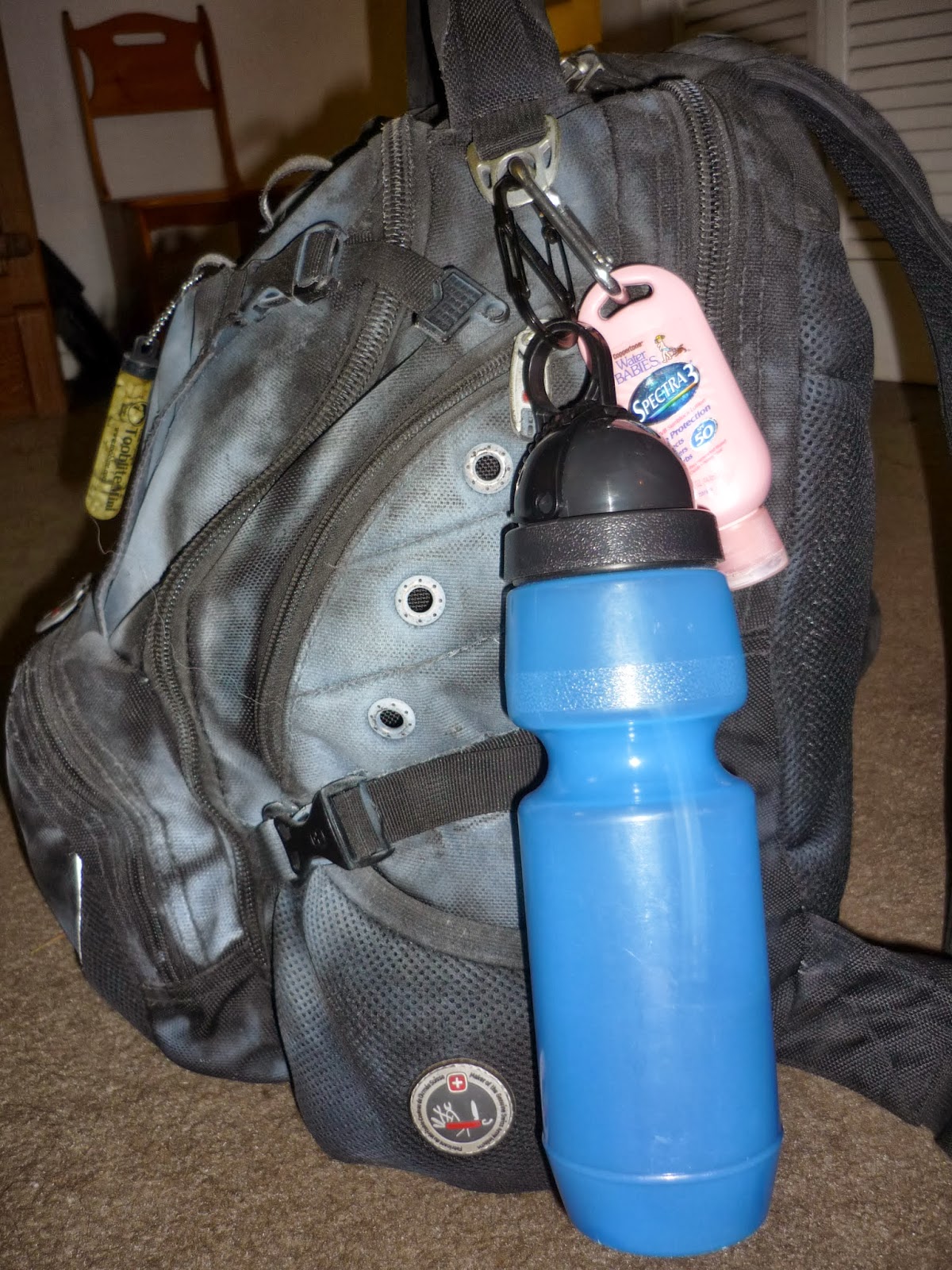


More sunscreen, a Tooblite so I can find this bag in the dark, and a Sport Berkey bottle with built-in water purifier.


Phew!  That is a LOT of stuff. It look me longer than I expected to photograph it all, which is why this post is a bit late.

As you can see, this is more than just a Get Home Bag.  It's also an "Oops, I'm having to spend the night" bag and a "Darn, I had a little accident" bag. I like to be prepared, y'see, and so whenever I get in the car to go somewhere, I take this bag along. Just in case. 

As always, comments, suggestions, and criticism are welcome regarding the contents of this bag.  Do you disagree with something I have?  Let me know!  I'm a big girl, I can take it!

Friday, January 31, 2014

SHTFriday: Zones of Assessment - Every Day Carry

Not actually Erin.
Picture by KJ Photography
& is used with permission. 
Back in 1979, when I was six or seven, my family moved to Germany. My father was an active duty Army O-5, and part of his duties in Cold War Germany involved studying the Fulda Gap and other "What if World War 3 Happens?" strategies.  (Fun fact:  He was one of the brass who planned and implemented Able Archer 83.)

If you've never lived in a foreign country as a child, it's a strange experience. I had to leave behind practically everything I knew about life to go live in a strange place where the weather was different, people spoke a different language, and I was surrounded by soldiers. None of this was especially bad, just highly unusual by anyone's standards -- and paradigm-shattering for a child.

The bad part was when we were told that, due to our strategic location, the Russians could invade AT ANY MOMENT and that one day (probably in the dead of night) my dad would get a phone call, and he'd have to go off to war and probably never be seen again. Worse, if that happened, my mom -- called the Senior Noncombatant in military parlance -- would only have a few minutes to get me, my brother, my sister and herself dressed, pack a few suitcases, grab our critical documents and head off to the airport to be evacuated back to the States.

Think about that for a moment:  You're a kid, and you're told that at any moment, life as you know it could come crashing down and in the space of an hour you'd lose your daddy, your toys, your pets and your sense of security all at once.

So yeah, you could say that I've been a prepper of some sort since early childhood. It influenced me heavily (and some days I wonder how I didn't end up even more neurotic than I am now) to the point where I am practically obsessed with being prepared for emergencies and having the necessary tools for survival, and being able to Get Out Of Dodge at a moment's notice.

All of which is a longwinded way of saying "Hi, I like to carry gear with me on a regular basis." I'm no longer worried about nuclear war (believe me, I learned to stop worrying and accept that which I could not change damn quickly), but I still like to be prepared for emergencies. Living in Florida means I have lot of emergencies for which I can prepare.

To no one's great surprise, my childhood heroes were Batman, Han Solo, and James Bond. They had gear, they had training, they had confidence, and they had really bitchin' rides that could get them out of trouble. Don't get me wrong, I'm still quite fond of them, but to that list I've added preparedness experts. I watch survival shows like some folks watch sports, and one of my favorites is Canadian survival expert Les "Survivorman" Stroud.  He has a technique called "Zones of Assessment" that he uses to determine what he has (and therefore, what he needs to do/get/have) in an emergency situation:

  • Zone One: What you have on your body
  • Zone Two: What you have access to (immediate surrounding)
  • Zone Three: What you can get (accessible after a short walk)


I've adapted his technique for preparedness:
  • Zone One: Every Day Carry
  • Zone Two: Car Kit/ Get Home Bag/ Bug Out Bag
  • Zone Three: What you can get from the environment
Today's post, as you may have deduced from the title, is about Zone One. These are the items that you have on your body, and therefore (barring injury) have constant access to and positive control over. 

There are a few "Well, duh" items on this list:  
  • Your clothes, obviously. 
  • Your shoes. 
  • Your glasses, if you need them. 
  • Whatever knowledge and training you have. 
Congratulations! Unless you're naked, you have rudimentary means of shelter, mobility, and means to take care of yourself. 

Then there's gear. What you carry is up to you and should be based upon your budget, your abilities, and what you're comfortable carrying. Here are what I carry every single time I leave the house. Yes, even to church - I've had to use the first aid kit when an elderly member of my congregation collapsed during service, and I was glad to have it. 


Top to bottom, left to right:
I love my Hip Holster. It holds stuff like a purse, but I put it around my waist so my arms are free. (Also, because it carries like a thigh holster, it makes me feel like I'm Captain Malcolm Solo of the Millennium Firefly whenever I wear it.)

Here's what it carries:


Lots of cool and useful stuff, eh?  Apologies in advance for the big ol' list that's about to descend, but this is my inventory of every day carry:
  • Emergency money (zippered pouch in back)
  • Surefire EP4 Sonic Defender earplugs
  • Pen
  • SOA MT1 knife (more on this below)
  • Nebo Blueline
  • 17 round magazine with 2-round extension (meaning that I have 30 rounds JHP on my person at all times)
  • Eze-Lap pocket diamond sharpener
  • NRA-branded multitool (with driver set)
  • Bic disposable lighter
  • My wallet (made of aluminum so my cards cannot be accessed by RFID readers)
  • A tube of commonly-used medications (painkillers, antihistamines, etc)
  • A small first aid kit containing:


    • The usual alcohol swabs, band-aids, first-aid tape, ointment for stings & burns
    • Fresnel lens for magnification
    • Rescue whistle
    • Small signal mirror
    • Capsule of smelling salts
    • Blister pack of Benadryl 

And here's a better look at my tools:


The SOA MT1 is my utility knife: it's cheap enough that if I beat it to death, or lose it, or have it confiscated by TSA, I won't be heartbroken. I confess that the design is over-the-top macho, and the blade is only 440 stainless. Still, it's a decent knife for doing knife-y things, and I like the integral glass-breaker and seatbelt cutter.

My Ka-Bar is named Tamara, and you can read more about her here. Yes, she's named after that Tamara, who was the inspiration to get the knife in the first place. 

My Glock 26 is named Oleg, and you can read more about him here. Yes, he's named after that Oleg, who helped raise donations so that I could afford the pistol and carry permit. Seeing a pattern?


Now some of you may be asking, "This is called Blue-Collar Prepping. How did you afford all of this?"

Well, let me tell you that I didn't did it overnight. My EDC kit has been a work in progress for many years, and I am constantly adding to it. Also, many of the items were gifts:
  • The iPhone belonged to my brother, and he gave me his old one for Christmas after he upgraded. 
  • The Hip-Holster was a birthday present. 
  • The watch (and strap) was another Christmas present. 
  • The Leatherman and Wallet were repurposed from my father, who got them as gifts and never used them.
  • As I said earlier, my Glock was crowdfunded by gunnies who wanted to see a pro-2A blogger armed. 
So there are indeed ways to prepare, even if you have a disposable income of less than $50 a week. 


To reiterate:  this is just Zone One. Wait until I talk about Zone Two before you accuse me of forgetting anything  (although I probably have... I always forget things). 


Questions and comments are always welcome!  Please, leave feedback below. 


Erin Palette is a participant in the Amazon Services LLC Associates Program, an affiliate advertising program designed to provide a means for sites to earn advertising fees by advertising and linking to amazon.com.

The Fine Print


This work is licensed under a Creative Commons Attribution- Noncommercial- No Derivative Works 3.0 License.

Creative Commons License


Erin Palette is a participant in the Amazon Services LLC Associates Program, an affiliate advertising program designed to provide a means for sites to earn advertising fees by advertising and linking to amazon.com.