Showing posts with label Sharp Things. Show all posts

Thursday, July 11, 2024

Product Review: Victorinox 6" Semi-Stiff Pro Boning Knife

Victorinox makes several styles of boning knife, and the one which I've used quite a bit over the last years is the 6" Curved Fibrox Pro

Bottom Line
It is an excellent value and is a pleasure to use in the hand. I've broken down several vacuum-packed cuts of beef and discounted turkeys with mine. Buying meat in bulk costs less per pound, but unless you like really big roasts, you'll need to do some final butchering yourself to make it worth the purchase in the first place, and this knife excels at that. 

6" Curved Fibrox Pro Boning Knife with Semi-Stiff Blade ($25 at Amazon)

The rest of this article is a point-by-point review. 

Edge Retention
The Victorinox boning knife holds an edge very well for a boning knife. These knives are designed for flexibility and toughness, and therefore aren't as hard as shorter, thicker, stiffer blades, which means that you'll want to know how to touch up the blade from time to time. However, as long as you aren't cutting straight into bone you won't need to hone it all the time.

Flexibility
The model I purchased said the blade was "semi-stiff", which translates pretty well into "slightly stiffer than a fish filet knife." You probably could filet a fish with this boning knife if you needed to. I find it easy to use when trimming the bones from turkey legs or pork shoulder roasts.

Corrosion Resistance
Top notch. Some stainless blades will develop spots of discoloration, but so far no such thing on the Victorinox blade. However, please note that I forbid my children from using or washing this blade; I hand wash it every time, then put it back on the magnetic knife holder.

Comfort in the Hand
If there's anything to nitpick, it's the plastic handle. While it is entirely functional, it feels like a plastic handle. Yes, it fits nicely in my hand; yes; the built-in finger guard is a good feature to have; but for such a well-made blade it is a bit of stark utilitarianism. If you prefer the feel of a wooden handle, Victorinox sells the same blade in a wooden handle for $15 more. 

6-Inch Curved Rosewood Boning Knife with Semi-Stiff Blade ($40 at Amazon)

Value
There are cheaper brands of boning knife on Amazon, and they will work. However, I watched a lot of comparison videos by people who use boning knives to earn their pay, and the Victorinox is really the bottom end of acceptable for their needs in that you can use it all day and not get fatigued.

Final Thought
Butchering an animal from start to finish is a lot of work, but even if you aren't cutting on a freshly cooling carcass, you should have some idea of what you are doing. If you didn't grow up on a farm, the "University of YouTube" is a great resource for watching professionals and dedicated amateurs process large slabs of protein into cuts ready to cook. So if you find a good buy on a "flat iron roast" and want to cut it yourself into two flat iron steaks, there's a video for that. Want to buy a "chuck roll" from Costco or Sam's Club and turn it into rib steaks, hamburger, stew meat, and roasts? There's a video for that too. The search function works wonders. And if you mess up, it's no big deal; just make stew meat or ground meat out of your mistakes.

Friday, June 14, 2024

Stainless Knife Steels: 440A vs. VG10

I have a passing interest in the history of both official and unofficial knives used by the US Military throughout history. In WW2,  the Marbles Ideal Knife was never official issue, but was known to be carried in every theater of operations. The Ideal pattern knife had been around for decades by the time WWII came about, and wouldn't have been out of place in any deer camp in America. This made the Marbles Ideal Knife a boyhood dream knife for many an American youth, up through when the Marbles company failed financially and essentially exists only as intellectual property. That being said, the current owner of the Marbles IP offers a modern take on the classic Marbles Ideal pattern knife: 

https://amzn.to/45scaYN


At $16 at Amazon, that Marbles knife is $10 less than what I paid for mine. But what does your $16 get you? Some 440A stainless steel, in a thick blade, with a rubber handle and a sheath to house it. However, that’s almost all you get with a nearly $90 Cold Steel SRK made in San Mai.

https://amzn.to/45se7EB


Cold Steel has been making the Survival Rescue Knife (SRK) pattern for decades and in many different steel types. It's even advertised as the Navy SEAL knife for sailors going through BUD/S (Basic Underwater Demolition/Seal training).

So what gives? 
What makes one a $24 knife and the other a $90 knife? Is the price worth the difference?

First, the Marbles Ideal is a Chinese knife, and the Cold Steel SRK San Mai is a Taiwanese knife; the difference in country of origin reflects in the price. 

Second, the Chinese 440A stainless steel blade is a standard cutlery stainless steel with a decent carbon content,  and depending on the heat treatment it can be awesome or awful for edge retention (the awful reputation comes from a lot of cheap gas station/flea market knives using 440A with a bad heat treatment). The SRK San Mai has a VG10 steel core, which is sometimes called a "super steel" due to toughness, corrosion resistance, and edge retention. Lots of producers make 440A, but there is only one producer of VG10, so that is reflected in the price difference.

Comparing the steels by chemical makeup, VG10 has more carbon but less chromium, and also has a significant Cobalt content in the alloy. This means that 440A is theoretically slightly more rust resistant, and VG10 is going to have better edge retention at a given hardness level (more carbon to make carbides in the steel matrix). In practice, this means you’ll need to sharpen the Marbles Ideal knife slightly more often than the SRK San Mai. You can’t tell the different by eye or feel; you'll need a chemical assay to do that for you.

Finally, market forces. The Marbles brand may have been a big name in outdoors publications decades ago, but not anymore. On the contrary, Cold Steel has been a big name in the knife industry for decades, and brand equity is a thing, so that reflects in the price as well.

What does this mean for you?
In my experience with both knives, they are both going to get the job done. The Marbles Ideal has a better belly for skinning large game and the SRK has slightly better edge retention. I’d take either one with me into a salt water environment and expect no problems, given the very high chromium content of both blades. However, that same high chromium content combined with the final edge hardness makes sharpening with traditional stones a very poor life decision, so I would use a diamond stone when sharpening both knives.
Given that both work, have good edge retention, which one is better and why?

The SRK is better, because the handle is more comfortable, and the edge retention is slightly longer. The sheath is also a better design in my opinion, but that’s largely irrelevant. However, is it over three times better? No. The Chinese Marbles Ideal knife offers great utility for your money if you're pinching pennies and need a nearly 7” stainless steel Bowie style outdoorsy knife to do outdoorsy stuff. If you could only have one tool, a 4-7" Bowie style fixed blade isn’t the worst option to take with you.

However, if you are in the market for a knife to use as a general cutting tool for a Get Home Bag or use around the homestead, it is hard to beat the Mora Companion which has a more comfortable handle than either the SRK or Ideal knives, and while the blade is much thinner at 1/8th of an inch, that means it is that much lighter on the belt or in the pack. It also means it's the absolute best knife here for food preparation (I know, I've tested all three). The Sandvik stainless steel blade is the softest of the three, but that means it can be sharpened more easily, and by conventional stones, no need for a diamond stone.

It's heavy and thick, but if you need a "big camp chore knife", then for the money the Marbles Ideal really is a great value.

Thursday, December 14, 2023

Prepper Christmas: the Worksharp

I've mentioned before that in my life I've owned ton of flashlights, but I've owned even more knives than that, and along with those blades I've owned approximately 13.2 million knife sharpeners. My grandfather taught me to sharpen knifes on traditional whetstones 30 years ago, and I own a set to this day. I also love both the Smith and Lansky quick sharpeners, I've spent a huge amount of time on an old Spyderco Tri-sharp, and various others that I can't recall. To put it mildly, I've got a pretty broad experience putting edges on blades.

In the way back early days of this blog, I admonished all of you never to use a grinder to sharpen a knife, and I hold to that admonition. Grinders remove material very rapidly, and can easily destroy an edge if you're not very careful. However, there is one tool I've found that eliminates virtually all of that risk: the Worksharp knife and tool sharpener

https://amzn.to/3to639e

There are a few versions available, but my personal unit is the Mk 2. It has a two-position angle guide, using 25 degree angles for pocket and working knives and 20 degree angles for kitchen knives and other blades that need a finer edge. That blade guide, as well as speed settings designed to control the amount of material removed as well as the amount of heat imparted to the blade, protect against all of the major damage risks presented by freehand use of a grinder. 

The reason folks want to use grinders to sharpen knives is because they think the grinder will be fast, and they're right, in theory; the problem is that the speed of a grinder leaves zero room for error. It also imparts heat to the blade, which can destroy the temper (the heat treatment that gives a blade its hardness). The Worksharp is definitely faster than you can run a knife on a stone by hand, but moves much slower than a standard belt sander or grinding wheel. This limits the amount of heat that builds up in the blade, and gives some forgiveness if the user gets a bit off kilter on the angle pulling the blade through. 

https://amzn.to/3RIXW0n

The kit comes with 6 belts in 3 grits. These are an 80 grit for very coarse sharpening; what Worksharp says is a 220 grit, though it feels far finer to me; and a 6000 grit extra fine for finishing. These do an adequate job of putting an edge on a knife, but they really feel lacking when taking a blade from stone dull or if the edge geometry needs changed to meet the new angles. Luckily, the Worksharp takes 1/2"x 12" belts, and variety packs are readily available. 

https://amzn.to/3RIB94S

Leather strop belts are also available for putting that super-clean final edge on. With a bit of practice and good belts, I can easily take a blade from stone dull to a quality level of sharpness in about 15 minutes. What's better, the way the guides are set up makes it almost impossible to screw up your blade while you're getting that practice.

There's a whole lot of ways to sharpen a blade. If you have someone in your life who makes serious use of a knife, this will almost certainly become one of their favorites.

Loki

Thursday, August 4, 2022

The Boy's Axe

Sometimes it's great to be a boy... or at least, it's great to use their tools.

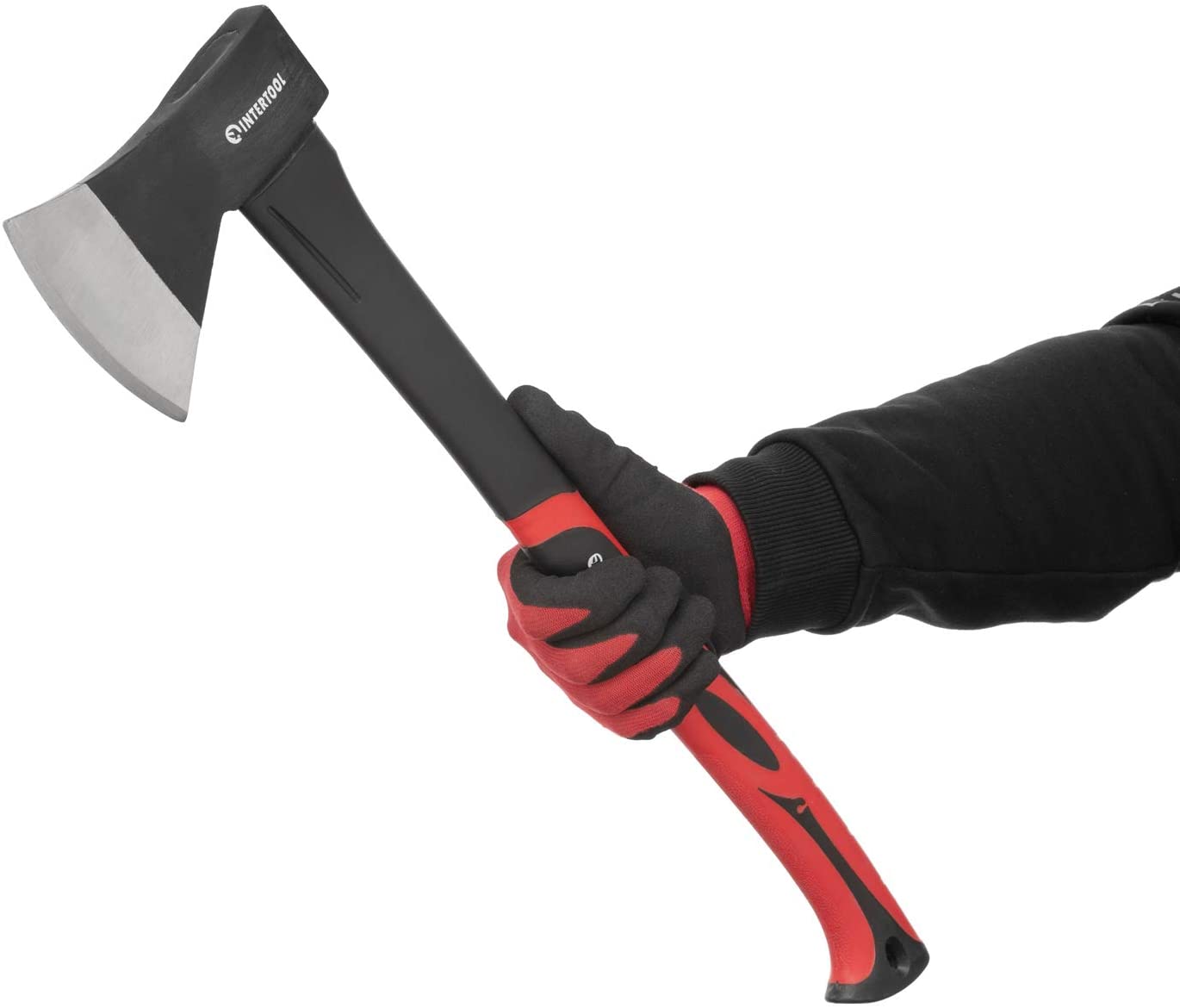
Recently I was cruising through a hardware store, getting parts for a work project, when I stumbled across a most curious tool. It was a compact axe, and it was so striking that I had to bring it home with me.

Before I say much more about my new axe, allow me to set up the hole that it fills. In my life, I've encountered 3 common axe-type objects: the hatchet, the full-size axe, and the splitting maul. All three are great for certain tasks, but have weaknesses that are very limiting. 
  • Hatchets are light and easy to carry, but their light weight and short handle leave them lacking in actual chopping power.
  • Splitting mauls are the exact opposite, with heavy heads and long handles. They hit like sledgehammers, but packing 6-10 pounds of maul isn't anyone's idea of a good time. They're also useless for tasks like felling trees or cutting downed timber to length. That big head which splits firewood like a dream makes them very difficult to control in anything but a straight downward swing. 
  • The full-size axe is a decent middle ground between the two, but it's still a bit heavy to carry in a pack, and the full-length handle is a bit cumbersome to pack around as well.
Enter the Boy's Axe, so named because it's an axe suited for young men to use. With a 2-2.5 pound head and 24-28 inch handle, it's about half the weight of a standard axe, and about 10 inches shorter. Its compact form factor is still a foot longer than a hatchet, with roughly twice the head weight, which means it hits far harder than the hatchet while being much easier to carry than its full-size brother. The longer handle also allows for (almost demands) 2 handed use, granting even more control and power than the hatchet can muster. 

https://amzn.to/3zrUBss


As with most tools, prices vary from "the cost of a decent meal" to "I'll never financially recover from this." And as with most tools, you get what you pay for (to a point), but buying the most expensive one isn't going to garner much of an advantage. 

If you're buying online, find one that has a substantial number of reviews with a consistently high rating, like the unit linked. If you find one locally, handle it a bit; the handle should be comfortable to hold, with no burrs or snags, and move easily in your hand. The head should have a decent edge, be firmly affixed to the handle, and have some kind of finish on it to minimize rust and corrosion.

If you do pick one up, have fun hitting and splitting.

Lokidude

Sunday, June 26, 2022

The Work Sharp Blade Grinder Attachment

Not actually Erin.
& is used with permission.

In my last post I sang the virtues of the Ken Onion Work Sharp Knife & Tool Sharpener, while at the same time saying that it had its limitations. Those limitations can be broken with the Work Sharp Blade Grinder Attachment

Some of you may say that it's foolish to have to buy an $80 attachment to a $130 tool just to make it work, and you might be right. All I can tell you is that this attachment made me very happy because now I can sharpen pretty much anything with this tool. It works great, and I'm happy with it, so it wasn't a foolish decision for me. Whether or not it's foolish for you is a question only you can answer. 

https://amzn.to/3mHKJ7H


Why do I love it?
  1. If I can lift it, I can sharpen it. I've sharpened axe heads and machetes without breaking a sweat. 
  2. It will sharpen at any angle between 10 degrees and 35 degrees. 
  3. It will even do vertical grinding. 
  4. It comes with 5 belts (extra coarse, coarse, medium, fine, and extra fine) just like the Knife & Tool Sharpener, only these are wider. 
  5. By adjusting the two rollers on top you can select a flatter grind (good for straight blades, like knives) or a convex grind (good for high curve blades, like axe heads). 
This may not sound like much to you, but the upshot of all this is "It does everything I ask of it, and does it easily." There's only one drawback to it -- and to me it's minor, but I understand that it might be a deal-breaker for a lot of people -- is that you have to free-hand the sharpening. 

https://amzn.to/3mHKJ7H


This is why the "blade rest", also called a reference plate in the instructions, is present. Here's how you use it: 
  1. You set the blade on the rest so that you know what position the blade should be in for sharpening. 
  2. You grasp the blade in a stable, two-handed grip. I like to hold it with one hand on the handle and the other pinching the spine near the tip. 
  3. You lift the blade, keeping it steady and maintaining the reference. 
  4. You place the blade against the belts and move from base to tip, backing off the belt when you are done so that you don't round off your knife point. I find it's best to rotate at the waist while doing this so that the blade is kept as stable as possible. 
  5. You smoothly set the blade back down on the blade rest. If it touches down without wobbling, then you know you did it properly. 

https://amzn.to/3mHKJ7H


Yes, this technique requires practice. It will take confidence and a willingness to practice on some beater knives. I was nervous at first, and I did it wrong the first few times. But I got better at it, and now I have the technique solidly memorized in my hands and arms. 

This tool isn't perfect. It's loud, and expensive, and dirty, and terrifyingly vague at first. But if you just give yourself permission to screw up, and you practice steadiness and confidence, you will soon be able to sharpen anything you can lift up to the belts. 

I love this. I wish I'd bought it sooner. 

The Knifegrinder by Goya 


Sunday, June 12, 2022

The Work Sharp Knife & Tool Sharpener

Not actually Erin.
& is used with permission.

Last week I reviewed a sharpener which didn't solve my problems with hard-to-sharpen knives, and promised that this week I'd tell you what I bought which did finally solve those problems.

The answer to that is "a belt grinder"; specifically, the Work Sharp Knife & Tool Sharpener (Ken Onion Edition), which is a belt grinder designed especially for knives. 

I held off buying this for many years, partly because of its price but mainly because of the fact that it is a power tool and if I lose electricity then I cannot use it. For some reason, buying a tool that required electricity to work made me feel like a "bad prepper" and so I held off... until I finally lost my temper with not being able to sharpen things. Spite, as it turns out, is a marvelous motivator. 


https://amzn.to/3MHiy3n

For the record, I specifically recommend the Ken Onion edition ($130) over the standard Work Sharp Knife & Tool Sharpener ($80). I do this for three reasons:
  1. The Ken Onion edition will sharpen in 5 degree increments from 15 to 30 degrees, whereas the standard will only sharpen at 20 and 25 degrees. 
  2. The Ken Onion edition will accept standard belts, whereas the standard will not accept Ken Onion belts (their widths are different).
  3. The Ken Onion edition can sharpen much larger blades, either by rotating the sharpening module forward or by replacing it with another attachment, whereas the standard edition cannot. 


It's my opinion, born out through my experience, that this utility is well worth the additional $50 in price. Once you see how well it works, I'm sure you'll agree. 

And boy howdy does it work. It's fast, it's efficient, and like any belt grinder it can aggressively mess up a blade if you aren't careful. My advice is to practice with a banged-up knife first; it's not like you're going to make it any worse, and you might make it better. After that, work your way up, and soon you'll be sharpening almost any blade to a razor edge and mirror polish. 

https://amzn.to/3MHiy3n


Here's some more advice based on my experience:
  1. Changing the belts isn't difficult but it can be annoying, so if you have multiple knives to sharpen, group them by coarseness. "These are really bad and need extra coarse for re-profiling, these just need medium for sharpening, and I want to hone this one with extra fine."
    • If you do this, only sharpen at one angle setting. Trust me, it's super easy to get wrapped up in this and then midway through realize "Oh dang, that last knife was 25° instead of 20° like the others, and now I've just done them all at 25° with coarse grit."
  2. I highly recommend that you wear hearing protection. While not especially loud on its own, if you're sharpening a lot or working on a really banged-up blade you can end up subjecting your ears to some sustained loud noises, especially if you have the RPMs running high. 
  3. This is a grinder, so it will kick out a fair amount of ground metal in the form of dust. Don't use this in an enclosed area (or if you do, wear a respirator) and be prepared to sweep up a lot of blue-black metal dust. 
  4. Be very careful when sharpening a tanto tip as you can very easily grind that down into a curve if you aren't careful. I would suggest using the Precision Adjust sharpener for those. 
  5. Blades which are both long and curved (such as kukri) or which have very thick bodies (such as axes) don't do well here. For those, I recommend using the Work Sharp Blade Grinder Attachment, which is only compatible with the Ken Onion edition. I will review this attachment next week. 

https://amzn.to/3mHKJ7H


Despite its price and reliance on electricity, I really like this product. It's amazingly aggressive, which as far as I'm concerned is a feature and not a bug, as it solved in a few minutes problems which had bothered me for at least a decade. It took knives which had divots on the cutting edge and made them sharp and shiny (if somewhat slimmer) again. This tool may not be for everyone, but if you absolutely need something sharpened and you have electricity, you can sharpen it. 

The Work Sharp Knife & Tool Sharpener Ken Onion Edition is available at Amazon for $130 with Prime shipping and it comes with one set of belts (extra coarse, coarse, medium, fine, and extra fine). Extra belt kits may be bought for $18 with Prime shipping. 

Sunday, June 5, 2022

The Work Sharp Precision Adjust Knife Sharpener

Not actually Erin.
& is used with permission.
This isn't going to be a review in my standard style. I've been putting off this review for about 2 months, and I'm not really sure why, but I figure an informal ("unprofessional," I guess) review will make this easier. 

I have several knives which have thwarted my attempts to sharpen them for many years (one of which for over a decade). I've tried many different sharpening systems, and none of them really satisfied me. When my friend Oddball, who is the knife guy among my friends, recommended the Work Sharp Precision Adjust Knife Sharpener system to me I figured it couldn't come with a better endorsement. 

And... 

Well... 

I don't hate it; I just don't love it, and that bothers me


https://amzn.to/3Npck9t

Before you get the wrong idea, let me reassure that this system does work... for pocket knives or smaller. Heck, it even returned my Derma-Safe folding knife to a razor's edge, thanks to its ability to sharpen to an angle as narrow as 15°. And if your knife has a tanto tip, this system will handle that easily. 

It just doesn't work very well on blades much beefier than a Mora Clipper, mainly because the vise which holds the knife in place has a triangular cutout (to accommodate the slim spine of most pocket knives, I assume) and all of the "outdoorsy" fixed-blade knives I've seen have a much thicker spine with definite right angles. As you might assume, a robust rectangular spine doesn't fit well in a triangular vise. 

There's also the fact that the vise holds the knife in place via a non-locking thumbwheel, so a knife with any appreciable weight will not be held securely. 

Also also, the jig which holds the sharpening abrasive actually obscures my view of the edge as it's being sharpened. This is such a well-known issue that pretty much any Google or YouTube recommends that the first thing you do is get a mirror and put it right up against the base so that you can see the blade in its reflection. This is a valid solution to the problem, but the fact that I have to fix a known problem to make my sharpener work properly bothers me on a visceral level. 

Also also also, given that the abrasive jig travels on a guide rod means that there is a limit to how high (edge to spine) my knife can be. For example, I can't sharpen parts of my Cold Steel kukri machete all in one go; I have to sharpen pieces, then unclamp and move the blade. 

All of this is really annoying, and if it weren't for the fact that it works so very well on my smaller knives I'd have sent it back for a refund. I can't hate it, because it does its job... so long as I have a mirror, and my blade isn't too long and/or too thick and/or too heavy. 


Personally, I'd give it a solid "C" rating. It's A+ at sharpening pocket knives, but anywhere from a D to an F for larger knives. 

Next week, I'll talk about what I ended up getting which actually did sort out my problems with uncooperative knives. (Hint: it's a power tool.)

Monday, January 3, 2022

Mora Knife Hack

Not actually Erin.
& is used with permission.

 As I've stated multiple times, I am a fan of the Mora Clipper knife, as are many other preppers. However, I think we can all agree that the sheath it comes with is only adequate at best. My biggest complaint with it is that it doesn't securely hold the Mora in place and any significant jostle can dislodge the knife from the sheath. 

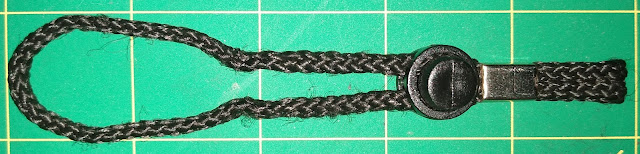
Try it yourself: holding the sheath at arm's length (to protect your feet) with the knife pointing down, give it a few firm vertical shakes. Odds are, the knife will fall out; mine certainly do. Fortunately, there is an easy fix for this. All you need do is purchase something known as a finger lanyard

https://amzn.to/3sSqskd

A button slide is preferable to a friction slide due to its ability to lock in place. A wrist lanyard will also work, but those are much longer and will flop around. As in all things, use your best judgement and find the solution which serves you best (or irritates you least, as the case may be). 

Step 1: Cut off the thin cord at the end. You don't need it and it will just get in the way. This is how mine looks:


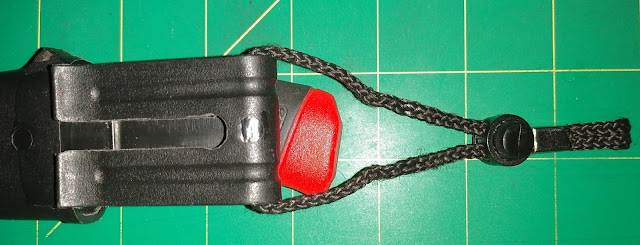
Step 2: Slide the finger strap under the belt hooks on the Mora sheath. I believe newer sheaths have one flange instead of the two on mine but this still ought to work. 


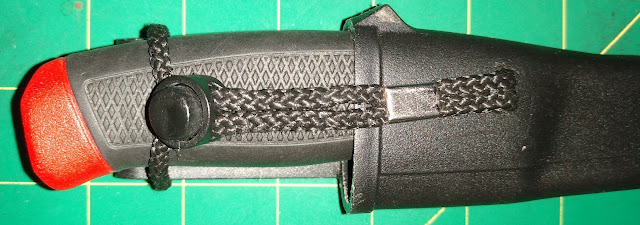
Step 3: Loop the lanyard around the knife handle and tighten it with the adjustable slide. 


You now have a Mora Clipper that is secured to its sheath and will not fall out no matter how hard it is shaken. 

Monday, March 22, 2021

Everybody Must Get (Whet)Stoned

In a previous article, I talked about files and said I’d get to stones later. Well, I checked and it’s later now. 

Also called lapping, sharpening, or whetstones, stones are used for polishing and honing, i.e. to produce a smooth finish, while files are generally considered to be tools for removing material. There are many different types and grades of stones to choose from, especially when working metal, but some are designed to be used for other materials such as glass. 

For this article, grinding wheels, although technically stones, are grouped with files as they are primarily used for metal removal.

Stone Types
The first division in stone types is natural versus artificial. As the name implies, natural stones are mined as found and then processed to their final form, while artificial stones come in a variety of bonded abrasives.

Natural stones are frequently named after their source location, such as Arkansas stones. Most Americans who’ve use a sharpening stone have probably used an Arkansas stone; they’re mined primarily in the Ouachita Mountains of Arkansas, but smaller outcrops can also be found in western Texas, Oklahoma, Japan, Syria, Lebanon, and Israel. Arkansas stones are a form of Novaculite, a Latin word  meaning "razor stone," which gives you an idea how old the use of stones for sharpening is. Arkansas stones are something of an industry standard, as they are very consistent in hardness and contain few impurities that affect their use.

Artificial stones are a combination of some type of bonding material (such as epoxy) and one or more abrasive grains (such as aluminum oxide, zirconium oxide, or silicone carbide). The material chosen and the specific size of the grains will determine both its cutting speed and finish quality.

For the casual user, the main difference between the two types of stone are price, as artificial stones are generally less expensive than  similarly-sized natural stones. However, there are some very cheap natural stones available that are often not worth even their very low price, and these low-end stones will usually break easily, cut poorly, and produce a poor finish.

Wetting a Whetstone
While some stones can be used dry, most will benefit from the application of a liquid, usually water or some form of thin mineral oil. This fluid serves several purposes: 
  • It causes stone particles to “float” on top of the surface, forming a slurry that can improve surface finish; 
  • The fluid also limits particles from being caught in the grain of the stone which can reduce the cutting ability or cause scratches;
  • Wetting a stone (not to be confused with a whetstone) can simplify cleanup. 
Most stones will work equally well with either oil, water, soapy water, or even spit.

Please don't ever do this. 

Care and Cleaning
After use, stones should be cleaned to remove any cutting residue, which includes particles of stone or metal as well as leftover lubricating liquid. (I generally wash mine with dish soap, water, and a scrubby sponge, then pat dry.) Once cleaned, stones should be stored so they aren’t damaged by other objects, many quality sharpening stones come with their own cases or boxes, but wrapping them in a clean cloth before putting them in a drawer can work as well.

As with any tool, proper care is essential for longevity. Unlike many other tools, stones are a consumable item. I’m sure most people have seen an old sharpening stone that has become almost bowl-shaped over time. When a stone is no longer capable of doing its intended job properly and easily, don’t hesitate to demote it and purchase a replacement.

Wednesday, March 3, 2021

Prudent Prepping: (Purple) Preparation Prevents Poor Performance

The dust has settled and the First 72 Hours have passed. Follow along as I build a long term plan via Prudent Prepping. 

I had a chance to break into my very basic First Aid kit to clean up and cover a very small cut to a finger belonging to the Purple Pack Lady. It's an odd story.

Purple Is The Color
I have no problem with someone having a favorite color, just as long as your favorite color isn't forced to be my favorite color. Besides the Purple Pack, there are shoes, socks, various apparel, stuffed toys (yes, even that one) and hats, but the one thing lacking was a small knife for Every Day Carry. Her home culture does not usually see women carrying knives in public, unless it is for food preparation or agricultural uses. Any EDC knife for her would have to be something that could be carried on a keychain lanyard, which meant small, light, and simple/easy to use. 

And Purple.

Jason Perry is a friend with a knife shop in Concord, CA where I've spent more that I should. He has found things for me before so this is where I went to ask for help. Did I mention that the knife had to be purple? 

Spyderco Ladybug 3 FRN Purple LPR3

https://tinyurl.com/y8qwfk96
And what a purple knife it is! This fit all the boxes that needed checked:

  • Small
  • Light Weight
  • Easy to use
  • And PURPLE!!!

It attaches to your keychain and is nearly as small as your car keys, one of Spyderco's smallest lightweight knives is the Ladybug.

Made of VG-10 stainless steel, the hollow-ground blade comes in a Plain Edge configuration. This modified clip-point blade style is matched up with a purple, lightweight handle of fiberglass-reinforced nylon making the entire knife weigh only 0.6 of an ounce (16.4 grams). The Ladybug doesn't have a clip but rather a lanyard hole for attachment to a keychain or lanyard.

Like its larger counterparts (and all Spyderco knives) the Ladybug 3 packs tremendous cutting power and can take on both fine and heavy cutting tasks. 

More on the last sentence soon.

Spyderco is a well respected brand and makes many different knives, many of which use the distinctive Thumb Hole as the opening method in place of studs. I don't have thumbs that work well due to several motorcycles crashes, so as much as I like how well Spyderco knives look, feel and work, I don't own any. That isn't a problem for Purple Pack Lady, so I ordered one of these for her. 

Remember when I mentioned the last sentence of the Spyderco ad? 


They come from the factory reasonably sharp, and if you are not very careful and deliberate in pushing the lock while holding the blade securely, you could end up with a small but painful cut, like the one shown above.

Out came the small First Aid box with my usual assortment of band aids in various sizes, alcohol wipes and triple antibiotic. Her finger was washed down, wiped with the pad, and a knuckle bandaid was adapted to the injured fingertip. I was given low marks for my sink-side manner, but earned an "Okay" score in how well I cleaned, applied ointment and pressed the 'wings' of the band aid down. I guess nurses are as hard to please as other professionals when having work done on them. 

The injury happens to be on the non-dominant hand, so while it is a bother to have a fingertip cut, it certainly could have been worse.

Recap And Takeaway

  • Personal relationships with local businesses can pay off with that extra bit of knowledge Amazon can't supply when searching for items in a non-traditional way -- like color as the priority.
  • Nothing was purchased this week -- I bought the knife last week. 
  • While the Spyderco LadyBug 3 can be purchased at a lower price than what I paid, supporting local businesses when they do the hard work is only fair.

* * *

Just a reminder: if you plan on buying anything through Amazon, please consider using our referral link. When you do, a portion of the sale comes back here to help keep this site running!

If you have comments, suggestions or corrections, please post them so we all can learn. And remember, Some Is Always Better Than None!

NOTE: All items tested were purchased by me. No products have been loaned in exchange for a favorable review. Any items sent to me for T&E will be listed as such. Suck it Feds.

Tuesday, November 17, 2020

The Gerber Armbar Drive

I've been carrying some variety of a Swiss Army Knife for going on 30 years. I started with a penknife as a small boy, upgrading to a couple other varieties before settling into the Victorinox Tinker I've carried for the past 15 years or more. My dad carries one, my grandfather carried one, and millions of other folks do every day as well. They're a solid, simple, affordable tool that is popular for a reason.

With all that said about them, the Swiss Army Knife (or SAK for brevity) has some weaknesses: They can get overly complicated in a hurry, many of the tools are less-than-ideal compromises, and the blades are rather lacking. They're thin, short, and with an odd profile. They serve average users fairly well, but they fall down a bit when called on for more intense tasks.


https://amzn.to/36IxSKd

Enter the Gerber Armbar Drive. It comes across as both stripped-down and a bit futuristic. It has an open frame and a single aluminum scale to protect it from everything else that rides in your pocket, and has almost exactly the same dimensions as the Tinker is it replacing. It doesn't have all of the tools a Swiss Army Knife carries, but it takes the most useful ones and implements them far better. 


https://amzn.to/36IxSKd

Starting with the knife itself, we have a Wharncliffe profile blade designed to be opened with one hand and with a thicker and stronger construction than the traditional SAK blade. The blade is the only tool on that side of the knife, allowing for stout construction and lockup. It also uses a liner lock for enhanced safety.


https://amzn.to/36IxSKd
The opposite side of the tool contains a pair of very functional scissors, a short awl, and the screwdriver that gives the tool the name "Drive." Each of these tools features a hook on the spine for easy individual opening. 

  • The scissors have extra long blades compared to most multitools, and fit and slice tightly. 
  • The awl is short and sharp, and constructed in such a way that it can be easily resharpened, unlike traditional SAK awls. 
  • The screwdriver is a 1/4" hex bit holder that comes with a Phillips/Slotted driver bit. It has a magnet to hold the bit and can take any 1/4" screwdriver bit. 
  • My only concern with this tool is that the magnetic bit holder feels a touch fiddly, like the bit may fall out at some point.

On the end opposite the tools is a folding tool steel end cap. When opened, it claims to serve as both a bottle opener and a pry bar; the bottle opener functionality is there, but I have yet to test the pry bar claim and am a touch skeptical. In the folded position, Gerber claims it works as a hammer, something else I have yet to test and again am skeptical on. As opportunity arises, I'll certainly test these claims, and see if my skepticism is warranted.

There are two tools that my SAK has that I miss on the Armbar Drive, however. I actually got a fair bit of use from the P38-style can opener when camping, and I used the file quite a bit as well (mostly on my fingernails, but still). Unfortunately, I don't see a way they could have readily fit them into the knife's footprint without making it overly large. 

Everything in pocket knives and multitools is a compromise, and the Armbar compromises well.

Lokidude

Friday, October 23, 2020

Omniblade Alternatives

Not actually Erin.
& is used with permission.
If you're a patron of the Assorted Calibers Podcast, by now you should have heard Oddball's review of the Omniblade, a $60(!) machete-hammer-hatchet-saw "multitool". If you aren't a patron, don't worry; the episode will be free on Monday. However, if you don't want to wait, here's an executive summary: It sucks. 

https://amzn.to/31AMQAa

As part of the commentary on that podcast episode, I mentioned that I would write an article for this blog where I would recommend for you cheaper and more effective tools than the Omniblade. The good news is that this is that article; the bad news is that I'm over budget... by $6. 

Machete and Hatchet
https://amzn.to/31SJUiH

I'm a big fan of the kukri-style machete, as the design makes for a good chopper of more than just foliage. I have owned a Cold Steel Kukri Machete ($30) for over a decade now and it has yet to disappoint me. Not only is it well-balanced and a pleasure to swing, but its 1055 carbon steel construction is as close to indestructible as I've found -- a far cry form the Omniblade's cheap 420J2 Stainless Steel which bends when chopping wood. Also unlike the Omniblade, the kukri machete doesn't need a specialized hatchet blade to chop wood, as I have used it to cut branches as thick as my arm off of trees. Not only does it do that well, there's not a dent to be seen. 

Price: $30
Weight:  almost 1 pound (15.87 oz)

Saw

How about a real saw instead of a saw blade on the back of something awkward? The Corona Folding Saw ($18) has an ergonomic handle, a chrome-plated high-carbon steel blade, and folds away for ease of carry. Plus, it doesn't have other sharp bits sticking out at uncomfortable angles waiting to cut you when you use it. 

Price: $18
Weight: 0.54 pounds


Hammer
I can't think of a reason why you'd need a hammer while out in the woods (pounding stakes? Get a rock!) but if you really want to carry one, why not get a tool that does other things along with hammering? The OX Tools 10" Molding Bar ($18) is also a chisel and a nail puller. 

Price: $18
Weight: 0.75 pounds
 

Comparison
The Omniblade:
  • weighs 2.35 pounds
  • costs $60
  • is made of cheap materials
My suggestions:
  • weigh a combined 2.28 pounds
  • cost $66 total
  • are made of quality materials
In short, the real tools are lighter, more durable, more likely to work properly, less likely to injure you, and for a negligible difference in price. 

Please don't buy poor-quality tools, especially if you plan to use them for survival. 

The Fine Print


This work is licensed under a Creative Commons Attribution- Noncommercial- No Derivative Works 3.0 License.

Creative Commons License


Erin Palette is a participant in the Amazon Services LLC Associates Program, an affiliate advertising program designed to provide a means for sites to earn advertising fees by advertising and linking to amazon.com.