Showing posts with label Communications & Signals. Show all posts

Tuesday, September 26, 2023

Writing Well

The dust has settled and the First 72 Hours have passed. Follow along as I build a long term plan via Prudent Prepping.

The title of this post is something I've never been accused of doing, ever. As a matter of fact, I was really, really tempted to call this post "Writing Good" but the thought was fleeting, which rhymes with beating, and I don't want that either. (Thank you, David. Bloodstains are a pain to remove. -- Editrix Erin)

I've been upgrading my gear to stuff readily seen in the dark or in an emergency, which is hard since the default color for 99% of most gear is Tacti-Cool Black. If you look hard and are willing to spend a bit more (or a lot more in some cases), alternatives are out there. Luckily, I found one thing that isn't terribly priced for what it is: the Rite in the Rain Weatherproof Mechanical Pencil!

https://amzn.to/3Pv5QZ3

From the Amazon Ad: 

  • MECHANICAL PENCIL: The wide knurled grip offers wet or dry glove-friendly handling on the job site.
  • STRONG BARREL: Durable resin and metal barrel survives through the toughest conditions.
  • LEAD: The dark 1.3mm lead won’t snap at the tip or break in the shaft.
  • INCLUDED WITH PENCIL: Each All-Weather Mechanical Pencil comes with 1 lead in the barrel.
  • REFILLS AVAILABLE: Rite in the Rain has clean erasers (13ER) and leads (13BR) refill packs available.
  • Lead is 120mm long – the full length of the pencil’s barrel.
  • ONE-HAND OPERATION: Easy click advancement of the lead.
  • STRONG CLIP: All metal clip won’t break on your tool belt.
  • ERASE WITH CONFIDENCE: Specially formulated eraser removes marks while not chewing into the paper.
  • PRO TIP: Made for tough jobs; Contractors, DIY, Police, EMS, Fire, Field Research, Camping, Hiking, Surveying

This is an amazing pencil, even if it is about half the price of a 3 pack of standard Rite In The Rain pencils. I don't own any other writing instruments that might be called Tactical, but this is what I expect one would feel like. The pencil is heavy, really heavy; I don't have a scale, but it weighs close to two Zebra 402 pens*. I lose pens and the Purple Pack Lady always needs pens for work, so I buy extras. Don't judge me!

The description of "wide , knurled grip" doesn't describe the front of this pencil correctly, which is a textured metal that screws into the body, making this pencil very nose heavy. That's not a problem for me, and I believe it is a feature for a tactical writing instrument. The lead is nice and thick, and it shows up nice and dark on standard paper as well as their notebooks. Replacement leads are available, and erasers too, from Amazon.

I will be putting this into my GHB for now and possibly placing this pencil in my other bags as well, not to replace the pens but to be something easier to see in a panic.


*Editrix Erin says: according to Amazon, the orange pencil weighs 0.96 oz, whereas the Zebra pens weigh 0.8 oz. 

Recap and Takeaway

  • All the things that can't be replaced with brightly colored duplicates are either going to be wrapped in contrasting tape or painted. Examples will be coming soon!
  • This pencil was sitting in the box with the Rite In The Rain notebooks that I give as gifts until I took the notebooks out last week. I'm not sure why it wasn't used until now, but it's a keeper.
  • One Rite In The Rain pencil, in orange, ordered from Amazon for $8.95 with Prime shipping.  
* * *

Just a reminder: if you plan on buying anything through Amazon, please consider using our referral link. When you do, a portion of the sale comes back here to help keep this site running!

If you have comments, suggestions or corrections, please post them so we all can learn. And remember, Some Is Always Better Than None!

NOTE: All items tested were purchased by me. No products have been loaned in exchange for a favorable review. Any items sent to me for T&E will be listed as such. Suck it Feds.


Saturday, January 14, 2023

Leave a Message

Not actually Erin.
& is used with permission.
Theseus used a ball of yarn to find his way through the Minotaur's Labyrinth. Hansel and Gretel used white pebbles to find their way out of the forest in which they'd been abandoned; they had less success with breadcrumbs. 

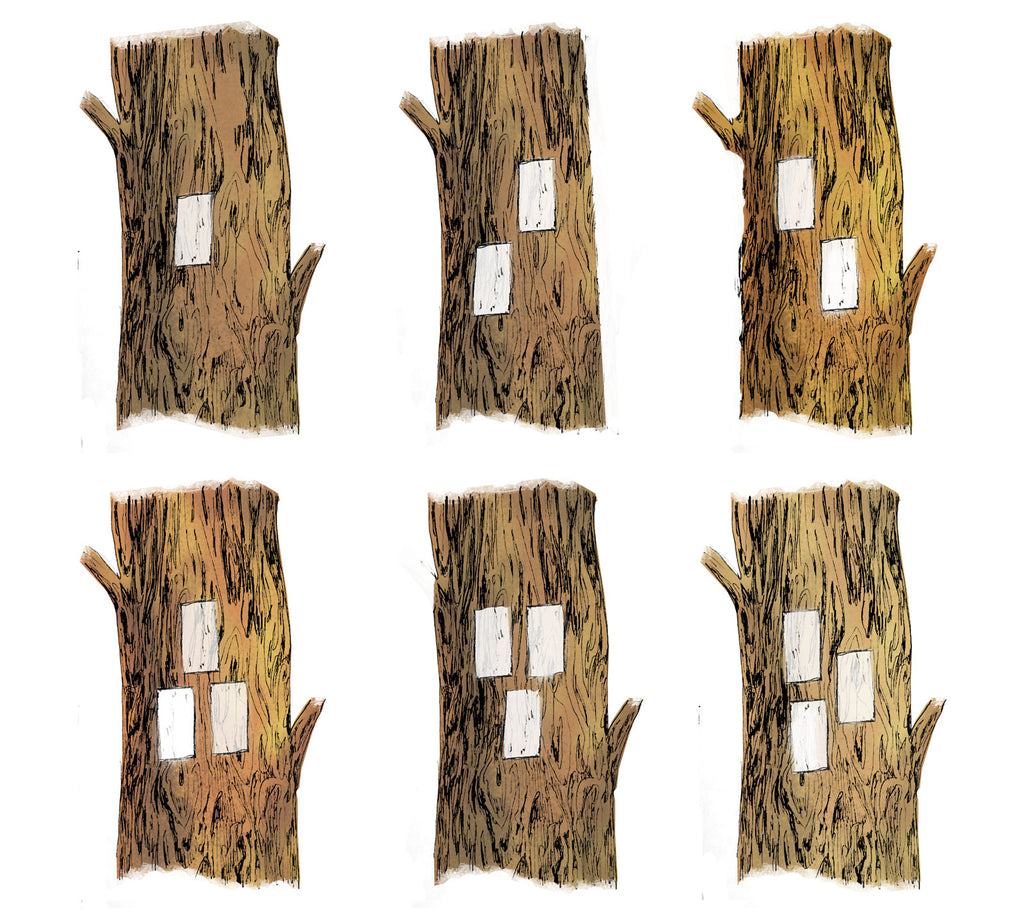
Even today, trails through forests are marked with blazes (hence the phrase "blazing a trail") in a variety of ways. 

Top row, L-R: "Keep going straight"; "Right turn"; "Left turn".
Bottom row, L-R: "Beginning of trail"; "End of trail"; "Spur leading to different trail".
https://www.greenbelly.co/pages/how-to-read-hiking-trail-signs-markers-blazes


Sometimes it's necessary to convey important information to others in a manner which is more durable than words on paper. The Hobo Code of last century was a series of pictograms which indicated safety, danger, resources, and the best directions in which to travel. 

https://www.trainparty.com/products/american-railroading-hobo-codes-poster.html


More recently, the FEMA X-Codes were made famous by 2005's Hurricane Katrina. You can learn more about them in this PDF

https://integratedskillsgroup.com/2021/06/urban-search-and-rescue-codes/


I would be remiss if I didn't mention the famous "Don't Dead, Open Inside" message from The Walking Dead, not only because preppers seem to love zombie shows but also because it aptly illustrates the importance of messaging left to right rather than up to down. 


Regardless of whether it is before, during, or after a disaster, the fact remains that it can be essential to leave a message to yourself or those coming after you, and in a manner which is visible and durable. This is why I gave David a soapstone holder for Christmas: it serves the same purpose as chalk, but is far less messy and fragile. 

Other useful tools to have with you, either in your bug out/get home bag or in your car:
With these four small and lightweight items you have the ability to leave an effective message practically anywhere. 

Friday, August 6, 2021

American Sign Language

One of the common topics of discussion by preppers is communications. We want to be able to find out what's going on around us, so we can figure out how to react. Long-range comms are nice, and we've had a few articles about radio and such over the years, but a one-on-one exchange of information can be more important and time-sensitive. There are a few problems, though:

  • Some of us are dealing with mask mandates due to the reactions of various governments and corporate “leaders” to COVID-19. Masks of any sort muffle the voice and make communications harder. For those who are hard of hearing or deaf that rely on reading lips to help understand what is being said, masks hide half of the face and make it impossible to see a person's mouth.
  • I wear an N95 mask at work when dealing with certain chemicals and levels of dust that are unsafe to breathe, so I know how they hinder clear speech. Add in the various machines that make enough noise to require hearing protection, and speech becomes a poor method of communicating. Since most of us older workers didn't have hearing protection available decades ago, many of us have some hearing loss and that makes it even harder.
  • English has many dialects and some people have a hard time making sense of those who speak a different dialect. I'm a Midwesterner, and while we have a fairly flat dialect without the changes in pitch common in several others, I've run into a lot of local people who have a hard time understanding Southern, British, or Creole/Cajun speakers.

There is a handy (pun intended) method of getting around these obstacles to clear communication: Sign Language.

American Sign Language (ASL) is a manual language that uses hand gestures and to a lesser degree facial expressions to communicate. Developed about 200 years ago as a way to teach the deaf and mute, ASL is a fully-formed language of its own with idioms, grammar, dialects, and unique contractions. ASL grew from native signs adopted by deaf people and a system developed in France to teach deaf and mute children. Up until the late 1600s, it was assumed that the lack of hearing meant a person was unteachable, and they were consigned to asylums or raised as imbeciles. By the 1800s, schools for the deaf started popping up around the US.

I grew up within view of a state school for the deaf that teaches children from 18 months to 18 years of age, so I learned a bit of ASL as a child. One of my school-mates had deaf parents, so he had to translate for me and I picked up the basic alphabet from him (along with all of the Helen Keller jokes). I've been teaching some of the guys at work (sorry, no women at the moment) some basic signs for when we're in places that don't allow for speech. Trying to yell over the noise and through the ear plugs gets tiring; it's just easier to sign the simple things.

It has recently become popular to teach infants some of the basic signs to give them a way to communicate with their parents before their verbal skills develop. My nephews could sign the basics like food, water, yes/no, and various toys long before they could speak. Kids are smarter than most of us think.

For preppers, there may be times where having a different method of talking to each other will be useful: not waking the off-shift crew, subtle hints during negotiations, and having a relatively uncommon language to hold private conversations in all come to mind.

There are lots of resources available for learning ASL, so start with the basics and keep learning. Here's the basic alphabet.


https://en.wikipedia.org/wiki/American_manual_alphabet

Amazon and your local bookstore have dozens of manuals and teaching aids, YouTube has hundreds of short instructional videos for common words and phrases, and Gallaudet University -- the first deaf college in the US, founded by the son of the man who got ASL rolling -- offers a free online course for learning ASL.

I've lost a lot of my foreign language skills due to lack of practice. All skills deteriorate without practice, so find someone to talk to once in a while to keep things fresh. You might even learn a few new “words” now and then.

Thursday, November 19, 2020

Alternate Social Media

 As most of our regular readers know, Facebook deleted all links to our little blog a short while ago with no warning or explanation. We're not alone in that regard; there seems to be an ongoing purge of "wrongthink" on many of the major social media right now. Twitter, Facebook, and Google's YouTube are either flagging, editing, hiding, deleting, or banning any content that they deem "wrong". This is one of the pitfalls of "free" social media: you're using their services, and they get to decide how you can use them. "Free" social media make their money (a lot of money) by selling ads and several of them have been selling users' personal data to ad agencies for a long time. Again, it's "free" to use and that EULA (End-User Licensing Agreement) that nobody reads before clicking "OK" gives them the legal power to do this to a certain degree. Lawsuits and investigations are attempting to define how and what the limits are, but for those of us who prefer to live a more private life there is an easy way to avoid being treated as the product instead of the customer.

Don't give them the information in the first place.

There are alternatives on the market for the "big 3" social media. After Facebook (FB) declared us heretics, we moved our little group (200 members and growing) over to MeWe. It's not as busy as FB and we can still keep in touch by sharing information and articles. Functionally, it has the same offerings as FB without the "fact checkers" deciding who gets to speak and who gets blocked. MeWe is growing, so I expect it will soon be easier to find friends and family there. 

Let's look at some of the other options out there.

Google Search

The largest search engine on the web, Google started out as a neutral entity with the famous motto of "Don't be evil". They have morphed into a gatekeeper of information that decides who and what gets to be found when people are looking for information, and they have a very strong political ideology. Here are some alternatives:

  • Startpage. No tracking cookies and the option for private browsing. 
  • Duck duck go. No tracking of your history or location, one of the best for privacy while searching. 
  • Bing. Owned and run by Microsoft, so it has some corporate strings attached, but MS has had its hand slapped in court a few times and they're learning to play nice. 

Facebook

Prior to FB we had MySpace and LiveJournal to connect with friends and share our thoughts and creative productions. They're both still active, but don't have the following that they used to. There have been many "FB killers" launched in the last few years, but none have gotten even a small fraction of the users FB has until recently. Here are a few options, with many more out there or in the works.

  • MeWe. As I've stated, MeWe isn't as active as FB, but it's growing. They don't sell your data or track you across the internet like FB and their commitment to freedom of speech is very strong. Free speech means that you may run across opinions or pictures that you don't like, but that is a small price to pay for your own freedom to speak out. Rather than getting offended, ignore and block the fools and go on with your life. Joining requires an invitation, click on the Fallout Shelter sign to the right for a link.
  • Gab. Laid out in a simpler version of FB, Gab offers most of the same features without the nannies keeping track of what you post. 
  • Diaspora. A decentralized form of social media, Diaspora uses "pods" instead of large servers to host its users. You choose which "pods" or communities you want to participate in. 
  • Discord. Another that requires an invitation to join, Discord was set up for gamers as a way to chat in test or voice while playing various games. Very light moderation of "boards", they allow a lot that would get you booted from FB. There is limited ability to share pictures and videos, mostly text chat and audio channels. There is a BCP Discord, you can find it by using the search box in the upper left corner.

Twitter

I've never been a huge fan of 140 character messages, but I know some of you are. Twitter has gone off the deep end in the last year or two, banning anyone with views contrary to theirs. Many of the folks who have been kicked off Twitter or effectively silenced by being excluded from search results have found other outlets for their pithy pronouncements.

  • Parler. Quickly becoming the new place for people who are tired of Twitter, Parler is a viable alternative.
  • Mastodon.  Decentralized and ad-free, Mastodon is laid out like Diaspora in a "pod" or community format. User-owned, so there is no corporate desire to farm your information for more revenue.


YouTube (owned by Google), Reddit, and several other social platforms are all in the same boat as FB and Twitter. The encroaching censorship and banning of any "wrong" expression of users is forcing people to find other ways to communicate. 

Use common sense when you use any online method of communication. Unless you have some serious encryption, everything you say can be intercepted and recorded. Corporations use this information to target advertising and build a profile of you and your activities, governments use it to track and monitor your activities with law enforcement being their main goal.

Tuesday, October 27, 2020

Guest Post: Is GMRS For You?

GMRS stands for General Mobile Radio Service and is a licensed service in the USA that shares some of the FRS (Family Radio Service) channels but allows use of radios and antennas that give you more range. In this article I will outline the steps to get a license, as well as talk a little bit about what equipment is available. 


Why GMRS?
Unlike Ham Radio, a GMRS license requires no test; just 3 questions on an application and a $70 payment. The license is good for 10 years and covers you and your immediate family all the way down to your grandchildren, including in-laws! You can conduct a family business using GMRS (so it’s good for a ranch or farm), but your employees are not covered; they would need their own license so they can talk with you. Many Public Service organizations such as CERT or REACT also use GMRS. With this license you could have you our own repeater if you wanted (or form a group to pay for putting one together)

How Much Range is "More"?
Mobile and Base Stations are up to 50W, but GMRS uses repeaters like you have with Ham. So depending on your terrain, you could communicate 5-10 miles between your house (with an outdoor antenna) and your car while you are out; with a repeater, that might be 50 miles. 

How Do I Get a License?


Get a FRN (Federal Registration Number)
If you already have a Ham License you might have a FRN already. If so, skip to “Apply for a License". 
  1. Go to https://apps.fcc.gov/coresWeb/publicHome.do
  2. Click on Register.
  3. Answer the questions. 
  4. Register as an Individual as GMRS licenses are only good for Individuals.
  5. Wait for the email with your FRN
Apply for a License
  1. Go to https://wireless2.fcc.gov/UlsEntry/licManager/login.jsp and log in.
  2. Click on Apply for a License (on the left hand column).
  3. Choose the bottom choice in the box (ZA - General Mobile Radio Service)
  4. Answer the additional questions about whether you are exempt as NO.
  5. Answer the question about whether you have been convicted of a Felony.
  6. Review to make sure all your answers are correct. 
  7. Sign by typing your full name and answering the question about what your title is as SELF.
  8. Follow the link to Payment. Please note that it will take a few minutes for the invoice to show up in the system, so wait about 2-3 minutes before clicking the link.
  9. Wait a few days to get the License.
  10. Order your radios!

Radios


Do I Need a Handheld?
The answer to this depends on 3 things:
  1. Do you only need a range of less than1mile under normal circumstances?
  2. Do you have access to a repeater you can access with only a Handheld?
  3. Are you wanting to have a passenger communicate while driving?
If the answer to any of these is yes, then a handheld is for you.

GMRS handhelds can have more power than FRS handhelds as well as better antennas (FRS only allows for fixed , non-upgradeable antennas). GMRS handhelds are are channelized the same as FRS and follow the same plan, but many GMRS handhelds also allow you to use repeaters. 

The Btech V1 handheld is about $60 (about twice what an FRS radio costs) but has 5w compared to the 2w of the FRS, allows you to access repeaters, and allows you to use a better antenna.

When Should I Get a Mobile? 
(and how much power do I need?)
Are you wanting to drive and talk at the same time? Many states have laws on the books saying you can’t hold a cell phone while driving, and it's hard to distinguish a handheld from a cellphone while passing a cop.  

Mobile radios range from 5w-40w in the models available currently (unless you want to go to eBay and get an older Motorola or other brand that needs a special programmer), and prices range from $99 on the low end to $249 or so for the more powerful units.
  • Mobile radios in the 5w category, such at the Midland MXT105, tend to be direct only (no access to repeaters) and come with fixed or magnetic mount antennas. 
  • Radios of the 15w or 40w variety, like the Midland MXT115, have fixed or magnet mount antennas but also allow you to access repeaters. 
If you don’t want to drill a hole in your vehicle, a magnetic mount antenna will work for most uses. There are various “Gain” antennas available; many of them are short (6”) ¼ wave antennas, but you can get larger antennas (such as ⅝ over ⅝ wave) that are 25” or so. More gain generally means further range. 

In short, if you are going to be out in a vehicle and want to talk, get a mobile radio.

Are Base Stations Worth the Expense?
I’ve not found many, if any, dedicated base stations for GMRS. The most common way to build one is to take a mobile radio, add a power supply, and purchase a base station antenna and coaxial cable. 

Probably the most common use for this would be when there isn’t a repeater locally available and you need more power than a handheld would give you or need to be able to talk directly to a mobile or handheld out in the field. On some channels you can use up to 50w to do either.

Base station antennas go from little spikes that are 6” tall to giant monsters that are 11.5’ tall; it all depends on who you want to be able to talk to. For “around the 10 acres,” a simple spike mounted high and clear of buildings and nearby trees might be sufficient; if you need to be able to access a repeater 10+ miles away then you might need a 6 foot tall antenna; but if you want to talk directly to a mobile out in the field, you might need the 11.5’ monster. 

There are many kinds of “coax” cable out there, but for a base station you want a minimum diameter of 0.400” and to keep it as short as possible, as the losses inside the coax go up dramatically by length.

Repeaters 

Join an Existing Group
There are some 1700+ repeaters in the US, many of which are open or private but you can join the group. Check out https://mygmrs.com/browse where you can search by state for repeaters around you. Joining a repeater group, or supporting an open one, means that you won’t be an unknown person (or family) when you need to use it. 

Like Ham Radio,  you want to be brief and to the point when communicating among your family during an emergency. Many of these repeaters have “Nets” where everyone checks in and verifies their equipment works. Some just have a net to chit-chat!

Buy Your Own Repeater
Let’s say that your family is all over the place and that you can’t tie up someone to act as a relay sitting at a fixed location (like a base station). In that case, the next step might be to buy your own repeater. A good antenna, coax and backup power are necessities for good repeater operation, so expect to spend between $600-$4000 for a repeater/antenna/coax.

There are 8 repeater pairs of frequencies you can use, and you want to coordinate such that you don’t “step on” someone who is already using a channel in your local area. Again, check out https://mygmrs.com/browse where you can search by state for repeaters around you, and listen a lot before you decide to buy/install a repeater.  

While there are a few low power repeaters that are easy to program and are good for “local” use, a higher power repeater will have to be programmed with a special programmer and “tuned” for the channel you choose. Getting a high, clear location that is able to “see” the areas you want to be able to operate is a big consideration.

Final Thoughts
Practice! In the middle of an emergency where your cellphones are dead isn’t the time to break out the GMRS radios for the first time. Instead, join a group of like-minded individuals and families.

I can’t stress enough that you need to practice! Send the kids off to play/explore with a handheld and use the radios to check in periodically; it will help them to understand how to use the radio as well as give them the discipline as to how to use them when needed. Go to the grocery store and practice using the radio to “ask for the thing you forgot.” Remember, cellphones may not be there when you need them.

Tom King
KA6SOX / WRJK601

Thursday, March 28, 2019

N11?

Last week I posted a bunch of information about where to find road condition information in various states. Several of the websites had “511” in the name, and one of my friends asked why that particular number was used, so I thought I would explain that a bit.

Way back when rotary-dial phones were still in use, every phone call was routed through mechanical switches, and the clicks that the phone made as the dial returned to its rest position controlled the mechanical switches. Because of certain physical restraints and standards imposed by the monopoly that ran 98% of the phone systems, the first three digits of any phone number (the area code) couldn’t start with a 1 or 0 and the second number was always either 1 or 0. The Federal Communications Commission (FCC) stepped in and brokered an agreement with Canada for a uniform numbering system, the North American Numbering Plan (NANP), under which certain numbers were set aside for public service use. The first digits 0 and 1 were still reserved for operator-assisted and long-distance calls respectively, but with the NANP we got the ubiquitous 911 emergency number along with a few others that aren’t as well known.

When the phone systems in the US switched to all-digital equipment in the late 1990s, it opened up that second digit in the area code and made millions of more phone numbers possible just in time for the explosion of the cell phone market. The Internet and cell phones have obsoleted many of the N11 numbers, but they’re still in the regulations. Here are the numbers in use and how they are to be used.

211
Community services and referral information. If you are looking to contact the local Red Cross or some other health/human services organization, try this number. It’s only available if the local government or a non-profit organization runs it.

311
City services and/or non-emergency contact for police and fire departments. This is a handy way to report potholes and graffiti around your city without tying up a line to the emergency services dispatcher (which is considered illegal — at the least a misdemeanor — in many states anyway).

411
Directory assistance. This is a left-over from a time when phone books were still common It’s only useful for local numbers, and most of the large cell phone companies don’t publish their customer’s numbers, so this one is somewhat obsolete, although many people still have land lines in addition to cell phones and those land lines still get printed phone directories.

511
Road condition information (usually at the state level). Most states still offer an automated phone service if you call 511, giving the highlights of road closures and construction.

611
Customer service. This number is not specifically designated as such, but is so used by many phone companies. It is the number to call for a problem with telephone service, or to report an outage, etc. Most of us have experienced what the phone companies consider customer service, so this one is pretty useless, in my opinion.

711
TRS (Telephone Relay Service) and TDD (Telecommunications Device for the Deaf), services for the deaf and blind. Paid for by the phone companies, TDD and TRS give the disabled a way to communicate in near real-time.

811
Before-You-Dig. This number was set aside for as a digger’s one-call system: before you dig into the soil anywhere, you’re supposed to call this number and the local utilities will send out a “locator” to find and mark any underground wires or pipes. Failure to use this normally free service has cost a lot of idiots a lot of money and caused some major headaches. “Bubba with a backhoe” is the derogatory term for someone who manages to pull up or cut into a buried phone line or gas pipe, causing a service outage that can vary from a neighborhood to a city, and (in the case of the gas) risk fire and/or explosion. I’ve seen some rather large outages in my time, up to and including the idiot who ruptured a high-pressure natural gas transfer pipe. That one took weeks to fix once the residual gas bled off (and was intentionally set on fire).

911
Emergency services. We’re all familiar with this one; if you need the police, fire department, or medical aid, you’ve been taught to dial 911. Cell phones are required by law to have GPS locators in them so the dispatchers can know where you are; land lines will show up with their version of caller ID, but phone-over-internet calls have created a hole in the system. The proposed authentication system for combating robo-callers may close this hole and shut off the “swatting” of people by spoofing their phone numbers.


I know this isn’t strictly prepper material, but I’m answering a legitimate question from a reader. We’re still dealing with flood waters in my area and it looks like we’ll be seeing them for several months. The snowpack upstream is just starting to melt and we’re expecting more rain, so the rivers will be full again this weekend. Unlike a hurricane or storm surge, our flooding tends to be long, drawn-out periods of miserable weather coupled with some of the most helpful people in the world.

Thursday, August 16, 2018

A New Meeting Place: BCP Discord

Many of us here are gamers, playing video games, board games, role-playing games, etc. When we play, we sometimes play as part of a group and communication is a huge part of working together. Those of us who play online use a service called Discord, a free service for chatting by text or voice over the Internet without the ads and snooping that come with most of the “messenger” apps.

I've never used Facebook's Messenger app. The one time I looked at it, I was shocked at how much they wanted access on my phone/computer. I went to the Google app store today and looked it up to see if they had changed, but sadly they still demand the ability to add or remove anything they want to from my contacts list, memory card, text messages, and even my accounts. I may be a touch paranoid, but the idea of giving a total stranger (who may not be friendly) the ability to modify, add, and delete files on my phone/computer is abhorrent. When you consider that the stranger may not like what they find, or may not like what you say and can add or subtract files that are admissible as evidence against you in a courtroom, you'd be daft to give them that access.

Discord doesn't ask for that level of access.
  • If you have an email address, you can set up an account. 
  • They need to be able to use your speaker and microphone to facilitate voice communication, and your camera so you can share pictures. 
  • They don't want to know your location, make phone calls, send text messages, or read confidential information from your calendar app like Facebook Messenger. 
  • Discord channels are also invitation-only and aren't searchable; the only way to join a conversation is to be invited into it, and most groups have varying levels of access and permissions to make changes.
All of this is to lay the groundwork for a new way to interact with the readers and writers here at Blue Collar Prepping. I have created a Discord server (their name for a chat channel) for our use. The writers here at BCP are also moderators on our Facebook page, and they will have moderator/admin access on the Discord server. 

If you decide to join us, you'll be directed to the Campfire, which is a general meeting place for all to visit. I'm still setting things up and there will be changes made as it grows, but I have text-chat areas set up for a few specific topics (first aid, firearms, weather-related discussions, etc). The voice chat area is a bit empty right now, but if there are enough requests we may be able to host a regular (weekly?) live chat or presentation of sorts. This is not limited to the writers of the blog; I want more input from you, the readers. To be honest, after almost 5 years of writing I'm starting to run out of ideas, so I need your input and questions to be able to write articles that are useful.

Live communication is something different than text. I feel it will allow for a better exchange of information if you can ask/answer questions without waiting a week or two for another blog post. I know there are readers out there with stories and information to share, and I'm trying to provide a way for us to connect with one another and maybe help each other out once in a while. 

Names will be changed to protect the innocent. They'll also get changed if you choose something offensive. 

There are still the usual BCP rules:
  • No politics. We're not here for that.
  • No blatant ads. There is a place for posting links to things you may have found, but we're not here to grow your business.
  • Three strikes and you're out. Warnings will be given for all but the most egregious acts. If you're really offensive, you won't get any warnings. I have limited the boot and b permissions for the participants. an privileges to a select few.
  • Keep it PG-13, please. We're all adults (mostly) here, but try to act like your mother is reading what you type.
Discord comes as a phone app (Apple and Android versions) as well as a PC app for Windows, Apple, and Linux. They all connect to the same servers, so if you already have an account you can just add BCP to your list. I'm still learning a lot about Discord and how to run a server, there are tools available that I am trying to find a good use for. Expect changes and improvements in the future.

I have an active game group that I am part of, so I check Discord quite often during the day. It doesn't slow down my phone like a web page would, and I can flip through the servers quickly to check for new messages. I have disabled push notifications so you won't be getting notified of anything except when someone mentions you by name.

If you want to check us out, install the app from one of the links above, then click on the link below. If you already have a Discord account, copy and paste the link into the “Join new server” spot.

BCP Discord server: https://discord.gg/5NvEWZd

Monday, May 14, 2018

Emergency Calling Lists

The rain is falling. The news says something about a hurricane in the offing. Your neighbor is building an ark out of gopher wood. Rather than dressing up as a capybara and trying to convince your neighbor to let you hitch a ride, you should probably check to make sure that your friends and family are okay, and possibly see if one of them happens to have a speedboat or something.

This is where having a calling list comes in handy.

A calling list is just what it says on the tin: a list of people to call in a disaster.(This can also function as a “medical emergency” list for the next time someone is in the hospital, enabling you to alert everyone that will want to know what happened with a minimum of effort and energy.)

Ideally, the people you are calling each have a list of people to call, and so on, forming a “phone tree”, where a large number of people get checked on and alerted to the latest disaster plans in a short period of time. I keep a current printed copy of the calling list somewhere easy to find and easy to acess for anyone I send to get it. I keep mine on my wall next to my refrigerator, right beneath the fire extinguisher.

A prepper's calling list should include:
  • All of your close friends and relatives that you will want to keep track of in case of emergency, prioritized by who is local and a prepper
  • A list of who each person on that list is responsible for calling
  • Any group preps that each person is responsible for
  • A secondary list of “these people will just want to know that I am fine” (Mothers that live a thousand miles away, for example)
  • You may want a “pre-disaster” and a “post-disaster” calling list. “Pre-disaster” is for things like an oncoming wild fire, where you have warning beforehand; “post-disaster” is for things like an earthquake, where you only have a chance to call them afterward.
  • This being 2018, I tend to have a list of people who prefer to text over those who call. Sending out a mass text is easier than calling each person, but dealing with the information management from the mass responses can be a pain. Use wisdom.
  • (If this is an option for you) Someone outside of the potential disaster zone, who can act as a coordinator.

Information to talk about:
  • The latest information on the disaster
  • Your current medical status in brief (just fine, broken arm, etc). This applies to both parties on the phone call or text.
  • Confirmation that the other party does not require aid (not necessarily medical)
  • Confirmation of any applicable meeting plans or meeting places
  • Any delegation of tasks that needs to happen
  • Confirmation that they will contact anyone else on the call tree for whom they are responsible

Other information to keep on hand:
  • A predefined meeting place for people to meet, well outside the likely disaster zone
  • A time frame for when you are likely to meet (hours, days etc.)
  • A list of your own immediate family/pets that you are responsible for, and the preparations you need to work on for them. 
    • People do dumb things when they are stressed from disasters, and having a written list ahead of time can save a lot of mental energy in a pinch. 
    • Being able to delegate tasks to someone can make a serious difference.
  • A list of local emergency numbers, as well as a list of radio stations, websites and other local information resources

Remember to have workarounds 
in case someone is sick/missing/not picking up their phone.
  • Make sure to assign the missing persons' tree calls to other people, or do them yourself so that everyone is covered
  • Leave a message with all the essential information that you would cover

I actually wrote a script for my calls
to ensure that if I have to delegate the phone calls to anyone that they can still cover all the important points:
“Hi, this is (name). (Disaster) is happening, and I wanted to call you to make sure that our plans are up to date.”

“I’m fine, but do you need anything?”

“Can you call the people on your list?”

“Cool. I will meet you at (Place) within a day and a half, on (Date). Talk to you soon.”
(Handy template: http://www.dotxls.org/emergency-call-list/ )


Calling lists make disasters less stressful to deal with, and can save a lot of stress and time when the disaster actually comes. If you have anyone else you are working with for your preps (even if you only have one person), they can save your bacon.

Good luck, and don’t lick the wires. 

Sunday, April 23, 2017

Gun Blog Variety Podcast #140 - Going to NRAAM 2017

There's no yellow brick road, but be sure to follow the GBVC cast at NRAAM!
  • Beth is still going to NRAAM... but the USCCA is not. Beth tells us how the NRA dis-invited them.
  • Some relationships are fiery; this one ends in arson. Who lit the fire? Sean takes a look.
  • Barron is on assignment this week.
  • Discretion is the better part of valor, and so Miguel reminds you to pick your fights lest you get in over your head.
  • In the Main Topic, Sean and Erin talk about concealed carry handguns as Personal Protective Equipment.
  • Tiffany is on assignment this week.
  • Friend of the show Sarah Cade asked Erin, "How do you find your family members in an emergency?" Erin has some ideas.
  • For some reason, family members seem to get upset when their criminal spawn get shot! Weer'd brings us the grandfather of one of the home invaders killed in Oklahoma.
  • And our plug of the week is NRAAM 2017. Follow us on Instagram!
Thank you for downloading, listening, and subscribing. You are subscribed, right? We are available on iTunes, Stitcher Radio, and Google Play Music!

Listen to the podcast here.
Read the show notes here.

Thanks to LuckyGunner and Remington for their sponsorship, and a special thanks to Firearms Policy Coalition for their support.

Blue Collar Prepping Transcript:
 Finding Lost Family Members
in an Emergency
This week’s topic comes to us courtesy of friend of the podcast Sarah Cade, who asked for advice on how to find family members in an emergency. And that’s a great question! However, it’s very tough to answer because in an emergency, the best way to contact family members - cell phones and the internet - may be down, or so overloaded with traffic that no signal can get through. However, there are some tips and tricks I can pass along to make finding a lost family member easier.

Now the first thing to keep in mind is that during a disaster, texts are far more likely to get through than voice cails, because texts require far less data. So ensure that family members have a phone that can send and receive texts! At this point I think even the dumbest flip phone can text so this shouldn’t be a problem.

Next, make sure that your family members have a way to keep that phone charged! There are a variety of ways to do this, with the simplest to make sure that each phone has a charging cable and both a wall and car adapter. A portable battery to charge the phone when they can’t get to an outlet is also a good idea. I recommend the Anker Astro E1, which is literally the size of a candy bar and can fully charge an iPhone 7 twice, and only costs $17 from Amazon.

Another good way to keep your cell phones operational is with a hand crank dynamo. I like the ones that are also flashlights and AM, FM, and Weather Band radios because that’s a lot of utility in one package. The iRonshow Emergency Dynamo costs only $17.99 and belongs in every prepper’s bag.

But even if the cell network is completely down, a cell phone can still be useful in locating your loved one. Make sure that you have a picture of each of them on your phone - if you have the time, take a picture of them right before you evacuate so you also have a visual record of what they were wearing - and so if you get separated from them, you can show people their picture on your phone while asking “Have you seen this person?” rather than trying to describe them.

Now back in episode 9, I recommended that people scan their critical documents - drivers’ licenses, passports, vaccination records, etc - and keep them in a thumb drive. This is still a good idea! In fact, you should have other family member’s information on this drive as well, because if you can make it a FEMA shelter, the government or the Red Cross might be able to help you find out where your family is, and having copies of their documents can’t hurt in trying to locate them.

Of course, you don’t want all that personal information hanging loose on a thumb drive, so I suggest encrypting it. I’m sure Barron will jump in next week if I get it wrong, but I’ve found that a great tool is an on-the-fly encryption tool like VeraCrypt which creates a virtual encrypted disk on your thumb drive. So long as you remember the password, you can open the encrypted files easily, but it will take others a long time to break through it!

ProTip: since you need to actually run the program to decrypt your data, install a copy of it on your thumb drive as well.

Finally, the best way to find your family members in an emergency is simply not to lose them in the first place. Pre-plan rendezvous spots if you ever get separated in an emergency. For example, my family uses the acronym ACE: if we get separated, or we cannot reach our house due to a disaster like a fire, our rendezvous spots are, in order: the Airport, our Church, and the local Epic Theater.

If you have to evacuate in multiple vehicles, make sure that every single one of them has a detailed atlas for every state you may have to travel through, and designate meet-up spots in case you get separated. This may be as simple as "the first rest stop across the state line" or as complex as a street address. Write these locations inside the cover of the atlas so they won't get lost.

And yes, I said locations, plural -- on a long journey you need more than one. General rule of thumb for military convoys is a rally point every 20 miles or so, but you don't need to go that route; something simple like "every Chevron station at an interstate exit" or "every highway exit that ends in 5" will suffice for most purposes.

So there you go, Sarah; I hope you found this helpful. And if you or any of our other listeners think of something I missed, go to Gunblogvarietycast.com, click on the Contact Us tab, scroll down to Erin, and leave me your idea in the comment box. Don’t forget to click on “More ponies” before you hit submit!

Thursday, February 23, 2017

News and information after TSHTF

After TSHTF, be it local or national, there will be a need for staying up to date on some news stories. Weather reports and forecasts will help you decide what to wear and whether or not travel is a good idea. Reports on road conditions and traffic can help you decide which routes are safest if you need to travel. Government activities like relief stations and the various restrictions put into effect for “safety” are good to be aware of. So how do you plan on getting the “news”?

I, for one, am reaching a point of saturation when it comes to “news”. When I was a kid we had the three main networks and the “news” came on at 6:00pm and 10:00pm every night. Radio stations gave highlights at the top of each hour, with a few AM stations providing news reports all day. In-depth news coverage was provided by daily newspapers that weren't 90% advertising.
With the invention of CNN in the 1980s we were given “news” coverage 24 hours a day, and the various other all-news channels now allow us to pick our form of bias in the “news” we get. Along comes the Internet and the Drudge Report and now we have “news” available whenever and wherever we go. Most of what is now reported falls short of being actual news and is mindless fluff, used to fill in the gaps between commercials. The worst are the commercials disguised as news shows. In disgust, I have stopped listening to most of it (especially during election seasons) and have narrowed my sources in the last few years.

How do you get news after TSHTF? For any large-scale crisis, I doubt the Internet will be available. Even in local emergencies, the electrical and phone/cable infrastructure can be damaged enough to shut down your access to the web. The Internet was designed to be resilient and will route data around damage, but it may not be able to get route it all of the way to your device. Local radio and TV stations will try to stay active, but they rely on outside sources for most of their content. Here are a few sources for you to think about:

Rumors
As much as I hate rumor-mongers, they can be a source of information. It may be incomplete or incorrect, but it's information. Small towns and distinct neighborhoods still have a few people with nothing better to do than keep track of the folks who live around them. These local busy-bodies can be handy if you need to find someone or check on them, since they'll know quite a bit about local conditions. I have a standing policy of not passing on unverified rumors, but I make exceptions for disinformation purposes. Sometimes I want people to believe things that aren't true, for my own purposes.

Any gathering of people will provide an opportunity to gather information, especially if it is peaceful. Churches, water sources, and informal gatherings will likely provide better quality information than a press briefing or “stump speech” from a politician.

Travelers
People will pick up news of their surroundings as they pass through, which means that sitting around a campfire swapping stories with folks who have come from or through an area you're interested in could be a good idea. Travelers may be able to trade information and current conditions of other locations for the things they need to keep moving towards their destination.

A subset of travelers would be someone on a route that passes by you. The mailman is going to see a lot of local conditions as he travels his route, as will food or fuel delivery drivers. Law enforcement and military will likely be under orders to keep their mouths shut, but medical and maintenance crews probably won't.

Radio
There are a lot of options for news available to anyone with a good short-wave receiver. I prefer digital tuning on mine, but the older analog tuners can be very good at picking up distant stations. Short-wave is Amplitude Modulated (AM) radio, so it will bounce and carry further than Frequency Modulated (FM) radio signals. Sources like the British Broadcasting Corp (BBC) and Deutche Welle (DW, it means “German radio waves”) still broadcast world news in English on frequencies that bounce to the far corners of the world. They are also good practice at picking out the bias in any news source, since they have completely different views on events that happen here.

Blending with the travelers from above is Citizen Band (CB) radio. Truck drivers still have them in their trucks and they do still chat with each other as they wander about delivering things. Very short range if you stay within the legal boundaries, but there are places that sell amplifiers capable of boosting the power 100-fold or more. The Federal Communications Commission (FCC) frowns on boosted CB signals and has been known to track down stationary ones.

For local radio communications, the Family Radio Service (FRS)/ General Mobile Radio Service (GMRS) bands are used by the little walkie-talkies that you can find in any electronics store. FRS/GMRS radios are very low power and short range, but they are cheap and easy to use.

If you want to be an active participant in the news system, amateur radio (Ham radio) is an option. We posted a guest article on the subject a few weeks ago, and there will be more to come. Trying to track down a testing location so I can start the process of getting my license is being a bit of a challenge. There are disadvantages to living in small-town America, but I have already found relay stations in my area that will allow better coverage around the hills. One more license to add to my collection of government-issued paperwork, but it shouldn't be too difficult to get.


Treat all information and news that you hear as questionable until you can verify it for yourself. Trusted sources should be designated now, before TSHTF, and even those may be compromised so take it all with a grain of salt.

Friday, February 3, 2017

Guest Post: Ham Radio

by Tim Kies

I have been a ham (amateur) radio operator since I was just 12 years old. Back then, the only way that I could use my license was by using Morse code, with a very simple transmitter that ensured I didn’t accidentally interfere with any other frequencies by broadcasting my messages into my neighbors' television programs or the airport control tower's flight instructions.


Morse Code
Things have come a long way since 1972, both technologically and in the way that the FCC licenses ham radio operators. My first transmitter was one that I built myself, using hand wound coils and crystals to control the exact frequency that I could transmit on. This precision was required by the FCC for my license class (Novice), which no longer exists under the present licensing system. Novice class also only permitted continuous wave (CW), or Morse code, transmitting.

Nowadays, Morse code isn't even a requirement for amateur radio operators, although many of us do use it as a practical and sometimes desirable method of communications because it requires less power and a less stable signal to make contact. Imagine that you  can hear someone speaking, but you can’t quite make out the words that they are saying; with Morse code, you can still communicate with that person. In this manner I have contacted someone in Lima, Peru all the way from Michigan using only 3 watts of power, which is about what it takes to light a tiny light bulb. Of course, for this to happen you need a proper receiver and conditions must be very good. 

Why Preppers Need Ham Radios
First, they are so incredibly inexpensive that they could be considered a legitimate substitute for phones for those on extremely tight budgets. The Baofeng UV-5R only costs $27 dollars from Amazon; for that money, you can buy two and give one to your significant other, communicating for no monthly charges and needing only to pass a simple test.

The best part about the Baofengs is that not only can they listen to FM and weather bands, but there are also local repeaters nearly everywhere. You can set your radio up to link into these repeaters, and the repeaters then send your signal out at a significantly stronger and more efficient range. This means that your inexpensive handheld 2-5 watts radio can communicate up to several hundred miles if you get into a linked repeater system. I live in the middle of the Lower Peninsula on Lake Michigan, and I have spoken with someone driving on the Mackinac Bridge using one of these little radios and the linked repeater system. 

Ham radio is often used when all other means of communication fail. A few years ago, the FCC auctioned off some frequencies that were to be used by the cell phone industry, which brought in billions of dollars. Clearly, the air waves needed for radio signals are worth their weight in gold, so if the FCC has allowed ham radio to keep their frequencies -- there is no sense of nostalgia in Washington D.C. -- they obviously have a healthy respect for the service that hams provide. When power goes out, cell phones tend not to work, so in times of disaster, ham radio operators are often the first to set up communication into and out of an area. 

The computer age has actually improved ham radio. Hams have always been on the cutting edge of technology, and now there are radios with no dials at all, just computers to control them. Some hams are bouncing radio waves off the moon to contact other hams, and some bounce signals off meteors or comets. Anything that can be sent over the internet can also be sent over the radio, so there exists something known as slow-scan television, where hams send pictures over the radio. Ham operation a hobby that is limited only by imagination and, of course, the wallet.

Licensing
A license is required, and the FCC has decided that the best way to handle the process is to let the hams take care of the whole thing themselves. The hams that do the testing are called the Amateur Radio Relay League, also known as the ARRL. They have been in existence since the early days of radio, and are a great resource for anything you could want to know about ham radio. They have lists of ham radio clubs, ham fests where they sell used equipment, and so much more than I could begin to tell you in this short article. 

Additionally, hams can obtain higher classes of licenses which grant more operation privileges, which enable you to talk to people pretty much worldwide. I have my General Class license, and so I have the ability to use more frequencies and methods of communications than Technician license class operators. In the same way, the class of license called the Amateur Extra has the all the options available to ham operators.

One thing that you of course must remember is that radio waves are not secure from anyone listening in, and it is illegal to use codes and ciphers to talk over ham radio. I doubt that it matters to most of us, but it is a consideration for some.


Hams are an important part of national emergency planning, so preppers ought to give it a look. Visit the ARRL webpage for more information, and directions on how to get started on your own ham radio adventure

Monday, January 30, 2017

A Handy Chart

Not actually Erin.
& is used with permission.
I don't like "phoning in a post" by just posting an infographic, but what else can be said about an extremely handy one-page sheet showing the morse code, semaphore, and maritime flag symbols for the alphabet?

Print this out, laminate it, and put it with your other prepping gear.

Monday, November 28, 2016

Steganography

Not actually Erin.
& is used with permission.
No, it's not a new dinosaur; steganography is the practice of hiding information (usually a message of some sort, often numeric) within a picture. While this was of limited utility in years past, the advent of personal computers and the Internet has made digital stegonography usable by all.

For example, let's say that you needed to give directions to a friend so that they could access your bug-out location, including such things as passwords, security codes, and the like, and you didn't want to transmit them in the clear (unless email is encrypted, it's "in the clear") but neither did you have time to deliver them written instructions.

The simple answer would be to send them an innocuous image (in my case, it would be a cute or funny My Little Pony picture as I have many of them on my computer, but in your case it might be a picture of your family, or a cute cat; just make sure that whatever you send is not "out of character" for you or for your recipient) with the relevant information encoded within it.
  1. Simply use an online stegonography service (like this one) to upload your image and compose your message. 
  2. Email the message to your friend, with a written clue (such as a specific phrase) that they should look for messages within the picture. 
  3. Your friend consults the same service, and using a predetermined password (do NOT include it in the message!) is able to read that message. 

There are of course a few drawbacks to this message:
  1. Your friend must remember both the clue phrase and the password.
  2. Your friend must realize that a message is being sent. 
  3. Your message isn't 100% private, as the online stegonography service knows the picture, the password, and the message. This is why an innocuous picture is important -- hide its importance by picking one that looks mundane!
As an example of how this works, a secret message has been hidden in a picture in this blog post. The password is the author's name.  Can you find it?

Thursday, November 5, 2015

Communication Skills


Transmitting & receiving information is the main purpose of communication.

Interpersonal communication is a basic part of our daily lives. During and after a crisis or disaster, it will become an important part of your daily life and could impact your ability to survive. Living and dealing with others makes survival a lot easier, and good communications make it easier to live and deal with them.

There are various theories and category sets for communication styles, which will vary by whichever teacher you listen to. If you research these styles, most of their emphasis is on how to deal with people based on their personalities (passive, aggressive, controlling, supportive, submissive, etc). and how they interact with yours. However, this places the emphasis on the personality and not the communication itself. This may work in a business setting when things are normal, but once the SHTF, most of us aren't really going to care about getting a poor performance review because we hurt someone's feelings. Warning someone that a bridge is washed out shouldn't require a minor in psychology; any method will work as long as the information gets passed on.

My System
I don't recall where I learned the system that I trust, I don't even have a name for it. It is different because it avoids most pop psychology drivel and focuses on HOW we talk to one another instead of WHY we talk that way. This fits into a post-SHTF scenario better in my eyes, because the emphasis is on the communication instead of the personalities involved. No system is perfect, though, and this is just one of many out there. Be aware that there are people who are stuck in one method of communication and will reject any attempts to move them into any other!

In a conversation (usually an exchange of information) there are two “roles” in play. I've seen them described as adult/child, superior/inferior, or teacher/student, but there are only two roles. I will use the adult/child description, but the others work the same way and mean the same thing. The size of the two parties is irrelevant; either side can be one person or a group of people.

Communication can take place between two adults, between an adult and a child (information flowing either way), or between two children. How we talk varies by our role in each of the four scenarios. Roles are fluid, and while someone may be an adult in one conversation, she may not fit that role in another. In complicated or long conversations, roles may change from topic to topic. Dealing with the concept of flexible roles tends to give people who demand rigid categories for everything nightmares, but that's a bonus for this system.
Adult to Adult
Peer to peer communication with societal limits. This is the rarest, yet most efficient form of communication: conversation between equals, with no one person dominating it. Disagreement is allowed, as long as respect is maintained. Treating the other person as an equal takes the power dynamics out of play, and works well unless you have someone who refuses to treat others as equals (arrogant or domineering) or to be treated as an equal (professional victim).

Examples:
  • a couple working out a budget
  • two co-workers deciding how to cover a shift
  • bloggers writing informative articles
  • experts consulting each other over something new

Adult to Child
Information is presented in such a way that disagreement is not encouraged and may not be allowed. Good for passing on information, this form is not good for discussions. Without discussion, the quality of the information may suffer.

Most government communications are of this type: information tends to flow from the adult to the child, as do requests and demands. Commonly seen between bosses and workers, teachers and students, and news media to consumers.

Telling stories and recounting adventures is an ancient method of passing on information that predates written language, and also falls into this category.

Child to Adult
Information flowing in response to a request or demand as well as requesting information, assistance, or clarification. Disagreement may be allowed, as long as respect is maintained. Talking to your doctor about symptoms, or just about any dealings with the police, fall into this category.

Child to Child
Peer to peer, but with fewer societal limits. Respect is optional, information is not the main goal of the conversation (the conversation itself is the goal), and there is a very good possibility that humor, sarcasm, intentionally painful statements, and honesty will be present. I would guess that a majority of social media communications fall into this category.

This category is good for blowing off steam and relaxing, but not very good for directly passing on information.

Problems arise when one party to the conversation assumes they are in a role that the other party doesn't accept:
  • Having your 12-year-old child think he is the adult in a conversation can and should create a problem (reminders both gentle and otherwise of who pays the bills can help correct this thinking). 
  • Having a roommate that will not get out of the child/child mode when it comes time to pay the bills will be a problem. 
  • Having a public servant of any type automatically assume they are in the parent role in any conversation should cause problems.

I prefer to treat others as equals until they prove me wrong. My ego is not so large that I can't accept the fact that there are people in the world that know more than I do about some things, so I can easily take on the “child” role in a conversation if I need to. I have lived a full and varied life, so I have information that some may find useful -- that's the main reason I write these articles every week. In doing so, I am in an “adult” role. The role that you choose is entirely up to you.

I also know that there are a lot of people in the world who don't want to have conversations that would challenge their beliefs and opinions. I choose to ignore those people when possible, and confront when inevitable. Confrontation is not conversation, however, and is conducted under a completely different set of rules.

The Fine Print


This work is licensed under a Creative Commons Attribution- Noncommercial- No Derivative Works 3.0 License.

Creative Commons License


Erin Palette is a participant in the Amazon Services LLC Associates Program, an affiliate advertising program designed to provide a means for sites to earn advertising fees by advertising and linking to amazon.com.