Friday, November 19, 2021

Prepper's Armory: Cartridge Versatility, Part 2

In my previous post I talked about cartridges that share enough common features to be used in a single firearm; these were mostly revolvers and other manually operated firearms. While I did cover some part swapping options, those were also mostly revolvers.

A request was made by our Editrix to talk about similar options for semi-automatic firearms. Due to the physics involved, this will almost solely deal with parts replacement. Keep in mind that not only can this get expensive fast, but it may also require a certain amount of part fitting.

A regularly repeated concept throughout the metallic cartridge era is a set of parts that will allow the use of .22 Long Rifle rounds in a centerfire firearm. Whether to reduce training expenses or increase versatility, this long standing idea has some value. The Colt Ace .22 conversion was one of the first successful options for use in a semi-automatic firearm, in this case the normally .45 ACP Colt 1911 and 1911A1 pistols. These conversion kits came with a lightened slide, barrel, ejector, barrel bushing, recoil spring guide, recoil spring, recoil spring plug, slide stop, and magazine, and could be used with any Government Model 1911.

Actual Colt branded kits are collector’s items and priced appropriately. However, there are other options on the market for converting semi-automatic pistols to rimfire. Among others, Advantage Arms offers a variety of kits for several different pistols. Pricewise, these can nearly equal the price of a dedicated budget .22 pistol. The Glockparts, Brownells, and MidwayUSA websites list this brand as well as others.

Similar concepts have been tried with semi-automatic centerfire rifles, and by far the most common today are for America’s Rifle, the AR-15. I have an earlier model made by CMMG and it works quite well, turning any .223/5.56 AR into a rimfire rifle suitable for training or small game hunting. The more recent versions of this kit lock back the bolt when empty, something my older one doesn’t do.
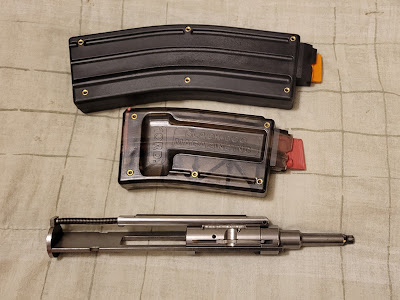
The author's CMMG AR-15 .22 LR Conversion unit

Other options are inserts and chamber adaptors like those made for many years by Sports Specialties/MCA Sports. These can be a much more economical option, but won’t cycle a repeating action. Inserts are for use in single shot and break action rifles and shotguns, and incorporate a chamber and short length of rifled barrel (usually around 10”) that fit inside the chamber and barrel of the parent firearm. A selection of these in popular calibers could make a single shot or double barrel shotgun very versatile indeed. However, at $95 each, the cost would add up quickly.

Chamber adapters, however, are the size and shape of a cartridge sans bullet and are generally for cartridges of similar bullet diameter. Inserts can be for almost any caliber smaller than the host firearm, and can be more easily used in repeating firearms. I bought one of MCA's more budget-friendly chamber adaptors that allows me to shoot .32 Auto and .32 S&W in my .30-30 Marlin. It’s reasonably accurate, and would be useful for small game at moderate ranges.
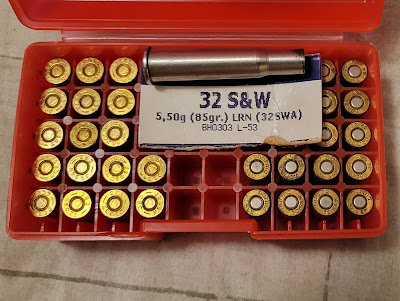
The author's MCA chamber adaptor for a .30-30 rifle

Finally, there are options to fire more than one centerfire caliber from semi-automatic pistols. This involves the purchase of spare barrels at a bare minimum, and possibly recoil springs and magazines as well. For example, buying a Glock or the new Smith & Wesson M&P in 10mm would potentially enable use of barrels in .40 S&W, .357 Sig, and 9mm, and a pistol in .40 S&W could potentially use barrels in .357 Sig and 9mm. 

It’s important to get the right initial pistol to start the process: always buy the largest caliber in the family first and work down from there.

I used the word potentially above because some caliber barrels have different external diameters and won’t mix and match with all slides. Having to buy an entire upper half of a gun (slide, barrel, and probably recoil spring) really puts this on the wrong side of a cost-benefit analysis. 

There are also custom barrels for wildcat or limited production cartridges, such as .460 Rowland, which can be used with many .45 ACP pistols. Obviously, this is not a budget friendly option.


That’s the semi-automatic side of the caliber versatility world. Hopefully this information was both interesting and useful.

Thursday, November 18, 2021

Charcoal, part 2: Other Uses

In Part 1 I mentioned uses other than fuel or filtration for charcoal. Here are a few others.

Art Media
Charcoal as a medium is as old as fire, but very hard charcoal is prized by artists. The various forms are covered quite well in this blog. If you live near an area with an active arts community, you may be able to find a market for some extra income or barter. I like the willow and vine charcoals myself; they're easy to make and small enough to work with.

Soil Amendment / Gardening
Adding charcoal to a compost heap will increase the carbon content and help keep the pH in balance. If your compost smells like ammonia, add charcoal and stir it in. Mixed into the soil, charcoal will retain moisture and nutrients to keep a garden going between rains or waterings.

Since charcoal hasn't been been completely converted to carbon, it will retain the minerals found in wood. Potassium is one of those and is a primary component of commercial fertilizers (remember the NPK formula for fertilizer?). Charcoal will add those nutrients back to the soil if it is worked into a garden. We use a branded form of charcoal in small amounts on corn fields commercially.

If you have a lot of charcoal, you can use it as a mulch around lighter colored plants. It retains moisture while blocking weed growth like normal mulch but without providing food and shelter to insects and pests.

Medicine
Activated charcoal is best for this, but plain charcoal will have the same effects, albeit greatly reduced. Detoxification (see Erin's post for more information) and gas reduction are common uses. Some of the claims you'll find in a quick search are unverified and questionable, but make sense. It also makes a passable toothpaste in a pinch due to its mild abrasive qualities, and some claim it helps whiten teeth.

Deodorizer
Have a room that smells? Placing cloth bags or small piles of charcoal near the source of the odors will clear the air. Remember to set the used charcoal aside for fuel use, since those trapped odors will be released when it is burned. I saw some good steaks ruined by being cooked over charcoal that had absorbed sulfurous odors a few years back -- the taste was indescribable.

Those of us who hunt know that many animals use their sense of smell to detect predators. Special soaps and detergents for washing hunting clothes are common, removing any fragrances that might spook a deer or other game animal. Storing your hunting gear in a container with a few chunks of charcoal will leave them scent-free, even after you've worn them a few times.

Rust/Mold/Mildew Preventer
Since charcoal absorbs moisture, keeping a few chunk in a container will help prevent rust on tools and other metal parts during storage. I've seen it used to preserve paper and cloth the same way; it stops the growth of mold and mildew on books and clothing.

Hiding Blemishes
Rubbing charcoal on dark wood will hide small nicks and bumps temporarily. I'm not a vain person, so "spa days" are a foreign concept, but a paste of charcoal can be used to pull oils and dirt out of the skin if used as a facial mask to prevent/treat acne.


Charcoal is one of those very useful things to know about and is fairly easy to make. Next week I'll get into the medium-to-large scale production of charcoal. It's not difficult, but can be time-consuming.

Wednesday, November 17, 2021

Small Victories, pt The Latest

The dust has settled and the First 72 Hours have passed. Follow along as I build a long term plan via Prudent Prepping.

A few more items have been allocated in gear set aside for the Purple Pack Lady. Details to follow.

But First...
In my recent post on starting to prep, I said to start with what you have, and add more. Later, in the BCP Facebook group, a question was asked on potentially buying longer-term storage items. I caught myself doing exactly the opposite of what I said in the above post: making suggestions that don't help and could possibly discourage someone starting to build a secure way to feed yourself or your family in an emergency. Blue Collar Prepping was started to show how folks like you and I can assemble gear and supplies on a very limited budget. 

There is a tendency in many online groups for the more experienced members to look down on those starting out in their mutual hobby. Jokes are made about the equipment the newbie has, how enthusiastic they are to find a needed item, and in general be less than helpful to someone with a beginner's budget.

Not here! If you look through all of the posts by every writer, and I think you should at least search through the blog for how all this started, you will find post after post after post with encouragement for the flea market finds, thrift store treasures or hand-me-downs that fit perfectly into a much-need place in somebody's life. Just in my own gear I have so many secondhand items that I'd have to unpack not only my EDC and GHB, but also dig out my camping gear, to make an accurate list. Not to mention that the items gifted me by friends who knew what I really needed would easily fill up one side of a 3x5 file card.

All this is a longwinded way of saying, "Start now with what you have, and buy what you need when you can afford it and build from there." Someone will always have something better, newer or more of "That Thing" everyone wants. Always! Don't let that prevent you from doing what needs to be done now.

Purple Pack Additions
I've said that I'm having to consolidate all my gear and get rid of many things that are not needed, due to a lack of storage space. This means reducing the number of my camping gear totes, and so the latest interesting thing set aside to go into The Purple Pack is a Solo Stove. 

I have two of them, which I purchased after the proverbial clouds parted, a ray of light illuminated me and a Voice said "Buy This Item!"... okay, it was really Erin and the other bloggers convincing me to get one. Solo was running a great sale then, and they have a BOGO sale going on right now!

Solo Stove Co picture

The Solo Stove story began with this little stove. Two brothers wanted to create an ultralight camp stove that could boil water in under 10 minutes using sticks and twigs as fuel.

The result: the Solo Stove Lite. Our Signature 360° Airflow Design™ lets you hit the trail, enjoy a hot meal, and keep moving.

Join thousands of others enjoying its powerful, efficient burn. See how it works below.

In case you're undecided, here is my review of the Solo Lite. 

Back to the story. As I was sorting my gear, various cooking supplies were uncovered and the Solo Stoves caught Purple Pack Lady's eye. I explained the difference between the Esbit stove now in her GHB and the Solo in the tote. After listening to the description, what I heard back was, "It's cute and I want to try using it on the patio of (facility) to see how it works! I have a small pan and want to try frying on it" Listening more, it seems that the Solo is a more refined version of what she has seen used in the past back home. I'm more than excited to have a hands-on demo done not by me, in real world conditions. I may not be able to get pictures of the actual cooking, but I will collect as detailed an AAR as possible. 

Recap And Takeaway
  • Everyone has a starting point. Try to remember how you began, whether it was with nothing or with lots of gear. We're here to help each other.
  • Go to the Solo Stove website to see all their deals. There are bargains to be had on other things, not just the Solo Lite, and all of their camping stoves are Buy One, Get One Free.

* * *

Just a reminder: if you plan on buying anything through Amazon, please consider using our referral link. When you do, a portion of the sale comes back here to help keep this site running!

If you have comments, suggestions or corrections, please post them so we all can learn. And remember, Some Is Always Better Than None!

NOTE: All items tested were purchased by me. No products have been loaned in exchange for a favorable review. Any items sent to me for T&E will be listed as such. Suck it Feds.

Tuesday, November 16, 2021

Erin's New GHB, part 8: Miscellaneous Tools

Not actually Erin.
& is used with permission.

Barring something unexpected, this is the last post in my New GHB series. I hope you found this "bag dump" helpful; I know for a fact that it certainly helped me. 

The following items are pieces of gear which are useful but don't specifically warrant their own category, so I place them in various nooks & crannies of my bag in order to keep the other pieces from rattling around and to make the best use of bag space. However, please don't think this means they're any less valuable than gear with a dedicated spot!

Spare Glasses
If you need glasses to see, then you must keep a spare in your bugout and get home bags. Several years ago I wrote a post on how to buy inexpensive spare glasses, but if you can't afford that, a simple if less effective solution is to put your old glasses into your bags every time you get a new prescription. 

Regardless of how you get your glasses, do not forget to put them in a rigid protective case! The very last thing you need in an emergency is to discover that your backup glasses are bent or broken because other items in the pack crushed them. 

Otis Tactical Cleaning System
If your bugout or get home plans include a firearm, you need a cleaning kit. I don't mean to suggest that you'll need to field strip your gun after you've shot it; rather, I'm talking about "I just dropped my gun into mud/sand and now the action is jammed" kind of cleaning, and the Otis Tactical Cleaning System is perfect for that. 

https://amzn.to/3FodQ7m
Not only is it small (about the size of my fist) and affordable ($36), but it will clean an impressive variety of firearms:
  • .22/.223/5.56mm
  • .270
  • .30/.308/30-06/30-30
  • .38/.357/9mm
  • .45
  • 12 ga
About the only thing I would add to it would be a small nylon brush (even a travel toothbrush would do) to help in cleaning. 

Sawyer Syringe
Not only is this needed to backflush your Sawyer water filter to extend its lifespan, but it's also a great way to irrigate wounds in the field. See this post for more information, and be sure to keep the syringe clean by storing it in a durable, cleanable container like a ziploc bag. 

EZE-Lap & Speedy Sharp 
If you carry a knife you'll need a way to sharpen it, these little gadgets are both effective and convenient. The EZE-Lap is a diamond hone that will touch up any dull edge, and the Speedy Sharp is a carbide tool that will not only put working edge on a seriously blunt piece of metal, but it also does an amazing job of generating sparks from a ferro rod. 

Books: Collins Gem Knots and the SAS Survival Guide
These are full-color pocket size books that contain a wealth of information. I keep them in a dry bag to protect them from moisture. 
https://amzn.to/3CpXnOd


I recommend both, but if you can only have one, get the SAS book ($11). 


Thank you for letting me show you my GHB. If I make any more changes, I will let you know!

Thursday, November 11, 2021

Charcoal, Part 1: Fuel

Erin wrote several articles about activated carbon for filtering and medicinal uses a few months back. This is good information, but there are more uses for basic carbon in the form of charcoal.

Most of us have used, or at least, seen charcoal grills for cooking. Charcoal is made from wood by heating it in the absence or lack of oxygen to drive out the water and volatile chemicals, leaving fairly pure carbon. Charcoal has several advantages over wood as a fuel for cooking and heating:
  • Easier storage. Wood has to be kept off the ground, covered from the elements, and neatly stacked to provide airflow for drying. You'll only bring in what you need to burn for a day in order to cut down on the pests and debris inside. Charcoal can be stored in a box, bag, or bin about anywhere until you need it. You'll have black dust instead of bits of bark, splinters, dirt, bugs, and other debris once you empty a storage space.
  • Longer storage life. Wood rots. Insects and vermin love woodpiles, as they provide shelter and food for them until they get a chance to move into your living quarters. Unless you are very careful with your storage, raw wood will only last a few years before it has degraded to a state where it's not usable as fuel. Charcoal, however, is close to coal in shelf-life, and without the water and volatile elements of wood, insects and vermin have no resources to exploit so it won't degrade as quickly. It is a bit more fragile than wood, so repeated handling will result in smaller pieces, but they'll still burn at the same rate.
  • Higher burning temperature. Pure carbon like coal or charcoal can burn at a higher temp because of the lack of water. Water takes a lot of heat to turn into vapor, and that heat is then not available for cooking or heating. Charcoal doesn't burn quite as hot as coal so it's safer to use in woodstoves.
  • More efficient. During the production of charcoal, the voids or empty spaces created by the removal of water and volatile elements form channels for combustion. This makes for a more uniform burn in a smaller space, which makes it easy to have a more efficient fire.
  • Cleaner burning. If you're smoking or drying meat for preservation, wood will impart a taste or flavor to the meat. Sometimes that is the desired effect; the use of hickory, mesquite, apple, etc. wood to impart a flavor is common, but if all you have available are cedar, pine, or some other wood with a disagreeable taste, you'll end up making dried food that not even the dogs will eat. The process of making charcoal removes all of the volatile compounds that will provide flavor, so the source wood isn't a factor. You'll end up with about the same amount of ashes as wood, but without the clinkers that coal will produce.
  • More uniform heat generation. Wood is never uniform, so you're going to have differing heat coming from different spots at different time as it burns. Look at the end of a log and you'll see the variations in quality of fuel: bark, soft outer layers, harder inner layers, knots, rot, etc. Charcoal production takes away most of the variations, leaving a more uniform fuel for a more uniform fire.
  • Higher energy density. Since charcoal doesn't have the impurities found in wood, you can get about three times the heat out of a pound of charcoal versus a pound of wood. While less dense than wood, the higher energy content per pound of charcoal makes transportation more efficient as well. For a scholarly explanation of the numbers, here's a report out of Africa comparing the two. Reading through examples from areas that lack our infrastructure is a good source of ideas for how to deal with the failure (or lack of) said infrastructure.
There are some downsides to charcoal, though, especially if used for cooking. The main detriment to using charcoal for cooking is the same benefit it has as a filter or medicine: its adsorption capacity. Storing charcoal near a source of strong odors will allow those odors to permeate it, and those concentrated odors will be released when you burn it. I've seen some very good steaks ruined by being cooked on a charcoal grill because the charcoal was stored for a long time near petroleum products. Nobody wants a T-bone that tastes like diesel fuel. 

Charcoal has many uses, so don't get stuck on just the fuel or filtration aspects. I'll describe a few other uses in my next post.

Wednesday, November 10, 2021

Prepper's Armory: Cartridge Versatility, Part 1

When selecting a firearm, ammunition supply should be a fairly high level consideration. After all, what’s the point of owning a gun for prepping purposes that takes unusual or hard to find cartridges? (Guns bought for collection purposes are a different matter entirely.)

Beyond that, there are a number of firearms that can utilize more than one cartridge. This can be either due to cartridge development history, or the ability to switch parts quickly and easily.

The following list is not exhaustive, but represents some of the most common cartridge groups likely to be encountered.

.22 Short, Long, and Long Rifle
While .22 Long is nearly impossible to find even in normal times, .22 Short is frequently available. Out of a rifle barrel this diminutive cartridge is not only potentially quite accurate but is also nearly hearing safe in volume -- not a bad combination when taking small game during a survival situation.

Either cartridge can chamber in any .22 Long Rifle firearm, but being shorter, they may not feed through the magazine and will almost certainly fail to operate any semi-automatic action.

.32 S&W through .327 Federal Magnum
Introduced as a black powder cartridge in 1878, the .32 Smith & Wesson and 1896 follow-on .32 S&W Long survived the transition to smokeless powder and are still commercially loaded to this day. 

In 1984, the Harington & Richardson company introduced the .32 H&R Magnum, a lengthened version of the .32 S&W Long, intended to duplicate the ballistics of the classic .32-20 Winchester cartridge but in a straight-walled case. It proved to be quite popular with small game hunters. 

Just over 20 years later, the Federal Cartridge company lengthened the .32 H&R Magnum and called the new chambering the .327 Federal Magnum. 

Due to the design lineage, all four of these cartridges can be fired from any .327 Magnum revolver. Revolvers in .327 Magnum have been made by Charter Arms, Taurus, Ruger, and Freedom Arms, as well as custom designs or conversions.

.38 Special & .357 Magnum
Long considered the gold standard of personal defense cartridges, .38 Smith & Wesson Special was introduced as a black powder cartridge in 1898 but transitioned to smokeless within a year. It is likely the single most common centerfire revolver cartridge on the market.

In 1935, the .38 Special case was lengthened slightly so it wouldn’t fit in older guns and was loaded to higher pressure to produce the .357 Smith & Wesson Magnum. The new cartridge took off like a shot (pun intended) and achieved legendary status fairly quickly.

While unlikely to be encountered these days, .38 Short Colt and .38 Long Colt will both chamber in any .38 Special revolver, and all three cartridges will chamber in any .357 Magnum Revolver.

There’s also the .357 Remington Maximum, a slightly lengthened and more powerful .357 Magnum, but guns chambered in this caliber are rare as hen's teeth, and so is the cartridge.

While named similarly, .38 Smith & Wesson is a completely different cartridge, and no attempt should be made to fire it in a revolver chambered for either .38 Special or .357 Magnum! The .38 S&W case is slightly larger in diameter and won’t fit in a .38 Special or .357 Magnum chamber. Neither should .38 Special be fired in a .38 S&W revolver as, if it does chamber, the case will likely rupture on firing.

L-R: .38 Special; .357 Magnum; .44 Special; .44 Magnum

.44 Special & .44 Magnum
A similar story follows the design of the .44 Smith & Wesson Special and the .44 Remington Magnum. Introduced in 1908 as a smokeless cartridge, the .44 Special was well liked by hunters and target shooters for its excellent accuracy. However, many handloaders felt it didn’t live up to its potential. This issue was resolved when the .44 Magnum was introduced in 1955 to great fanfare. 

Again paralleling the .38 Special, the .44 Special was made by lengthening the older .44 Russian case. This means a .44 Magnum revolver can chamber any of these three cartridges. With the popularity of Cowboy Action Shooting, some limited runs of .44 Russian have been made.

.45 Schofield, .45 Colt, .454 Casull, .460 S&W
This family is another example of incremental development, but with a twist. The .45 Colt cartridge was introduced in 1873 with the Colt Single Action Army revolver, and the .45 Schofield was released two years later for the Smith & Wesson revolver of the same name. Due to the design of the Schofield revolver, the cartridge needed to be about 1/8” shorter than the parent .45 Colt.

.454 Casull was developed in 1958 during the Magnum craze of that era and, while based on the .45 Colt, it’s not only longer but was also reinforced near the case head.

At almost half an inch longer than the already lengthened .454 Casull, the .460 Smith & Wesson Magnum introduced in 2005 is nearly rifle-like in proportion: its 300 grain bullet loading equals the power of the .45-70 Government rifle round.

A .460 S&W Magnum revolver can chamber any of the shorter calibers with corresponding reduced power and felt recoil.

Part-Swapping Conversions
Several single action revolvers on the market are available with both .22 Long Rifle and .22 Magnum cylinders that can be interchanged with a few moments effort. The Ruger Single Six and Heritage Rough Rider are two examples of this design concept.

For centerfire fans, .45 ACP cylinders are available for some .45 Colt revolvers. E.M.F sells one for the Pietta 1873 style revolvers and Cimmaron sells one for their Model P revolvers.

There have also been custom conversions of Smith & Wesson Model 25 .45 Colt revolvers involving .45 ACP cylinders that use Moon Clips. This conversion would also allow the use of .45 GAP cartridges in the same handgun.

The T/C Contender was introduced in the mid-1960s and by using quick change barrels allowed for chambering from .22 Long Rifle to .47-70 in both rifle and pistol configurations.

There are also combination guns which have both a rifle and shotgun barrel based on the 19th century Cape Gun concept. Examples include the venerable Savage Model 24 or the modern Model 42 as well as the Springfield Armory M6 Scout.


Whatever style of survival or prepping firearm is being considered, don’t forget to think about ammunition options as well. You just need to look back at the past year and a half to see the importance of ammunition interchangeability.

Good luck and safe shooting.

Tuesday, November 9, 2021

Erin's New GHB, part 7.5: Food Hauling

Not actually Erin.
& is used with permission.

Hi, and welcome back.

I apologize for the absence; the past month has been really hard on me and I needed to pull away from most interaction to get my head and my soul in order. I'm going to ease back into blogging with a short, easy update post. 

I mentioned previously that I'd bought two bricks of SOS Emergency Food Rations and that I was going to take a test hike with them, and that if I was able to carry them easily then I'd get two more because that would give me seven days of calories. 

Well, the good news is that I was easily able to hike with the two bricks. 

The bad news is that four bricks are just too heavy, and I aborted that hike a quarter mile into it. 

However, all is not lost: I reconfigured the contents of my chest rig and was able to fit a ration brick in there, and I can hike with that configuration quite easily. This gives me (3600*3 = 10800/2000 = 5.4) nearly five and a half days of rations at 2,000 calories each, plus whatever supplemental calories I have in energy bars, soups, etc. I'm quite happy with this arrangement. 

I know it looks like I might be able to fit another ration
brick on top of the first, but it won't fit. The bricks are 
taller than they are wide by half an inch. 

Next week ought to be the final post in my GHB series. 

The Fine Print


This work is licensed under a Creative Commons Attribution- Noncommercial- No Derivative Works 3.0 License.

Creative Commons License


Erin Palette is a participant in the Amazon Services LLC Associates Program, an affiliate advertising program designed to provide a means for sites to earn advertising fees by advertising and linking to amazon.com.