Friday, January 16, 2015

My Bug-Out Bag: Part 4 of Many

Not actually Erin.
& is used with permission.
Part 1
Part 2
Part 3

Welcome to Part 4 of what I now think will be a 6-part series. Today I'm going to show you what's inside the quick-access pockets of my backpack, or as I like to call them, my "overhead compartments".


As you can see from the photographs, the zipper for the front pocket sits right behind my head, so I have packed it with soft padded things. I don't want to give myself a concussion with my own bug out bag!


These are all items that I might want to access without having to take the pack off:
  • A shemagh, which belongs in every prepper's gear. 
  • Mosquito net for my face. 
  • Cooling bandanna. 
  • Roll-up sunglasses, like you get from the optometrist after they dilate your pupils. 
  • Gardening gloves. 
  • Fleece gloves, still in wrapper to keep them dry.


Further back: a tube of Vaseline, can of bug repellent, and a tube of high-SPF sunscreen.


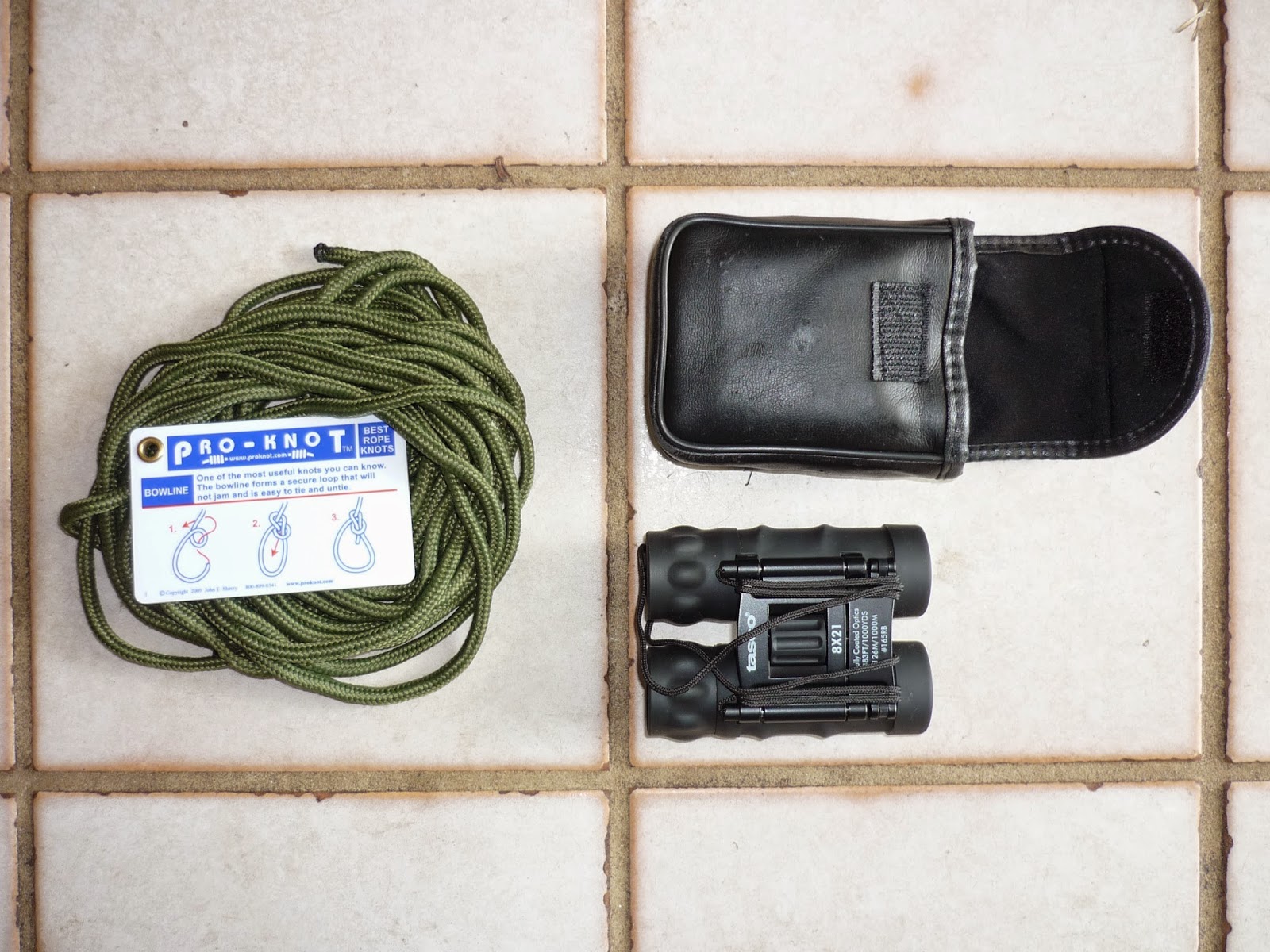
Way in the back, least likely to be needed: 20 feet of 550 cord, a card on common knots (in case I can't recall how to tie one) and a small binocular.

I'm currently debating if I should move my blister kit and spare socks to this pocket, or if I'd be better off taking the pack off if I need to care for my feet. Suggestions?


There is also a top pocket, but it is both smaller and harder to get to. I use it for things that I don't want to have rattling around loose in my pack.

  • Plastic sheet in International Emergency Orange that can be used as a shelter, a ground sheet, or a distress signal.
  • Knitting needle with yarn, in case I need to repair my backpack or clothing.
  • A pot gripper
  • Wooden clothespins; can be used for laundry, for attaching a tarp to paracord lines, or as kindling in an emergency. 
  • Cordial of Jim Beam. 
  • Roll of electrical tape.
  • Roll of 1" wide Gorilla tape


This is probably going to get me some raised eyebrows: a GoalZero Nomad solar panel. GoalZero occasionally has some clearance sales and I got this one at a ridiculous 50% off. I have it mainly for the 5V USB output; with this I can charge a smartphone, a tablet computer or e-reader, or a battery to store the power for charging the above later.

Yes, this is a luxury item. But I have lots of knowledge on both my iPhone and Kindle, and they weigh less than books. Also, they will help keep me from being bored out of my mind, so I regard this as useful for morale.

Also included: various charging cables, an extra set of earbuds, a lens cloth for cleaning the solar panels, two packets of oral rehydration salts, and two tubes of Zip Fizz: one orange, one berry. Hey, if I'm a refugee, I deserve a little treat!


Next:  The main compartment, which will likely be divided into 2 segments. 

Thursday, January 15, 2015

Water Purification, Part 3 - Technologies

Treating water to make it potable is done through a few basic processes (or a combination) to reach the desired quality of water.


Heat
Pasteurization is the process of heating water or food to a temperature high enough, and for long enough, to kill the pathogenic organisms present. Boiling is not needed; all that is needed is to get the water above 160° F (71° C) for a few seconds. There is a simple pasteurization indicator called a WAPI, but if you don't have one, just boil the water and let it cool. Overkill usually works.

Boiling only affects biological contaminants and may actually concentrate chemical contaminants (for an example, see my post concerning Microcystin and blue-green algae).

Distillation is boiling the water to a vapor state and then condensing it back to a liquid state. Distillation will remove all of the biological and most of the chemical contaminants, but chemicals that have a boiling point below that of water can carry over and actually be concentrated in the distillate; the larger the difference in boiling point there is between water and the chemical in question, the better chance there is that it will be removed. Anyone who has ever tried to distill alcohol will tell you how hard is is to get that last 5-10% of the water out of the alcohol (which is actually an azeotrope, and a subject for another time).

Distilling large quantities of raw water will require a lot of maintenance on the equipment to remove the sediment, known to boiler operators as "mud". Anyone who lives where the water is "hard" knows what a teapot looks like after a month's use, and the build up of lime reduces the efficiency of your boiler (and may cause failure its failure).


Cold
Cold means freezing. Freezing water will kill most of the larger and more complex organisms, but won't affect viruses or some of the more hardy forms of life. Chemical contaminants can be reduced or eliminated through freezing (depending on the specific chemical involved), but any chemical with a freezing point close to that of water has a good chance of being left in the ice.

Water is odd in the chemical world because it expands when it freezes, where most everything else contracts and gets denser. This is why ice floats, which is a good thing because it separates the water from the contaminates. Ice harvested from a lake or river starts off fairly clean and is usually potable untreated. Fresh snow and rain are also safe, unless there are abnormally high amounts of crap in the atmosphere (volcanic ash, nuclear fallout, ash from forest fires, etc).


Chemical Treatment
The three main chemicals used to treat water are Oxygen, Chlorine, and Iodine.

Oxygen works by burning (oxidizing) the organisms, and can also remove some of the metals found in raw water by converting them into forms that are easier to filter out. Potassium Permanganate is a strong oxidizer, and is a good source of oxygen for treating water (see this post for details). Ozone is a more energetic form of Oxygen that works well, but requires special handling and equipment.

Chlorine acts on the organisms by disrupting the cell walls. Pure Chlorine is a corrosive gas and is not to be played with unless you have the training and equipment to do so safely. Bleach contains both Cl and O, so it works both ways. I discussed bleach in an earlier post, specifically about the threat of blue-green algae.

Iodine tablets have a long shelf-life, small size, are solid instead of liquid, and work in the same manner as Chlorine. Iodine tablets are convenient because they are sized for a typical quart or liter canteen. Iodine works well on bacteria and common parasites, but does nothing for viruses. Both Iodine and Chlorine require time (typically 30 minutes) to kill the microbes present. Potable Aqua is one of the common brands of Iodine tablets.


Filtration
Filtration is the process of passing water through a membrane or substance that allows the water molecules to pass through but traps impurities. Filter media is made up of a variety of things, with ceramic and plastic being the most common methods of removing biological impurities, and carbon being used to remove unwanted chemicals. Since the individual filters all have varying claims of efficiency, I'll try to list a few for you to compare. When doing your research, be careful to check the efficiency rating as well as the price and rated flow for each filter. Your mileage will vary, and I am not going to lie and tell you that there is one perfect filter that will fit everyone's needs. Most of the better filters on the market (or ones you can make) use more than one form of filtration. Simple is good, but when you're dealing with one of the most vital things you need to stay alive, it may help to add a level of complexity if it makes enough of an improvement in the quality of water.

Several filters also incorporate a coating or layer of silver as an additional antibacterial step. I'm not totally sure (meaning I haven't had it proven to me) of the effectiveness of silver as an antibacterial. There is plenty of anecdotal evidence of silver's effects on bacteria, but I haven't seen any honest, unbiased lab trials proving the claims.

A word of warning: if you live in an area where the ambient temperature drops below freezing, you must make provisions for keeping your filter warm after use. It is almost impossible to get all of the water out of a filter between uses, and because water expands when it freezes, the formation of ice crystals inside any filter will lead to rapid failure of the filter media. I carry a Sawyer Mini for many reasons, one of them being that I can cap the ends and hang it around my neck (inside my clothes) in between uses to keep it from freezing.

Coarse filtration
Also known as prefilters, anything from a clean piece of cloth to a bed of fine sand will remove large (> 10 micron) particulates and will extend the life of any further filtration method used. Sand filters are commonly used in the operation of swimming pools to remove algae and large debris, and would make a good prefilter for a large group. Just allowing cloudy water time to sit undisturbed will let the larger particles settle to the bottom of your container. If you carefully pour the clearer water off of the top (decanting) it will take some of the load off of your water filter and will help extend its life. Here's a repeat of a chart I posted before to give you an idea of the sizes of common contaminates.

"Cut-offs of different liquid filtration techniques" by Peter in s - Own work.
Licensed under Creative Commons Zero, Public Domain Dedication via Wikimedia Commons


Carbon filters
Carbon filters use activated carbon, a heat-treated form of charcoal, to trap chemical impurities. By heating charcoal in the absence of oxygen, the process opens up millions of micro-pores in the surface of the charcoal, making a filter media with a very high surface area and an affinity for impurities. Carbon filters are rarely seen alone; they are generally a part of a system that uses multiple methods of filtration to clean the raw water. Carbon is very effective at removing chemical contaminants but do almost nothing to remove biological contaminants (and may even serve as a breeding ground for some if left wet).

Ceramic filters
By using proprietary methods of making very small voids (empty spaces) or pores in a piece of ceramic, several companies have developed ceramic media that are capable of blocking anything larger than 0.1 micron. Large ceramic filters tend to use gravity to force the water through, while the smaller ones will have some sort of pump attached to allow the use of a smaller filter element and still get reasonable flow through it.
Just Water is one of the standard ceramic filters. Berkey, Katadyne, and Doulton are some other well-known names of ceramic filters. Ceramic filters generally have the ability to clean more water over their useful lifetime than plastic membrane filters, but are larger and more expensive. They are also more fragile since the filter media is brittle and heavy. Ceramic filters are easy to clean, usually requiring nothing more than wiping the media off with a clean sponge or scouring pad. Sometimes scrubbing with a toothbrush is needed to clean the surface and restore the flow rate. Several brands include a mesh or cloth sock over the filter itself as a prefilter. 
Variations in manufacturing will change the size of the pores, changing how effective they are at removing contaminants. Some of the simpler and cheaper ceramic filters are quite popular for NGO's (like Potters for Peace) to distribute or produce in third-world countries as a reliable and moderately effective method of cleaning water. Sometimes just getting the majority of the pollutants out can make a big difference.

Plastic filters
Plastic filters such as the Life Straw, the Sawyer Mini, and the Platypus use a series of tubes and the force of gravity or suction to force the water through them. The brands I listed are not the only ones on the market, but they are the ones with the best consumer and lab ratings. I tend to avoid buying life-support equipment made in factories in China and Mexico, since they don't seem to have a good grasp of the concept of quality control.

Micro-filtration/ Ultra-filtration
Micro-filtration uses very tightly controlled pores in a plastic membrane to allow very small things like water molecules to pass through, while rejecting anything bigger than the pores. There are two different modes of operation;
  • Laminar flow: the raw water is passed over the membrane and the filtered water (filtrate) is collected while the contaminants are carried away by the flow. This wastes some water, but doesn't require as much maintenance.
  • Radial flow: the raw water is forced through the membrane and the contaminants are trapped in or on the filter membrane. This method requires back-flushing to clear the membrane.

Reverse Osmosis (RO)
RO is a higher form of micro-filtration, capable of separating water from even dissolved solids like salt. RO requires high pressures to force the water through a semi-permeable membrane, and it is both slow and energy-consuming. Most RO units are laminar flow systems that force the raw water along the surface of the membrane: a portion of the water passes through the membrane and the impurities are carried away in the left-over water as a waste stream. Be aware that the waste stream can concentrate chemicals enough to be a hazardous waste, although that's normally only a problem with very large RO units. Maintaining RO systems consists of replacing the filter modules when they get fouled too badly.


UV light sterilization
Fairly new technology, UV light destroys microorganisms by disrupting the DNA within the individual cells. The main advantage to using UV light is the speed with which it kills microorganisms, usually measured in seconds. Industrial and municipal treatment plants use large UV light sources to disinfect water and there are a few rechargeable personal-use UV devices on the market. UV will not affect chemicals to any noticeable extent.


Ion exchange
The average water softener is a good example of ion exchange technology. Using resin beads of two types (anionic, or negatively charged, and cationic or positively charged) mixed together, they trap dissolved chemical contaminants based on the ionic charge of the chemical. The common pitcher-style home filters like Brita, Pur, and ZeroWater are ion exchange filters with a carbon stage to help remove bad tastes. The small household filters of this type are disposable, since they have no provision for regenerating the resin once it becomes saturated with impurities. Large ion exchange systems keep the anionic and cationic resins separate and are regenerated using strong acids and bases to knock the trapped impurities off of the resin, then rinsing them to remove the acid or base. Ion exchange methods will have little to no effect on biological contaminants by themselves.


Next week I will examine, in detail, some of the possible sources of raw water and what you may expect to find in them. This should help you decide what level of treatment you're going to need and what to look for in a filter.


Wednesday, January 14, 2015

Prudent Prepping: January Buffet post

The dust has settled and the First 72 Hours have passed. Now we concentrate  on what to do in, and how to plan for, the long term via Prudent Prepping.


January is a slow month for me. Sales taper off in the post-Christmas "Look-at-these-bills!" budget crunch, so I usually have a bit of spare time to go through the gear not mentioned in last week's post, along with several updates on gear and supplies.


Bug Out, In, and Around
From previous attempts at prepping, I have learned that the food I select needs to be things I, and those around me, like to eat and can fix fast, easily, and cheaply. One neglected part of all this is how well these menu items clean up. To make things fair and have reproducible results, all testing was done indoors. (Sorry, no outdoor survival recreations.) This was a test to see if what I have now are the types of things I want to use going forward. My MSR Stowaway pot was used on a gas range to make the cooking and cleaning tests as uniform as possible and also to simulate "Get Home" conditions.

Canned soup and chili
  • Cooked quickly with no surprises. 
  • Water added to the pot loosened food residue before the boiling point.
    Breakfast food (Instant oatmeal and grits/cream of wheat)
    • Cooked as expected. Oatmeal is something I cook for myself normally and have in my bug out gear. 
    • Residue loosened quickly but these items can scorch if the long-cooking varieties are used instead of instant. 
    Pastas with sauce and Mac n' Cheese
    • Slower cooking. Much slower since the portions used from the original packaging need to be reduced for a smaller serving size, and water needs to be watched more closely. 
    • Residue was not so easily removed, especially from the mac n' cheese pot. Extra time and effort, along with extra water, was needed to get the cheesy goo out of the pot.
    At the start of the washing and cleaning portion of this test I found another item lacking in my prepping gear: Paper towels and/or another way to wash and scrub the pot. I don't like the idea of a sponge being used in my prep gear, since sponges can go 'sour' and harbor bacteria. A wash rag is not much better in a Get Home situation. Who wants a wet rag in their gear? Who wants that wet rag in a plastic bag, growing a science project? I don't, so a partial roll of paper towels has been added to my Get Home Bag.


    Gear Check
    • Check your flashlights and batteries. Make sure you have extra bulbs in the flashlights, spares in your bulk storage and fresh batteries installed and close to your lights. Buy extra batteries and put them in your bulk stores. DATE THE PACKS so the oldest packs get used first. 
    • Add another space blanket or poncho to your GHB if you can afford it. There is always the chance you will be with someone in need. If not, grab two or three 33 gallon trash bags for emergency rain gear.


      Finances
      • Make sure you have cash on hand at home, in the car and your Get Home gear. I have $40 rolled up in a piece of foil and then duct taped to the bottom of my Get Home Bag. The tape looks like I'm covering a rip or hole in the bag. The same thing can be done in your car. 
      • I am putting away all my change at the end of the week, and once a month I roll it up and take it to my bank. This money is my cash reserve. 


      The Takeaway
      Practice what you plan to do now, before you need it. Make your mistakes in the back yard or on a weekend camping trip. Use your stores as you think they will be used in an emergency.


       If you have comments, suggestions or corrections, please post them so we all can learn. And remember, Some Is Always Better Than None!

      NOTE: All items tested were purchased be me. No products have been loaned in exchange for a favorable review. Any items sent to me for T&E will be listed as such. Suck it Feds.

      Tuesday, January 13, 2015

      Lighters

      I've said many times that, whenever possible, I cheat at survival/preparedness. One of my favorite ways to "cheat" at firestarting is to use lighters. Matches break or get wet; ferro rods and other sparkers require practice to use, and are particular about their tinder, but lighters are dead easy and stone simple.

      Lighters are lightweight, reliable, and (usually) cheap. Most shrug off being wet, and they light a wider variety of questionable tinder than spark methods. There are three main types of lighters, each with their own unique advantages and disadvantages.

      Clockwise, from left: Barbecue lighter;
      three of the author's refillable lighters and a case; and a disposable lighter at center.

      • Refillable liquid-fuel lighters: The best-known example is the Zippo, but there are many varieties. When maintained properly, they last virtually forever. (I confess to having a small collection of these, some being twice my age or more.) However, there are weaknesses to this variety of lighter:
        • They are by far the most expensive of the three types. 
        • They require regular fueling. 
        • They are cumbersome and clumsy to use when lighting survival fires.
      • Disposable lighters: Sold at every grocery store, gas station, and beer-bait-and-ammo in the country, these are a preparedness staple. They're cheap, often priced at less than $1. They can't be refueled, but will light hundreds of times or more, depending on their size. They also have the most compact form factor of the three types, fitting neatly into a pocket, backpack or purse compartment. They're also rather covert, as they are so common nobody bats an eye at seeing one among regular pocket gear, in contrast to a box of matches or a flint and steel.
        • They suffer from the same firestarting clumsiness as a Zippo
        • They can run out of fuel at an inconvenient time.  
        • Capitalize on their low price and carry a spare, or some other manner of starting a fire.
      • Barbecue lighters: Similar to a disposable lighter in that they come pre-fueled and are usually not refillable, these lighters use a piezo or other sparking device instead of a wheel and flint. This enables them to produce a flame 6" or more from the user's hand. Some even have a flexible wand. This makes them, from a firestarting standpoint, the cream of the crop for lighters. 
        • On the downside, these lighters are quite a bit more expensive than common disposables. 
        • They also take up quite a bit more space than the other options, pushing the borderline of being too large to be commonly carried.


      • Bonus: Everstryke Permanent Match. Seen all over the internet, the Everstryke match is an interesting hybrid of a lighter, match, and ferrocerrium rod. There have been mixed reviews across the internet (and the BCP community), and here's my take.

      Quarter for scale.
      In short, it mostly works. It requires fuel, just like a refillable lighter, and is used by sparking the ferro rod, which catches flame on the captive wick. The form factor is delightfully small, almost cute. Mine evaporates fuel, albeit at a far slower rate than my zippos, so it occasionally needs to be fueled, even in storage. The ferro rod is small, making it more difficult to spark than dedicated rods, and the match "stick" is a bit short to be truly useful. Basically, it's a neat gizmo, and likely worth exactly what you pay for it. I wouldn't depend on it as a source of fire without having at least one different backup on hand.

      There's nothing wrong with taking Easy Street when you can.

      Lokidude

      Monday, January 12, 2015

      Book Review: Prepping for Women

      Hiya folks!

      It's been a while, I know, but I'm back for a quick post. Erin directed this particular book my way not too long ago, and I have to admit I was a bit intrigued but had resigned myself to not expecting much. It's easy to regurgitate information that you can find on the internet via Google or Bing, so I did not have high hopes.

      However, I was pleasantly surprised with this book. If you remember correctly, I wrote a post a while back about reusable options for menstruation needs. The author, Tracey Murphy, does an excellent job on this topic in that she is able to present way more information on each option than I ever could have.

      She covers the cups, the pads, the tampons and the sponges. No, you read that right: sponges. This is not something I would ever personally consider, but she does a good job laying out information on all the options.

      She also covers PMS and yeast infections, also in greater detail, as well as things like herbs that are great for taking the edge off the former and speeding up healing on the latter. She even talks about Yoga positions.

      "Yoga?"

      Yeah, yoga. Yoga is a good low-stress exercise for aging joints that gets the blood flowing and endorphins going. We like endorphins; they counter pain, low moods and depression.

      The author also cites all of her references at the end, and includes all the necessary "talk to your doctor first before you get herb happy" lingo.


      Overall, I give the book an A-.
      1. Everything she says can be found on the Net, but she presents it all in a comfortable progression of information that feels very natural. 
      2. This is a newly published title (December 26, 2014), so its information is up to date. 
      3. There are no politics present. 
      4. There are plenty of health warnings, and reminders to talk to other people who've been using things (like herbs) for a long time before you dive in. 
      5. It's a bit of a short read for my tastes, which is why it's an A minus. 
      It's a good buy and a good read. Recommended!

      Sunday, January 11, 2015

      Gun Blog Variety Podcast #21

      Not actually Erin.
      & is used with permission.
      It's time for another episode of The GunBlog VarietyCast! Adam and Sean host another riveting episode:

      • Erin Palette talks about Light and Fire.
      • Nicki Kenyon drops in to talk NSA and Edward Snowden.
      • Miguel Gonzalez chats about what lessons we can learn from Paris.
      • Barron B. sees some computer hacks in the wild.
      • And Weer'd takes note of the anti-gunner blood dancing over the poor woman in Idaho accidentally shot by her child.

      All that and more, so download, listen, and subscribe. And don't forget to share it with a friend!

      Listen to the podcast here,
      Show notes may be found here.

      Friday, January 9, 2015

      My Bug-Out Bag: Part 3 of Many

      Not actually Erin.
      & is used with permission.
      Part 1
      Part 2

      Sorry for the delay between parts, dear readers, but the holidays happened. Now, on to Part 3, where I show you what I have in the side and back pockets.


      Both side pockets are for items I am likely to need quickly and do not want to root around for.  The left side pocket is for heat, light, quick shelter, and knife maintenance.

      • Razor knife by Derma-safe
      • Pack of tissues (can be used for blowing my nose, wiping my bottom, as a hasty wound dressing or as kindling)
      • Mini LED Maglite with strobe and candle function
      • 44-hour candle with matches
      • SOL 2-person survival blanket (I have raingear in my pack, so this is more for warmth than for dryness)

      • Firestarting tin with 2 rolls of duct tape, 1 box of waterproof matches, 1 hexamine tablet, 1 packet of tinder-quik, and 2 sheets of folded aluminum foil
      • Disposable lighter
      • 25 feet of FireCord
      • Ferro Rod with striker
      • Chapstick (protects lips AND serves as fuel)
      • Lansky knife sharpener
      • Speedy Sharp
      • EZE-Lap diamond file
      • Rust Eraser
      • Pen of WD-40 (lubricant, metal cleaner, and combustible)


      The right side pocket is mostly for hygiene and quick access to important tools, with some stuff from the left side that wouldn't fit.


      • Two bottles of 5-Hour Energy drink
      • Two folded aluminum foil bread pans
      • Hobo tool
      • Sillcock Key
      • Biodegradable wet wipes (even if they dry out, they're still good as toilet paper)
      • Dental floss
      • Bottle of camp soap (can be used to wash my body as well as dishes)
      • Hand sanitizer
      • Wash cloth
      • Scrubby dish cloth


      Finally, the small back pocket contains snacks, important personal documents, and some items that won't fit anywhere else due to their size and shape (and which I don't want in the main compartment).


      • Vacuum-sealed beef jerky from House of Jerky
      • Chocolate "Prep Shake" (basically a liquid meal -- just add water)
      • Nite-Ize Knotbone -- 550 cord connectors/tie-downs
      • Repair kits for tents, air mattresses, etc

      • Parabolic mirror for starting fire
      • Pouch with punk wood and jute twine
      • Survival snare kit (1 big, 1 small)
      • Two Speedhooks
      • Not shown for purposes of operational security: ziploc bag full of important documents, like a copy of my birth certificate


      Next week: What's on top?

      The Fine Print


      This work is licensed under a Creative Commons Attribution- Noncommercial- No Derivative Works 3.0 License.

      Creative Commons License


      Erin Palette is a participant in the Amazon Services LLC Associates Program, an affiliate advertising program designed to provide a means for sites to earn advertising fees by advertising and linking to amazon.com.