Wednesday, April 13, 2016

Prudent Prepping: Gear Test

The dust has settled and the First 72 Hours have passed. Now we concentrate on what to do in, and how to plan for, the long term via Prudent Prepping.

Following up on the original post that mentioned my new sleeping pad, I had a chance to try it out this past weekend. Now, I didn't get outside for this test; it rained Friday, Saturday and early Sunday morning, and I don't deliberately go foul weather camping any longer. This test was conducted under controlled conditions at my sister's house, where I was dog sitting for the weekend.
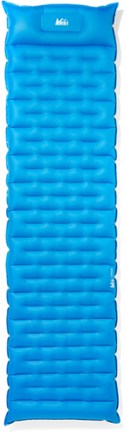
http://tinyurl.com/htoneqo
A quick recap: this is a Cirrus Air Pad, purchased on closeout a month ago from my local REI store. It's a really nice pad that takes up less space than what it replaced (a Thermarest) and is more adaptable and in my opinion more comfortable.

Inflation (covered here) went very quickly -- about 2 minutes to get the pad filled enough to lie on, and another minute or so to make it as firm as I wanted.

After getting the pad inflated and situated in the spare bedroom, I fluffed up my sleeping bag, grabbed my travel pillow, and stretched out for the night.

... or so I thought.

My sister's dog is a 'takeover' from my brother-in-law's family -- they were downsizing and moving into a place that did not take large dogs, so Lily the Lab is still getting used to a new house and routine. This meant visits during the night to check to see if I was still there and attempts to sleep on top of me.

About every 2 hours. All Friday night.

For the time I was actually asleep, the pad was outstanding. There was less air mattress sound and feel than in my first impression and the long term durability should be great, after a 90 lb. Lab walked over it with no ill affects!

Need I mention that I abandoned the test after one night?


As I discussed before, stowing the pad was fast and easy:
  1. Open the deflation valve (most of the air empties quickly) 
  2. Press to flatten 
  3. Fold in thirds lengthwise and roll from the foot, slowly, to expel the remaining air 
This pad is one of my favorite items, ever! If you get a chance to check out an REI store, it will be worth it just to see some of the really neat gear assembled in one place.


Just a reminder: if you plan on buying anything through Amazon, please consider using our referral link. When you do, a portion of the sale comes back here to help keep this site running! 

If you have comments, suggestions or corrections, please post them so we all can learn. And remember, Some Is Always Better Than None!

NOTE: All items tested were purchased by me. No products have been loaned in exchange for a favorable review. Any items sent to me for T&E will be listed as such. Suck it Feds.

Tuesday, April 12, 2016

Fishing: Rods and Reels, Ways and Means

There is an unimaginably wide variety of rods and reels on the market, each one fitting a particular niche or designed for a specific job. The rod used in the surf is different from the rod used to fish weed beds on a bass pond. Both of those rods are different from the rod used to fish high mountain rivers.

The Types

Fly Rods
Image from flydepot.com
Rods used for fly fishing are very long and thin. They usually range between 7 and 9 feet long, with a very whippy feel. They're only really useful with fly fishing reels and line. While fly fishing can be an effective way to catch fish, it is really more of a hobby for most folks than a survival skill.


Trolling Rods
Image from fishusa.com
Trolling is the technique of pulling bait or lures behind a boat. Trolling can be done with a variety of rods, but rigs dedicated to the purpose also exist. These rigs use heavy, stout rods and large reels with weighted lines, often color marked to indicate length. Trolling is a highly effective way to catch fish, but does require a boat. If you're stocking the freezer, it works great. As a survival method, it is almost useless.

Spinning and Spincasting
Image from learninghowtofish.com
These rods are great general purpose rigs. Which one you see is often a regional thing, but they work the same way. They come in a wide range of weights and stiffnesses, able to meet almost any need.


Which One Do I Choose?
Image from orvis.com
The rig you choose is mostly determined by the water you fish. On a mountain river awash with insects, a fly rod is excellent. They also work well in small ponds, but on larger rivers and lakes, spinning or spincasting rigs are hard to beat. In deep water chasing big fish, nothing matches a trolling rig.

If you can only have one rod, I'd recommend a spinning or spincasting rig, roughly 6' long with 6-8 pound line. It's a jack of all trades and master of none, but it can be employed in virtually any water for any species. Something made by Shakespeare or Zebco will be easy on your budget while providing lasting performance.

Lokidude

Sunday, April 10, 2016

Gun Blog Variety Podcast #86 - Will Hillary Use NATO to Attack the NRA with Cosmo Couples?

Adam, Sean and the gang bring you another great episode of The GunBlog VarietyCast!
  • Erin Palette finally explains what she means by "Groupness." 
  • Just when she thought she was out, Trump drags her back in. Nicki Kenyon just wants to talk about NATO, but talking about NATO means talking about Trump talking about NATO.
  • We didn't think she could join us, but Beth Reoch Alcazar managed to get in at the last moment from US Concealed Carry Association headquarters. She and her friend Katie Strupp discuss the USCCA Concealed Carry Expo in Atlanta, Georgia 4/29/16 through 5/1/2016.
  • What are the differences in rechargeable batteries? Well, Silicon Graybeard is happy to let us know.
  • And did you see that "Cosmo Women Berate their Men for Owning Guns!" video? Weer'd has. And you know what that means! Time for another patented Weer'd Audio Fisk!™
Thank you for downloading, listening, and subscribing. You are subscribed, right?
Listen to the podcast here.
Read the show notes here
Thanks also to Firearms Policy Coalition for their support. Go to StopNewsome.net to help FPC crush Governor Newsome's ammo ban.

And a special thanks to our sponsor, Law of Self Defense. Use discount code "Variety" at checkout for 10% off.

Upcoming Law of Self Defense seminars:
  • August 7 - North Carolina specific - Raleigh, NC
  • August 13 - Oregon and Washington specific - Sherwood, OR
  • August 20 - Tenessee and Kentucky specific - Nashville, TN
  • October 15 - Arizona specific - Glendale, AZ
  • October 16 - New Mexico and Texas specific - Las Cruces, NM

Saturday, April 9, 2016

I Really Want This to Fund

Not actually Erin.
& is used with permission.
If you've been reading this blog for any length of time, you know that I'm a big fan nifty gadgets. As a prepper I'm also a fan of items with multiple uses as those save space as weight.

Well, the item I'm going to talk about now is both multi-use and a nifty gadget: the Mule Light V2.


So why should you back this Kickstarter? Two reasons.

The Mule v2 does everything I need a flashlight to do. 
  • It has a high beam, a low beam, and a strobe. 
  • Need a broad light while you're working on something? It does that. 
  • Need a bright (300 lumen) spotlight that doesn't ruin your night vision? It does that, too. 
  • Need a black light for tracking blood. finding stains, or charging glow in the dark things without (again) ruining your night vision? It even does that. 

It has excellent battery life.
  • If you get The Works you have two choices of battery:
    • AAA batteries, which are easy to find but don't last as long, or
    • Rechargeable Li-Ion battery. Pair that with any basic solar panel or dynamo and you have a way to recharge your flashlight during the day. 
  • Use of hybrid mode -- where a three-second burst of light charges a glowstick -- extends both battery life and illumination capability to incredible levels (240 hours of use with AAA, 540 hours with Li-Ion).


I acknowledge that, at $65, it's rather spendy. But given all that it does, and its long battery life and ability to be recharged in the wild and this is a very useful and versatile piece of kit. I feel safe saying that because I've bought and used UVPaqLite products in the past, and they have never disappointed me.

I really want this project to fund, so if you're at all interested, please pledge within the week. We're about $33,000 shy of fully funding with only 7 more days to go.

Friday, April 8, 2016

Preventing Radiation Sickness for Dummies

Not actually Erin.
& is used with permission.
PREVIOUSLY: Ionizing Radiation for Dummies

I'm not going to sugar coat this: if you absorb a high enough dose of ionizing radiation, you're going to die. The only thing doctors can do is pump you full of painkillers so that your last moments aren't spent in agony

A smaller dosage can be treated with blood transfusions, antibiotics (to keep bacteria from overwhelming your damaged immune system), and administration of binding agents. In some situations, bone marrow transplants may help.*

But all of this is rather academic, since "Go to the hospital to be treated by professionals" isn't practical in most of the post-SHTF scenarios that preppers plan for. Fortunately, there are things you can do to prevent acute radiation poisoning in the first place.

1) Keep It Off and Out of You
As I mentioned in Ionizing Radiation for Dummies, Alpha and Beta particles are not especially penetrating and can be stopped by skin or thick clothing. Since you won't know what kind of radiation you may be exposed to in an incident, the best course of action is to assume the worse but hope for the best.

If you are affected by a radiation emergency:
  1. Seek shelter immediately. The more matter you have between you and the radiation, the safer you are. 
  2. If you are unable to find shelter, cover as much skin as possible with as much clothing as you can safely wear (i.e. do not wear winter coats in the summer for more than a few minutes)
  3. Take special care to cover your hands, nose and mouth, and eyes. Although not ideal, gloves, sunglasses, and a shemagh or handkerchief tied over your face will work in this case. 
    • Why do this? Because while radiation on your skin is bad, radiation inside your body is far worse. 
  4. If you have an open wound, cover it immediately. 
Once safe, you must decontaminate yourself.
  1. Remove all outer clothing and place it in a bag or bin that is clearly marked as containing hazardous materials; the last thing you want to do is track it inside. 
  2. Wash yourself in warm soapy water, and shampoo your hair (but do not use conditioner; this will cause radioactive particles or contaminants to bind to your hair).
    1. Do not scrub vigorously! The last thing you want to do is irritate your skin or open a wound that allows contaminants inside your body.
    2. If you have a bandaged wound, waterproof it (a coating of vaseline or duct tape will do) before showering. Replace the bandage after the shower. 
  3. If you do not have access to a shower, wash as best you can; soap and water in a sink, or even a simple wet wipe if that is all you have. 
  4. Blow your nose to remove any contamination you may have inhaled. 
  5. These simple steps will remove 95% of all radioactive contamination. (However, if you've been exposed to ionizing gamma, x-ray, or neutron radiation, none of this will help; but see below. 
As a point of interest, these procedures are also the same for preventing radiation exposure from radioactive fallout, as illustrated in this video: 


A printable PDF of this information is here

For more information on decontamination, go to this Radiation Emergency Medical Management page. Decontaminating wounds is here; decontamination of children, the elderly, pregnant women and others is here.

2) Prevent Internal Contamination
If you have followed all of the above steps, then ideally you have prevented radioactive particles or particulates from entering your body... but we do not live in an ideal world. Fortunately, there are chemical agents you can take to prevent uptake of contamination, or flush it from your body. 

This prevents the thyroid (a gland necessary for survival) from absorbing radioactive iodine. A single Potassium iodide pill "fills up" the thyroid with non-radioactive iodine, rendering it unable to absorb radioactive iodine for 24 hours. 


This binds to radioactive cesium and thallium, preventing it from being absorbed by the body and allowing it to be expelled through defecation. 

While it is available in a 500 mg pill under the name Radiogardase, it is not available in the United States without a prescription. However, Survivalblog gives instructions on how intrepid preppers can acquire chemically pure Prussian Blue (not the paint pigment!) and put it in gel capsules for personal use. 

Much like Prussian Blue, DTPA binds to radioactive substances -- in this case plutonium, amercium and curium -- to prevent reuptake and speed its excretion from the body. 

Unfortunately, DTPA is an injection and is not available to average preppers. 

3) Pray
Unfortunately, there isn't anything else to do at this point without access to medical professionals (and if you have such access, you need to get there posthaste). Try and maintain a positive attitude, trust that your efforts were effective, and hope for the best. 

The "good news" about a lethal radiation dose is that you're going to know within 24 hours if you've been exposed or not. The bad news is that you could die quickly, or linger for days. The neutral news is that, as a prepper, you have the choice of going out quickly and painlessly via firearm rather than linger, if that is what you want. I'm not usually one to advocate suicide, but if I'm dying from radiation poisoning I'd rather not linger painfully. 


Footnote
*The actual medical effects and treatments of Acute Radiation Syndrome are beyond the scope of this "for dummies" article; those interested in learning more are encouraged to start with Biological Effects of Radiation and Cutaneous Radiation Injury videos from the CDC, and then move on to what the Merck Manual and the Mayo Clinic say.


NEXT: Radiation Terminology for Dummies

Thursday, April 7, 2016

Death and Burial: An Update

I've had a rough month. With the deaths of my father-in-law, mother, and aunt all occurring within three weeks, I have had to deal with the subjects of death, dying, and burial on a personal level that I haven't experienced before.

I went back and read a few posts that I wrote two years ago when we first kicked off this blog, and decided that they needed an update.

Death and Burial: Body
TL;DR Our bodies are mortal, we will all die one day. What do we do with the mortal remains?

The original article covers methods of dealing with dead bodies, but there is another facet to dying that I need to write about: “Natural causes” deaths have common steps or stages that they progress through. This list is not a schedule; the stages are often jumbled and there is no set sequence.
  • Loss of appetite and thirst. As the body starts to shut down, its energy needs dwindle. The dying person will refuse food and drink because their body isn't calling for it.
  • Fatigue or excessive sleep. With less food (and therefore energy) going into the body, the person may sleep constantly, or at least very often. Sleep may also be sporadic and irregular.
  • Weakness. Again, less energy going in means there is less available for use in moving the body.
  • Confusion or agitation. As the end gets near, the dying person may not recognize or acknowledge people around them. Mumbling and incoherent or nonsensical speech is common, as are fear, panic attacks, and hallucinations.
  • Breathing problems. Labored breathing, interrupted breathing, and phlegm building up in the airways and causing a “rattle” when breathing are all common.
  • Changes in urination. With reduced water intake the kidneys have less to work with, causing the urine output to become dark -- often as dark as tea or coffee. Dropping blood pressure also causes the kidneys to shut down, which will mean less (but more concentrated) urine output.
  • Changes in circulation. As the internal organs shut down, blood flow is concentrated in the brain and torso. Hands and feet may become cold, and near the end of life they will be mottled red/blue/purple or blotchy where they were once pale or gray. This normally appears on the soles of the feet first.

Death and Burial: Mind
TL;DR Our bodies react in specific ways after death.

There's not much I can add to what I originally wrote. When my father-in-law entered hospice care, a team came in and turned off the internal defibrillator built into his pacemaker as part of his DNR (Do Not Resuscitate) advanced directive. Advanced directives are right up there with your Last Will and Testament when it comes to important paperwork: assigning medical decision-making powers and defining what level of advanced life support you want used must be in writing and available if you are unable to communicate.

TL;DR Grief and mourning. We react to the death of others in our own individual ways.

I have seen all forms of grief in the last month. Some people are more accepting of the inevitability of death than others, and their grief is internalized. Denial, anger and depression are common responses, but there is still no set “stages of grief and mourning” that we all have to go through. The “counselors” that demand we all check the boxes on their precious lists deserve to have their pieces of paper shoved where the sun doesn't shine. That's not anger coming from grief; that's anger coming from watching idiots recite a litany that they learned in night school that they have no understanding of.

Supporting each other is vital at these times.
  • If a family member can't go to the funeral, there is no reason to assign blame or derision.
  • Some people don't want to see a loved one after death -- they prefer to remember the deceased as healthy and happy. While I see this as a minor form of denial, I don't have a problem with people trying to avoid extra pain.
  • We all have to deal with death and grief in our own ways. The one exception that I can see is removing someone who is having a psychological melt-down in public. All they are going to do is upset others around them when most of the people there are already upset enough.
Death and Burial: Soul
What happens to the immortal part of us?
I never got around to writing this one because of all of the different versions of the afterlife that are available. This is the subject of a college degree, not a weekly blog post.


Both my mother and my father-in-law where good Christian people, and I am sure they are resting comfortably somewhere, waiting for the rest of us to join them. I wasn't close enough to my aunt to know for sure, but I never heard anything bad about her. I have hope that she is at peace with her God.

I'm glad that my family members are no longer in pain, and have traveled beyond this earthly realm of work, pain, suffering, and death. I am sure that I will meet them again when it is my turn to cross over to a better place, and I look forward to that day, but there is still a hole or two in my heart that will take time to heal.

Wednesday, April 6, 2016

Prudent Prepping: What's In Your Mouth...

The dust has settled and the First 72 Hours have passed. Now we concentrate on what to do in, and how to plan for, the long term via Prudent Prepping.

I have some dental problems: fillings needing replacement, a crown that now may be cracked; and teeth out of alignment; all things that I was trying to fix from before my recent return to singleness. The first two issues are going to be put off a bit longer until my finances are in better shape, but the last is being fixed (starting from zero) with Invisalign braces/inserts I bought to try and save the teeth I have, which is related to this weeks topic.

... Should Stay In Your Mouth
Teeth are very important to our overall health, as seen in this article. Proper digestion is affected by the many different things we call saliva, all of which cannot properly start to work until you and your teeth spend some time chewing. If you want to eat, you have to take care of your teeth, and I want to keep mine for as long as possible -- several relatives have not taken care of their teeth, or had access to regular dental care, which resulted in removal of their natural teeth and getting bridgework, partial and/or complete dentures.

Brushing and flossing is part of good dental health, and the Invisalign system requires extra steps to maintain good dental hygiene, since the 'braces' can hold food or other items next to your teeth for long periods of time. This means I have to brush after eating and especially after drinking anything other than water. I have carried a toothbrush, toothpaste and floss in my B.O.B and G.H.B. for a while now, but with my transition to a smaller E.D.C bag, I need to resist the urge to pack too much into this smaller bag, since it was purchased to prevent this from happening.

The TOOB
https://www.rei.com/product/737990/aurelle-toob-brush
This is exactly what I wanted when I worked for a company in S. California while living in the S.F. Bay area and was required to fly every other month for meetings. I always had to substitute a small tube of generic toothpaste for my preferred brand, since the tubes were too big to get past the Travel Naz -- I mean the child grop -- I mean TSA screeners -- in my carry-on luggage. But this nifty little device has a refillable toothpaste tube that fits into the handle of the brush!

Here is a demonstration showing how it works. It really is as simple as it looks:
  • Unscrew the bottom of the TOOB toothpaste tube
  • Attach to your full size, regular toothpaste, 
  • Remove the top of the TOOB and squeeze until the mini tube is full. 
As often as I brush, the toothpaste runs out fairly quickly, but compared to buying and using $0.99 travel tubes, it is a bargain to be able to use my own brand. After 3 weeks and 3 refills, I don't see any problems. Everything is covered in hard plastic that I wash under hot water whenever the paste runs out.

The Takeaway
  • Staying healthy is more than exercise and the proper foods; also it's eating and chewing correctly.
  • I need a compact way to carry toothpaste and a tooth brush. This is everything in one package.
Recap
  • One TOOB tooth brush/tooth paste combo: $5.95 from REI. $8.48 and free shipping from Amazon.
Just a reminder: if you plan on buying anything through Amazon, please consider using our referral link. When you do, a portion of the sale comes back here to help keep this site running! 

If you have comments, suggestions or corrections, please post them so we all can learn. And remember, Some Is Always Better Than None!

NOTE: All items tested were purchased by me. No products have been loaned in exchange for a favorable review. Any items sent to me for T&E will be listed as such. Suck it Feds.

The Fine Print


This work is licensed under a Creative Commons Attribution- Noncommercial- No Derivative Works 3.0 License.

Creative Commons License


Erin Palette is a participant in the Amazon Services LLC Associates Program, an affiliate advertising program designed to provide a means for sites to earn advertising fees by advertising and linking to amazon.com.