Tuesday, February 9, 2021

The DIY Slow Match

Not actually Erin.
& is used with permission.
 I received an email from Creek Stewart the other day where he was advertising a "slow match": a length of cotton rope with a piece of brass tubing around it. To operate it, just stick the cotton rope through the tubing until a sufficient amount is revealed, then light it (with a match, lighter, or even sparks off a ferro rod). The match will burn as long as there is exposed material; when it burns past the brass tube, the fire runs out of oxygen and extinguishes itself. 

https://www.survivalonthe7th.com/

While you could pay $8.95 plus S&H for this, I think it would cost less and be more fun to assemble such a thing yourself. The cotton rope can be found in most hobby & craft stores under macramé supplies; Hobby Lobby charges $2.29 per yard of 1" rope. One inch is probably too thick, but as you can see this rope is made by twining other smaller ropes together; you can unravel those. 

Without knowing the thickness of that sub-rope I can't tell you exactly what type of brass tube to get, but I think that this 1.5" long, 9/16" wide macramé tube (10 for $6.99) looks ideal. 

Doing it this way, you pay close to the same price as one ready-made slow match ($2.29+$6.99 = $9.28), while giving you enough material to make several. Add them to every fire kit and Bug Out Bag you own, or give them away as Christmas presents to your prepper friends!

Monday, February 8, 2021

Parts is Parts

Following in the spirit of my post on keeping AR pattern rifles in good repair, I’d like to talk about the importance of having spare parts on hand.

As discussed previously, all firearms need periodic maintenance in addition to regular cleaning after use. Any time a firearm is field stripped, parts should be checked for wear. Documentation provided with the firearm will most likely have recommendations regarding replacing springs as well as other wear prone parts, so RTFM: Read The Firearm Manual. If the firearm didn’t come with a manual, as is often the case with used guns, check the manufacturer’s website. They may have a copy available for download. There are also a number of web based resources for manuals, such as this PDF Manual library.

With that out of the way, what spare parts should be kept on hand? Much of this will depend on the type, make, and model of firearm. For example, with 1911 style pistols I tend to keep a firing pin and spring, some magazine springs, a couple of recoil springs, a recoil spring plunger or two, and some of the smaller springs and pins on hand. Most of these parts are available in this convenient pack or this one.

It’s important to understand that springs wear through cycling. The more a gun is used, the sooner the springs will need to be replaced. The best source for firearm springs I’ve found is Wolff Gunsprings.

Small pins can get lost, or in some cases launched, during disassembly and reassembly. Pretty much every 1911 owner has at one time or another sent their recoil spring plunger into low earth orbit, sometimes never to be seen again.

The recoil spring and guide rod in most modern pistols are a single assembly. It’s not a bad idea to have one or two of those on hand for emergencies.

With striker fired pistols, it’s not recommended to disassemble the striker assembly itself, but there are reasons it may need to be removed from the slide. In case it gets lost or damaged, a spare is an inexpensive insurance policy.


If there’s any likelihood of removing the striker assembly, the slide end cap will have to be removed first. This is another one of those parts that can go flying and vanish into an alternate dimension. These also tend to be inexpensive, so having an extra on hand just makes sense.

One improvement I recommend specifically for Glock owners is replacing the takedown lever with an extended version, like those made by Lone Wolf Distributing. It makes disassembly so much easier. This part is listed as the slide lock lever. When replacing the slide lock lever, it’s a good idea to have a spare slide lock lever spring or two on hand as well. Keep in mind these parts are often specific to the model, and sometimes generation, so order carefully.

For handguns with removable grip panels, spare grip screws are a good investment. I already mentioned magazine springs earlier, but followers, floorplates, and (if appropriate) floorplate locking plates can mean the difference between using that magazine now or waiting for the part to arrive in the mail.

Most of the part categories I mentioned for pistols will also apply, to some degree or another, to rifles and shotguns as well. If a favorite rifle has a removable striker, keep a couple of spares in the parts bin. If a pump shotgun magazine tube endcap isn’t retained, maybe have one of those in there too.


Specifically for AR owners, there are prepackaged sets of commonly lost parts. Aero Precision offers one which is appropriately enough called the Oops kit. They also have a field repair kit which overlaps the oops kit and includes most of the pins and springs needed for the lower receiver.

In addition to one or both of these kits, I also recommend having some firing pin retaining pins and a few sets of gas rings in inventory. Be especially careful with these though, as any spare AR parts have a habit of growing into a new AR build.

One final point on spare parts: Murphy’s Law applies here as it does everywhere else, by which I mean the one part no one ever thinks they’d need may be the one that breaks or get lost.


Obviously, this is by no means a complete list of spare parts to keep on hand, but hopefully, it will get people started on a spare parts bin to potentially help reduce future aggravation.

Friday, February 5, 2021

Bread, the Staff of Life

Bread is referred to as the “staff of life” in European cultures (most of the rest of the world relies on rice or root crops as a primary source of carbohydrates). Carbohydrates are the primary source of calories in most diets, with animal fats being a close second. We need calories to function -- they are the fuel for our bodies -- and carbohydrates are an easy source.

Carbohydrates are basically chains of chemically-bonded sugars; the longer the chain, the more “complex” the carbohydrate. Simple sugars contain one or two sugar molecules, but complex carbs like starches will have hundreds, and cellulose has thousands. Starches can be broken down by various digestive methods into sugars that our bodies can actually use, but we're not set up to handle cellulose and have to run that through animals with longer digestive tracts to get any use out of them, which is where the animal fats come from.

One of our retired authors wrote an article on simple bread years ago, and that information is still valid. Bread is one of the earliest things humans started to make as a way to store and transport food when we began the long crawl towards civilization. A few years ago, archaeologists found a chunk of fossilized bread that set the beginning of baking back several thousand years: for centuries it was thought that we'd been making bread in some fashion for about 10,000 years, but this new find was over 14,000 years old. 

Grinding up seeds and roots makes them easier to eat and digest, so people had been making gruel or porridge (think oatmeal, but made with other grains) for a long time. Wild grains that made good-tasting bread like wheat and barley were the first to be domesticated and grown intentionally, so bread actually predates agriculture. Cooking ground grains breaks down some of the complex carbohydrates and makes them easier to digest, while also killing any pests or microbes that can cause spoilage. It also softens the grain for the older family members who may be missing some teeth and can't chew whole seeds any more, or the really young members who haven't grown any teeth yet. Baking that gruel into something you could put into a bag or pocket wouldn't have taken much thought or effort.

Bread is also a handy way to contain other foods like meats and vegetables. Just look at the variety of pitas, sandwiches, meat pies, and tortillas found around the world.

Bread is simple. All it takes is water, ground grain or powdered roots, and an oven or griddle. The very simplest breads will be flat breads like tortillas or naan, cooked on a flat rock or piece of metal placed over a fire. Roughly three parts flour and one part water, you mix it into a workable dough, shape it into patties about a half-inch thick, and place it on a greased, hot surface to cook it into bread. Everything else to be added only affects the taste, texture, and shelf-life. Baking bread has turned into an art form; even the various pastries and cakes available today are nothing more than fancy breads with frosting on top, but any edible grain that you can find can be ground into flour and baked into bread. 

Since really basic bread is nothing more than baked mush, it will be dense and chewy. Leavening agents have been developed to make it “rise” by the introduction of pockets of gasses into the dough. This added porosity makes the bread easier to chew and swallow, but doesn't add anything to the nutritional value and yeasts will actually eat some of the sugars to produce those gasses.

 Most of our common grains are grasses, so planting a patch of rye or crabgrass isn't any harder than tending a yard. A quick list of common grains can be found here, but I know of a few more that aren't on that list, and one on that list that will anger local farmers since it's an invasive species that is hard to kill. Hard to kill is a good thing for a prepper, as it means a more reliable food supply, but planting something that can take over the neighbor's fields won't be appreciated and may be illegal in some states.

Things other than grains can also make usable flour. Edible roots like cattails, yams, and arrowroot grow all over the US and can be turned into good flour. Nuts like acorns and hazelnuts (filberts) are easily ground into flour, and provide more protein than most grains. Wild plants that can be used to make bread are something to watch for as you forage, since that bread will be easier to transport, store, trade, and eat than the raw materials.


Bread in its many forms has been around for a long time, and knowing how to make it should be on every prepper's list of skills. It doesn't have to be a loaf of sliced white bread in a plastic bag to be bread; just look at the recent introduction of tortilla wraps on a lot of menus. For those of us with food allergies, changing to something other than wheat might make sense and there are lots of other options.


Wednesday, February 3, 2021

Prudent Prepping: Idle Musings

The dust has settled and the First 72 Hours have passed. Follow along as I build a long term plan via Prudent Prepping.

This post is going to be several topics that I've mentioned before, or are things that haven't really made it on my "Seriously, Make This Happen" list. At least yet. 

Range Tripping
Even with the cold, rain and wind over the last three weeks, every time I try to sneak out to the closest range and sight in the Swamp Fox Kingslayer mentioned here, here and here, either the benches have been full with a line to get in or it's been too rainy to even open up. With little rain in the forecast through the weekend, I don't expect to be reporting anything but more disappointment. However, I will make several attempts at it, just in case I get lucky. If I get in, right after finishing I'm going to buy some lottery tickets.

Purple Pack Additions
In the continuing story of The Purple Pack, the last addition was a Sawyer Mini mentioned in this post from November 2020. As was mentioned, our schedules don't match very often and getting together to discuss serious additions is hard. As the year progresses, we seem to have more and more time to talk and plan about what might happen when/if the weather calms down and the state doesn't catch on fire again. I won't push for major changes, but rather for small things that are obviously practical right now and not 'Prepping Related', like upgraded flashlights for her cars. 

Speaking of which, I ordered two Nitecore P12GT 1000 Lumen Flashlights

https://amzn.to/36B1ERF

From the Amazon page: 

  • Premium CREE XP-L HI V3 LED
  • Maximum output 1000 lumens
  • Boasts a peak beam intensity of 25,700cd and
    high efficiency circuit board provides up to 520 hours runtime on low level
  • Side switch interface provides one handed operation and easy access to all functions
  • Intelligent memory function stores preferred brightness setting
  • High-efficiency regulation circuit provides unwavering output
  • Toughened ultra-clear mineral glass with anti-reflective coating
  • Constructed from aero grade aluminum alloy with HAIII military grade hard-anodized finish
  • Waterproof in accordance with IPX-8

I have two of these right now, and I recently ordered an extra charger to have one at home and one ready to go. This way, every small flashlight uses the same batteries and charger, making it very easy to swap batteries around so everyone can have a operating light. 

The very next addition that I want to make is a stove of some kind. I've been told, "Why do I need a stove? You are with me and you have one, so why do I need one too?" I'm seriously thinking of putting an Esbit Stove and fire cubes in a ziplok, putting it in the bottom and saying nothing about it! Unfortunately, that's not how I operate and no matter how much I'd like to do that, I can't.
https://amzn.to/3aw7Ziz

Once I figure out how to clear that hurdle, I think it will be easier to upgrade to the SOLO Stove I have sitting on top of my storage totes, just waiting to go to a good home! 

Recap And Takeaway

  • Continuing to take things easy, since "Slow and Steady Wins the Race" to prepping success!
  • Purchased this week: Two NITECORE P12GT 1000 Lumen flashlights from Amazon for $73.95 each and one Nitecore D2 DigiCharger from Amazon for $20.99, both with Prime shipping. 
  • Everyone now has interchangeable lights for all vehicles and a spare charger! 
* * *

Just a reminder: if you plan on buying anything through Amazon, please consider using our referral link. When you do, a portion of the sale comes back here to help keep this site running!

If you have comments, suggestions or corrections, please post them so we all can learn. And remember, Some Is Always Better Than None!

NOTE: All items tested were purchased by me. No products have been loaned in exchange for a favorable review. Any items sent to me for T&E will be listed as such. Suck it Feds.

Tuesday, February 2, 2021

(Battery) Back That Thing Up, part 1: Why Batteries?

Our benevolent editrix got to asking me questions over the weekend about large battery backup power solutions. She's curious about what it would take to reasonably back up her home, and if going battery is worth it compared to the alternatives. Since this kind of thing is pretty much my professional wheelhouse, I decided to make a series out of it. 

Providing for your own emergency power needs basically falls into two categories: you can generate it with fuel, or you can supply it from batteries. Yes, I am aware that power can be generated by windmills, water wheels, and various other sources, but those solutions are esoteric, incredibly specific, and often unreliable. I'm also aware that solar panels are a thing, but they only make power when the sun shines, so if you want the lights to be on after dark, we're back to batteries.

Generators
Generators are great. They're the gold standard for backup power, and for good reason: they're a tried and true technology that can be set up so that no user input is required for backup power; if the grid goes dark, the generator senses this and starts itself. They also supply more power than batteries and will keep supplying that power as long as they have fuel. If natural gas is an option for you, then you have virtually limitless power, but it will be expensive.

Generators do have serious downsides, though. They're somewhat noisy, so running one at night might upset your neighbors. They also create toxic exhaust like any other internal combustion engine, so they have to be placed in such a way to keep that exhaust and heat from entering or damaging your home. Along with that placement, even fairly compact generators aren't exactly small; you either have to store a large, heavy unit somewhere until you need it, or you have a permanent machine placed near your home to deal with. 

As with all engines, generators require regular maintenance. Regular oil changes are a concern, and permanent generators have an "exercise" cycle to deal with, where they will start themselves up and run for a period of time on a regular basis to keep everything functioning correctly.

Batteries
Batteries don't have exhaust, they don't need much by way of maintenance, and they're silent as a church mouse. They're a bit limited in output, however, and they also tend to cost a bit more. 

If you want to take advantage of the benefits batteries offer, the first step is to determine how much battery you need. Consider carefully what you need to be running; you might get a few nice-to-haves on top of your needs, but focusing on the essentials will maximize your battery life. In addition to the amount of power you'll draw from your batteries, you need to consider how long you'll be drawing that power. Where I'm at, power outages are generally resolved within 24 hours; a friend of mine in hurricane country this year was without power for more than a week, and Erin tells me that's not an uncommon thing. Batteries used for backup power are sized in watt-hours or amp-hours, and those numbers are key to determining how much battery you need. 


Next week, we'll look at how long some common loads can be run on very popular backup systems.

Lokidude

Monday, February 1, 2021

AR Maintenance 101

Guns are fairly intricate mechanisms. While they can go long periods with minimal maintenance and no issues, it’s a good idea to know how to maintain them beyond a simple cleaning.

Since the AR family of rifles is probably the most popular semi-automatic rifle in the country right now, I’d like to discuss some of the malfunction causes and solutions that the average owner can take care of at home.

The heart of the AR is its gas system, commonly referred to as gas impingement. In this system, gas is diverted from the barrel and fed back into the gas key on the bolt carrier group. This channels the gas into a chamber behind the bolt, pushing the bolt forward and the carrier back. Since the bolt can’t move forward, being locked into the barrel extension, the carrier has to move back. This movement of the carrier causes another component, called the cam pin, to rotate and unlock the bolt. The bolt and carrier then move back together during the action cycle.

All of this is very dependent on a few components being in good repair and properly set. Specifically the gas key bolts need to be properly tightened and staked and the gas rings need to be within spec and replaced when they wear enough to cause function issues.

Happily, most carriers come with the gas key bolted down and properly staked. Unfortunately, not all of them are. Knowing the signs of gas key leakage or worn gas rings and how to remedy the situation can prevent your rifle from being transformed into a really awkward straight pull bolt action.

Gas Key
If the gas key bolts are not properly tightened and staked, they can loosen during the firing cycle. This allows gas to leak out around the base of the gas key and rob the system of pressure, leading to short stroking of the action, feeding issues, and failure to lock open on an empty magazine.

A replacement gas key won’t be staked and will look similar to this one from Rubber City Armory.

If the gas key is loose, don’t just tighten the screws and call it a day. The key needs to be removed and the mating surfaces thoroughly cleaned before reassembly. Once that’s done, the bolts need to be tightened and properly staked. There’s no need to really crank down on them; firmly hand-tightened with a proper bit driver is all that’s needed. 

Once this is done, it’s time to stake the bolts. No special tools are needed for this job other than a center punch. I prefer an automatic center punch like this model from JelBo, though a manual center punch and ball peen hammer can work just as well.

Make sure the carrier is properly secured. I use a bench vice with padded soft jaws, but a couple of pieces of wood clamped to a table can suffice.

All that needs to be done is to displace some metal from the gas key into the head of the bolt to prevent it from turning under vibration. Don’t go crazy.

This is one in my collection. The first attempt as staking turned out to be insufficient, so it had to be done again. That’s why the staking looks more aggressive.

In case anyone was wondering, I’m not a fan of thread locker on firearms. There may be some instances where it’s warranted, but much less than it’s used. If you must use some kind of thread locker on a firearm, blue shalt be the color thou shalt use, and the color of the thread locker shall be blue. Green shalt thou not use, nor either use thou red. Black is right out.

Gas Rings
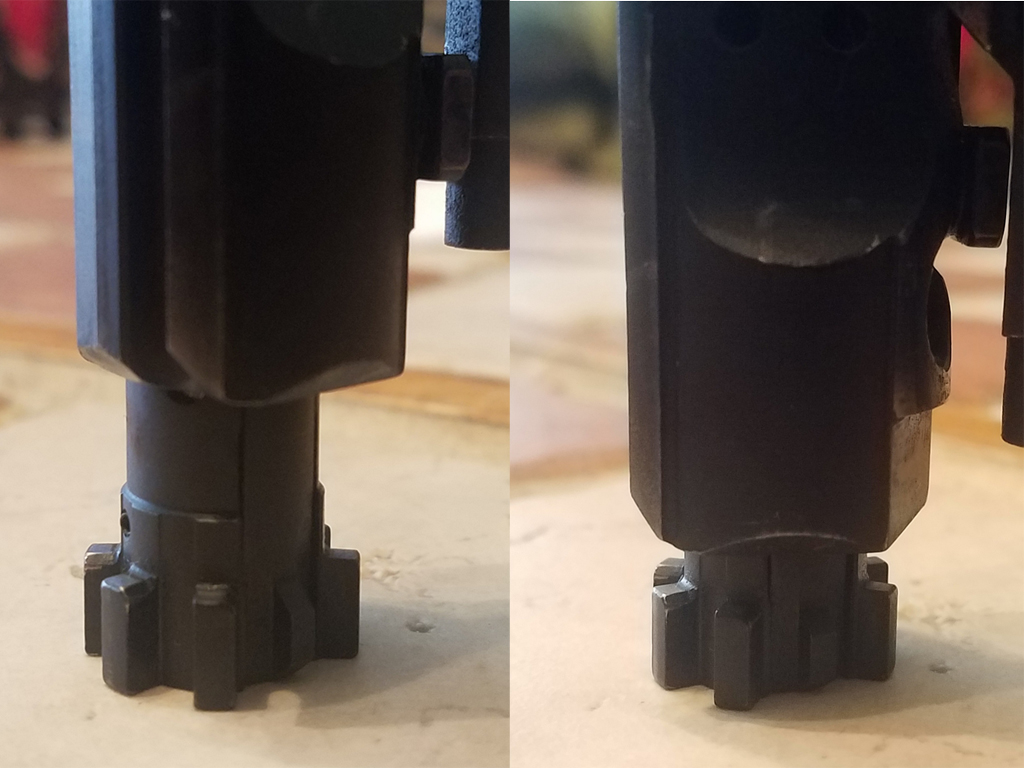
The gas rings on an AR bolt, like the rings on a car engine cylinder, add a gas seal as well as some friction to the system. Every time the bolt cycles, they rub against the inside of the carrier and wear. Gas rings, like springs, are consumable parts and will need to be replaced eventually. The signs are similar to a loose gas key, but there’s a simple test to check gas ring friction.

After removing the bolt/carrier group from the rifle, make sure the bolt is in the forward position and gently stand it up on the bolt face. If the carrier stays up, the rings are fine. If it slides down the bolt, it means the rings are sufficiently worn to require replacement.

The bolt requires three rings and they are usually sold in convenient three packs, like these from Brownells.

Remove the bolt from the carrier and wipe off any grease, oil, or loose carbon. Using a knife point or sharp pin (do not use the firing pin) find the gap in the rearmost ring and pull it towards the tail of the bolt, stripping the ring out of the retaining groove on the bolt. Repeat for the other two.

Clean the retaining groove and replace the rings. Don’t worry about the gaps in each ring lining up, the first time the bolt cycles they’ll shift around. Lubricate the bolt and reassemble. There should be a noticeable increase in friction.

Remember, take care of your tools and they’ll take care of you.

Thursday, January 28, 2021

Soothing Flames

Fire is one of humanity's oldest tools, and one we've spent some time writing about it here. Building a campfire isn't difficult to do well, but a poorly laid fire won't burn as efficiently and will be harder to light and keep lit. Fire is important to a prepper for its many uses: fireplaces and wood stoves produce heat for some of our houses, candles and liquid-fueled lamps can provide light, and gas or oil stoves/ovens cook our food. 

One of the lesser-known uses of fire, and specifically flames, is the calming or soothing effect it has on people. We're hard-wired to associate sitting around an open fire with security, socialization, and relaxation. Our ancestors used fires to cook their food, deter predators, chase away insects, and light their dwellings. All of these things lead to a reduction of stress and a feeling of security. In times of crisis a fire might be needed to stay alive, but the side effects are worth the effort even if you have food, water, and shelter taken care of.

Several studies have confirmed the benefits of watching a fire. Researchers as far apart as Sweden, Japan, and Alabama have done scientific studies to measure the effects of real and virtual fireplaces, campfires, and candles on the human mind and body. Lowered stress, reduced blood pressure, and more relaxed brain functions are all proven effects of the simple act of watching a flame. People become most sociable around a fire; they're willing to sit closer to each other and conversations are easier to start. One of the interesting bits I found in the studies was that the audible crackle of a wood fire had much to do with the level of relaxation associated with a fire. Deep down in our subconscious, we can tell a fake fire from a real one.

Most modern houses and apartments aren't furnished with a usable fireplace, about the closest you're going to find is the fake log gas fireplaces that provide the ambiance without the mess. Virtual fireplaces are more common around the holidays, but you can find DVDs of hours of fireplace video if you look around. Setting up a flat-screen TV with a DVD player is a lot easier and cleaner than lighting a fireplace, and we all know how convenience is the goal for a lot of folks. Flickering “flame” light bulbs are another option; the LED versions are cheap and simulate a candle pretty well.

I do have to throw in the caveat that “fire is a useful servant but a terrible master”. Fire and flames MUST be kept under control to prevent tragedy. Never leave an open flame unsupervised, keep children and pets (and people with similar mindsets) away from fires of all sizes, and always have a way to extinguish a fire close to hand. The calming effect of fire can induce drowsiness, so make sure your fireplace has a spark screen and the candles are contained in a chimney or lantern before you drift off to sleep. Up until Edison developed a usable light bulb and started running wires to every building, people used flames to light and heat their houses, so for most of our history fire and flames were a normal part of our lives. Sadly, most people are untrained in how to live with open flames in modern society.

I've always felt more at ease when sitting around a campfire and even a simple candle or kerosene lamp with its flickering light is enough to calm my nerves a bit. Cheaper than drugs or alcohol and, as long as you use some common sense, a lot safer. The next time you're felling stressed out, try watching a flame for a while to see if it helps. Anything from a candle to a bonfire, whatever you can fit into your life at the time, it's the flame that may help sooth your mind. A lot of my articles are written with a candle or lamp burning in the room. I find it relaxing and it helps coalesce the random thoughts that bounce around inside my head.

The Fine Print


This work is licensed under a Creative Commons Attribution- Noncommercial- No Derivative Works 3.0 License.

Creative Commons License


Erin Palette is a participant in the Amazon Services LLC Associates Program, an affiliate advertising program designed to provide a means for sites to earn advertising fees by advertising and linking to amazon.com.