Showing posts with label Food Storage. Show all posts

Wednesday, October 2, 2024

Saving Sourdough Starter Long-Term

Let's say you've got a good sourdough starter going, but circumstances arise where you won't be able to use it for quite a while. It has to be fed regularly, or it will die. Or let's say you want to send some to someone, and shipping a container of working starter isn't really an option.

The solution is to dry your starter. 

This started as a "Will this work?" experiment, and it does. I spread some starter out on a plate and left it on the table. A couple of times a day I'd stir it around as it dried, and after a few days I had a lot of little chunks of dried starter. I put some in a baggie, squeezed out most of the air, and left it on the table for several months.

To determine if the starter was still alive, I put some of those bits into a bowl, added half a cup of unbleached flour, stirred in enough warm water to make a very soft dough, put on a loose-fitting lid, and set it out of the way. By the second day it was bubbling, showing that the yeasts had come out of hibernation and were growing, and it worked normally for baking. Success!

The next method I tried was easier. I spread out some of the starter on a sheet of no-stick aluminum foil, then set that in a safe place while it dried. By spreading it thin it can dry faster, and when dry you can flex the foil and it will flake off, giving thin, light pieces that can be crushed up easily or stored as-is.

At this time I haven't tried vacuum-packing it, which is next to on my list of things to try, but it should work nicely.

Wednesday, November 23, 2022

Prepper's Pantry: Preserving Herbs and Spices

Now that harvests are pretty much complete in most of the country, it's time to start preserving our harvests. In previous posts I've talked about the equipment and process of canning, pickling, and a brief overview on spices.

Dealing with herbs and spices is fairly simple, or at least it can be. As with any food preservation process, making sure the produce is of best quality is the most important first step. Once they've been examined, sorted, and rinsed, we can move on to preservation, with different options available depending on the type of vegetation we're dealing with. Dehydrating and freezing are the two most common options, so I'll focus on those processes here.

Dehydration
Dehydration can be handled in an oven, an air fryer, or a dedicated dehydrator. If using a dehydrator, it's recommended to get one with a fan as that will considerably reduce the time required.

As with any other form of dehydration, the trick is to get as much moisture out as possible without burning or singing the product. This is one of the benefits of a dedicated dehydrator, as they generally operate at a relatively low temperature.

Before dehydrating the checked and cleaned vegetation, the next step will depend on the herb or spice in question. Those with smaller leaves, such as oregano or rosemary, get processed on the branches, while those with larger leaves, such as basil or bay, are separated from them. Parsley simply has its stems trimmed.

Once sufficiently dried (and if appropriate, the leaves removed from their branches) the next step is storage. Depending on intended use, they can be left relatively whole, crumbled by hand, or run though a spice grinder or spice mill to get more of a powder-like product.

Regardless, they need to be properly stored, since oxidation is the enemy. For ready use, spices and herbs can be placed in small, airtight jars and stored in a cool, dark place. Adding an oxygen absorber to each container can help preserve freshness. Longer term storage should be in vacuum sealed bags, also containing oxygen absorbers, and still placed in a cool, dark place.

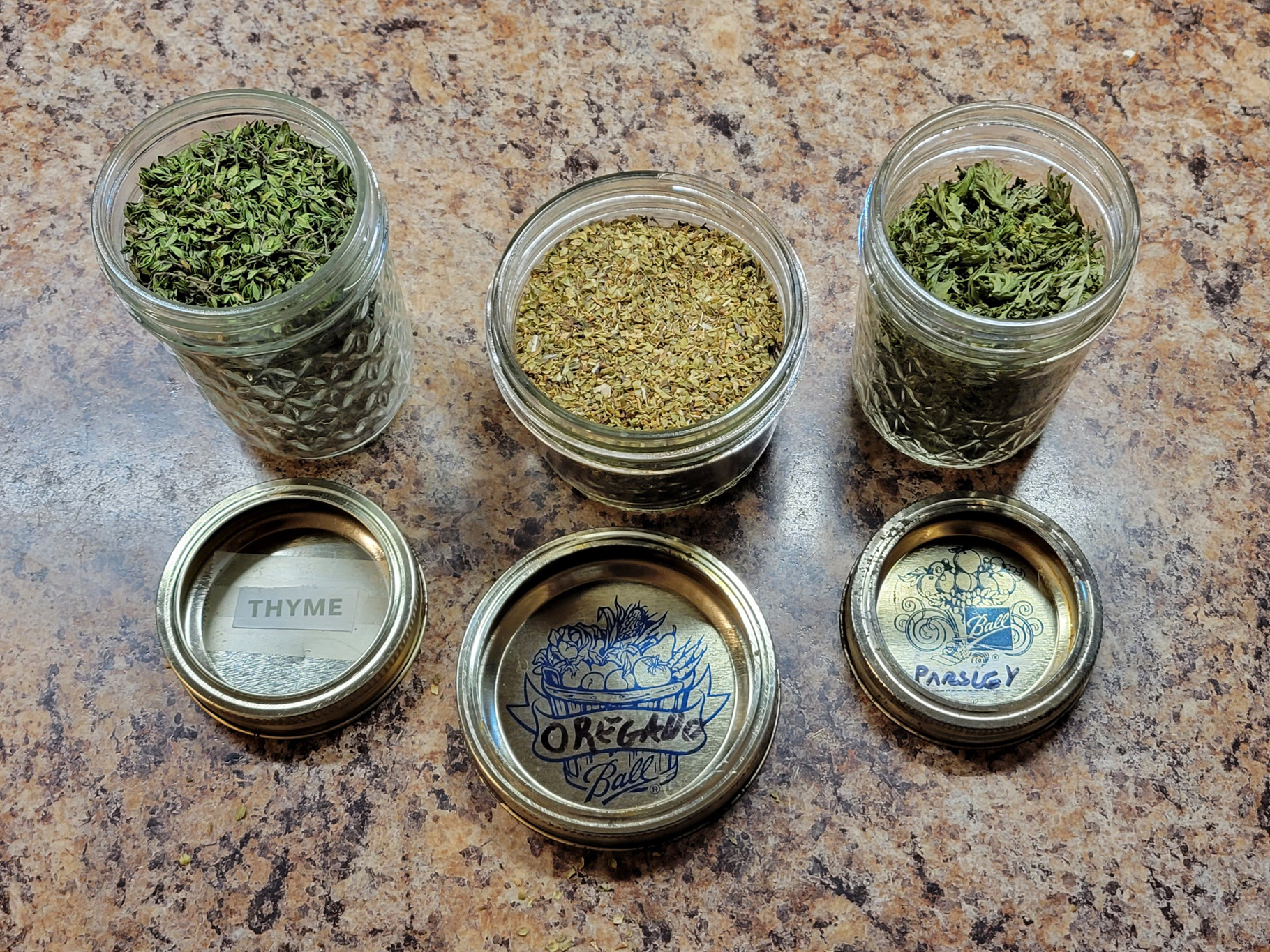
A selection of dehydrated herbs from the author's pantry

Freezing
Another option for some leafy herbs is freezing. The leaves are separated from the stems, rinsed, and then layered in slightly damp paper towels, before being packed in Ziploc or vacuum sealed bags. These get labeled with the date and put in the freezer. Since no moisture is being removed (in fact, more is being added), herbs stored this way should be used within a few months at most; otherwise, too much flavor will be lost to freezer burn.

There's no point to growing our own herbs and spices if we lose them to spoilage. Hopefully, these tips will keep them fresh through the long winter months to come.

Wednesday, November 2, 2022

Prepper's Pantry: Chocolate

Everyone knows about chocolate, one of the most popular edibles in the world. Most people like it, many love it, some can't eat it for health reasons, and a few simply don't enjoy the flavor. As a bonus, by the time this post is published Halloween will have just ended, which means all sorts of chocolate will be on sale.

History
The origin of chocolate comes from the region known as Mesoamerica, an area that ranges from central Mexico down to northern Costa Rica, where the cacao tree is native. It was harvested and processed primarily for use as a beverage by native tribes, possibly fermented in some manner.

The first European to encounter cacao was most likely Christopher Columbus, though it didn't make much impact on his return. It wasn't until Spanish interaction with the Aztecs by Hernan Cortez that chocolate became more known in Europe, though at first only as a medical treatment of abdominal and digestive issues, most likely due to its extreme bitterness.

It took a few hundred years to develop industrial processes to make chocolate both palatable and inexpensive enough for mass marketing. Today, of course, chocolate is available in a bewildering array of flavors and mixes, usually at a fairly reasonable price. It has many types including bakingdarkmilk, and modeling, with these types coming in both solid and powdered forms for different uses. (There's also white chocolate, but as that's just sugar lying about being chocolate, so we won't discuss it here.)
 
A selection of the author's chocolate stash

Chocolate can pack a lot of energy in a fairly small package, especially if mixed with nuts, seeds and dried fruits as in trail mix. This makes it an excellent choice for outdoor activities such as hiking. During World War II the United States Government, in cooperation with various American chocolate companies, developed the D-Ration, a moderately palatable 4oz bar designed for use in emergencies. These came in packages of three bars of roughly 600 calories each to make a soldier's, marine's, or airman's daily ration in extreme situations.

Storage
There are three major concerns when it comes to chocolate for emergency use: melting, going rancid, and eating it all before an emergency occurs. Proper packaging and storage can help with the first two, no power in the universe has been found to prevent the third.

Chocolate is best stored in a cool, dry, dark place, ideally between 65 and 70 degrees Fahrenheit, and should be kept in an airtight container or packaging, because chocolate can easily pick up the odors of surrounding foods. When stored in this manner, it can last quite a while: milk chocolate can stay fresh for over a year, dark chocolate for nearly two years, and filled chocolates (i.e. chocolates with a non-chocolate filling) for around three to four months. If stored in the freezer, this duration can be increased, perhaps even doubled. Of course, this assumes the chocolates don't get eaten before then. 

There are two things to keep in mind as chocolate gets old: texture and bloom
  • Texture: As chocolate ages, some of the more liquid volatiles will escape, causing the chocolate to have a more crumbly or grainy texture. This has little to no effect on the nutritive or energy value, just the mouthfeel
  • Bloom is a white coating that may appear on the surface of chocolate following prolonged storage. This is due to either fat or sugar migrating to the surface as the chocolate ages.
Neither of these issues are anything to be concerned about, but should be considered as part of the storage and rotation of supplies.


Chocolate can be enjoyed in many ways: as an ingredient in baked goods, in beverages, confectionary of various types, as an element of trail mix, and, of course, as a simple chocolate bar for a treat... but I think we can all agree that the best chocolate is the type you get for free  on Halloween and Valentine's Day, or on sale afterwards. 

Tuesday, June 14, 2022

Prepper’s Pantry: Flour

Many of the recipes I’ve shared in my posts involve some form of flour. At a basic level, flour is the ground product of any of a number of grains, beans, nuts, roots, or seeds. Humans have been grinding all sorts of plants to a fine powder for at least eight thousand years, though there’s some evidence it may go back much earlier in our development.

The biggest issue with long-term storage of flour, as with so many things, is oxygen. If the germ of the grain is left in during production of flour, the fatty acids present start to oxidize immediately, leading to spoilage. This high risk of spoilage led to the prevalence on the market of white wheat flour, which is basically whole wheat flour with the germ and bran removed. In fact, most wheat flour is processed as white flour, and then the germ is added back in after it’s treated for preservation, producing whole wheat flour.

Currently in the United States, the most common flour is made from wheat. Following that, corn is the next most popular source, and even these basic categories have a number of varieties. However, almond, various bean, buckwheat, chickpea, hazelnut, peanut, potato, rice, tapioca, and many other flours can be found in the baking aisle of many grocery and specialty stores.

It’s not uncommon in the baking aisle to see packages of flour labelled all-purpose, bread, biscuit, cake, enriched, pastry, self-rising, unbleached, and whole wheat. These divisions are generally based on the fineness of the grind as well as additives or supplements in the mix, though some labels are more for advertising purposes.

A selection of flours and friends from the author’s pantry.
L-R: Self-rising white; regular white; potato flakes; Semolina; 
whole wheat; White Lily soft wheat; corn Masa; corn meal; corn starch.

The most common uses of flour are for making things like bread, pasta, cookies, cakes, and as additives in a wide variety of other foods. For example, when making a roux to thicken gravy and sauces, some form of flour is essential to produce the proper consistency. In non-food use, when mixed with water and a little salt, flour is an essential ingredient in papier-mâché or wallpaper paste. It can also be used to make a sort of clay for children’s projects.

While it’s certainly possible to get un-milled grain and run it through a manual or electric mill, that’s a pretty significant investment in time and money. Most preppers are likely better off buying pre-milled flour in bulk and storing it in food-safe airtight containers with oxygen absorbers. Larger quantities can be kept in buckets, and smaller amounts in Mylar bags. In our house, we tend to store some flour in canning jars and zip lock bags because we have them conveniently at hand.

While there is some overlap between types and styles, it’s important to use the right flour for the job. Coarseness, density, water retention and other factors will determine how a particular flour affects a recipe. As they say, "Horses for courses."

Good prepping, and good cooking.

Friday, June 10, 2022

Book Review: The Lost Superfoods

While wandering a bunch of prepper sites I saw an ad for a book called The Lost Superfoods. The ad mentioned that it had a recipe for the emergency ration crackers used by the US government in the 1960s when they stocked the fallout shelters around the country. Since I have an interest in most things from the Cold War era, having served in the military back then, I spent the $27.00 and had a copy delivered.

This is a review, so don't expect me to copy the entire book; I'll give an overview and my opinions on the quality and quantity of information in it.

https://amzn.to/3Hb3tpM

The first chapter covers the emergency rations that were stockpiled to feed people in fallout shelters in the event of a nuclear war with the USSR. This was a short-lived program, but thousands of shelters were stocked and ready. The rations were a thick cracker, sort of a hardtack crossed with a graham cracker, with hard candies to provide extra calories. Less than 1000 calories per person, per day, for two weeks was enough to keep people alive in a shelter where there was little chance of strenuous activity. All of the original rations were recalled in the 1970s, but I've seen a few examples that were not sent back and they were inedible by the 1990s; 30 years was just too long for a cracker to survive. The recipe and baking is pretty simple, because most survival foods are simple. If I get the time this fall I may test this one and see if my limited kitchen skills can pull it off.

Other chapters cover various ways to store meat and fish for long periods. Going back to the recipes used by sailors and explorers hundreds of years ago, long before refrigeration was available, the authors present each in a chapter with clear instructions and plenty of color pictures to help you get it right. (Spoiler: preserving meats uses a lot of salt.) Some of the items are a bit odd, but that makes them fit into the category of "forgotten" foods. Jerky, pemmican, biltong, home-made Spam, bully beef, potted meat, and bacalao (salted cod) are covered in sufficient detail to get you started on storing animal protein.

Canning several different things is covered fairly well, and I liked the chapter on canning butter. It's been a long time since I last used a pressure cooker, but I know several families that put up a lot of food in them every year. Fruits and vegetables are staples when canning food, and this book covers the basics. There are plenty of recipe books for canning fruits and vegetables and the information doesn't get old, so look in used book stores and garage sales for grandma's old cookbooks.

About a third of the book is general prepper knowledge, things like how to grow your own yeast, what to do with the food in your freezer if the power goes out, and how to use Mylar bags and oxygen absorbers to store food.  Good general information, but only lightly related to "lost superfoods".


In my opinion, this is a good book to have on the shelf. The price isn't horrible for the amount of information presented, and the color photos and clear descriptions are rare in prepper books. You can buy the book at Amazon for $27.00 (shipping is extra). 

Tuesday, April 26, 2022

Vacuum Sealers Suck

Unlike the ancient techniques of dehydrating or smoking, vacuum sealing is one of our youngest food preservation techniques. As with many newer technologies, this one came out of the industrial boom of World War II.

Vacuum sealing as we know it was developed by a German citizen named Karl Busch around 1940 for preserving food on a small scale. He didn’t introduce economical industrial vacuum sealers until 1963, beginning a worldwide revolution in food preservation. The Busch Vacuum Solutions Company is still in business today and continues to innovate.

The basic concept of vacuum sealing is simply the removal of air from the Mylar or plastic package that contains the food. This reduces oxidation, and most notably freezer burn, preserving the food for longer periods. In addition, the vacuum sealing process helps prevent spoilage by minimizing the growth of harmful bacteria, fungi and micro-organisms.

The first thing needed is obviously a vacuum sealing machine. We have a model similar to this; when we got ours it was considerably less expensive. However, there are quite a few budget friendly options available.

The Author's Vacuum Sealing Machine and rolls of bags

Most machines come with a small starter roll of sealer bags, but more bags can be purchased as needed

All vacuum sealing machines have certain standard features such as a bag cutter, but some have additional accessories, such as an attachment for sealing different types of containers.

This is the process we follow when vacuum sealing meat, using chicken quarters we bought in a value pack from our local grocery outlet as an example

  1. Stage all the equipment and supplies ready at hand.
  2. Rinse the chicken and pat dry.
  3. Seal one end of the bag and cut to length.
  4. Place the chicken in the bag, pushing it against the bottom seal and avoid getting any juices on the opening.
  5. Place the open end of the bag in the sealing chamber, making sure there are no fold or creases.
  6. Activate the vacuum sealing function.
  7. Check to make sure the bag was properly sealed and there are no leaks.
  8. Label the bag with the contents and date.
  9. Clean any food residue off the machine.

Two chicken quarters sealed and ready for the freezer

Maintenance is generally fairly simple: we wipe it down and disinfect the unit after each use. Our model has a vacuum chamber tray that can be readily removed for easy cleaning.

Many different items besides food can be vacuum sealed using these machines. I know people who have sealed packets of ammunition, emergency clothes, and even matches.

A good vacuum sealing machine and quality bags can provide a valuable resource for preserving and protecting our preps.

Tuesday, March 29, 2022

Prepper's Pantry: Eggs

Humans have eaten eggs since before recorded history. They were, and are, an essential part of our diet, featuring in the cuisine of every culture, region, and religion. They are an incredibly versatile ingredient, whether eaten as-is or combined in a dish. In the western world, chicken, duck, and goose eggs are the most commonly used, but eggs from every species of bird from quail to gull have been eaten somewhere. 

Some of our readers may remember the “Incredible Edible Egg” ad campaign from the 1970s. Eggs can be purchased fresh, dehydrated, frozen, salted, pickled, shelled in cartons, and there are even egg substitutes for use in cooking and baking.

In the United States, eggs are washed during production to clean the shell and make them more attractive for market. Unfortunately, this removes a thin coating from the egg called the cuticle. Without this coating, the eggs will spoil quickly unless refrigerated.

Fresh, unwashed eggs can last for months unrefrigerated if the cuticle is intact and the shell is otherwise undamaged. Eggs can also be preserved at home using the following methods.

WARNING: Only use farm fresh eggs, even if the instructions say "use store bought". The risk of spoilage is much higher!

While there are some reported health risks from over-indulging in eggs, they provide a considerable amount of nutritive value. Probably the greatest health risk involving eggs is spoilage and bacterial contamination, specifically Salmonella. This was the rationale by the USDA for recommending eggs be washed as soon as possible after laying.

So enjoy eggs if you are able. Everything from fried for breakfast, hardboiled in a salad for lunch, to egg drop soup sopped up by Challah for dinner. There are a near infinite number or uses for this wonder of nature.

Tuesday, March 15, 2022

Prepper's Pantry: An Apple A Day

Apples are one of the oldest cultivated fruits, having been domesticated between 4,000 and 10,000 years ago somewhere in central Asia. Being fairly storage stable, they followed trade routes to other parts of Asia, Europe and, by the 17th century, the Americas. Much credit is given to John Chapman, better known to folklore as Johnny Appleseed, for the spreading of apples among the North American colonies.

Currently, there are an estimated 7,500 different varieties (PDF warning) of apples (called cultivars) worldwide. They can generally be divided into two main categories: discovered or found, and bred or cultivated. These groups have a tendency to overlap as many of the breed histories have been lost to time.

An example of this is my personal favorite apple, the McIntosh, a small, hard, red and green apple with crisp flesh and a tart flavor. Good for saucing, baking, and eating, the McIntosh was discovered in 1811 when John McIntosh was clearing an old farmstead in eastern Ontario. There is no record of who planted that tree or where the seeds came from.

When properly stored, apples can last a long time while still retaining their flavor and nutritive value. One of the simplest ways for short to medium term storage of apples is the fruit drawer of a refrigerator. Apples store best right on the edge of freezing (32 degrees Fahrenheit) and prefer high humidity, up to 90% if possible. Few refrigerators can provide this, which is why root cellars were, and still are, a traditional method.

A cool, damp basement is actually one of the best places to store apples. They should be carefully examined for bruises and cuts, wrapped in paper (one bad apple really can ruin a bunch), and placed in a single layer. Larger apples should be rotated out first as they tend to deteriorate faster. Depending on the type, apples can last up to a year in optimal conditions. 

Apples that don’t meet storage requirements can be eaten as-is, preserved in another manner such as drying, canning, or freezing, or used in sauce and baked goods.

Even if their skin is slightly wrinkled and their flavor has started to fade, properly-stored apples can still be a wonderful treat all year round.

Wednesday, February 23, 2022

Got (Dry) Milk?

The dust has settled and the First 72 Hours have passed. Follow along as I build a long term plan via Prudent Prepping.

Following on last week's post about buying now, I did some shopping! 

Following A Plan
I listed my rough outline last week for extending my stored food and one item was dry milk. After reading the post to several  friends, one mentioned the powdered milk already in the house, the Nestle Nido brand. I didn't think about this, as I don't use powdered milk or creamer in my coffee.

From the Amazon ad:
  • https://amzn.to/3JQV9vu    


    One 28.2 oz (approximately 26 servings) canister of Nestle NIDO Fortificada Dry Whole Milk Powdered Drink Mix. EBT item in eligible states
  • Nestle NIDO Fortificada powdered drink mix delivers 5 essential vitamins and minerals in every cup
  • This milk drink mix is easy to mix for a nutritious beverage the whole family can enjoy
  • Dry whole milk beverage contains calcium, zinc, Vitamin A, Vitamin C and iron
  • Stir 4 tbsp of NIDO Fortificada Dry Whole Milk beverage into 1 cup of warm water

I mixed some in cold water following the directions and, while it certainly isn't the same taste as milk from the dairy counter, it wasn't bad! I've since used it in my coffee and on hot cereal and it was also very good. 

The container in use here is the largest size, 3.52lbs. I decided not  to buy that for my gear and instead purchased two of the smaller, 1.76lb cans. One reason for buying this is the fact it is whole milk powder and most things on grocery store shelves are reduced fat items. If it gets to the point of using this in an emergency, having all the fat available for calories will be a big help. 

Besides the convenience of two smaller cans for dividing gear between packs/users, one drawback to Nido is also the reason for me adding to my gear: it is full fat and that makes it much more heat sensitive and potentially liable to spoil faster. As this is something currently popular in the house, I am confident that with the inspection and rotation schedule in use with my gear, spoilage will not be an issue. 

If you decide to not order from Amazon*, Nido is something that can be found in many different ethnic markets, especially Hispanic and Asian/Filipino stores. By buying locally you prevent Amazon from shipping you dented and almost expired product, which is a common complaint in the online reviews. 

*No joke, every little bit helps keep this site up.

Recap And Takeaway
  • Purchased from my local Asian market: Nestle Nido Fortified Powdered Milk, $13.99. Yes, it will definitely be cheaper from Amazon, but I'm okay with the price difference for the reasons listed above.

* * *

Just a reminder: if you plan on buying anything through Amazon, please consider using our referral link. When you do, a portion of the sale comes back here to help keep this site running!

If you have comments, suggestions or corrections, please post them so we all can learn. And remember, Some Is Always Better Than None!

NOTE: All items tested were purchased by me. No products have been loaned in exchange for a favorable review. Any items sent to me for T&E will be listed as such. Suck it Feds.

Thursday, February 17, 2022

Buy Now, or Bye-Bye

The dust has settled and the First 72 Hours have passed. Follow along as I build a long term plan via Prudent Prepping. 

I'm looking at my paycheck after getting a raise this year -- the first one in a while, actually -- and listening to the news telling me that, as of right now I can buy less with it than I did last year. I need to think about how to do the best with the money I have, before there's even less.

Inflation
I am not smart enough to explain inflation, its causes or its cures, so I will give you an explanation from the smart source Forbes Magazine. I'm sharing this with everyone because it is clearly written and if there are technical terms, the article takes to time to explain their meanings. As I understand it, inflation is what happens when the number of purchasers is larger than the amount of available goods.

What can be done about inflation? There are several possible answers in the linked article that depend on your personal circumstances. One thing is certain, though: inflation affects poorer people first and hardest. Unless your wages have increased dramatically (mine didn't), 7.5% inflation (that some say is possibly closer to 15%, depending of who you listen to), gas prices up $1.50 per gallon, and grocery store shelves empty of totally random items week to week isn't helping me feel good about the economy. 

Now, saying that doesn't mean I predict the U.S. turning into Venezuela next year. Nor do I recommend hoarding Charmin and Bounty in expectation of there being a black market in toilet paper. What I do suggest, however, is stocking up on your basic food items you buy now.

What Is The Goal?
Acquire three months' worth of food sufficient for three meals a day, if you don't already have that. If you are thinking of buying larger packages, plan out where you can put everything first. 

How much do you need on hand for three months' worth of meals? Start by actually adding up how much of whatever you are using for each meal, and do that for a week. Multiply that by 90, and you now have a solid goal. 

When you do your planning, don't forget to add up potential spices for your meals. Even simple recipes can call for things other than salt and pepper. 

I have space in a closet where my supplies are stored that should have room to keep another month of goods without forcing things. Since my buying plan is based on "What If Something Happens" and not "Suddenly, Venezuela", I'm buying a bit more than normal of the usual items, but without going crazy. Where is this extra money coming from, you ask, since prices are rising faster than wages? I have almost stopped going out for dinner and other entertainment spending. 

As my area has frequent blackouts, all my stored food is canned, with minimal frozen meat. I will be adding some items from companies that specialize in freeze dried food, since their sizes are more economical when figuring prices-per-serving, just not when you see the purchase price. To store the odd-sized stuff, I'm looking to buy two more food-grade 5 gallon pails for rice, since a 25lb bag fills one nicely. This will also work with beans or other bulk grains. 

I'm looking to add this to my stored food in the next 4 weeks:
  • 2 lbs steel-cut oatmeal
  • 2 lbs of powered milk
  • 4 three-packs of Spam. While I'd really like to buy canned bacon, the price per pound is not in my budget.
  • 5 cans of chicken breast.
  • One can of powdered butter. Here is where a prepping company shines: Augason Butter Powder is very good and easy to use. It's not the same as stick butter from the dairy counter, but it works.
  • 25 bs of rice. We use rice a lot, and when stored correctly, it won't go bad. 
  • 5 lbs of pasta
  • 5 lbs of salt
  • 5 lbs of sugar
  • After checking with the Head and Assistant Chef, their list of assorted spices and sauces.
  • Mustard, mayonnaise, hot sauce and whatever else the Chef says is needed.
There's no need to get things through Amazon, especially as the cost to subscribe just went up $40 per year.  The only odd item on my list is the butter powder, which can be ordered from other retailers.

Recap and Takeaway
  • If starting a Three Month shopping list seems hard, there are many places that will have suggested items. My tastes never seem to line up with the list authors, so I've taken to seriously looking at what is used per week and buying from my own list.
  • Nothing was purchased this week, but several things will be bought very soon.
* * *

Just a reminder: if you plan on buying anything through Amazon, please consider using our referral link. When you do, a portion of the sale comes back here to help keep this site running!

If you have comments, suggestions or corrections, please post them so we all can learn. And remember, Some Is Always Better Than None!

NOTE: All items tested were purchased by me. No products have been loaned in exchange for a favorable review. Any items sent to me for T&E will be listed as such. Suck it Feds.

Thursday, October 14, 2021

Getting Started: Food

The dust has settled and the First 72 Hours have passed. Follow along as I build a long term plan via
 Prudent Prepping.

The friend I gave prepping books just asked what I think are questions every beginner asks: How do I start? What do I buy? Where do find everything? 

The cliché' answer is, of course, At The Beginning. I recommended looking at our entire blog and searching (from the actual blog, not Facebook) for the topics that are important. 

The question I seem to be asked most is What food do I buy? and the answer is Buy What You Use Now. Start with buying two extra of your normal canned/jar items and put those away. Then search for 'Food Storage' in the box on the upper left of the blog page, and be prepared to scroll through many really good posts. especially those from Chaplain Tim and Erin.

The next question, especially from folks that might be a bit well-off, is How long can I expect canned goods to last? The answer is longer than you might think. Erin has a post on 100 year old cans that is quite an eye-opener! 

There are several other posts on this blog which mention shelf life, but an article appeared in my news feed recently that addresses this nicely. From the article How Long Does Canned Food Last? Here’s What You Need to Know:
"Exactly how long does canned food last, and is it safe to eat canned food beyond its printed expiration date?
Here’s the good news: Canned goods actually last indefinitely if they're kept in good condition, according to the USDA. But that doesn't necessarily mean that they’ll still taste optimal ten years from now! There are actually several factors that limit the shelf life of canned goods, but in general, foods that are more acidic will expire sooner, while low-acid canned foods will actually last for longer. If you’re wondering about specific canned foods, though, here’s how long they’ll last on your shelf, as well as in the refrigerator after you open them." 
I do recommend reading all related posts from the blog to get even more food storage ideas. 

What if I want to plan further out than 5 years? Or have a budget that allows spending more? Possibly a lot more? 

That is something I personally don't have any experience with, since I am solidly Blue Collar in my upbringing and budget. I strongly recommend diving into Jim Cobb's book that  I mentioned in this post and reading pages 68-69. Two weeks to a month's worth of food is pretty easily done, following the 'Buy Two  Extra' plan. After 3 to 6 months, depending on how much you spend each week, you will have your month supply. 

Now, if you've recently hit Powerball or Super Lotto, things are much different. There are many different long-term food storage companies, but the one I like is Mountain House. Their product tastes good to several different people I served samples, and they have a very wide assortment of to choose from. 

Mountain House 6-Month Emergency Food Supply: $3,999.00

https://mountainhouse.com/products/6-month-emergency-food-supply

From the webpage: 
Emergency food supply of breakfast, lunch, and dinner for one person for six months, or two people for three months. Kit contains 540 total pouches and provides approx. 1,724 calories per day. Just add water and have a comforting, delicious meal in minutes. No pots, pans or cooking required. With the longest, proven shelf life in the industry, have peace of mind with Mountain House.
Or, if you want to go big:

Mountain House 1 Year Emergency Food Supply: $7,829.00
https://mountainhouse.com/products/1-year-emergency-food-supply
Emergency food supply of breakfast, lunch, and dinner for one person for twelve months, or four people for three months. Kit contains 1,080 total pouches and provides approx. 1,724 calories per day. Just add water and have a comforting, delicious meal in minutes. No pots, pans or cooking required. With the longest, proven shelf life in the industry, have peace of mind with Mountain House.
Here is a link to what is in the 1 Year Emergency Supply assortment. It is pretty complete, in my opinion.

Unfortunately, both items are sold out at the moment and, from what I can tell, when they are in stock inventory disappears very quickly. Now I want to say this certainly isn't the only way to go, and I would like the other authors here to add their recommendations to this list. Google can be your friend, but the "Prepping Food Rabbit Hole" can be very wide and deep. That's not to say don't look; just have a plan for what you are searching for... and maybe a lifeline to pull you out.

I can't tell you what you need, but all of us can at least point you to resources where you can find reliable information. Happy Hunting!

Recap and Takeaway
  • I seriously doubt there are any Powerball winners hidden here, but even so, knowing what is out there can make searching easier.
  • Find out what you and those around you like. Buy that and keep it in a secure place.
  • Nothing was purchased this week, but there will soon be additions to the Purple Pack, my own GHB and house stores.
* * *

Just a reminder: if you plan on buying anything through Amazon, please consider using our referral link. When you do, a portion of the sale comes back here to help keep this site running!

If you have comments, suggestions or corrections, please post them so we all can learn. And remember, Some Is Always Better Than None!

NOTE: All items tested were purchased by me. No products have been loaned in exchange for a favorable review. Any items sent to me for T&E will be listed as such. Suck it Feds.

Monday, October 11, 2021

A Variety of Spices are the Spice of Life

Any prepper worth their salt* is going to have a good supply of long term food storage. While many preserved foods may be good at stability and nutritive value, they don’t always get high marks for flavor, and a week of eating bland but healthy meals can have a serious effect on morale and general outlook. After all, there’s a reason military MREs come with those little bottles of tabasco sauce.
* I see what you did there, David.  -- The Editrix

Many herbs and spices, if kept in a cool dark place in well-sealed containers with oxygen absorbers, can be preserved long term and still maintain good flavor. This is because the two biggest causes of loss of flavor in spices are oxygen and light.

Tips for preparing longer term spice storage:

  • Buy spices with expiration dates as far out as possible.
  • Keep the container sealed.
  • If the container is opened, use a dehydrator or the oven set on low to force out as much moisture as possible.
  • Each container should have its own fresh oxygen absorber.
  • Store the spices in a cool dark place.

If working with fresh herbs and spices:

  • Wash them carefully.
  • Pluck any wilted leaves.
  • Remove the stems.
  • Remove as much moisture as possible in a dehydrator or the oven set on low.
  • Seal in containers no larger than necessary.
  • Each container should have its own fresh oxygen absorber.
  • Store the spices in a cool dark place.

With proper care, a vacuum sealer can be used to store larger quantities of spices.

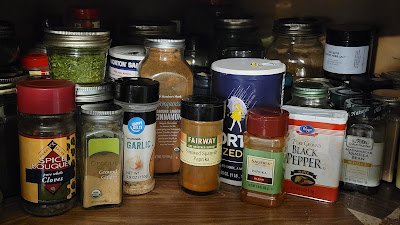
A glimpse into the author's spice cabinet

While the variety of spices is legion, certain seasonings are more frequently encountered. As everyone has different preferences, the spices chosen can vary significantly.

Salt
Probably the most common spice used throughout the world is salt, to the point it’s part of common parlance. Look back at my first sentence for one example; another is referring to something necessary but boring as “Like rice without salt.” Roman legions even received part of their pay in salt, from which the word salary is derived. 

Modern table salt is not just simple NaCl, but has anti-caking agents and iodine added for storage and health purposes respectively. (The reason we often see a few grains of rice in a salt shaker is they act as a basic moisture absorber.) Salt is fairly easy to store long term, and is unlikely to lose any flavor.

Pepper
Black pepper is almost certainly the next most common spice.  Ground pepper's flavor will deteriorate over time once unsealed: leaving peppers in kernel form increases storage life, but adds another complication in the need for a grinder.

Other Spices
Depending on individual taste, both garlic powder and ginger powder are two excellent choices as they add a good amount of flavor for their volume. Though, is there ever such a thing as enough garlic?

Chili powder, paprika, and cinnamon (either stick or ground) are other spices that offer a good bang for the buck and bulk. The first two also come in a wide variety and can be tailored to appropriate foods and cooking method.

When storing leafy spices, such as parsley, sage, rosemary, or thyme, keep in mind that they will lose flavor more quickly, and possibly develop mold, if not very thoroughly dehydrated. For home use, herbs and spices can be stored in the freezer for quite a while without loss of flavor, though some will suffer in appearance.

Remember, the plural of spice is spice, and also spices.

Friday, October 1, 2021

Food Storage Season

For those of us who grow food, things start to get interesting after the first full week of autumn. Summer is over, the growing season is coming to an end, and we have the fruits of our labor to deal with. Most people who grow some or all of their own food try to plant a variety of foods that will mature at different times; this is to ensure a steady supply of edibles and helps avoid catastrophe in the event of a crop failure by not putting all of your eggs in one basket. Because of this mentality, we're dealing with food storage for a couple of months, with the bulk of it being harvested in the fall.

I don't preserve as much food as we did when I was growing up -- my family dynamics and living conditions have changed too much -- but I recall the annual rush to get all of the tomatoes canned and the sweet corn frozen. Fruits were either canned or turned into jellies and jams, cucumbers were pickled and put in jars (three or four different recipes) but we had moved beyond making our own sauerkraut (grandma still did that, though). Root crops (onions, garlic, etc.) went into the cellar along with the apples, peppers and a few other things that were hung from the basement ceiling to dry, and herbs were sealed up in carefully labeled jars. 

Meat cycled through the freezers with the seasons, with chickens going in during the early summer and red meat being processed and frozen in late summer. Fishing is a year-round activity (once the ice gets thick enough December-February) and small game found their way into the freezer from October to February. The only big game in my area are white-tail deer, and they're more of a pest than a food source to me; besides, the hunting regulations are so arbitrary and confusing that I have never needed to hunt the long-legged rabbits. If the system fails and we're in a crisis, I've helped process enough of them that I could make meat out of one and I have several methods of hunting them.

As  I recall, the main problem during the fall canning season was the shortage of containers and space to put them all. A few decades ago it was easy to put a smile on a housewife's face: all you had to do was bring home a few boxes of canning jars from an estate or garage sale, as there were never enough jars, lids, or rings for everything. Shelf space was the second problem. Even with a full basement and a good-sized pantry, the results of a good harvest would overflow into boxes and the surplus was often gifted to or traded with neighbors.

Preppers who choose to buy their food and store it can run into the same problems.

  • I tend to buy by the case; it saves me a little money and it's easier to transport while the cans are still in their box. I have my pantry with a storage room behind it, and once a box gets opened it gets moved to the pantry for use. The back room has sturdy shelves to hold the weight of cases of cans, and I'll be adding to the shelves as soon as I clear out some of the clutter that has found its way into the corners.
  • Rice and beans are staples of the prepper diet because  they're cheap, easy to find, and they store well, but finding a place to stack 20-50 pound bags where the rodents can't get into them can be a challenge.
  • One of my local prepper friends has standardized his purchases on the #10 cans (the large, almost 1 gallon cans that you see in commercial/institutional kitchens). A lot of the “preparedness” companies sell food in #10 cans, but you'll need to have a way to reseal the cans after you've opened them unless you're cooking for a few dozen people. It's difficult to eat a gallon of any one kind of food before it goes stale unless you can refrigerate, or at least close, the open containers.
  • Stored water takes up a lot of space and is heavy. We've covered several methods for storing water over the years; use the search box for older articles.

These are all things you need to consider as you plan your garden for next year, or find some extra money and invest it in food. Ask yourself Where is all of that food going to go until we eat it?

Monday, September 27, 2021

Prepper's Pantry: Pickling

I’ve mentioned pickling in earlier posts, such as the ones on vinegar and canning, so it seems appropriate to go into more detail about the supplies and techniques to create these tasty treats at home.

Pickled vegetables can be made in a variety of ways, but for this post I’m going to focus on only two of them, as they are faster and less labor intensive than other methods (one of these methods involves using a salt water brine and several weeks of soaking and monitoring; another involves packing the vegetables in salt and letting them sit for weeks or even months). 

When canning or pickling, always use the freshest produce

Pickling by Hot Water Canning
Refer to my posts about canning equipment and process for the basics, since canning pickled vegetables is handled similarly; this webpage can provide more details. Vegetables used in canning can be preserved whole or reduced in several ways; cucumbers, for example, can be cut into halves, disks, slices, or spears. 

Since one of the major elements used to preserve canned foods is proper acid balance, vinegar is the primary liquid. Cider vinegar is preferred due to its milder flavor, but white vinegar can be used interchangeably.

Prepare the jars as usual, then add spices to taste. I like garlic dill pickles, so I put in each jar:

  • A sprig or two fresh dill (1 to 1½ teaspoons dried)
  • A couple cloves fresh garlic, slivered (1 to 1½ tablespoons crushed)
  • 1 tsp mustard seed or mustard powder
  • ¼ teaspoon salt
  • Cucumbers

The jars are filled to no less than ½” of the top with heated vinegar, often cut with water and a pinch of sugar, then the lids and rings are added. Hot water process as normal.


Carefully examine produce for bruises or other damage

Refrigerator Pickling
When pickling vegetables in the refrigerator, the same initial process is followed:

  • Examine the produce
  • Trim, slice, or chop the vegetables
  • Add spices
  • Fill the jars with vinegar

There are, however, some differences:

  • The vinegar doesn’t need to be heated
  • Flavored vinegars can more easily be used
  • Headspace is less important
  • The containers used are more variable (Chinese soup containers are excellent for this purpose)

Once everything is prepared, let the containers sit undisturbed in the refrigerator for 14 to 21 days.

One of my favorite refrigerator pickled dishes is cucumber salad:

  • Cucumbers, sliced in half lengthwise then into crescents
  • White onion, quartered then sliced
  • 1 teaspoon each salt, pepper, and sugar (adjust for taste)
  • Balsamic vinegar, cut 1:1 with water

Once all the pickled cucumbers and onions are eaten, the liquid can be reused once or twice as-is, then refreshed with more balsamic vinegar. This makes an excellent side dish, especially in the summer.


The techniques described here can be applied to nearly any vegetable, preserving them and adding more delicious options to your prepper pantry. 

Thursday, August 5, 2021

Hidden Treasures

The dust has settled and the First 72 Hours have passed. Follow along as I build a long term plan via Prudent Prepping. 

My equipment has been moved out of my parents house, gone through, and items I no longer need have been sold, given away or thrown out. I'm trying to organize a small amount of gear to be kept in the care home where my Mom is, but that is still a work in progress. 

When I pulled some of my totes out of where they were stored, 
I came across some of my old Boy Scout equipment! I found my mess kit, authentic Sierra Club cup, utensils, webbing belt and canteen pouch that was (I believe) Korean War surplus, purchased from a real-deal Army Navy store in the middle 60's. 

What's missing is the canteen, the aluminum kind with the nice screw cap and the funky flat link chain retainer. I was using this well into the 1980s and water purification was done with various tablets or boiling. No fancy filters back then! I not-so-fondly remember the taste of those tabs in that metal canteen... I'd like to find it again. It may still be in a corner or a box, but I think it's long gone. I'm keeping the belt and pouch for strictly sentimental reasons, since I've got two newer sets of belts with Nalgene bottles and holders. 

I also found the balance of my fishing tackle in a tote. This will need some work to sort out the tangled mess, because I dropped this tackle box off the tailgate of my truck a long time ago, broke the lid, and instead of buying a new tackle box right away I just put the broken mess in a tote to be fixed later. Much later. Don't ask.

In the bottom of the tote I found a genuine, no-kidding Herter's sheath knife along with an early 70's Buck 110 folder. I didn't have time or a decent place to take some pictures of both knives, but I will post them soon. What's a "Herter", you ask? You could find anything you needed or didn't want in there. Just read the short article linked above to get a taste of what this catalog contained. From bear traps and fly-tying supplies to tents, you could order them from Herter's; think of them as the Sears Catalog of outdoor supplies. 

Also found inside one of my Buckets of Holding was food that I didn't know was there. I dumped everything in the pail that wasn't relatively inert, like salt, black pepper, cinnamon and sugar. Everything which could be considered 'Food' was seriously out of of date by at least 5 years! There weren't any bulged cans, leaking bottles, or obvious spoiled items, but I wasn't taking any chances. I did take the top off a peanut butter jar just to smell, and it was right on the edge of rancid, confirming my avoidance of any trail mixes containing peanuts no matter where they come from. 

I purchased my food safe pails and locking lids from a local company many years ago, but Home Depot has been carrying food grade pails and lids for some time now. However, due to inventory and shipping issues, finding them in your local store might be a problem. I will be using several of the pails to store equipment other than food, since the Purple Pack Lady can handle a fully-loaded five gallon pail weighing 40-50lbs easier than she can handle a 27 gallon tote. Those pails will be hers, with her deciding how to fill them and and where she wants to store everything. Her personal GHB is still a bit thin since she hasn't given much thought to, or gone over, the list of things I put together that are in my bag. She's still taking baby steps on the long road of prepping.

Recap And Takeaway
  • I really needed to have better access to my gear before. Now that I've cleaned everything out, all my stuff has been relocated to where it can be gone through much, much easier.
  • If you break something, replace or fix it right away if you can. You never know when that gear might be needed.
* * *

Just a reminder: if you plan on buying anything through Amazon, please consider using our referral link. When you do, a portion of the sale comes back here to help keep this site running!

If you have comments, suggestions or corrections, please post them so we all can learn. And remember, Some Is Always Better Than None!

NOTE: All items tested were purchased by me. No products have been loaned in exchange for a favorable review. Any items sent to me for T&E will be listed as such. Suck it Feds.

The Fine Print


This work is licensed under a Creative Commons Attribution- Noncommercial- No Derivative Works 3.0 License.

Creative Commons License


Erin Palette is a participant in the Amazon Services LLC Associates Program, an affiliate advertising program designed to provide a means for sites to earn advertising fees by advertising and linking to amazon.com.